

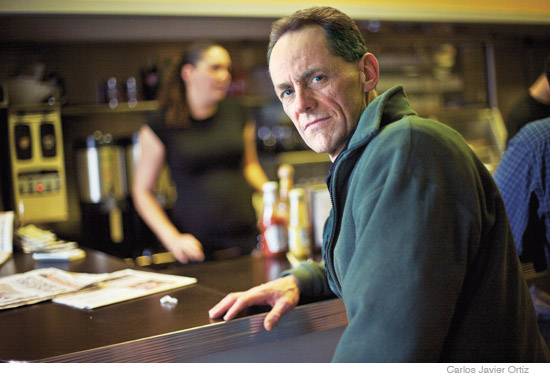
If life were fair and the gods of journalism just, I would be able to report to you that when John Conroy was laid off by the Chicago Reader nearly three years ago, his bosses quickly came to their senses and rehired him, and he has continued with his award-winning, life-saving investigative reporting ever since. I’d be able to tell you that after almost single-handedly exposing a torture ring of rogue officers inside the Chicago Police Department—a reign of terror that may have sent scores of wrongfully convicted poor black men to prison, and, in some cases, to death row—Conroy covered what could be the last chapter of the decades-long scandal this spring without having to go around town knocking on doors to find an editor willing to pay him more than what he was making in 1975.
Finally, I wouldn’t have to report that Conroy now is “sometimes given to despair’’ and is seriously thinking about quitting journalism, even though in these perilous times journalism needs his kind more than ever.
Since this is not a fairy tale, but a nonfiction dispatch from the frontlines of twenty-first century American journalism, I have to tell you instead that Conroy, who recently turned fifty-nine, hasn’t had a full-time job since he was laid off in December 2007 by the Reader, Chicago’s free weekly alternative newspaper that used to come in four sections, choked with ads and listings, but now comes in only one. “For years a lot of journalists in town just didn’t take us seriously,’’ says Mike Lenehan, a former editor and part-owner of the Reader before it was sold in 2007. “We were just the free paper. In those days, ‘free paper’ was a stigma. John’s work changed that.’’
Since it was founded in 1971, Conroy did more, perhaps, than anyone in the paper’s fine lineup of writers to put the Reader on the map of serious journalism. There’s no question that Conroy did more than anyone else in all of journalism to expose police torture in Chicago. Conroy and the Reader kept the story alive for years until reinforcements arrived from the downtown dailies and a group of Northwestern University journalism students and their professor. Eventually, the efforts of Conroy and other journalists—especially Maurice Possley, Steve Mills, and Ken Armstrong from the Chicago Tribune, who broadened the story to include prosecutorial misconduct—defense lawyers, anti-death-penalty advocates, and a citizens’ police watchdog group convinced then-Illinois Governor George Ryan that the system was broken. In 2003, Governor Ryan emptied death row, sparing the lives of more than 160 condemned men and women, several of whom said their confessions were false and had been extracted through torture by a police commander named Jon Burge and his detectives inside a police station that came to be known, in some circles, as “the house of screams.’’
Jo Ann Patterson’s son Aaron, a gang member, was “interrogated’’ inside that station house before being convicted of double homicide. She has no doubt that her son would be dead today, executed for a crime he did not commit, if not for the long, lonely crusade of John Conroy. “John’s articles helped save Aaron’s life and showed how the system can really get you caught up,’’ she says. “But Aaron wasn’t the only one John saved. A lot of people owe him their thanks.’’
Over the years, the city has shelled out millions in legal fees and settlements, including nearly $20 million to Patterson’s son and three others arrested by Burge and his officers. In 2006, a special Cook County prosecutor’s investigation concluded that the commander and his men had obtained dozens of confessions through torture. “I can’t begin to tell you,’’ says Andrea D. Lyon, a criminal defense attorney and the author of Angel of Death Row, a memoir about her experience representing condemned prisoners, “what an enormous loss it is to not have someone like John doing the in-depth work he was doing.’’
Lyon says everyone involved in Chicago’s criminal justice system knew something was amiss at the Area 2 police headquarters on the city’s Far South Side, where most of the alleged torture took place. Prosecutors knew it. Judges knew. Reporters knew, too. But no one, she says, said or wrote anything about it until Conroy and maybe one or two others came along. “The groundwork came from John Conroy rolling that big stone up that steep hill,’’ she says. “He’s utterly trustworthy and honest. You don’t hand over your files to him if you think your guy is guilty. He’ll find a witness that maybe the prosecution couldn’t find. He’s patient, easy to talk to. He’s smart but not arrogant. He’s part of a dying breed, a real-life investigative reporter who cares. He’s an unsung hero.’’
Where has Conroy gone? Wherever he can find work. Conroy—the author of two well-received nonfiction books, Belfast Diary: War As A Way of Life, on the troubles in Northern Ireland, and Unspeakable Acts, Ordinary People, an examination of the practice of torture in three democracies: Belfast, Israel, and Chicago—has transformed from journalist to juggler, trying to keep several freelance jobs in the air at once. One of his gigs is writing scripts for online health videos about domestic violence, STDs, and childhood obesity. He’s written a few magazine pieces, including a first-person account of getting mugged in 2008. He has done some radio reporting. He has also worked as an investigator for a lawyer pal with whom he plays hockey in a no-slap-shot, no-check league. He started playing at age fifty-four. So far, he’s worked on two narcotics cases for his friend and now is investigating a murder case—the stabbing of a barber on Thanksgiving eve, 2008. “I have to do other things to support the journalism,’’ he says. “It’s very stressful. The pay is low and getting lower. It’s become demeaning. I have two kids. I’m not a spring chicken. Sometimes I am given to despair.’’
Tall and lanky, with the lived-in face of a character actor, Conroy is the kind of reporter your mother dreamed you would grow up to be: dogged, driven, caring, righteous, cranky, smoldering, and moral. Don’t take your mother’s word for it, though. Check it out. Conroy would.
Stretching back nearly two decades, Conroy’s nuanced, morally complicated stories about what was allegedly happening inside “the house of screams’’ set the agenda for much of the coverage by Chicago’s two daily newspapers and its television newsrooms. Conroy’s articles, such as a piece he wrote in 2006 called, “The Police Torture Scandals: A Who’s Who,’’ were a vital road map for any reporter—or prosecutor, defense lawyer, or civilian police department investigator—coming fresh to the story. “The scale of criminality,’’ he wrote,
is immense: hundreds of assaults (most victims were subjected to more than one attack), hundreds of acts of misconduct qualifying as felonies. Some detectives, called to testify in various proceedings, may have committed perjury on five or more occasions in a single case.
And knowledge of the abuse traveled up the ranks: Police superintendents were informed of the torture and knew the identities of some of the torturers. State’s attorneys were informed of the torture, and no one was ever prosecuted. Now that the statute of limitations has run on many if not all of these crimes, state prosecution is unlikely, though victims’ attorneys hold out hope that federal charges are possible.
All of the known victims are black. Some were sent to death row on the basis of tortured confessions and perjured testimony by police, and many are still serving long sentences. All of their confessions are suspect.
Most of the accused police officers are white. Many have been promoted or have retired with pensions. Some of the prosecutors informed of the torture are now judges. One serves on the Illinois Appellate Court. And one is the mayor.
The tools of torture included burning suspects on radiators, beatings, mock executions, games of Russian roulette, near suffocation with typewriter covers, and electric shock to the genitals. No one has been tried for the alleged torture that went on inside the house of screams. Until now.
In May, high above the streets of the city he patrolled for years, often with honor and distinction, the alleged leader of the torture ring, Jon Burge—a burly, first-through-the-door, decorated Vietnam veteran—went on trial in federal district court in Chicago. Burge’s path to the Dearborn Street courthouse was blazed by the more than 100,000 words Conroy wrote over the years about the case.
But Burge, who is sixty-two, lives in Florida on a police pension, and is reportedly battling cancer, is not facing charges of torture. The statute of limitations on that charge ran out long ago. Instead, he is facing perjury and obstruction of justice for allegedly lying in 2003 during a civil suit about his role in the torture ring. Burge has always maintained his innocence. One of his lawyers, Richard Beuke, refused to comment on the case or Conroy. Beuke said Burge would not comment either.
No journalist knows more about Burge, or the band of alleged torturers in blue he is supposed to have led, than Conroy. Yet, on the first day of jury selection in early May, Conroy didn’t have an assignment to cover the trial. He showed up in the twenty-fifth-floor courtroom anyway. Faith and stubbornness made him go. “I’ll probably cover it for somebody, hopefully not full of resentment for what I’m being paid,’’ he says. “Part of me is wondering why I’m doing this. I guess there’s this sense of seeing something through. And I actually think I could cover this case pretty well.’’
Conroy sat about twenty-five feet behind Burge. From behind, Conroy says, Burge looked much the same as he did when they first met in 1989. When Burge slowly got out of his chair and said, “Good morning, ladies and gentlemen,’’ to the prospective jurors, Conroy says he recognized “the same gravelly voice.’’
When the proceedings finished for the day, Conroy lingered, hoping to have a word with Burge. But Burge and his lawyers left too quickly. “I would have said hello,’’ Conroy says. “I don’t know how he feels about what I have done. There are a lot of people out there screaming that Jon Burge is a monster, but I have not portrayed Jon Burge as a monster.’’ In a 2005 piece, for example, Conroy dug into Burge’s army record from the 1960s that described how the eighteen-year-old recruit went on to become a military policeman in Korea, “gathering five letters of appreciation from superiors that praised his loyalty, devotion to duty, outstanding performance, military bearing, appearance, attention to detail, tact, and extra effort.”
In 1968, Burge volunteered for Vietnam. He returned home in 1969 and soon joined the Chicago Police Department. In 1972, Conroy wrote, Burge prevented a twenty-two-year-old woman on the South Side from committing suicide by jamming his thumb into the firing mechanism an instant before she squeezed the trigger.
“I think if you were to look at the press coverage of Jon Burge and look who has written about the heroic things that he did on the job and in Vietnam, I’m pretty much solo,’’ Conroy adds. “If someone else did it too, they took it from my coverage.’’
As a young reporter in the mid-1970s, Conroy was about to leave his job at Chicago Magazine. Both man and magazine were young and raw, and he planned to move to South America to make his mark as a foreign correspondent. But a colleague convinced him to move instead to South Chicago, the land of steel mills and the tough people who worked them—Serbs, Croatians, Latinos, and African Americans. The colleague told him there were great stories to be told about urban politics, union conflicts, race, and the fading American dream. It was the gritty stuff of Upton Sinclair and Nelson Algren. Conroy agreed.
For decades, South Chicago had been one of America’s entry points, a portal through which waves of migrants from Eastern Europe, Mexico, and the American South had come to find their footing. By the time Conroy arrived, the earth had shifted. The mills were on the edge of a steep and swift decline. A way of life was coming to an end. “I didn’t quite understand it on an emotional level at the time,’’ he says. “I wish I had made that connection because I’m now part of a dying industry. I didn’t understand what it means that something that seemed rock solid when you were growing up would become a relic, something people talked about referring to the old days.’’
He wrote a five-part series about what he saw and learned in South Chicago, including the rise of a young politician nicknamed Fast Eddie and a bitter union election. “There was a lot of racism in South Chicago,’’ he says. “And it’s a cliché to call the politics bare-knuckled, but that’s what it was. There were fist fights and people got hurt.’’
When his worthless ’63 Chevy was stolen and one of the people he was writing about threatened to throw him down the stairs, Conroy decided it was finally time to see the world. In 1977, he went to Northern Ireland and freelanced for the Chicago Daily News, which had recently shut down its foreign bureaus as that great paper slid toward its grave.
Conroy spent a few weeks there and quickly realized how “bad the press coverage of Northern Ireland was,’’ he says. “Reporters would fly over when there was a major incident. It was covered like you’d cover a fire. There wasn’t any context to it. People back here couldn’t understand why these two people who had the same color skin and worshiped the same God were fighting each other.’’
He started writing for the Reader in 1978. But he couldn’t get the troubles out of his mind. Both his parents traced their roots to Ireland. His family had visited when he was a teenager. He still had relatives there. In 1980 he returned to Northern Ireland for ten months on an Alicia Patterson Fellowship to work on what became his first book, Belfast Diary. He got more than a book out of it. He also met his wife, Colette Davison, a psychologist.
Belfast Diary was published in 1987. By then, Conroy was back at the Reader. In 1988 Ann Close, an editor at Knopf, contacted him and told him she had read and admired the book. She proposed he write another, this time specifically on torture, which was a way of life and war in Northern Ireland. Conroy had started researching torture around the world when a friend at the Chicago Lawyer newspaper told him about Andrew Wilson, a convicted cop killer, who claimed he had been tortured by police and was now suing in federal court.
Wilson’s suit sounded interesting but preposterous. Wilson and his brother, Jackie, had been convicted of killing not one officer, but two—William Fahey and Richard O’Brien—during a traffic stop in the winter of 1982. Now Wilson was saying he had been tortured by some of Chicago’s finest. Conroy walked into the courtroom, thinking Wilson did not have a chance. “He killed two cops—a career criminal, going up against decorated detectives—no way,’’ Conroy says.
As the six-week trial dragged on, Conroy slowly began changing his mind after listening to the medical testimony and hearing both Wilson and Jon Burge, who at the time was the head of Area 2’s detectives, testify. Maybe Wilson’s charges of being burned by police and receiving electric shocks to his genitals, nose, ears, and fingers were not that preposterous. Maybe they were true. “I can’t say there was a moment when I said, ‘Oh, my God, this is true,’’ he says. “It was a gradual dawning.’’
Something else dawned on him. “I began to realize how important this was,” he says. “And nobody seemed to care.’’
Conroy was often one of the few, if not the only, reporters in the courtroom. The proceedings ended in a mistrial, followed a short time later by a second weeks-long trial, in which Wilson won a mixed verdict. The jury found that his constitutional rights had been violated and that the city had a de facto policy of allowing police to abuse people suspected of killing police officers. But the jury also found that Wilson had not been subjected to excessive force as a result of that policy. (Wilson appealed and won a third civil suit in 1996. The city was ordered to pay $100,000 to the family of Officer Fahey, which had filed a wrongful death suit against Wilson, and another $900,000 to Wilson’s attorneys. Wilson did not receive a dime and died in prison of natural causes in 2007, about three weeks before Conroy was laid off.)
Conroy sat through the first two trials but did not publish a single word until the final verdict was in. His story in the Reader hit the street on January 25, 1990. The headline was, “House of Screams, Torture by Electroshock: Could it happen in a Chicago police station? Did it happen at Area 2?’’ He thought his work was done. Now the downtown dailies would jump all over the story and the house of screams would come tumbling down. “John really was kind of waiting around for the lid to blow off and nothing happened,’’ says Mike Lenehan, his former editor and still a close friend. “He was disillusioned. John has this strong streak of Irish Catholic to him. He’s just as upright as a guy can be.’’
If the press didn’t immediately see the import of Conroy’s story, the inmate population in Illinois certainly did. Soon, Burge and his detectives were facing dozens of accusations of torture. In 1993, after an internal police department investigation and as the accusations against him continued to pour in, the city’s Police Board fired Burge. He was never charged with a crime, though, and a number of men remained in prison, some on death row, as a result of the confessions they gave inside the interrogation room at Area 2. Conroy stayed on the story.
In 1996, the Reader published his second long article on the case, “Town Without Pity, Police Torture: The courts know about it, the media know about it, and chances are you know about it. So why aren’t we doing anything about it?’’ Michael Miner, a Reader editor who writes a popular media column for the paper, edited most of the seventeen stories Conroy wrote about police torture. They often worked at Conroy’s kitchen table in suburban Chicago, poring over documents and eating homemade scones.
The men knew they were treading in sensitive political territory. Every fact or assertion was double- and triple-checked. “John’s a fastidious guy,’’ Miner says. “He holds himself to a higher standard than anyone I know. He was extremely cautious in what he reported.’’ They also knew they had “a terrific’’ story on their hands. “It seemed to be our franchise,’’ Miner says. “One story suggested another. It was just a bottomless well of material.’’
One day in early December 2007, Miner was in the Reader office just north of the Loop when Alison True, the editor, said she wanted to talk to him. True has been the Reader’s editor since 1994. She proudly had given Conroy the time and the space to tell his incredible stories. Some of them ran close to 12,000 words. What True wanted to talk to Miner about was layoffs. It broke her heart, she told Miner, but Conroy and three other feature writers had to be let go. The paper, its editorial budget cut nearly in half, could no longer afford what Conroy did best. “The investigative reporters who remain on staff,’’ she says, “are the ones who are in the paper every week.’’
Miner says True “was sick about it. I was sick too.’’ They discussed the best way to handle it. True decided she would personally tell each of the four. Conroy was not in the office, so True drove to his home. She stayed about thirty minutes. “It was the worst day of my professional life,’’ she says. “Maybe it was in the top two worst days of my personal life.’’
Conroy says he harbors no ill will. Regrets, sorrow, yes, but, “I’m still friends with the people who fired me.’’
One of his regrets is going into journalism in the first place. At least that’s what he says when the bills are due and he doesn’t know where his next freelance assignment is coming from. When Conroy set off for the University of Illinois in 1969, he wanted to make a lot of money. He majored in finance and got good grades. Conroy and his three sisters had heard stories from their Irish-American father, a salesman at Sears, about the horrors of the Great Depression. Conroy’s mother, a bookkeeper and graduate of DePaul University, had her own Depression tales, but the memories were not seared into her soul.
But the campus and the country were in turmoil in those days. Conroy did not want to be on the sidelines. “I wanted to do some good in the world,’’ he says. He switched his major to English with a minor in journalism. “It was probably the first bad business decision I made,’’ he says. “If I had stayed the course as finance major I wouldn’t be worried now about how I am going to get my kids through college.’’
After college, Conroy, who grew up in suburban Skokie, joined Vista, the domestic Peace Corps. During his nine months working with the poor on Long Island, he helped start a community newspaper, the Fair Hearing. Then he sent out 120 application letters, hoping to land a journalism job. He got three offers. “I was twenty-three years old,’’ he recalled in his remarks upon receiving the Studs Terkel Award for excellence in reporting about Chicago’s diverse communities in 2005. “I’d been hired by what later became Chicago Magazine as the bottom man on a three-man editorial totem pole. I was making $7,500 a year and was worth about that much. At the time, Chicago Magazine was owned by WFMT, where Studs had his daily show and the magazine and radio station shared the same offices. So there was I, who knew nothing, sharing the same hallways with Studs, who knew everyone . . . and whose books were full of people you could not ordinarily read about, ordinary people doing extraordinary, brave, and sometimes questionable and even cruel things. I couldn’t believe my luck.’’
Conroy is old school. He asks the questions, but he’s reluctant to answer them, especially when they are about him. When he was approached by Chicago Magazine to write about being mugged in 2008, his instinct was to say no, even though he needed the money. He ended up writing the piece, “A Mugging on Lake Street,’’ which was published in September 2009. In the piece he writes about his ambivalence: “As I scramble to make a living from freelance assignments, I should also be thankful that an editor solicited this story and kept the offer on the table until I overcame my reluctance. That editor was laid off while the contract was in the mail.’’
The article touches on the main issues of Conroy’s reporting career—crime and violence, race and justice. It begins:
I was ambushed on the West Side last year, an attack that on its face made no sense. I’d never seen my assailant before; he’d never seen me; no words were exchanged; nothing was taken. Like many crime victims, I wanted the incident, which changed my life for the worse, to have some meaning. I’m white, he is black, and in time it was hard not to wonder if race had something to do with it.
His mugger turned out to be a teenager who stepped off a curb to slug Conroy, apparently for kicks, as the journalist rode past on his bicycle. The blow knocked Conroy to the pavement. He tore ligaments in his right knee. His face needed stitches. “I think of myself as a tolerant man,’’ Conroy wrote, “but that tolerance has been taxed by the pain and the consequences to my body and my life.’’
Conroy eventually meets with his mugger, whom he calls Larry. Larry and his mother agree to cooperate on a story about the incident, but when Conroy calls them for an interview they duck him. He calls again and again until Larry’s uncle demands payment for their cooperation. There is no interview. “Deep down,’’ Conroy writes, “I’ve had an irrational and ridiculous sense of betrayal. As a fellow journalist put it when I tried to explain this to him, you pay into the karma bank, and you expect a certain protection in return.’’
I ask Conroy why he was so reluctant to tell this powerful personal story. He answers in an e-mail: “Writing about race is not difficult, but writing about race when you’re in the story is a minefield. I did not want to write a story that made me out to be a whining victim.’’ He tells me he worried about what the response might be, but it was better than he expected. “Nothing I’ve ever written has provoked such an outpouring of commentary, and although there’s a certain gratification in the volume, there’s also a definite sadness. I wrote about the likelihood of men being executed for crimes they might not have committed for years—a far more important topic—without hearing much of anything at all.’’
Conroy has written a play, My Kind of Town, based on his reporting about police torture. He started writing it before he was laid off. Finishing the two-act drama has proven to be both therapeutic and nerve-wracking. There have been several readings of the play by professional actors, but so far it has not been staged. Nor has it done a thing for Conroy’s bank account or the college fund for his two children.
On a chilly Chicago night, just before spring, a group of haunted men sit in the front row of Thorne Auditorium at the Northwestern University School of Law, waiting to hear a reading of My Kind of Town as part of a fundraiser for the Center on Wrongful Convictions based at Northwestern. They are tough men, from tough neighborhoods, street-accredited professors of crime and punishment. One of the men is an ex-general in a once-powerful Chicago street gang. Another used to be called Satan. Some perch on the edge of their seats as the night progresses. Others sink so low they almost disappear. All of them could teach a seminar about the unspeakable acts that even ordinary people inflict upon their fellow human beings in the name of law and order.
The men watch as two actors read a scene in which Rita and Albert, a divorced couple, argue about their son, Otha, a gang member on death row. Albert is a cop:
Rita: He didn’t do it.
Albert: He did plenty. You don’t know the half of it. What he got, he had comin.
Rita: He did it all with guns. Now all a sudden he gonna burn down a building?
Albert: He confessed.
Rita: After they put a plastic bag over his head.
Albert: No, no, no. After Otha says they put a bag over his head . . .
Rita: So you think they had a shock machine, they shock a man in his private parts, but they ain’t going to suffocate somebody?
Albert: I didn’t say they had a shock machine.
Rita: But it wouldn’t surprise you.
Albert: does not reply.
When the reading is over, one by one the men slowly troop to the stage to briefly share their stories with the 350 lawyers, students, and others in attendance. The man once known as Satan says he was dragged from his home by Jon Burge and his crew in 1973 and taken to the police station where he says he was tortured. “It’s hard to speak about,’’ he says. “No words can express how we feel.’’
The former gang chieftain speaks last. “Torture is hell beyond a shadow of a doubt,’’ he says. “But please note, justice is coming.’’ Then he looks down at Conroy seated in the front row. “John Conroy, you’re a bad man,’’ he says. “You’ve always told the truth. You never sugar-coated anything.
“Whatever you do, please stay the course as you have all these years,’’ he says. “You have made a difference.’’
Conroy has stayed the course. And in late May, he got his own small measure of justice when WBEZ, a local public radio station, hired him to blog the Burge trial. “Blogging is sort of old dog, new tricks,” Conroy says. “I’ve never worked for a daily before. Writing every day is going to be an interesting challenge.”
His first blog post, on May 21, posed the question, “Would there be a Burge trial without Andrew Wilson’s ears?” Conroy wrote that he has had “occasion to wonder if former police commissioner Jon Burge would still be a high-ranking officer today, indeed, if he might not have become superintendent, but for Andrew Wilson’s ears.” Photographs taken by a public defender of the scars on Wilson’s ears shortly after Wilson had been interrogated by Burge and some of his men helped to convince a civil jury—and later the civilian police department investigators—that Wilson was telling the truth about being tortured with electric shock.
A few days after his first post about the trial, Conroy was back in the courtroom, taking notes on a yellow legal pad when Jonathan Jackson, the national spokesman for the Rainbow/PUSH Coalition and the son of the Reverend Jesse L. Jackson, introduced himself. For the last five years, Jonathan Jackson has been an outspoken advocate for “Burge’s victims,” and for the need to prosecute “their torturer.” Jackson shook Conroy’s hand and said, “It was your writing that got me into this. Thank you.”
Don Terry is a 2009-2010 Encore Fellow at CJR. He has worked at the Chicago Defender, the Chicago Tribune, the St. Paul Pioneer Press, the St. Paul Dispatch, and The New York Times, where he was part of the team that won the Pulitzer Prize in 2001 for the series “How Race is Lived in America.”