

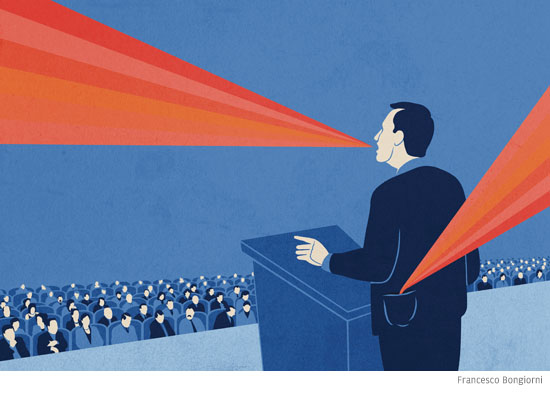
Gillian Tett, the US managing editor of the London-based Financial Times, is “sharp” and “glamorous,” according to a 2010 profile by The Daily Beast. She may even be “the most powerful woman in newspapers,” the Beast said, as the FT “intends to become a status symbol of American business.” Tett is also a star on the Wall Street speaking circuit, a fact not mentioned in that profile. Testimonials from satisfied customers can be found on the website of Leigh Bureau, the speakers’ agency that books many of her talks. “Tett really wowed them, she talked about the present and the future of the markets,” according to an unnamed “federal mortgage company” that hired her. “We were very pleased with the forward-looking focus of Gillian’s topic, as many of the guests who were attending were clients of ours concerned with the next steps for their investments,” according to an “investment and asset management firm.”
Asked about her engagements, Tett told me she receives up to $20,000 a speech. A cut goes to the Leigh Bureau, and travel, lodging, and related expenses are paid by the customer. On occasion, Tett ventures outside the US, as in a speech last year to Unigestion, a Swiss asset manager. As for the money that comes to her from speaking—“well into the six figures,” she calculates-—she says she donates it, “for the most part,” to charity, specifically to a project for disadvantaged youngsters in the British city of Liverpool.
Tett has plenty of company. Many journalists give paid speeches to businesses and business groups. And Wall Street, as it happens, is probably the top source of such engagements. Household names like Bank of America as well as obscure hedge funds, private-equity firms, and others in the financial world frequently hire journalists—including scribes who regularly cover Wall Street—to deliver speeches at events ranging from publicized conferences to small private dinners with select clients. Millions of dollars have flowed to journalists in speaking fees in recent years.
Is this a scandal, a dark and an indelible stain on journalism, or really not such a big deal? What does Wall Street, which is all about the bottom line, after all, get from such engagements? Is this a matter of journalism ethics? Not surprisingly, what may at first seem a simple judgment call turns out to be a bit more complicated.
Even though the practice of journalists speaking for money is not a new one, these questions are especially ripe for exploration because of the enormous importance of Wall Street as a political and economic story for the press. The US economy is still suffering from the 2008 financial crisis, and Wall Street, saved by a controversial federal bailout of some $1 trillion, is emerging as a core issue in the 2012 presidential campaign—especially with the prospect that the Republican nominee will be Mitt Romney, a former private-equity baron.
The public needs to trust the press to get the story straight, all the more so because of pervasive distrust of Wall Street itself. According to a CNN/ORC International poll of Americans released in October, “two-thirds say Wall Street bankers are dishonest, a number that has gone up by a third in roughly two decades.” The Occupy Wall Street national protest movement attests to the suspicions.
In this toxic climate, many financial journalists are on edge, worried that any misstep could make them the target of criticism for being too cozy with Wall Street. Back in October, New York Times op-ed columnist Joe Nocera, who often writes about finance, was taken to task by media critic Erik Wemple of The Washington Post for speaking at a securities conference in Miami sponsored by Wall Street firms including Goldman Sachs, J. P. Morgan, and Morgan Stanley. The gig appeared to breach the paper’s own rule for not permitting staff journalists to take speaking fees from any for-profit sources. Nocera “declined to address the speaking fee,” Wemple wrote, and he also declined to talk to me.
But while some news organizations don’t permit their staffers to take speaking fees from any sources, including Wall Street, there is still plenty of action out there.
The lineup of writers on financial affairs who have spoken at Wall Street events—and are promoted by speakers’ bureaus as available for hire—is star-studded. The list includes Michael Lewis, a best-selling author and contributing editor to Vanity Fair; Niall Ferguson, the author, Harvard professor, and a featured contributor to Newsweek and The Daily Beast; James Surowiecki, who writes “The Financial Page” column for The New Yorker; and James B. Stewart, the author and Pulitzer Prize-winning journalist who has written widely for newspapers and magazines. (Stewart says he’s done no speaking engagements with for-profit sources since he began writing a financial column for The New York Times in June 2011.)
“I turn down 20 paid gigs for every one that I do, and I don’t particularly like to do them,” Lewis said in an e-mail. “Raising of course the question of why do any paid speeches for anyone, the answer to which is: a) it feels insane not to do a few of them; b) it actually helps me, as a writer, to be forced to air views and material in front of a live audience; and c) I often pick up valuable material from the hosts.”
Lewis went on to say, though, that since the financial crisis he has “turned down anything from anyone who took bailout money, but not because I worried they might be paying me to be more polite about them. I didn’t think that businesses being kept alive by public subsidies should be paying speaker fees at all to anyone.”
Fees vary widely. Niall Ferguson’s “booking fee range” is $50,001 and up, according to the All American Speakers website. In 2011, he spoke at a Las Vegas conference sponsored by Skybridge Capital that The Economist called the “Davos for the hedge-fund world.” He didn’t respond to a request for comment.
Fareed Zakaria, host of the weekly CNN show Fareed Zakaria GPS, has a rate of $75,000, as reported in Harper’s. His general topic on the show is geopolitics, but he has covered Occupy Wall Street and the European financial crisis and interviewed Mohamed A. El-Erian, the CEO of the investment firm Pimco. Over the years, he has been retained for speeches by numerous financial firms, including Baker Capital, Catterton Partners, Driehaus Capital Management, ING, Merrill Lynch, Oak Investment Partners, Charles Schwab, and T. Rowe Price, according to the website of the Royce Carlton speakers bureau.
Zakaria didn’t respond to a request for comment, either, but a CNN spokeswoman said: “We have full confidence in Fareed Zakaria’s professionalism and judgment and do not think his outside speaking appearances interfere with his CNN responsibilities on his weekly show or his commentary on CNN.”
The fees might sound like big money—and to most journalists, they are. But to Wall Street, they’re peanuts, a readily justifiable expense. One reason financial firms hire high-profile journalists for speeches is for favorable brand association. Back in November, Bank of America issued a press release touting its engagement of Malcolm Gladwell, a star staff writer for The New Yorker and best-selling author, for a series of speeches “to deliver quality education and actionable advice to small business owners in various markets throughout the country.” The entire point seemed to be to forge a public link between a tarnished brand (the bank), and a winning one (a journalist often described in profiles as the epitome of cool). Criticized as “a shill” for Bank of America by Jason Linkins of The Huffington Post, Gladwell told The Atlantic Wire that, “like any number of other writers these days who do speaking on the side, I’m happy to chat about whatever I’m working on to whomever wants to listen.”
But there are many occasions when the event is private and exclusive. Asked about a talk that Zakaria once gave to Baker Capital, a staffer at the Manhattan-based private-equity firm said only that the event took place at the Boathouse in Central Park and was for investors. A request to senior management for more details went unanswered.
So what’s the point of hiring journalists for such unpublicized events? It’s possible that attendees glean insights that are useful for their investments in the securities markets—as suggested by some of the comments on Gillian Tett’s speeches. But it’s hard to see how professional investors are going to learn much of actionable value from a journalist, even an accomplished one. The exception might be for political insights about, say, government regulation or taxation of an industry. Journalists often do possess such insights—and Wall Street firms employ an army of political-intelligence gatherers in Washington, typically lobbyists and consultants, to be as up-to-date as possible on actions that might affect investment holdings and strategies.
Asked why she thought journalists like herself were sought to speak at Wall Street events, Tett, whose 2009 book Fool’s Gold skewered the financial industry, replied: “We’re paid to think on our feet. It’s not because they’re trying to buy our minds or influence.” And indeed, her book is proof that even a journalist who takes Wall Street’s money can still be appropriately skeptical of Wall Street’s practices. Similarly, writers such as Lewis, Nocera, and Stewart all have established reputations as tough critics of Wall Street. It seems unlikely, in any case, that an investment firm paying a journalist for a speech could be shameless enough to expect the “return favor” of positive coverage. “It’s never occurred to me that anyone is paying me for anything other than the talk, and no one has ever suggested it,” Lewis said. Even so, just as journalists prize inside sources at Wall Street firms, even the most private of firms, knowing there could come a day when scandal darkens their door, have a natural interest in cultivating ties with influential journalists.
Firms may also use speaking gigs to reward a journalist whom they have reason to believe is friendly, or at least not inveterately hostile. In May 2006, The New Yorker published a “Financial Page” column by James Surowiecki arguing that “hedge funds have been far more of a boon to financial markets than a bane,” despite being “easy to hate.” Later he gave a paid speech to a group of hedge-fund clients. He confirmed his participation in the event, which until recently was listed on the website of the Leigh Bureau. “As a rule the talks I give are about the ideas in my books, and aren’t connected to the topics I write about in my column or the arguments I make,” Surowiecki says.
The best answer I heard to why Wall Street hires journalists for speaking gigs came from a hedge-fund manager who is familiar with the practice but doesn’t employ it himself. He says high-profile journalists have a certain glamour or celebrity appeal that makes them a price-effective marketing lure, even when a speaking fee approaches six figures. “The event is surely put on by someone who is inviting his best clients,” this source says. “The firm paying the speaking fee is getting a bunch of high rollers who might invest in their funds—and who surely wouldn’t be there without the speaker. It’s not just a Fareed Zakaria, it is anyone who is interesting and famous.”
Suppose, the hedge-fund manager continued, that the outcome is that just one guest—the manager of a pension plan, say—decides to invest $10 million in a fund of the firm staging the event. Under typical Wall Street practice, the firm will snag a 2 percent management fee—which works out to $200,000 for a $10 million investment. Plus, there’s the prospect of earning a standard 20 percent performance fee on any gains. That’s a pretty nice return.
Martin Wolf, the FT’s chief economics commentator, also gives paid speeches to financial firms. “Speaking engagements have always been an accepted part of the FT’s practice, and my representation by the Leigh Bureau is not in any way hidden,” Wolf told me. “I give my views on aspects of the world economy. I do not see an issue.”
As comfortable Wolf is about the ethics of giving paid speeches to financial firms, for other financial journalists the matter is one of growing angst. These folks worry that their readers and viewers will think they are too close to Wall Street, even if their coverage of the financial industry is hard-nosed and penetrating.
As a result, they weigh each invitation carefully. Take the case of Gretchen Morgenson, an assistant business and financial editor and a financial columnist at The New York Times who won a Pulitzer Prize in 2002 for her “trenchant and incisive” coverage of Wall Street. On occasion she gives paid speeches to universities, as Times policy permits, and sometimes she appears, for free, at financial-industry events—but not without doing due diligence. “I did recently participate in a one-hour question-and-answer session about the state of the economy and markets with about 50 clients of First Long Island Investors, a small, local registered investment advisory firm,” she said in an e-mail. “It does business only in New York and Florida, has 200 or so accounts, and does not conduct securities underwriting or trading for its own account. As such, it would not be a firm I would cover. I received no honorarium for my participation in this session and before I agreed to participate, I checked that the firm had not been subject to any regulatory or disciplinary actions.”
Another prominent financial journalist, who does give paid speeches at Wall Street events, also runs the traps. “I don’t want to be speaking at events run by disreputable organizations—that’s a first filter,” he said.
Are readers really monitoring these journalists that closely? Yes. A financial writer at a leading news organization that bans speeches to for-profit firms told me that, in the current environment, readers are intensely suspicious of how journalists are covering Wall Street. “If I write anything that is even remotely positive about Wall Street organizations, they will send me an e-mail saying, ‘You’re in the pocket of these people,’” this journalist says. “If you were actually in the pocket”—defined, he says, by taking money from the firms for speeches—“that would a real problem.”
Given the varying circumstances and different opinions on the matter, what should the rules be in journalism on speaking fees—taken from Wall Street or anyone else? Robert Dowling, a former assistant managing editor for BusinessWeek who at one point supervised ethics policies, recommends public disclosure—of a journalist’s appearances as well as fees. “It seems hypocritical for the press to criticize Newt Gingrich for taking $1.6 million from Freddie Mac but not tell readers where you as a journalist are earning outside income—and how much,” he says.
I’m certainly no purist on this question. After I wrote a book, published in 2009, about America’s role in the world, I actively sought to give speeches on the university market on this theme, and I still, on occasion, as a freelancer, give paid speeches to nonprofits. I recently was awarded a $1,000 Poynter fellowship to deliver a day’s worth of talks to students at Yale on how media cover Russia and on topics in my book. Such talks can be learning experiences for me—just as Michael Lewis suggested—and there doesn’t appear to be any motive for the university other than to stir thought and debate.
Nor is it evident that Wall Street’s money for speaking engagements has kept journalists, including at outlets with accommodating policies, such as the Financial Times, from providing tough coverage of the financial industry.
Still, the acceptance of speaking fees from Wall Street does strike me as a real problem for journalism. It is a dilemma, most of all, for journalists assigned to the financial industry, because the public has a right to expect that this coverage will not be informed by anything other than the journalist’s reporting and analysis. Any financial journalist—whether a “straight” newsperson or opinion writer—who takes money from Wall Street is inviting skepticism and even cynicism, fairly or not, about the work he or she is doing.
A big problem with speaking income is that, whatever the use of the money—the mortgage, the kids’ college fund, better bottles of wine—the journalist is precisely aware of the source. Even in the case of speaking fees donated to charity, a US citizen is eligible for a tax break, and the appreciation and good works of the group on the receiving end of the donation are also, in a way, things of value to the giver.
And such fees surely have an impact on coverage, if not necessarily an obvious or insidious one. A financial journalist who has been paid for speeches by Wall Street firms told me that he would never write a story about any company that has paid him a fee. Great, except that the more speaking he does, the more he will be restricting his range of coverage. Unconscious self-censorship could be a factor, too, as journalists who enjoy Wall Street’s money might come to feel more simpatico toward their benefactors’ perspectives on various issues. It’s a pretty typical human reaction, after all. The New York Times reported recently that doctors who take money from drug makers often are more willing than doctors who don’t to prescribe drugs in “risky” ways. Why should journalists be any more immune to this than physicians are?
For journalists who take money from Wall Street firms but don’t cover financial issues, the conflict is less apparent. Who cares if a celebrity journalist gets paid to serve as marketing bait for a private-equity firm trolling for new investors? My objection is perhaps more aesthetic than ethical: It’s a little cheesy for a journalist to serve such slick, mercenary purposes. As for big-name journalists who help financial firms buff the brand, that work is better left to the likes of Sam Waterston, the celebrity pitchman for TD Ameritrade.
My focus here is on Wall Street because it is such a prominent source of speaking income, and because of its salience in today’s news. But the same questions and objections apply to the health-care sector, also a major source of funds, and any other industry the press covers. The damage is to reputation—to the fee-taking journalists and more broadly to journalism itself. “I hate the idea of these guys doing it,” a veteran financial journalist, who doesn’t give speeches for money, told me. “Everyone is wheeling and dealing in this culture. Even a perceived conflict of interest ruins it not only for the journalist, but for journalism. Reputation is everything.”
That’s harsh, but it seems telling that, with the notable exceptions of Gillian Tett, Michael Lewis, and Martin Wolf, most of the journalists I tried to talk to about their speaking appearances resisted comment, or would only talk anonymously—which is a little ironic. One prominent scribe pleaded not to be mentioned at all. (Sorry, no passes.) I still have the bite marks on my neck from a telephone conversation with another who demanded to know whether he was the target of a “hostile inquiry.”
The good news is that leading news organizations have in place strict policies to limit the practice of taking fees for speeches or even to ban it entirely, on the premise that the practice is inherently problematic.
At The Wall Street Journal, Robert Thomson, who was hired as managing editor in 2008, has set the gold standard, decreeing a flat ban on paid speeches. Staff under his watch can’t take fees for speeches from any source, profit or nonprofit—not even if they give the money to charity—and they can’t take payments for travel or other expenses. “If we think a speech is important for us to do, we do it on our dime, to avoid any possible conflict,” says Alan Murray, a deputy managing editor at the paper. Editorial-page staffers are permitted to take speaking fees from nonprofits but not from for-profits.
At Bloomberg, the company handbook, The Bloomberg Way, states that “Bloomberg journalists may not accept speaking fees” or payment for expenses from any source. There is, however, a loophole: The policy does not cover regular Bloomberg View contributors, a spokeswoman said. Clive Crook, for instance, is a featured columnist who writes about economic policy and financial affairs and is a member of the Bloomberg View editorial board but not a full-time Bloomberg staffer; he is thus allowed to give paid speeches to financial firms and does so.
CNBC, which features wall-to-wall coverage of the financial markets, also has admirably tight standards. If star anchor Maria Bartiromo wants to speak at an event for investors, that’s fine, with permission from her bosses, but she cannot be paid. And this rule applies to events sponsored by any other business interest as well as nonprofits.
The bad news is that these institutional ethical standards are likely to become less meaningful as the number of salaried journalists continues to shrink and the ranks of independent journalists, without a permanent staff affiliation, continue to grow. These reporters are free to effectively draft their own ethics policies. In such a media universe, the ethical trajectory is apt to be downward, as experience suggests that it is corporate management that provides the hard push for strict standards.
John Harwood, of CNBC and The New York Times, can attest to the reluctance of journalists to clean up their acts on this front. Back in the mid-1990s, as a Wall Street Journal staffer, he ran for a seat on a committee of correspondents that set the standards for issuing daily press passes to congressional reporters. His sound but un-winning platform: require journalists to disclose sources of outside income, including speaking engagements. His colleagues rejected him for the position.
Speaking fees are “to me more an appearance issue than an actual conflict,” Harwood recently told me, “but nobody should be under the illusion that our credibility doesn’t need shoring up.” Harwood was the journalist, at a GOP debate back in November, who pointedly asked Newt Gingrich what he did for all that consulting dough from Freddie Mac. It’s a good thing he was the one asking that question, with his unimpeachable record of not taking money from the financial industry or other sources. He was throwing a stone, as we journalists are supposed to do in our line of work, and thankfully he was invulnerable to any thrown back at him.
Paul Starobin , a former Moscow bureau chief of Business Week, is the author of After America: Narratives for the Next Global Age.