

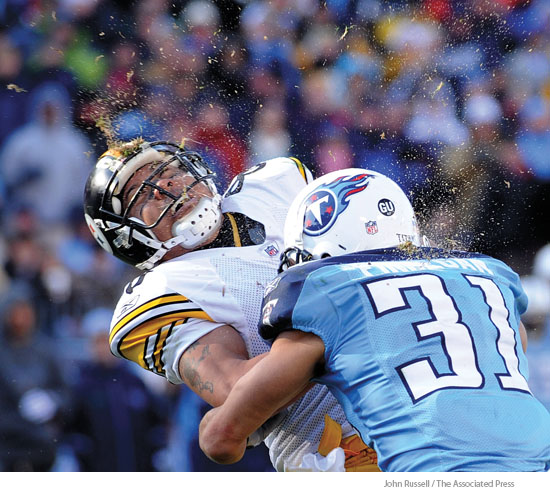
On October 17, 2010, the Philadelphia Eagles hosted the Atlanta Falcons before a crowd of nearly 70,000. The game was expected to be a tough contest between two of the top teams in the National Football League, but the Eagles jumped out to a quick 14-0 lead and, early in the second quarter, were driving again. On third down, the Eagles lined up to pass, with wide receiver DeSean Jackson split out far to the right. After quarterback Kevin Kolb took the snap, Jackson took a few steps forward, then turned left and sprinted across the field. As Kolb’s pass arrived, Jackson leaped and grabbed it, arms outstretched. He had just turned upfield when his progress was stopped by Falcons cornerback Dunta Robinson, who, arriving from the opposite direction, drove the crown of his helmet into Jackson’s shoulder. The collision knocked both players to the turf for several minutes; each was later diagnosed with a concussion. But the media firestorm that ensued can’t be explained only by the ferocity of Robinson’s tackle, or by the concussions suffered by nine other players on what was soon dubbed “Black-and-Blue Sunday.” After all, violent hits like Robinson’s had been tolerated, even celebrated, in sports media for years.
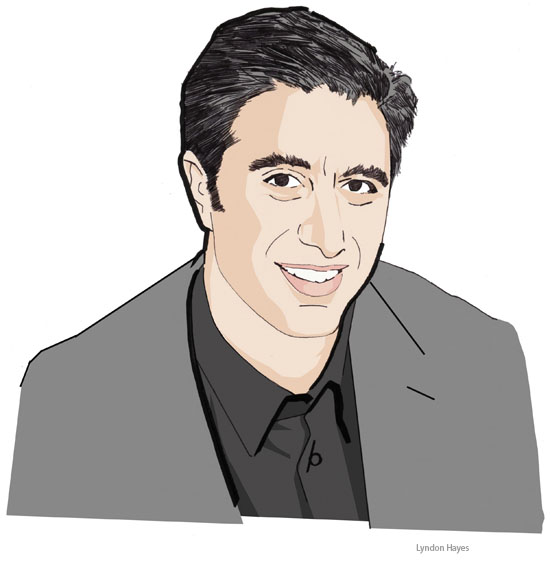
The about-face was the result, in large and improbable part, of the work of a stats-oriented freelance baseball writer named Alan Schwarz. In early 2007, Schwarz reported in The New York Times that Andre Waters, a former Eagle who committed suicide at age forty-four, had been found to have a degenerative condition known as chronic traumatic encephalopathy (CTE). The Times hired Schwarz within months, and over the next four years he wrote scores of stories about the concussion-related risks faced by football players. His articles uncovered elevated dementia rates among retirees and documented obfuscation by the NFL; they prompted congressional hearings and scrutinized an unregulated helmet industry; they showed wives caring for fading husbands and communities trying to protect their children. Other reporters had covered this terrain before, but never with the persistence of Schwarz, who kept the story going by, in his words, demanding that the people he was covering “make sense.” In the process, he put the issue on the agenda of lawmakers, sports leagues, and the media at large—and helped create a new debate about risk and responsibility in sports. CJR’s Greg Marx interviewed Schwarz in New York City last summer.
The Math Geek
My first day of kindergarten, when we went around the room and everyone said what they wanted to learn, what did I say? “I want to learn square roots.”
I went to college planning to become a math teacher. I just loved numbers. But by the time I majored in math, I was pretty burned out on school. And a friend of mine was on the school newspaper, The Daily Pennsylvanian. It had a great reputation, and it seemed like a fraternity that I could join. As a kid, I had gotten into baseball through baseball cards—I really liked the numbers. So I joined the paper and wrote sports, and by the time I graduated, I decided I wanted to be a sportswriter.
I did what everybody does—I sent out letters to every newspaper in the country. And I didn’t get nibbles anywhere. I still have my rejection slip from Neil Amdur here at The New York Times. But I did have a family connection at The National who helped me get considered, and I got hired there as an editorial assistant. Basically, I answered phones and tried to help Mike Lupica get his stories filed. But when things started to get rough financially at the paper in late November 1990, I was in the first round of twenty-five let go.
By this time I knew some people at Baseball America, and it turned out they had a spot for me. I spent six years there writing and editing everything you could possibly think of involving baseball. When I left and came back to New York, I had friends all over publishing, so it wasn’t that hard getting freelance gigs. I wrote for Inside Sports, I got my first article in the Times, I got on ESPN. I sort of knew everybody and everybody knew me, and it was a very good situation.
Fumbling Over ‘Encephalopathy’
In the summer of 2005, my old editor at Inside Sports, who was then at the World Wrestling Federation, called me up and said that a wrestler he knew, this former Harvard football player named Chris Nowinski, had written a book manuscript on concussions and maybe I could give him advice. I was blown away by it—not the text as much as the way everything was footnoted, and footnoted correctly. It was really carefully done. I just thought, wow, this is great.
Now, like everybody else I thought a concussion was a brain bruise—I had no interest in, no knowledge about the topic. But you could tell this was important. So I introduced the wrestler to a couple of publishers and agents, as a professional courtesy. But it never went anywhere, and that was the end of it. I did that stuff all the time.
I forgot all about it until about a year and a half later, when I got a call completely out of the blue from Chris Nowinski. It was late December, a couple days before Christmas. I remembered who he was—it’s hard not to remember the Harvard-football-player-turned-professional-wrestler-concussion-guy. And he said, “I’m pretty sure I’ve got something big here, but I’m not sure I know what to do with it, and you’re the only one who ever took me seriously.” It was Andre Waters—Chris was in the process of having Waters’s brain tissue examined for CTE.
I had to decide what to do with this. And I thought, you know what, this is very serious, it feels like a New York Times story. I was friendly with Tom Jolly, the sports editor of the Times, so I set up a meeting. I still remember all of us fumbling over the word “encephalopathy.” But Tom recognized instantly that this was possibly a very big deal.
They let me do the story. In retrospect, it feels preposterous. I had barely written a word about football—I had done a couple of numbers columns, “Super Bowl excitement index” and silly things like that. Certainly not concussions. And all of a sudden I was talking to neurosurgeons and neuropathologists and ultimately finding out Waters’s test did come out positive, having to call the NFL, and work through what the case meant and what it didn’t mean, what it might mean.
I didn’t really understand neurons and protein deposits and things like that, but I didn’t really need to. I listened to Chris, and I listened to Bennet Omalu, who was the neuropathologist who handled the Waters case. And then I repeated what they said to lots of leaders in the field. And if those people all say “yeah, that’s significant,” you as the writer don’t necessarily have to understand everything. We all, frankly, fake expertise—that’s almost our jobs. But also, and this is important, if there was a story at the Times that dealt with a scientific topic, it got vetted by Science. Someone looked at it and made sure it wasn’t wrong.
Two Plus Two Equals Five
What I did bring was my math background, which really played a huge role in all of this. These doctors were telling me this condition, CTE, does not happen in regular people—it does not happen unless you bang your head over and over and over and over and over again. So this is a million-to-one shot that’s come in three times in a row on NFL players who have been examined for it—Mike Webster, Terry Long, and now Andre Waters. [Webster, a star offensive lineman during the 1970s and ’80s, suffered from dementia and depression after retiring; he was diagnosed with CTE after his death at age fifty in 2002. Long, a teammate of Webster’s, was found to have CTE after he committed suicide in 2005 at age forty-five.]
If I didn’t know anything about neuroscience, I did know enough about conditional probability to know that something was different about this group of football players. And when the NFL, or the NFL doctors, tried to tell me that those three didn’t mean anything—that their published studies asserting that everything was hunky-dory were the last word on the matter—they were attacking my core belief system. They were telling me that two plus two equaled five, and I knew they were wrong. Because the point is not that there are hundreds of football players out there who are not suffering any of these types of deficits. The point is how many of them are having the deficits, and how that compares to the general population.
In February of 2007, I heard that the league was soliciting applications for a fund to help former players who had been diagnosed with dementia and Alzheimer’s, what was known as the 88 Plan. I knew instantly that that was going to be their downfall. Their strategy had always been to discredit the data or the methods of every study that had linked football with cognitive impairments. And here they were collecting the data—they were blessing the data.
And I knew that once the number of people in the plan reached a certain point, about sixty or eighty, there would be a decent sample to analyze, in terms of at what age these players were starting to show signs of dementia. I needed to wait. But I always had in the back of my mind, “I can’t wait to get my hands on that list.”
In January of 2009 I found out that the number of players in the plan was ninety-five. A little while later I was on the beach in Puerto Rico, with my wife. I should have been more with my wife, but I was thinking about this stuff—I just knew I was on to something. And I started sketching the numbers out on this little Marriott pad, literally while I was on the beach. I was doodling around—if there’s this many people alive, what would the curve look like?
When I got home, I started calling as many people as I could, trying to find out who was in the plan. It wasn’t that I needed the names themselves, but it was important to know the players’ birth years, to get a sense of how old they were when they started to experience dementia. I thought somebody would just leak the list to me, but holy shit was that thing locked down. It was virtually impossible; you always heard the same small group of names. Eventually, I pieced together sixteen, and that was actually enough to have a pretty good idea of what was going on. You could basically know what the age-distribution curve was going to look like.
So the next question was, what’s the denominator? How many retired players are alive? I knew that there were about 13,000 living ex-players, so I sketched out a reasonable estimate of their age groups. I also happen to have a good friend who has the best biographical data on athletes of anybody, so with his help I got those numbers almost exact.
The rates I got actually weren’t that alarming. But the real breakthrough came later when I noticed that the plan was only open to vested players, those who had played four or five years in the league. So the denominator just plummeted, and the rates of dementia went whooosh.
By August of 2009, we were getting ready to try to figure out how to publish this—“data proves,” or “suggests,” or “indicates,” whatever verb we were going to end up comfortable with. And then somebody leaked me the Michigan study, a phone survey commissioned by the NFL that showed these dramatically elevated rates of Alzheimer’s and memory impairments among former NFL players. It was a different data set, but it proved what I had been noodling with. The numbers were almost identical. Basically, the NFL scooped me. Their own study scooped me. When we published that story, people finally understood.
We published my 88 Plan analysis a few months later, after the lawyer for the players’ union did his own noodling with some numbers, and came out saying everything’s fine. Well, it was totally fucked up. His numbers were wrong, and his analysis was wrong. And I could tell that instantly, as soon as the person who leaked it to me handed it to me, because I had studied it myself.
Dispassion Drives People Crazy
One of the challenges throughout was how to take otherwise dry material and turn it into something humane, to put a face on it. Most of the time, those faces were women. I realized pretty early that it was the men who lived the dreams, and the women who lived the nightmares. Their husbands were either brain-damaged or brainwashed, but the women got it. And so I used them to understand, to learn, to find out more.
At the same time, none of them ever said, or even suggested, that football should not be played. None of them ever said, “I hate football.” Eleanor Perfetto, whose husband has degenerative dementia, said, “Hey, I’m a football fan.” Linda Sanchez, the congresswoman who starred at the hearings, said she’s a football fan. They’re all fans; they don’t want it to go away. They just want it to be less stupid.
Dispassion is incredibly powerful in a reporter. It drives people crazy. If I come off as somebody who’s trying to change football, I lose something. There are people who are wired to play off the amplitudes of argument, and if you stray too far from what makes sense, boom—they cut you off right there. They jump into a zone more reasonable than yours, and you’re sunk. But if you go down the middle, they got nothing.
It was similar with the helmet story. Helmets were something I always wanted to look at, but I never really had a chance to do it until May or June of 2010. And once I did a little digging, I learned that the standards to which helmets are held has nothing to do with concussions.
Now maybe they can’t, but people think that they do. That was the thing the guys in the helmet industry who came to hate my guts never understood—all I was saying is that the helmets, intentionally or not, are communicating a level of safety that they do not afford. The goal was just to get the consumer to realize they should pay more attention and expect more. And from there, whether the child or the parent chooses to engage in that activity is their business, it’s not my business.
The helmet article, though, was also a case of me becoming part of the story in a way that I wasn’t comfortable with. There was a sense that this subject was going to evolve how I decided it would. Everything that was going to come after that was just going to be because Schwarz wanted to stick his nose into it. It just didn’t feel right. At the same time, a lot of people started to assume my mindset was something that it wasn’t—they almost made it seem like I was a crusader. The only thing I’m a crusader for is accurate statistical statements. If I’m an advocate for anything, it’s for making sense.
Part of the Story
And then there was the Dave Duerson episode, where after he killed himself I found myself getting accused of helping to cause his suicide. [In February, Duerson, a former NFL star who helped administer the league’s disability plan, fatally shot himself in the chest. Apparently suspecting that he had suffered brain damage, Duerson left a note asking that his brain be examined; he was subsequently found to have had CTE.] He had read my stories, and obviously I had not painted a lot of portraits of players doing just fine. At least in writing the note—that request was caused by me.
So, of course I looked in the mirror. And maybe I had not done a good enough job of explaining that this doesn’t happen to everybody, that the point is just that it happens to significantly more of them than it should. When the Duerson results were about to come out, I knew—I said, people have underreacted to all of these; they’re going to overreact to this one. And so I wrote a story on how people are misinterpreting the rate at which these things are happening: just because fourteen out of the fifteen who have been examined posthumously have been found to have it, doesn’t mean that fourteen out of fifteen football players have CTE. It’s a completely separate mathematical animal.
But to be publicly accused of causing someone’s suicide—I didn’t think that was fair. It left me feeling, I don’t think I’m supposed to be this much part of the story. And by that point, this had taken such a toll on me mentally. I would dream about it; I would think about it constantly. Four and a half years is a long time to be on a tightrope. It was time to see if I could get it out of my head. So I left the sports department in April, to start writing about education. I plan to retire at the Times, and I won’t be writing about concussions when I do.
Looking back, the main lesson I learned? Never trust the phrase, “According to a study published in. . . .”
Greg Marx is an associate editor at CJR. Follow him on Twitter @gregamarx.