Sign up for the daily CJR newsletter.
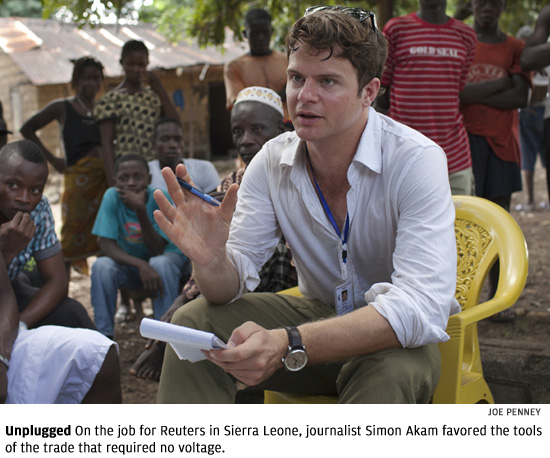
About two years ago, I took a position as a freelance correspondent for Reuters in the West African nation of Sierra Leone. As I am now preparing to leave, I think there is value in laying out the practical aspects of operating as a journalist in one of the world’s poorest countries. Sierra Leone emerged from a bloody civil war in 2002; six years later, it still held the last place among 179 countries in the UN’s human development index. By 2011, it had risen off the bottom but was still ranked 180 out of 187. Gross income per capita remained just $340 per year.
In Britain, my home country, Sierra Leone is still widely considered a conflict zone. Tony Blair deployed British troops there in 2000, searing the civil war onto the British consciousness. Today, though, Sierra Leone is astonishingly safe. That is not to say it is absolutely safe; one night, men cut their way into my house in Freetown, the capital, with bolt cutters, and I awoke with them in my bedroom. They made off with a haul of electronics and dropped a knife on the way out. However, such instances are rare. Risk is largely confined to the country’s lethal roads and the what-if scenarios created by the lack of medical resources.
Instead of risk, the reporter in Sierra Leone faces difficulty. For me, Freetown life largely pares down to a continual quest for three commodities: electrical energy, functional telecommunications, and cash.
First, electricity: Sierra Leone has extremely limited grid power. Voltage spikes can blow up irreplaceable laptop chargers, unless bulky anti-surge protectors are used. And with grid power so scarce, you rely on diesel generators, which are prohibitively expensive to run all day.
Second, communications: When I arrived in Sierra Leone the country was one of a dwindling band of nations still lacking fiber-optic connections to the outside world (Chad and Eritrea were others). It was not unusual to spend half an hour trying to send an email. A year later, cable made landfall on Lumley Beach in western Freetown, but more than a year after that, the cable has yet to come online. The consequence is that data communications—required to digitally file copy—are horrifyingly slow.
So my initial months in Freetown were dominated by a perambulation around the few establishments in the city—hotels, mainly—that maintained generator power all day and had Internet connections. After almost a year, I persuaded my masters that this situation was unsustainable. In response, they gave me a satellite phone. For a giddy month, I worked on my veranda, my BGAN Explorer 300 pointed at the eastern sky like theological apparatus used in the veneration of a pre-Christian god. Then the bill came, north of $2000. Reuters promptly decided that the BGAN was only for emergencies. The company instead let me rent a desk in an office—with power and Internet, albeit a temperamental connection.
The office could not solve the third Freetown scarcity, cash. Sierra Leone’s currency, the “leone,” retails at around 4,400 to the dollar. The highest denomination note remains the 10,000. Such devaluation renders the wallet ineffectual for the carriage of serious wealth (you can carry $30 worth, not $300). For substantial sums, I favor instead the black plastic bag.
The bigger problem is not the bulk of the currency but the difficulties in obtaining it. You can pay for almost nothing with a credit card in Sierra Leone; all transactions are cash. I befriended Titus, the operator of the Visa cash-advance machine in Ecobank’s Freetown branch. Titus is a good man. But his contraption, like all electromechanical devices in Sierra Leone, is routinely broken. (And now Ecobank has abandoned the service altogether.) And so, all too often, I reverted to Freetown’s semi-functional fleet of ATMs, constantly jamming themselves on wads of near-worthless paper. You can spend hours traversing the capital, searching for a working ATM to get money to buy supper.
Sometimes the individual dysfunctions of Sierra Leone collided into a wholesale collapse of possibility that I will call here the “Freetown conundrum.” The best way to explain it is to describe a hypothetical variant of the type: You awake. It’s 91 Fahrenheit in the shade, and the humidity is 87 percent. The sheets are stinking with sweat and insecticide. The cell phone’s battery is about to die. The generator at the office has broken, and even before it went down, the Internet collapsed. A diesel shortage means there’s no fuel for the generator at home. The ATMs are offline, so there’s no cash to get to a hotel to use its communications equipment. The only realistic option is to go back to bed, thwarted again by West Africa. However, even that is not an option, as it is now 95 in the shade and there’s no power for the bedroom fan. In situations like this, I periodically feared I might go mad.
It is not fair to judge all of Africa by Sierra Leone. My home for the past two years is not in the top category of dysfunctional states on the continent—Congo and Somalia are in a different league. However, Sierra Leone is much worse off than many African countries. Once, in Senegal, I was shocked and delighted to be able to buy a flight with a credit card through an efficient travel agent. Likewise, in Ivory Coast, the sophistication of the locals was wholly different from my experiences in Freetown.
At the same time, aspects of Sierra Leone are improving. Economic growth is high, and the infrastructure is strengthening. Electrical power is more plentiful than it was. The daily struggles of living there can blind you to this progress.
But it would be a lie to say that those struggles, over a period of two years, did not have an effect on me. Many Westerners I met in West Africa took it as an article of faith that all of the region’s woes were the result of outside malfeasance—someone else’s fault, going back to colonialism and the slave trade. After two years in Freetown I not only cannot agree, but I think such views—promulgating as they do an abdication of responsibility—are bad for Africa. The Western world undoubtedly committed atrocities to the continent. But today it is up to Africans to carve out a brighter future for themselves.
Local journalists in Sierra Leone face a situation that is substantially more difficult than my own. They are smart and well informed, and able to see subtleties in stories that I was blind to, but they lack institutional backing and have meager resources. Too many of them, I regret to say, resolve this problem by taking bribes. Freetown’s multiple newspapers therefore collectively present a shrill and often wildly sycophantic discourse. When I wrote about government corruption, they ran bizarre ad hominem attacks on me. A front-page story in the Awareness Times, “Misguided journalists on doomed mission,” complete with an unflattering photograph, was my favorite.
Given the low literacy rate in Sierra Leone, broadcasting has greater reach than print, but it, too, has problems. In the runup to the Sierra Leone election in November the theoretically independent Sierra Leone Broadcasting Corporation covered the ruling party twice as much as the opposition.
I learned a great deal about life, as well as journalism, in Sierra Leone. It is highly unreasonable, of course, but when I return home and speak to reporters who work in the First World, I sometimes feel something like scorn: They never had to fix a broken Td5 Land Rover engine, deal with the thuggish police who arrest their translator, or place ice on their feet to cool down enough to sleep. All in all, I did well by Sierra Leone, even if much of what the country taught me was that the world is a harder place than I had previously thought.
Has America ever needed a media defender more than now? Help us by joining CJR today.