Sign up for the daily CJR newsletter.
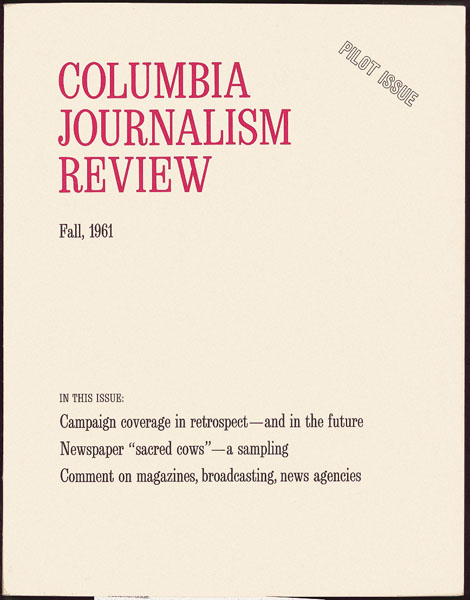
What journalism needs, it has been said time and again, is more and better criticism. There have been abundant proposals for professional study panels, for institutes with squads of researchers, for critical journals. Columbia University’s Graduate School of Journalism has decided to attempt such a journal. Two considerations brought about the decision: First, the need, magnified in a critical era like this, for some effort to assess the performance of and to help define—or redefine—standards of honest, responsible service. Second, the obligation that falls on a serious professional school—a graduate institution, national in character—to help stimulate continuing improvement in its profession and to speak out for what it considers right, fair, and decent.
Columbia’s Faculty of Journalism cannot pretend to Olympian qualifications. It does combine the detachment needed to be reasonably impartial with the professional experience needed to sense what is possible and what is not. It can also draw upon the vast experience of its part-time teaching staff and its alumni, as well as upon the growing number of alert, inquiring minds within journalism and informed critics from the outside.
All the proposals for organized criticism—whatever their intent or merit—point to one conclusion: that there exists, in and out of the profession, a widespread uneasiness about the state of journalism. The Review shares this uneasiness, not over any supposed deterioration but over the probability that journalism of all types is not yet a match for the complications of our age. It believes that the urgent arguments for a critical journal far outweigh the hazards.
In launching this experiment, the School has set for the Review these goals:
To deal forthrightly with what it finds to be deficient or irresponsible and to salute what it finds to be responsible, fair, and professional.
To discuss all the means that carry news to the public, thus viewing the field whole, without the customary partitions.
To provide a meeting ground for thoughtful discussion of journalism, both by its practitioners and by observers, to encourage debate, and to provide ample space for reasonable dissent.
To attempt systematic studies of major problems in journalism, drawing not only upon published sources but upon new research and upon correspondents here and abroad, including many of the School’s alumni active in the profession.
To recognize that others (like Nieman Reports, Journalism Quarterly, the Saturday Review, and, in some ways, trade publications like Editor & Publisher and Broadcasting) have been doing part of the job and to acknowledge their work in the Review’s pages.
As a division of a large private university and as an institution that has mediated between the academic world and journalism for nearly fifty years, the School is committed to no single interest beyond its belief in good journalism and graduate education in journalism. The School has tried to prepare more than 2,500 graduates for careers in journalism. Now it believes it is time to try to assess the field they have entered.
No single issue of this publication will satisfy all the editors’ standards—least of all this pilot effort. But the Review will try to emulate all sincere journalism by coming as near the whole truth as possible.
Has America ever needed a media defender more than now? Help us by joining CJR today.