Sign up for the daily CJR newsletter.
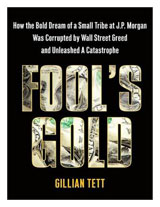
Fool’s Gold: How the Bold Dream of a Small Tribe at J.P. Morgan Was Corrupted by Wall Street Greed and Unleashed a Catastrophe
By Gillian Tett | Free Press | $26, 304 pages
I can’t imagine there’s a better vehicle to tell the story of credit derivatives—the financial instruments that laid the groundwork for the financial crisis—than the one Gillian Tett uses in Fool’s Gold. The author, a top reporter and columnist for the Financial Times, views the whole mess through the prism of a single company: JPMorgan Chase. As Tett sees it, the firm essentially invented the credit derivative, proselytized for it, and then avoided most of the excesses it enabled, only to watch it send the entire industry into a free fall.
 That Tett has written a readable book about credit-default swaps, collateralized debt obligations, asset-backed securities, and so on, is itself an accomplishment (though it ain’t exactly beach reading). But she has a good story here, too, taking us inside the genesis of the crisis. It all began at a Boca Raton hotel in 1994, where a rambunctious crew of idealistic bankers broke noses, threw bosses into the pool, and conceptualized the financial product that would cause the near-destruction of the world economy a little more than a decade later. It’s fascinating to follow this crew over the next fifteen years, as they navigate the shoals created by their own invention.
As with so many inventions, though, the idea of the credit-default swap wasn’t truly invented by the J.P. Morgan crew—they were just the first to fully realize its potential. A credit-default swap is essentially an insurance contract purchased to protect against (or speculate on) the possibility that an entity will default on its payment obligations. If you lend money to Company X but want to hedge your risk, you buy a CDS from Company Y protecting against the possibility of a collapse at Company X.
According to the gospel of financial innovation, these instruments dispersed risk throughout the economy, making the system more secure. But they also had perverse consequences, which the industry surely must have foreseen. For instance, if you loan somebody money and insure yourself against the risk that he won’t be able to pay you back, you have less incentive to make sure he can, you know, pay you back.
Tett describes the thinking of Blythe Masters, one of the key creators of CDS, on separating risk from lending: “Doing so would overturn one of the fundamental rules of banking: that default risk is an inevitable liability of the business…. For the first time in history, banks would be able to make loans without carrying all, or perhaps even any, of the risk involved themselves.”
Therein lies the genesis of the bubble, along with the easy-money policies of the Federal Reserve. Allowing banks to offload risk enabled them to lend more and more money at a pace the economy wasn’t able to absorb. Meanwhile, collateralized debt obligations were turbo-boosted: the banks had a new incentive to push mortgage companies for more loans, so they could shovel them off to hungry investors and reap the giant fees.
From the beginning, J.P. Morgan saw serious flaws in the mortgage securitization racket, and mostly avoided it, despite serious temptation as the market poured buckets of money into competitors in 2005 and 2006. It beggars belief that Morgan’s bankers were the only ones smart enough to see through the scheme. But Tett makes clear the competitive pressures that kept nearly everyone else “dancing,” in the infamous words of Citigroup’s ex-CEO Chuck Prince.
She’s also good on the decades-long run-up to the explosion in credit derivatives, and her catalog of regulatory missteps is cringe-inducing. In 1987, for example, the Commodity Futures Trading Commission, which regulates derivatives like corn futures, proposed to regulate the precursors to CDS. It was promptly slapped down by the financial lobby. (A decade later, CFTC head Brooksley Born fought a heroic but losing battle to regulate CDS themselves.)
Bill Clinton, taking office in 1993, had campaigned on “an anti-Wall Street stance,” and would have presumably kept the industry on a short leash. But he folded when “faced with the formidable lobbying power of Wall Street,” and would later empower anti-regulatory characters like Robert Rubin and Larry Summers.
In 1994, a series of derivatives scandals—including one that bankrupted Orange County, California—tarnished the industry, and most observers assumed that its freewheeling days were over. But again the almighty banking lobby flexed its muscles with Congress, and pressured journalists “to stop writing about derivatives in such a negative light.” Again, nothing was done. Tett rightly calls this fiesta of wire-pulling “one of the most startling triumphs for a Wall Street lobbying campaign in the twentieth century.” Four years later, Long-Term Capital Management blew up after it made ill-fated bets using derivatives. And again, nothing was done.
The incredible thing about J.P. Morgan’s 1994 brainstorming session in Boca Raton is that it took place against the backdrop of the unfolding derivatives scandals on Wall Street. While this havoc was playing out in the economy, J.P. Morgan was trying to figure out how to morph its latest creation into something new and exponentially bigger. It makes you wonder what schemes are being hatched even now, and how much regulation will actually be imposed, since it’s clear that the industry is emboldened by mixed signals from Washington.
The great irony of Tett’s book (and of the last decade of financial history) is that J.P. Morgan dodged the fallout from its radioactive creation. I suppose the person who builds the bomb knows best how to defuse it. As for the analogy with atomic weapons, it’s less of a stretch than it sounds. Witness this unintentionally ironic quote from a Morgan banker: “I’ve known people who worked on the Manhattan Project—for those of us on that trip, there was the same kind of feeling of being present at the creation of something incredibly important.”
If there’s a problem with Fool’s Gold, it’s that the author lets J.P. Morgan off the hook a bit too easily. The derivatives team comes off like a cadre of wizened gurus, and Tett’s somewhat gauzy portrait of the bank’s culture is hard to swallow.
Contrasting J.P. Morgan’s culture with that of its rapacious competitors, for example, Tett insists that “the senior bankers still talked about banking as a noble craft, where long-term relationships and loyalty mattered, both in dealing with clients and inside the bank. While at other banks the emphasis had turned to finding star players, offering them huge bonuses, and encouraging them to compete for preeminence, at the Morgan Bank the emphasis was on teamwork, employee loyalty, and long-term commitment to the bank.”
Relatively speaking, Morgan’s culture was better than that of its peers. But let’s face it: Wall Street isn’t in the nice-guy business. Tett has excellent access to the players, which makes her story that much more vivid, but at times she seems a bit too sanguine about their motives and selective reconstruction of history.
She doesn’t, however, let the media off the hook. The author tartly notes that a critical Securities and Exchange Commission ruling in 2004 on leverage ratios for brokerages got “almost no attention in the press.” That ruling allowed the brokerages to double their debt levels, adding much more air to the bubble.
And as we’ve said before, the press institutionally just isn’t set up to cover the debt world, as Tett points out. Far more business reporters cover equities than bonds, and very few understand the arcana of that industry—and even fewer understood it before 2007. Tett also reports that the commercial-paper sector, which was one of the first areas to break down, was “comprehensively ignored by journalists and regulators in the previous years.”
The credit-ratings agencies, which like to claim First Amendment protections, come in for a justified bruising of their own. When they appear in Tett’s narrative, they are hapless and essentially corrupt. Which is only fair: Standard & Poor’s, Moody’s, and Fitch were linchpins in the whole mess. Without the agencies sprinkling holy water on those ungodly securities, they wouldn’t have existed. Tett points out that the banks “constantly threatened to boycott the agencies if they failed to produce the wished-for ratings.” Needless to say, they got them.
The final third of the book alone is worth the price of admission, if only as a crib sheet for the events of the last two years. Tett does the best job I’ve seen of reconstructing the drama of the meltdown. Reading through it is a useful reminder of how close we came to an utter cataclysm. After the Bush administration disastrously let Lehman Brothers fail, it had the sense to prop up AIG and get into the bailout business, however clumsily. Tett quotes one senior banker in London, speaking before it was clear what steps the administration would take: “If this continues, the next logical step is that the cash eventually stops coming out of the ATM machines—if that happens, God help us all.”
How perilously close to the abyss we were! Now the question is how will we keep from returning there. In her concluding pages, Tett dips into her training as a social anthropologist and recommends that bankers and regulators take a “holistic” approach to measuring risk and preventing it from getting it out of hand. That, however, is a nebulous catchword. Here is something more concrete: No more off-balance-sheet entities. No more securities so complex top bankers can’t understand them. No more “too big to fail.” No more unlimited leverage and fake capital ratios. And if you take away a single principle from this book, let it be this one: when lending, bankers must have their own skin in the game.
Has America ever needed a media defender more than now? Help us by joining CJR today.