Sign up for the daily CJR newsletter.
For a profession whose entire raison d’être is communication, American journalists sure have done a lousy job of explaining why the slow-motion disintegration of the business model upon which their livelihoods have depended for the past three hundred years might have significant negative consequences for the country. The arguments one hears tend to sound like high-school civics lessons that people automatically tune out. And those are from the serious journalists. The unserious ones—the ones whose ranks are booming—present a daily argument for saying good riddance to newspapers and the like—with the Murdoch empire’s recent phone-hacking scandal being only the most gruesome.
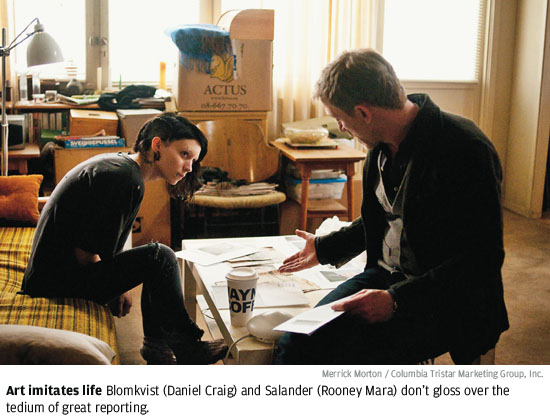
Ironically—and apparently somehow below the radar of most journalists in America—the profession was recently blessed with what could have been, and still might be, the most effective propaganda vehicle for the societal significance of journalism I could imagine. His name is Mikael Blomkvist, and the paunchy, forty-year-old, lady-killing, black-coffee-and-bourbon swizzling, cigarette-smoking, crusading, feminist, Swedish journalist just happens to be the hero of perhaps the best-selling book series in the world. The late Stieg Larsson’s Millennium trilogy—The Girl with the Dragon Tattoo, The Girl Who Played With Fire, and The Girl Who Kicked the Hornet’s Nest—have already sold upward of fifty million copies worldwide, and spawned three pretty decent Swedish films. MGM’s release, over Christmas, of David Fincher’s $100 million Hollywood version of The Girl with the Dragon Tattoo, with yes, James Bond (Daniel Craig) playing Blomkvist, is no doubt driving those numbers even higher.
True, just like Mr. “Shaken, Not Stirred,” Blomkvist is too good to be true. He works for Millennium, a profitable, do-good, investigative business magazine of which he is part owner and editor that has no imaginable analog in American journalism. (It is modeled after the tiny anti-racist magazine, Expo, that Larsson helped found in 1995 and for which he continued to labor until his fatal heart attack in November 2004 at age fifty, just before the publication of Dragon Tattoo.)
Blomkvist, therefore, lives and works in a journalistic environment about as far as possible from the kind of politics-as-entertainment/entertainment-as-politics that dominates American mainstream news—particularly business news, where Larsson’s billionaire villains would, until very recently, likely have been treated as akin to super-heroes. As the business writer Chrystia Freeland has mused, “You don’t have to be a fictional Scandinavian social democrat to wish that business journalism in the United States was more about afflicting the comfortable and less about cozying up to them.” But if highbrow American journalists would look up from their decaf soy lattés, they might find much to cheer, or at least to ponder, in Larsson’s trilogy. For in addition to earning its bona fides as a first-rate, albeit decidedly implausible, murder mystery series, it also is among the most nuanced and thorough fictional demonstrations ever written of the importance of journalism to a democratic society.
It’s true that Larsson cheats. Not only do women fall in love with Blomkvist too easily, but the idea that the Robin to his Batman is the magical “Girl” with not only a generous set of tattoos but also a photographic memory and the ability to hack into any computer system in the world, is not bloody likely either. Her hacking talents—not unlike, come to think of it, those of the Murdoch cretins but in this case used only for good—make it possible for Blomkvist to become privy to all sorts of secrets that would elude a mere mortal journalist. What’s more, he becomes so personally involved in the story that he ends up caring far more about the fate of the individuals he is reporting on than about his responsibility to publish anything approaching “the whole truth.” Near the end of Dragon Tattoo, when Blomkvist finally finds the object of his frenetic search, he explains to her that she has no need to fear exposure: “I’m not thinking of exposing you. I’ve already breached so many rules of professional conduct in this whole dismal mess that the Journalists’ Association would undoubtedly expel me if they knew about it…. One more won’t make any difference.”
But what make the trilogy so valuable to the cause of journalism are the things it gets right. Over the course of more than 1,750 pages, its author captures a remarkable number of the challenges that doing honest journalism involves, as well as the reasons it matters whether people keep doing it. This is significant, given the profession’s apparent inability to make a compelling case for itself, at least in the eyes of the readers, viewers, and listeners who do not appear to be concerning themselves terribly much with its rapid disappearance. The journalists’ credo can be found in the instructions offered by Erika Berger, Blomkvist’s lover, best friend, and editor, to one of the young writers in her employ: “Your job description as a journalist is to question and scrutinize critically—never to repeat claims uncritically, no matter how highly placed the sources in the bureaucracy. Don’t ever forget that.” This could sound like the kind of pabulum that has entered into the speeches of all the gruff, quietly heroic newspaper editors once concocted by Hollywood, from Humphrey Bogart in Deadline, USA through Jason Robards in All the President’s Men. But in Larsson’s gothic and twisted murder mysteries, the attention to journalistic detail with which readers must identify to make it to the end can only endear them to the men and women sufficiently dedicated to Berger’s lofty mission statement to stick with it.
The trilogy’s plot, while impossibly complicated to describe, much less condense, frequently turns on matters of journalistic propriety of the kind that are rarely discussed outside badly lit newsroom cafeterias and gloomy university seminar rooms. We see Mikael and Erica struggle with love and danger, but also with questions of proper sourcing in a magazine article versus a book, a little magazine versus a powerful (and compromised) newspaper. We see the drudgery of research, of interviewing sources, and building a story one detail at a time; of trying to figure out who’s lying and why, how to publish what one knows without giving away what one doesn’t, and then how to manipulate the numbskullery of television to build the biggest echo chamber possible for one’s work.
Along the way, almost all of the (frustrating) details of the profession are laid bare.
First, media organizations are rarely honest about themselves. When a terrific story by another underpaid freelancer about the manipulation of, yes, global toilet prices and the exploitation of third-world workers threatens the public reputation of a newspaper’s owner as a man of decency and honor, it goes through only because Berger has recently left Millennium to be the newspaper’s editor. The cynicism of the crotchety time-servers she encounters at her new job is also not of the cute, heart-of-gold variety that we typically find in fictional portrayals of the profession. “Today’s task is to write an editorial on the demonstrations,” Berger’s editorial-page editor explains to her. “I could do it in my sleep. If the pinkos want to start a war with Denmark, then I have to explain why they’re wrong. If the pinkos want to avoid a war with Denmark, I have to explain why they’re wrong.”
Larsson, moreover, is particularly astute in his portrayal of the psychological vulnerability that journalists feel when they try to travel independent of the pack. At one point, Blomkvist finds himself wondering if his friend and aide-de-camp, Lisbeth Salander—the tortured, possibly autistic, punkish, tattooed “Girl” genius of the titles—might actually be guilty of the crazy crimes for which he knows she has been framed, simply because that’s what everyone in the media assumes. No one, not even the man who knows best, is immune to the crippling power of the media master narrative.
No less significant is Larsson’s treatment of the role money plays in the profession. Journalists, few people understand, are awfully poorly paid. Blomkvist lives on junk food, coffee, and cigarettes, with virtually no creature comforts. The freelancer who is murdered for the information he stumbles upon can only afford a secondhand laptop. Larsson is also the first storyteller in any medium I have ever encountered who has an editor attempt to balance the monetary cost of a story against its societal value, something that has been the bane of this journalist’s career but rarely merits a mention in journalism-based entertainment. (Like Woody Allen’s infuriatingly magnificent on-screen apartments, the Hollywood version of the journalist almost always enjoys an unlimited expense account.) “Blomkvist had blown 150,000 kroner on the Salander story,” complains the magazine’s acting managing editor even though it’s a story upon which the capture of myriad murderers—to say nothing of the future of the nation’s democracy—may well depend.
In many respects, these details are peripheral to the story of Salander’s struggle against the murderously evil genius she is battling. As with most entries in this genre, the blood and guts—and the suspense that accompanies them—are what keep things moving and the reader riveted. And of course the dramatic details of Larsson’s life, death, and afterlife have kept the world’s attention focused on the author himself, as well as on his warring partner, Eva Gabrielsson, and (now extremely wealthy) father and brother, and the distribution of the avalanche of proceeds from his estate. But nowhere have I seen anyone argue for the books’ value as illustrations of both the difficulties and the importance of the journalistic profession.
After all, without Blomkvist, the (really) bad guys would win. Good people would be destroyed; bad people would get away with murder. Swedish democracy would be compromised quite possibly beyond redemption. (The internal debate Blomkvist undertakes when deciding to what degree it is proper to cooperate with Swedish authorities both to punish the bad guys and to save his country’s soul is among the most sophisticated and compelling treatments of this issue I’ve seen anywhere.)
Part of the problem, of course, is that newspapers rarely pay attention to books anymore. The New York Times is the only paper that still publishes a stand-alone book review section, and fewer and fewer papers devote any daily space to even a single review. (In late July, the Los Angeles Times laid off every one of its already freelance book reviewers and columnists, leaving the job to just four remaining staffers.) This ongoing dereliction of duty when it comes to the world of literature might explain why no editor has so far tried to exploit Larsson’s magnificent posthumous achievement for the potential propaganda goldmine it contains. They are too busy touching up their résumés.
Has America ever needed a media defender more than now? Help us by joining CJR today.