

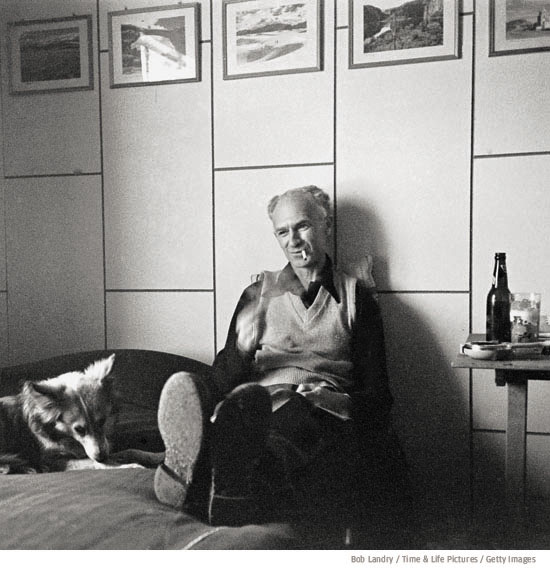
In the spring of 1932, Ernie Pyle took over as the new managing editor of The Washington Daily News, an afternoon tabloid whose rackety little newsroom occupied the third floor of a narrow building a few blocks from the White House. His desk was near the city editor and the telegraph editor, and among the headaches he inherited was to referee their competing demands for space in the paper. He was thirty-one years old, and it was a job he thought he was supposed to want: a top editor for a big paper in the newspaper chain he had joined soon after leaving Indiana University, at the start of what promised to be a vivid presidential campaign between Franklin D. Roosevelt and Herbert Hoover. He was miserable.
Indoors was not his natural habitat. Pyle preferred to be out chasing stories, not inside shaping them, but he was such a swift, deft hand with copy—a deadline poet who could make lesser writers sing in voices they didn’t know they had—that his bosses at Scripps-Howard kept calling him off the hunt and lashing him to a desk. His frustration in his latest desk job only grew as he watched his reporters come back to the newsroom without the kinds of stories he wanted to put in the paper.
“Keep your eyes open,” he wrote in a memo to his staff. “There are swell stories floating around your beats every day that you either don’t see or don’t bother to do anything about when you do see them.”
He continued encouraging them in a tone that was almost wistful, as if he were addressing himself. “You can hardly walk down the street, or chat with a bunch of friends, without running into the germ of something that may turn up an interesting story if you’re on the lookout for it. News doesn’t have to be important, but it has to be interesting. You can’t find interesting things, if you’re not interested.”
Pyle himself was about as interested as a man could be, and he knew those interesting stories were out there because he had proved adept at getting them himself. To become managing editor he had left a job he loved as an aviation columnist, which was, in the era of Lindbergh and Earhart, something like being a technology columnist at the dawn of Jobs and Gates. He regretted that decision now.
“Routine and deadening,” is how he described the managing editor’s job in a letter to a friend. “It is hard and fatiguing work, and I get no chance to do any writing.”
Then, in December of 1934, a bit of luck came his way: a lingering dose of flu. Pyle weighed 108 pounds (“small, frail … bashful and unimpressive,” as his first editor described him), and when sickness got in him it tended to stay awhile. Head someplace warm, the doctor told him. Pyle loved to drive—not fast, but far—so he and his wife, Jerry, pointed their new Ford coupé south.
They had fallen in love with the Southwest on an earlier journey, but this time as they passed through Arizona, New Mexico, even California, all they found was an unsettling dampness. They gave up their search for the sun in Los Angeles, where, in the rain, they loaded themselves and their car onto a slow freighter for a three-week cruise that eased them through the tropics before delivering them back to the East Coast. There was a hole in the paper when they returned: the spot reserved for the syndicated columnist Heywood Broun, who was on vacation. Pyle filled it himself with an eleven-part series of the kind he had always dreamed of writing.
“You know, my idea of a good newspaper job would be just to travel around wherever you’d want without any assignment except to write a story every day about what you’d seen,” he had told a friend soon after first joining the News. Now, a decade later, that was just what he had done.
Readers loved the stories, and his bosses did, too. The editor in chief of Scripps-Howard described them as having “a Mark Twain quality that knocked my eye out.” Pyle soon had a new job, and a $5 raise: $100 for six columns a week, about a thousand words apiece, mailed back to Washington from wherever he happened to land and find something interesting.
“I will go where I please and write what I please,” he wrote back to the friend to whom he had earlier complained about his job. “It’s just the kind of job I’ve always wanted and I hope I can make a go of it.”
So on August 2, 1935, the day before his thirty-fifth birthday, he and Jerry started driving north in their coupé, spending $3.60 for twenty gallons of gas, $2.20 for lunch and dinner, and $2 for a room near Doylestown, Pennsylvania—the first day of five years during which he crossed the continent twenty times, touched down at least three times in every state, and visited every country but two in the Western Hemisphere. “We have worn out two cars, five sets of tires, three typewriters, and pretty soon I’m going to have to have a new pair of shoes,” he later wrote. He filed something like 2.5 million words.
In 1947—after the war that brought Pyle fame, adulation, and death—his editor, friend, and fellow Hoosier, Lee G. Miller, culled and stitched those columns into Home Country, a posthumous contribution to a familiar and persistent genre of American nonfiction: the road book. Home Country was also the fulfillment of a wish that Pyle, when he uttered it, didn’t know would be among his last.
“I hope that someday you people will publish the book of mine that I like best myself,” he told his publishers before leaving for the Pacific theater in 1945—a trip that ended when, terminally curious, he stuck his head up too soon from the roadside ditch into which he and his companions had leaped from their Jeep to seek cover from a Japanese machine gunner. “That’s the book with all the stuff I wrote before the war, the book about my own country. About home. I think that’s the best writing I’ve ever done.”
It wasn’t, but then how could it be? As engaging as Pyle is about his tour through Monument Valley, it inevitably pales when compared to his walk along the beach at Normandy. But Pyle’s peacetime dispatches were, as Orville Prescott wrote in his review of Home Country for The New York Times, “more truly an authentic contribution to Americana” than any of the other star columnists of the era. “And because Ernie Pyle was a good reporter and an extraordinarily attractive personality all his columns were readable, many of them were thoroughly interesting and quite a few were delightful.”
Delightful enough that, in 1989, when I took my own journey across America for my own road book, Home Country was among the handful of books I brought along for the ride in my 1980 Chevy Citation. I read it then to measure how the country had changed since Pyle was on the road. When I read it again recently, I saw that it was a measure of something else now, too—of how much journalism has changed since I was on the road.
Because of the way it was cobbled together from Pyle’s daily columns, Home Country is, as the Times review noted, “necessarily choppy, scrappy and fragmentary.” It does not have the kind of narrative engine that drives road books like Travels With Charley or Blue Highways—a single, purposeful journey in quest of a big idea, incrementally accumulating and dispensing wisdom along the route. What it does have is something it shares with Pyle’s far better-known collection of war columns, Brave Men: it has an index.
My journey for my book was largely done in the dark—chronicling the Americans who went to work each night while the rest of the country slept—and Pyle’s index was a useful torch. It let me quickly find if he had been where I was going, and he usually had: Boston, St. Petersburg, Laredo, Seattle, and plenty of other places about which he always had something interesting to say.
But the index is also useful for the way it illuminates Pyle’s notion of what a reporter’s job is. The index consists entirely of the names of people and places; nothing but human beings you could buttonhole with questions, or cities, towns, and crossroads where you might try to find a medium-boiled egg, crisp bacon, and some dry toast, his preferred breakfast. No entry for “Dust Bowl” or “Depression” or “New Deal” or “Civilian Conservation Corps,” although he wrote about all of those things. A few of the names are famous (Walt Disney, Gene Autry, George Washington Carver), but most belong to people whose one turn in the national spotlight came when Ernie Pyle happened to bump into them.
Franklin D. Roosevelt is in the index, too, but when you turn to page 56, you find no commentary upon his policies, just a tenderly observed account of the way he maneuvered himself out of his touring car at his hotel in Rapid City, South Dakota:
The President put both hands on one leg, and pushed downward, locking the jointed steel brace at his knee. He slowly did the same with the other leg. Then he put his hands on the side of the car, and with his arms lifted his body out and up and onto his legs. He straightened up. I have never seen a man so straight. And at that moment the tenseness broke, and the crowd applauded. The President’s back was to the crowd, and he did not look around. It was brief and restrained applause….It was as though they were saying with their hands, “We know we shouldn’t, but we’ve got to.”
Far more space in Home Country is allotted to the shepherds, hat-check girls, tugboat captains, crab fishermen, silver miners, moonshiners, revenuers, soda jerks, agate hunters, abalone divers, sharpshooters, and Death Valley cave-dwellers whom Pyle chatted up in the easy, unassuming way that led one of them to tell him, “Why, I feel like I’d known you all my life.” He didn’t think celebrities had cornered the market on interesting lives. “Every time I go to a night club I waste too much of the evening down in the men’s department trying to find out from the whisk-broom boy how much he makes in tips,” he wrote when he was in Los Angeles and itching to get out.
Pyle was much happier in a leper colony in Hawaii, or above the Arctic Circle in Fort Yukon, Alaska, with Maud Berglund, her three daughters, and the twenty-two dogs they used to run a trapline from their one-room log cabin. “Eleven months of the year they did not see a living soul,” he wrote. “They lived alone among snow and wolves and moose and mountains.” He was especially fond of prospectors—Josie Pearl, in her tar-paper shack in the desert thirty-five miles outside Winnemucca, Nevada, is a particularly memorable one—perhaps because their trade so nearly resembled his own: hunting for shiny bits of light in a world so often dimmed by shadows.
Pyle did much of his prospecting in the newsrooms of local papers, picking up tips on where the good stories were waiting in each new town he visited. He carried in his car, along with his carefully annotated AAA Hotel Directory, a wooden box in which he filed leads, contacts, clippings—the raw material for future columns. His editors occasionally put in requests. “I don’t like that idea,” he said to a suggestion that he take a look at the impact of government relief efforts in one small city. “It sounds too important!” But he did take a look, and the resulting series was set in North Platte, Nebraska. He wrote another series, about the drought in the upper plains, that was good enough for Scripps-Howard to nominate for a Pulitzer. (It didn’t win; the war is what finally earned one for him.)
Pyle traveled with one suit, three neckties, a supply of ten-cent white cotton socks, and a Borsalino felt hat that he finally lost on the set of a Joan Crawford movie, one more reason to hightail it out of LA. He would report for a few days, collecting material for several columns or more, and then hole up in a hotel room to write them in batches. He spent seven days in Monument Valley and the Four Corners region, and then, sunburned and nursing a cold, spent the next week in an Arizona tourist cabin writing about it: twenty thousand words, enough for three weeks of columns.
The job wore on him, a hole with his name on it that he had to fill every day, and he was irked by friends who regarded it instead as a permanent vacation. “One story a day sounds as easy as falling off a log,” he wrote in one column. “Try it sometime.” He tried to build up what he called his “cushion” of columns, the more weeks ahead the better, and to plump that cushion he sometimes told stories from his own life—sometimes serious (his columns about his mother’s stroke brought her sympathetic get-well wishes from across the country), and sometimes not (one of his most popular pieces documented his struggle with a recalcitrant zipper on his trousers).
When Pyle wrote about himself it was almost begrudgingly, as if he couldn’t quite figure why anyone would be interested in the life of a no-account bumbler like him. He was a “funny little hothouse man—no chest, no tan, no muscle” in one column, “scared to death at meeting strange people” in another, and in still another he imagined what a historical marker might say in his birthplace of Dana, Indiana: “In his later years Mr. Pyle rose to a state of national mediocrity as a letter-writer, a stayer in hotels, a talker to obscure people, and a driver from town to town.”
But that, of course, was why he was such a good reporter, and why the people he met found him so easy to talk to: he knew it was the story that mattered, not him.
Pyle’s star dims a bit each year, as his original readers—those who eagerly turned to his column during the war to learn what life was like for the soldiers overseas—gradually die off. So sparsely visited was the museum in his childhood home that, in 2009, the state of Indiana cut its funding and demoted it from the ranks of state historic sites. His typewriter is now in the state museum in Indianapolis, and his home is open by appointment only, tended by volunteers.
What also seems to have faded over the years is the journalistic genre Pyle was a master of: the “human-interest” story, as it was once so widely and quaintly known. Tethered only loosely—if at all—to the news, human-interest stories were based on the premise that humans were inherently interesting, and that other humans were interested in reading about them. Such stories remain a staple for metro columnists at daily newspapers, but theirs is a dwindling band. (A notable and enduring holdout is David Johnson at Idaho’s Lewiston Tribune, who for a quarter-century now has been opening the local phone book at random to find the subjects for his “Everyone Has a Story” column.) And CBS News recently resurrected the On the Road franchise once held by the late, and avowedly Pyle-esque, Charles Kuralt.
But when the lives of non-newsmakers make it into the news these days, it tends to be for reasons other than simple human interest. They are usually characters in a larger drama, illustrations of a bigger story—the family fighting foreclosure, the unemployed breadwinner looking for a job. The Internet is dense with the minutiae of ordinary lives, from diary musings to elaborate video productions, but much of it is impenetrably private, and spread randomly across an unmapped wilderness. Fewer reporters with Pyle’s kind of curiosity and empathy, or his regular forum, are artfully crafting all that minutiae into stories that, like his, speak to a wider audience. America has more than twice as many people now as it did during his Home Country wanderings. Are their lives not worth the attention of professional storytellers?
The traditional apprenticeship system of journalism tends to move reporters steadily up a ladder from small stories to bigger ones. Young reporters cover cops and courts, maybe try some features and sports, at a small paper or station, learning how to get inside the lives of people unlikely to ever draw the attention of a glossy magazine or national network. But as they rise, they tend to leave those smaller stories behind; it’s the big stories, after all, where the prizes wait. What Pyle never forgot as he rose is that all stories are, at heart, small stories. All the best stories, no matter how big, are built around human beings faced with something tragic or joyous, epic or transcendent. And he remembered that when he parked his Ford and crossed the Atlantic into the biggest story of all.
The index of brave men, like the index of Home Country, is nothing but names and places: the servicemen Pyle interviewed, and the hometowns they left when they marched off to war. Enlisted men outnumber officers. General George Patton is not in the index. Captain Henry T. Waskow of Belton, Texas, is.
“I was at the foot of the mule trail the night they brought Captain Waskow down,” Pyle wrote in what might be my favorite sentence in all of journalism—an entire philosophy and methodology in sixteen words.
Waskow was a company commander in the 36th Division, fighting in the mountains of Italy, and he was loved by his men in a way that no one else would have ever known had Pyle not been there to witness it. Pyle was with them before Waskow died, and he was with them when Waskow’s body came down the mountain lashed to the back of a mule, and he was with them as they gently said their goodbyes. It was Pyle’s most famous column, taking up the whole front page of The Washington Daily News, and providing a narrative frame for the movie Hollywood made about him, The Story of G. I. Joe.
For all his bashful, homespun, shoe-gazing manner, Pyle had some firm ideas about his trade. He was a stickler about his copy: “I try to make it sound almost like music,” he once wrote to Lee G. Miller, complaining about injudicious editing. “And often the dropping of a word or the cutting of one sentence into two shorter ones destroys the whole rhythm of it.” He had low regard for the reporters on the White House beat: “They’re all so goddamned smart and know everything—just a bunch of super boys out looking down upon the country hicks.” And he had what might be called, although not by him, a credo: “to make people see what I see.”
You go there, and you get the story—that’s what he did in Fort Yukon, Alaska, and what he did in the mountains of Italy, and what he was doing when he died on Ie Shima. You don’t pontificate or speculate, analyze or muse. You go there and you ask and you watch and you listen and then you tell what you learned. You bear witness to the world beyond your readers’ world. You take them to the places and introduce them to the people they might otherwise never see.
Home Country was Pyle’s boot camp. It was across those years of travel—years when, as he wrote, “I have no home….America is my home”—that he sharpened his eye as a reporter and his voice as a writer; that he proved big audiences would read small stories about ordinary people; that he came to know so well the country the soldiers he met later were fighting for. Overseas, in the war, he always asked those soldiers where they came from, and it was often someplace he had once been.
Kevin Coyne