

And again those are marginal tax rates. Unfortunately, most people don’t understand the difference between marginal rates, which is how much tax you pay on the last dollar you earn, and what people actually end up paying. The Carter administration didn’t confiscate 70 percent of rich people’s money in income taxes. The effective federal tax rate for the top 1 percent in 1979 was just 22 percent (including all taxes, particularly corporate income tax, the overall effective federal tax rate for the top 1 percent was 37 percent, well above 2007’s 30 percent rate, which is surely lower today.)
Then there’s this stunner:
Despite all of this, the refrain from Treasury Secretary Tim Geithner and most of the Democrats in Congress is our fiscal mess is a result of “tax cuts for the rich.” When? Where? Who? The Tax Foundation recently noted that in 2009 the U.S. collected a higher share of income and payroll taxes (45%) from the richest 10% of tax filers than any other nation, including such socialist welfare states as Sweden (27%), France (28%) and Germany (31%). And this was before the rate hikes that Democrats are now endorsing.
Moore’s logic: Since the U.S. collected a higher share of taxes from the richest 10% than other nations then that means we haven’t cut taxes for the rich. I don’t think I need to explain that one.
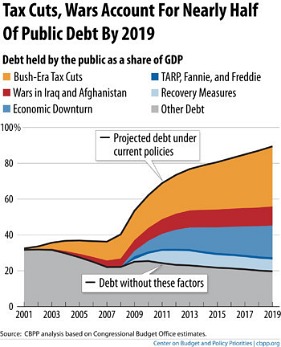
A couple of points I will make, though: The rich pay more taxes here because they get much bigger share of the income pie than their counterparts in Sweden, France, or Germany. And here’s a chart that shows how much of the debt comes from the Bush tax cuts of 2001 and 2003, which were extended for a couple of years by Obama late last year:
The folks on the WSJ edit page are no dummies. They know all this stuff. But spreading disinformation is just fine as long as it serves their larger purpose. And sure enough, the zombie lie is starting to spread.
It’s hit the heartland in a post by Milwaukee Journal-Sentinel columnist Patrick McIlheran, who uncritically parrots the bogus 62 percent number and doesn’t understand the concept of marginal tax rates:
Why is it, Stephen Moore asks in the Wall Street Journal, that Democrats think taking away two-thirds of someone’s income is sustainable policy?…
You can ask why it’s just that two-thirds of someone’s income vanishes, but Moore is practical: Will this help government fund itself?
Human Events spreads it. WSJ sister network Fox News does too, turning Moore’s question into a declarative “Dems Want 62% Top Tax Rate,” as does Moneynews.com and dozens of lesser blogs. CNBC and Larry Kudlow lend a hand:
Hey, throw enough stuff against the wall and something’s going to stick.
Reason No. 5,752 why you should never trust The Wall Street Journal’s editorial pages.


My impression is that the difference is less that other nations have lower tax rates on the rich, but that they have higher taxes across the board - which pay for a larger set of services, most notably national health insurance programs. Wealth inequality aside, if you compared, for example, Canada to the U.S., but included the cost of health insurance and uninsured care as a "tax" on U.S. residents, the "share" paid by the wealthy would drop - not because they got a tax cut but because the contributions credited to the rest of us went up significantly.
#1 Posted by Aaron, CJR on Fri 27 May 2011 at 10:27 PM
(Your website really needs to make the representation, "you may use HTML tags for style", more of a reality.)
#2 Posted by Aaron, CJR on Fri 27 May 2011 at 10:30 PM
Everyone knows the WSJ is a Murdoch organ and discounts the value of its news and editorials accordingly. I use Bloombrrg.
#3 Posted by KurtRex1453, CJR on Fri 27 May 2011 at 11:21 PM
thank you for shining a bright light on the dark right wing disinformation game.
#4 Posted by stevenf, CJR on Sun 29 May 2011 at 03:02 AM
while i appreciated the Zombie illusion, I think the headline counter argument is essential and if I'm understanding correctly, the Clinton Tax rate level is accurate.
so,
Dem's restore tax rate to Clinton years 39%, Republicans make up 62% tax misleading once again.
Republicons can't be trusted, can they?
#5 Posted by stevenf, CJR on Sun 29 May 2011 at 03:10 AM
Does anyone know where Moore got this: "Mr. Obama raised the possibility of eliminating the income ceiling on the Social Security tax"?
#6 Posted by Russell, CJR on Sun 29 May 2011 at 11:56 AM
That's quite rich of CJR to call the WSJ kettle black while relying so heavily on source links to the hackiest of all state-worshiping hacks (Mother Jones, WaPo, the NYT, and the like). Never mind the forest when you have such a sapling to fell. Geez...
#7 Posted by Dan A., CJR on Mon 30 May 2011 at 06:50 AM
Ryan has a selective aversion to sloppy arithmetic.
He is right to call out the WSJ for misrepresenting the math in this editorial, but he had no trouble tolerating David Cay Johnston's miscalculations with regard to the tax burden on the "poor":
http://www.cjr.org/the_audit/banana_republic.php
Specifically, in adopting Johnston's misguided conclusion that the "poor" pay disproportionately more taxes than the "rich", Ryan failed to inform CJR's readers of a few crucial figures missing from Johnston's calculus, namely:
1. Tax credits - specifically the Earned Income Credit - and that when these credits are included, it turns out that the "poor" don't really pay any net taxes; indeed, they receive more money in payments from the federal government than they pay in all forms of taxes.
Johnston (and Ryan) would have the readers consider only the debits, and not the credits, in considering the net burden on taxpayers - clearly as mathematically corrupt a consideration as the one committed by the WSJ.
2. Benefits. Johnston (and Ryan) bemoan the purported "regressive" nature of employment taxes, but make no room in the equation for Social Security or Medicare payments. Why? Because doing so quickly dispels the silly notion that the working "poor" aren't making out in the current tax scheme - the people who pay the most into the system receive the least benefits (as a percentage of their contributions).
When Ryan carries water for the commie/liberal cause, he sees no need to bother his readers with all the numbers, but when it comes to defending the cause, he wants the math done right, by God - every penny accounted for.
CJR readers deserve real journalism - not this kind of sloppy advocacy.
#8 Posted by padikiller, CJR on Mon 30 May 2011 at 12:53 PM
Man life is too good for the poor.
Anyway, I didn't come to respond to padkiller's usual barf, I was going to talk about zombie lies and their enablers.
Such as politifact, yet again.
http://krugman.blogs.nytimes.com/2011/05/29/discretionary-truthiness/
Another half true for republican puke funnel? Classy.
#9 Posted by Thimbles, CJR on Mon 30 May 2011 at 06:23 PM
I posted a largely overlapping fisking of this Moore piece on 5/26, http://bit.ly/mHvf0s . Note one more lie:
Moore gets his single largest jump toward 62% by imagining a "topless" hike in FICA taxes:
"But that's not all. Several weeks ago, Mr. Obama raised the possibility of eliminating the income ceiling on the Social Security tax, now capped at $106,800 of earnings a year. (Never mind that the program was designed to operate as an insurance system, with each individual's payment tied to the benefits paid out at retirement.) Subjecting all wage and salary income to Social Security taxes would add roughly 10.1 percentage points to the top tax rate. This takes the grand total tax rate on each additional dollar earned in America to about 58%. "
Here again, Moore is beating up on a maximalist imagined Democratic position. Both Bowles-Simpson and the BPC plans propose raising the FICA cap to a level at which it would capture the statutorily-set target of subjecting 90% of Americans' earned income to the tax -- which means raising the cap to the range of $180,000--190,000 of earnings per year. At the far left goalpost, the House Progressive Budget proposes to "raise the taxable maximum on the employee side to 90% of earnings and eliminate the taxable maximum on the employer side." That proposal, again, has zero chance of becoming law. And no one is seriously proposing lifting the cap entirely.
#10 Posted by Andrew Sprung, CJR on Tue 31 May 2011 at 02:51 PM
"And no one is seriously proposing lifting the cap entirely."
Obama as a candidate in 2008: http://money.usnews.com/money/blogs/capital-commerce/2008/06/13/obama-plans-a-massive-hike-in-social-security-taxes
I recall reading a similar proposal from Obama in either late 2009 or 2010. With a Republican House, it's not going to happen. However, if Democrats take back the House and make similar Senate gains to what Republicans did in 2010, it would be in play again.
Incidentally, to get back to the article, the top marginal tax rate in 1988 was not 28% but 33%. The confusing part is that the rate on the highest income was 28%. The 33% was on people who were above the 15% bracket and below the 28% bracket. The Bush compromise of 1990 decreased this to 31% while increasing the top rate to 31%.
Another neat factoid: if you added 15% (marginal tax rate) to 15.3% (employer and individual shares of the social security and Medicare taxes) and divided by 1.0765 (to adjust the base to include the employer's share of payroll taxes), the rate was approximately 28%. Thus the 1986 deal created something that was almost a flat tax. The weaknesses were the 33% rate and that people might pay payroll taxes on income in the 33% and 28% brackets.
#11 Posted by Matt, CJR on Tue 31 May 2011 at 04:10 PM
If only the Dems' proposals really were for a 68 percent max marginal rate. That would put us back near Nixon territory, tax rates wise.
Hey, Patty, if you add in EITC for the poor, you then need to factor in subsidies for the richest 1 percent as well. Mr. David Cay Johnston has done this, at book length, and the results are not supportive of your position. Facts are stupid things, Mac.
#12 Posted by Edward Ericson Jr., CJR on Tue 31 May 2011 at 04:32 PM
Matt, in your linked article, Obama's exact words are "adjust the cap." Nowhere does he suggest eliminating the cap, breathless pundits notwithstanding.
#13 Posted by Your Name, CJR on Tue 31 May 2011 at 05:49 PM
Edward Ericson, Jr. wrote: Hey, Patty, if you add in EITC for the poor, you then need to factor in subsidies for the richest 1 percent as well. Mr. David Cay Johnston has done this, at book length, and the results are not supportive of your position
padikiller responds: Thank you for reinforcing my point, Edward.
Johnston includes tax credits for the "rich" in his calculus, but ignores the tax credits for the working "poor". He also includes the payment of employment taxes into the Treasury, but ignores they payment of benefits from the Treasury in the form of SSI, Social Security retirement, Social Security disability, Medicare, Medicaid, S/CHIP, Food Stamps (up 39% since Obama took office), etc, etc, etc, etc....
Commie/liberal arithmetic sleight of hand that our resident "watchdog" Ryan should have exposed to his readers, and would have, were he interested in journalism instead of advocacy.
The simple, undeniable fact of the matter is that once the Earned Income Credit is included into the math.... The working "poor" receive more money from the U.S. Treasury than they pay into it... PERIOD. Once you figure benefits into the equation, the "poor" are shown to be cashing in from Uncle Sam to the tune of thousands of dollars per year, on average.
This is just the R-E-A-L-I-T-Y.
And CJR readers deserve to know of its existence.
#14 Posted by padikiller, CJR on Tue 31 May 2011 at 07:15 PM
Why "poor" in quotation marks, Padi?
#15 Posted by Nancy Irving, CJR on Wed 1 Jun 2011 at 02:31 AM
Excellent article, not that it will have the slightest effect on the crowd the WJS editorial board caters to.
But, please, please don't repeat the false meme that Obama extended the Bush tax cuts. We have enough problems in this country from being president-centric and from not comprehending the constitutional process of enacting legislation, and the political realities of that process. Careless references might not be as destructive as Stephen Moore's outright lies, but they also sully public discourse.
#16 Posted by Fred Brack, CJR on Wed 1 Jun 2011 at 03:06 AM
@ Nancy Irving - I have placed "poor" and "rich" in quotation marks because these terms are undefined and so are used fluidly (and thus routinely abused) in argument. In reality it is nearly impossible to be truly "poor" in America - if one qualifies for SSI (spending money, courtesy of working Americans) then one automatically qualifies for food stamps, section 8 housing, Medicaid, utility assistance, etc.
When the biggest medical problem facing the American "poor" is obesity, it can't seriously be claimed that the "poor" of our present society resemble the truly poor people elsewhere in the world.
@Fred Brack - If Obama didn't extend the "Bush tax cuts" (which should now properly be referred to as the "Obama tax cuts") then who did?
The extension only became law after Obama put ink on the paper - and Obama was the man who drove the deal not only to extend the tax cuts, but also to lower employment taxes.
#17 Posted by padikiller, CJR on Wed 1 Jun 2011 at 07:22 AM
Padkiller nailed it … using misleading statistics to make an argument is bad when it’s the WSJ editorial page and “brilliant” when done by David Cay Johnson.
#18 Posted by Mike H, CJR on Wed 1 Jun 2011 at 12:55 PM
"Why "poor" in quotation marks, "
Because Padi is a "retard". If you're looking for a deeper answer than that, believe me - there isn't one.
#19 Posted by Thimbles, CJR on Thu 2 Jun 2011 at 10:37 AM
Speaking of zombies and playing loose with budget numbers … how does the CBPP come up with the figures it used in generating its graph? The report that the graph is hyperlinked to matches very closely with CBO’s 10 year projection but the CBO bases its projections, in part, off of current tax law and takes into account the legislated expiration of certian aspects of it. Currently, the Bush tax cuts are set to expire in 2013 (as they were only given a temporary extension) and this assumption is what the CBO based its 10 year budgetary outlook off of. How can the CBPP come up with a 10 year forecast that nearly identical to the CBO’s when they used two drastically different interpretations?
#20 Posted by Mike H, CJR on Thu 2 Jun 2011 at 12:49 PM
What has been disappointing has been how the fact checking sites have reviewed claims such as Paul Ryan's claims. Marginal Income Tax rates are just that. Medicare Taxes may increase the effect on top rate earners but unless you compare apples to apples against all income categories for marginal rates both for payroll taxes and income taxes you are not giving the public an accurate portrayal. Also, the elimination of deductions qualifications are not increases to margtinal rates, they are simply what they are-- a limit of the ability to adjust your taxable income downward, they are NOT a surcharge.
#21 Posted by Ecletic Observer, CJR on Thu 2 Jun 2011 at 01:42 PM
"For Moore’s headline purposes he includes state taxes to get to 62 percent, but when he compare it to rates under Reagan, he doesn’t include state taxes."
Yes, he does, "After the landmark Tax Reform Act of 1986, which closed special-interest loopholes in exchange for top marginal rates of 28%, the highest combined federal-state marginal tax rate was about 33%"
#22 Posted by Tina Bollman, CJR on Sat 3 Mar 2012 at 03:05 PM
