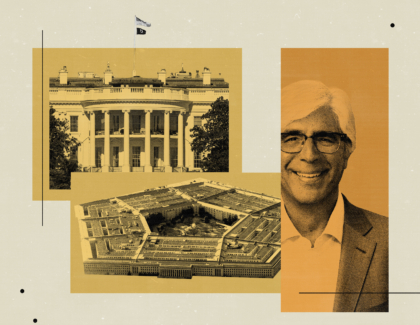
Bloomberg this morning posts a really good profile of Elizabeth Warren, who, despite much of the press’s dismissal of her earlier this year, has become one of the most influential people in Washington. Her Consumer Financial Protection Agency is very likely to become law soon, and it’s quite possible she could be picked to head it.
This has the once all-powerful, now just all-but-all-powerful banking industry sputtering:
If Congress creates the watchdog, the director should have “a working knowledge of how financial institutions operate,” said Scott Talbott, the financial roundtable’s chief lobbyist.
Translation: The industry wants somebody it can regulatory-capture. You know, like I said yesterday about Josh Tyrangiel taking over at BusinessWeek, Someone who’s not been schooled (and blinkered) in “this is how it’s done” is more likely to see problems in how it’s done. Warren infuriates the press’s Church of the Savvy, as Jay Rosen calls it, that says “you can’t do that”—play between the 40 yard lines.
Bloomberg doesn’t buy into that and I’ve seen a loosening in the derision of the press toward Warren as it’s become clear how influential she has been—remember that Bloomberg story recently opening with President Obama asking if Larry Summers and Tim Geithner had read Warren? Bloomberg adds here that she pow-wows with Barney Frank, head of the key House Financial Services Committee, twice a week on the CFPA legislation.
There’s some really sweet color in this story, too. Warren, like me, is an Okie, so in her Wall Street internship “At first, she said she thought she was being made fun of as a rookie from the sticks” (I can sympathize):
“I got out my little notebook, and the senior partner started talking about frozen pork belly futures,” Warren said, recalling an early meeting. “How dumb do they think I am? I wasn’t going to fall for it because I am a sophisticated person. It finally occurs to me that he is serious, and that there is a market for pork bellies.”
Reporters Mark Pittman and Bob Ivry correctly use the term “populism,” unlike so many others in the press, in referring to Warren’s ideas. Basically, it’s prioritizing the interests of the vast majority of the population, left and right—“We were out in Colorado at a hearing for rural finance and people came up to her,” Silvers said. “That wasn’t exactly Obama country out there, if you know what I mean”—over the narrower interests of the entrenched elite. Also: common sense.
For instance:
“Credit cards are like snakes: Handle ‘em long enough and one will bite you,” she said. “You have to remember what are incomes to banks are outgoes to families.”
Or:
“I made a decision at the beginning that the experts wrecked this economy and the public has a right to know what’s going on,” she said. “It’s our economy on the line and the experts can’t be trusted. I want everyone to be part of the solution to how we want to change our economic world. If it’s risky or makes me look stupid to someone, so be it.”
And you just have to step back and admire this:
Warren, who graduated from high school at 16 and said she prefers Coors Light beer over iced tea.
God, I love this woman! I'm retired and semi-handicapped, so I watch a lot of cspan, and I've seen her testify or take part on panels a number of times, and her intelligence and earnestness shine. I say let her and Sheila Baer run the economy and let Larry and Tim go back home!
#1 Posted by Carol Harper, CJR on Thu 19 Nov 2009 at 09:54 PM
Seconded.
And Thirded:
http://trueslant.com/matttaibbi/2009/10/22/elizabeth-warren-for-president/
Though I would also accept a Warren/Brookelsy Born ticket.
http://www.pbs.org/wgbh/pages/frontline/warning/
#2 Posted by Thimbles, CJR on Thu 19 Nov 2009 at 11:02 PM
This report from Frontline
http://www.pbs.org/wgbh/pages/frontline/creditcards/?utm_campaign=homepage&utm_medium=proglist&utm_source=proglist
sets up quite a good argument for the proposed financial products consumer protection agency. It covers much of the unregulated sides of the industry such as the use of universal default by credit card companies, debit overdraft charges, and payday loan outfits (who come off looking good by comparison to the credit sharks because they are upfront about what they do. There's no mystery as to how they make money off of you). They touch upon the difficulty in regulating the financial players since their lobbying teams are all star. Joe Nocera makes the interesting point about how there is a central conflict in the missions of the current bank regulators in that they're charged with protecting the consumer and yet they are also supposed to ensure the strength and soundness of the banking system, and the banking system gets stronger and sounder when it gouges its customers for revenue.
Some of the program is review from the classic frontline "The Secret History of the Credit Card" and I think they either relied on Geithner's storytelling too much, or the way he's been characterized in the reports I've read are incorrect. He claims to be fighting against all these other regulators for Warren's protection agency, and a times reporter vouched for his story, but I doubt it based on what I've read of the guy. I don't think his lunches with Pete Peterson would be going smooth if he decided to 'be a liberal and interfere with things that are none of their business' (paraphrased quote from the father of the debit card. Some of these guys on tape did themselves no favors.)
Couple of thoughts about the program. It's interesting how much these guys talk about free markets where the consumer and vendors are fully open and transparent with each other and transactions take place efficiently and competitively (like the payday loan guy featured in the program), and how much these guys rely on information asymmetry to generate revenue. Customers are always getting hit with surprise fees instead of upfront ones because there's an industry pressure to be sleazy. These vendors can compete, even dominate, with a worse product for the consumer because they can market it as a product with free features (such as checking) while they control the information of what you've spent and the order of how your transactions are processed. Their profits are rooted in your unawareness of what your transactions are doing to you.
The other thing that comes to mind is that there is few, if any, pro-consumer financial products company. You would think that when so many banks are offering shoddy service and dirty trick product marketing, one company would take advantage of the consumer resentment and forge a business model that put the consumer first. That's how the free market is supposed to work, but how it actually works is that when one bank gets away with a profitable anti-consumer activity, all banks emulate it. Why is that?
Perhaps it's because financial relationships in the US are not two party, vendor - client relationships. There is always the third party to consider, the shareholder/investment professional. The interests of a vendor-client bank are served when the bank offers products to increase market share and maintain profitability. In vendor-client-shareholder relationship the vendor has to pick its preferred interests because the shareholder is pleased when profit margins are high (which is indicative of a consumer gouge) and consumer is pleased when the profit margins are low (which could be indicative of consumer value). The investment professional will make recommendations to buy or sell a bank, to raise or lower its credit rating, based on p
#3 Posted by Thimbles, CJR on Wed 2 Dec 2009 at 02:32 PM
For all those who are fans of Eliot Spitzer's good side
http://www.cjr.org/the_audit/spitzers_ghost.php
Here's an interesting interview with the former governor of New York and now Slate columnist:
http://www.democracynow.org/2009/12/4/eliot_spitzer_geithner_bernanke_complicit_in
AMY GOODMAN: Well, why don’t you start off by talking about how you think President Obama has handled the economy, the bailout? And you can’t speak in sound bites.
ELIOT SPITZER: Alright, no sound bites on this show, which is good news. And thank you for inviting me.
Thimble note* This is one thing I like about Democracy Now. It's not Hardball bickering, it's informative people allowed to speak on informative subjects. Rachel Maddow does this too to a lesser extent and it's a pleasure to watch.
/Thimble note*
ELIOT SPITZER: Let me begin by saying that I think Senator Sanders was wrong in only one respect: it wasn’t that the Fed was asleep at the switch; they were actually complicit. And by that, what I mean is that the Chairman, Ben Bernanke, and Tim Geithner, when he was the president of the New York Fed, actually built and participated in creating the structure that now has collapsed. And that, I think, is what is so problematic to so many of us. They are now claiming credit for having taken trillions of our tax dollars and given those dollars back to the banks to return them to solvency, when the initial bankruptcy and the initial illiquidity and the initial crisis was very much a consequence of the very policies they put in place...
AIG was, to a great extent—their financial products division—a Ponzi scheme supposedly guaranteeing hundreds of billions of dollars of CDS collateral, credit default swaps, with no collateral behind it. That is part of what brought us down.
But that is the system that the Fed was overseeing. They specifically rejected the effort back in ’94, ’95 to regulate this swamp. The derivatives, that are a quintessential Wall Street creation, have some small utility at an economic level, but became an enormous revenue stream for banks, and they were unregulated. People made a fortune. We taxpayers hold the bag.
Now, the money, put in perspective, the $12.9 billion, a small piece of the whole bailout—Arne Duncan, our Secretary of Education, has $4 billion to redo all of K-through-12, and everybody’s saying, “Isn’t this great? Four billion dollars.” Goldman Sachs got $12.9 [billion]. Eight billion dollars for high-speed rail. Entire high-speed rail stimulus effort, $8 billion. Goldman Sachs got $12.9 [billion]. So what are the priorities, in terms of infrastructure investment, job creation, building the foundation of an economy that will permit us to be competitive so that real Americans can get jobs, not just investment bankers and lawyers?...
Chairman Bernanke said yesterday; he said, the problem is the banks aren’t lending. Wait a minute. He’s the one who gave the banks all the money. And I kept saying to Geithner and Bernanke, “Negotiate.”
They don’t know how to ask anything back in return for giving the banks all this liquidity. Why was it not a precondition of their being bailed out that they lend? Why was it not a precondition that they reform mortgages? In other words, so many consumers are still underwater, their houses worth less than the mortgage. Why not go to the banks and say, “You must reduce the face value of mortgages by x percent. We’re giving you trillions of dollars, not only cash, but the hidden subsidy that people don’t focus on”?
When credit is at zero percent, banks borrow at zero. They can buy T-bills at three percent and make a huge sum of money. And they’re doing
#4 Posted by Thimbles, CJR on Mon 7 Dec 2009 at 10:17 AM
From the lady herself
http://www.huffingtonpost.com/elizabeth-warren/america-without-a-middle_b_377829.html
Families today spend less than they did a generation ago on food, clothing, furniture, appliances, and other flexible purchases -- but it hasn't been enough to save them. Today's families have spent all their income, have spent all their savings, and have gone into debt to pay for college, to cover serious medical problems, and just to stay afloat a little while longer.
Through it all, families never asked for a handout from anyone, especially Washington. They were left to go on their own, working harder, squeezing nickels, and taking care of themselves. But their economic boats have been taking on water for years, and now the crisis has swamped millions of middle class families.
The contrast with the big banks could not be sharper. While the middle class has been caught in an economic vise, the financial industry that was supposed to serve them has prospered at their expense. Consumer banking -- selling debt to middle class families -- has been a gold mine. Boring banking has given way to creative banking, and the industry has generated tens of billions of dollars annually in fees made possible by deceptive and dangerous terms buried in the fine print of opaque, incomprehensible, and largely unregulated contracts.
And when various forms of this creative banking triggered economic crisis, the banks went to Washington for a handout. All the while, top executives kept their jobs and retained their bonuses. Even though the tax dollars that supported the bailout came largely from middle class families -- from people already working hard to make ends meet -- the beneficiaries of those tax dollars are now lobbying Congress to preserve the rules that had let those huge banks feast off the middle class.
Pundits talk about "populist rage" as a way to trivialize the anger and fear coursing through the middle class. But they have it wrong. Families understand with crystalline clarity that the rules they have played by are not the same rules that govern Wall Street. They understand that no American family is "too big to fail." They recognize that business models have shifted and that big banks are pulling out all the stops to squeeze families and boost revenues. They understand that their economic security is under assault and that leaving consumer debt effectively unregulated does not work.
Families are ready for change. According to polls, large majorities of Americans have welcomed the Obama Administration's proposal for a new Consumer Financial Protection Agency (CFPA). The CFPA would be answerable to consumers -- not to banks and not to Wall Street. The agency would have the power to end tricks-and-traps pricing and to start leveling the playing field so that consumers have the tools they need to compare prices and manage their money. The response of the big banks has been to swing into action against the Agency, fighting with all their lobbying might to keep business-as-usual. They are pulling out all the stops to kill the agency before it is born. And if those practices crush millions more families, who cares -- so long as the profits stay high and the bonuses keep coming.
America today has plenty of rich and super-rich. But it has far more families who did all the right things, but who still have no real security.
#5 Posted by Thimbles, CJR on Mon 7 Dec 2009 at 02:50 PM
Does the Consumer Financial Protection Agency (CFPA)have an email address or phone number yet?
#6 Posted by Kim Skrinak, CJR on Tue 28 Sep 2010 at 08:57 AM