Sign up for the daily CJR newsletter.
The Securities and Exchange Commission sued a Canadian drug maker this week—and in the process blew apart the premise of a two-year-old 60 Minutes investigative piece on short sellers.
The March 2006 segment by Lesley Stahl sought to warn viewers about hedge funds that use bad information to drive down stock prices to benefit themselves at small investors’ expense.
To make its point, 60 Minutes focused on a lawsuit brought by Biovail Corp., of Toronto, which accused the big hedge-fund SAC Capital, of Stamford, Connecticut, and a stock-research firm of conspiring to spread bogus information about the company.
As the 60 Minutes announcer said:
If you have money in a retirement account or a pension fund, pay attention, because, as correspondent Lesley Stahl reports, hedge funds have become a major force in the market. When they make a move or “take a position,” as they say, it can affect your bottom line.
In this case, one of the largest companies in Canada is claiming that the hedge fund SAC was trying to make a killing by killing the company.
On Monday, though, the SEC sued not the targets of the 60 Minutes piece, but Biovail itself and two of its executives, alleging accounting fraud and other wrongdoing. The SEC said the drug maker “repeatedly overstated earnings and hid losses in order to deceive investors” and “actively misled investors and analysts about the reasons for the company’s poor performance.”
Biovail settled the case and agreed to pay $10 million in penalties without admitting or denying the allegations.
The SEC charges against Biovail effectively torpedo the Stahl piece, which was devoted to airing the drug maker’s allegations that the stock-research firm, a predecessor of Gradient Analytics, concocted phony research to please SAC, a client.
In fact, the danger to investors was Biovail. So, 60 Minutes had it exactly wrong. But it’s worse than that: Biovail had been under SEC investigation since 2003. So it was clear at the time that Biovail was probably not a good example of a public company victimized by shorts. In fact, it was more likely that the Biovail example would prove the value of shorts, as it has.
The 60 Minutes segment acknowledged that its alleged victim was under investigation, but buried the information artfully in the middle of a denial of wrongdoing by the hedge fund.
Here it is. The emphasis is mine:
The hedge fund SAC denies all the charges in Biovail’s lawsuit and says that the decline in the company’s stock was due to earnings shortfalls and investigations by authorities, including the Securities and Exchange Commission, “not any conspiracy.”
Confused? I think you’re supposed to be.
This is not a detail. The ongoing SEC probe of Biovail called into question—from the start—the main pillar supporting the 60 Minutes story about supposedly rogue hedge funds.
The network had good reason to believe that the bad apple in its piece was Biovail, but went forward anyway.
A spokeswoman for Stahl said she was too busy to respond to questions from
CJR. A spokesman for 60 Minutes said in an email:
Biovail’s settlement of these SEC charges does not change our story, which was about how giant, unregulated hedge funds can leverage their power in the stock market.”
A spokesman for Biovail says the company continues to pursue its claims against SAC and Gradient.
An SAC spokesman declined to comment.
Gradient, for its part, issued a triumphant press release:
The SEC’s complaint confirms the validity of Gradient’s critical analysis of Biovail but raises serious questions about how companies retaliate against analysts with threats, intimidation, and lawsuits.
The Scottsdale, Arizona, company noted that the chief of the SEC’s New York office, Mark Schonfeld, credited analysts who raised questions about Biovail.
“Part of the credit does go to people who were asking a lot of questions and were rightfully skeptical when the company was making representations that just didn’t quite make sense,” said Schonfeld in a CNBC interview.
The 60 Minutes saga is as part of a long-running and venomous fight pitting a few, mostly smaller, public companies on one side and short sellers, research firms and financial journalists on the other. The companies contend that shorts routinely manipulate markets using unethical stock-research firms and financial journalists, who the companies claim are incompetent or worse.
The piece featured an interview with the Biovail chief executive:
“When you’ve got these companies, these people out there trying to bring you down, we’re lucky we survived,” says Eugene Melnyk, the CEO of Biovail, the Canadian pharmaceutical company that’s suing the hedge fund SAC, and others.
“There’s a group of people that got together and essentially attacked the company by putting out false reports,” says Melnyk. “And we’re just fighting back for our shareholders.”
“Is your allegation that SAC made up a lot of this stuff in order to depress the stock so they could sell it short?” Stahl asked.
“That’s what’s alleged in the complaint,” he replied.
The piece includes interviews with ex-Gradient employees, one of whom calls the research firm a “shop for hire.” Another ex-employee alleges that Gradient analysts took down SAC’s allegations against Biovail like “dictation.”
Of Gradient’s work, the piece says:
The report was replete with comments like this: “history of unusual … aggressive accounting;” “earnings overstated;” “severely negative free-cash flow.”
Of course, it turns out, Gradient was right.
The segment included interviews with former Gradient employees Demitri Anifantis and Darryl Smith, who bring in the media:
“Did the Biovail report go to anybody outside of your client circle?” Stahl asked Anifantis.
“Yes, media. A lot of media outlets had access to the service as well,” he replied.
“So, in other words, Camelback was trying to generate this publicity… that further helped SAC,” Stahl asked.
“Sure, sure,” Smith said.
The Stahl piece rankled many financial journalists who found it deeply ignorant, particularly for the way it characterized short sellers—who are a vital counterpoint to the Wall Street hype machine—as somehow bad by definition. Reporters also felt the story tarred by implication the journalists who use them as sources.
Indeed, the 60 Minutes piece was doubly frustrating because the work of exposing corporate frauds is already difficult and thankless enough.
Joe Nocera of The New York Times nicely summed up this sentiment a few days after the broadcast:
The silliest idea embedded in both the Biovail lawsuit and the 60 Minutes segment is that because an analyst, a short seller, a research firm, and even a reporter are talking with one another—and perhaps even collaborating—that they are somehow engaged in stock manipulation. This is what people do in markets all the time, on the long and short sides. When you have a big position in a stock, you want to persuade others to your point of view. You make your case in phone calls, or at conferences, or over drinks. You try to get reporters to write articles reflecting your views. If you can get others to agree with you, and either buy or sell because they are persuaded by your logic, that is good for both you and the market.
In some ways, the process is even more important for a short seller because his point of view is invariably a minority one. In early 2001, when the short seller James Chanos became convinced that there was something amiss at Enron, he didn’t keep that information to himself. He spoke to Bethany McLean, the Fortune reporter who then wrote her famous story, “Is Enron Overpriced?” And he presented his views about Enron at his annual Bears in Hibernation conference. One of those attending was Mark Roberts, a newsletter writer who then wrote a tough report on Enron. According to a witness in the Enron trial, that is the report that caused Jeffrey K. Skilling, the chief executive, to exclaim, “They’re on to us.”
The short-versus-public-company fracas peaked in May 2006, a few months after the Stahl piece. The SEC, which was probing Gradient because of the corporate complaints, subpoenaed three financial reporters—Herb Greenberg of Marketwatch, Jim Cramer of TheStreet.com (and CNBC’s Mad Money show) and Carol Remond of Dow Jones Newswires—sparking an uproar. Journalists and their supporters argued that SEC probe infringed on reporters’ First Amendment rights and chilled tough reporting.
The SEC later dropped the subpoenas and backed away from the idea of subpoenaing reporters altogether.
The SEC dropped its Gradient probe last year.
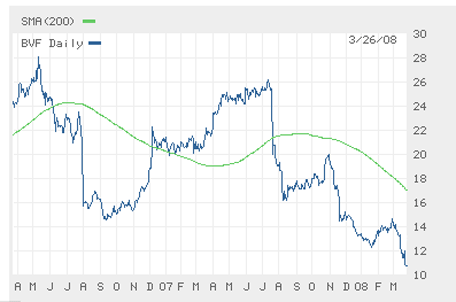
As it turns out, SAC and Gradient were doing investors a favor. Biovail traded around $24 a share when the Stahl piece ran. Now’s it under $11, a drop of 55 percent, including nine percent on news of the SEC settlement. Dow Jones provides this two-year chart:
One can only hope 60 Minutes viewers listened to the shorts and not 60 Minutes.
But the ongoing SEC probe of Biovail was always going to be a time bomb under this story.
This week, it blew up.
Has America ever needed a media defender more than now? Help us by joining CJR today.