Martin Peers had a smart Heard on the Street in yesterday’s Wall Street Journal on the critical question of how much of the recent plunge in media companies’ fortunes has been a cyclical decline versus a secular one.
It’s obviously some of both, but the mix will decide what the next five years look like for magazines and newspapers, the critical providers of original reporting in the country. Alas, I’ve crunched some numbers on the industry and they’re beyond ugly.
First, some definitions. A cyclical decline is one due to the inevitable ups and downs of the broad economy. Most businesses get hurt in the recession part of a cycle but do well in the expansionary part and their fortunes more or less move up or down with the economy at large.
But structural changes in the economy or a specific industry can result in secular changes for a business. Think for instance, the classified-ads business of newspapers, which has been walloped by eBay and craigslist (with a final indignity provided by the cyclical collapse of the housing bubble). Most of those revenues aren’t coming back. That’s a secular decline.
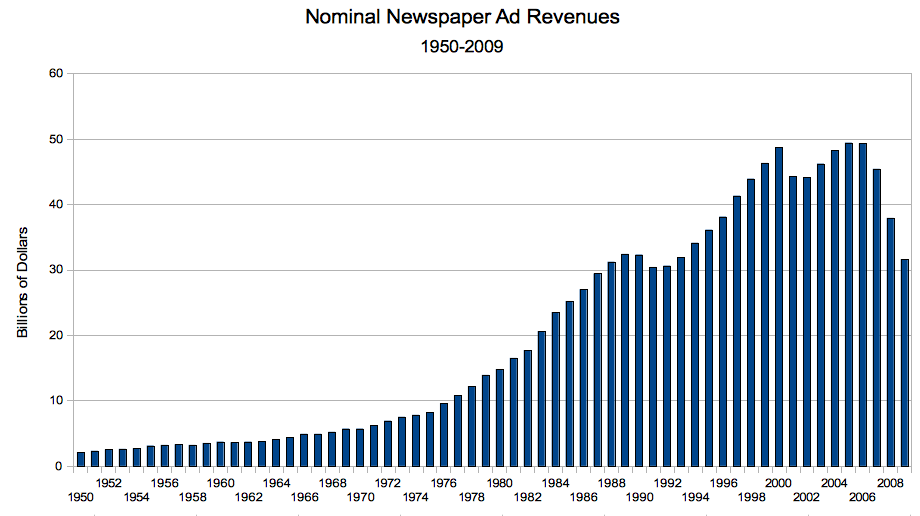
Overall daily newspaper-industry ad revenue just flat-out crashed last year, plunging 16.7 percent to $37.8 billion from $45.4 billion in 2007, which itself was a bad year with ads down 7.9 percent from $49.3 billion in 2006.
It gets worse. So far 2009 has been more dismal than 2008. Alan Mutter predicted in January that newspaper revenue would tumble 17.3 percent this year to $31.6 billion, or just below 1993 levels. If anything, his numbers may be optimistic. Several major newspaper companies have reported declines of about 30 percent so far this year.
But even that $31.6 billion understates just how awful the numbers are. Remember $31.6 billion in 1993 bought a whole heckuva lot more than $31.6 billion does today—49 percent more to be exact.
So I went back through the Newspaper Association of America’s data on newspaper-industry revenue, which goes back to 1950, to see what year we’re actually even with now. It’s ugly: You have to go back to 1965 to find a year with revenue lower in 2009 dollars than what this year is projected to be. That year, the industry took in $4.42 billion, which works out to $30.22 billion in current dollars. The industry can only hope this year hits 1966 levels, which work out to $32.4 billion in real dollars. (A caveat: there are fewer papers now than there were in 1965 and production is more efficient.)
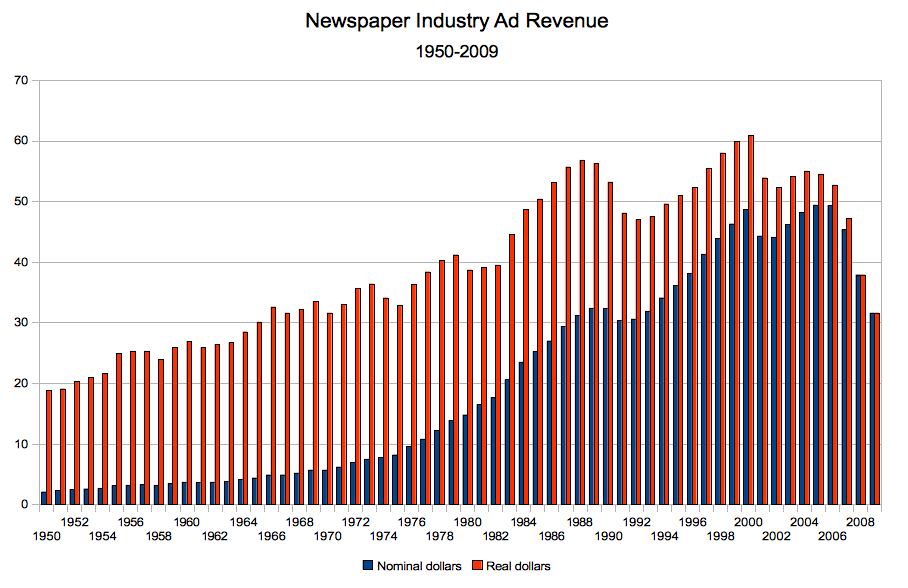
Here’s a chart I cobbled together that illustrates the disparity between nominal and real (inflation-adjusted) numbers. Note: the 2009 number is Mutter’s $31.6 billion estimate. Click the chart for a bigger image:
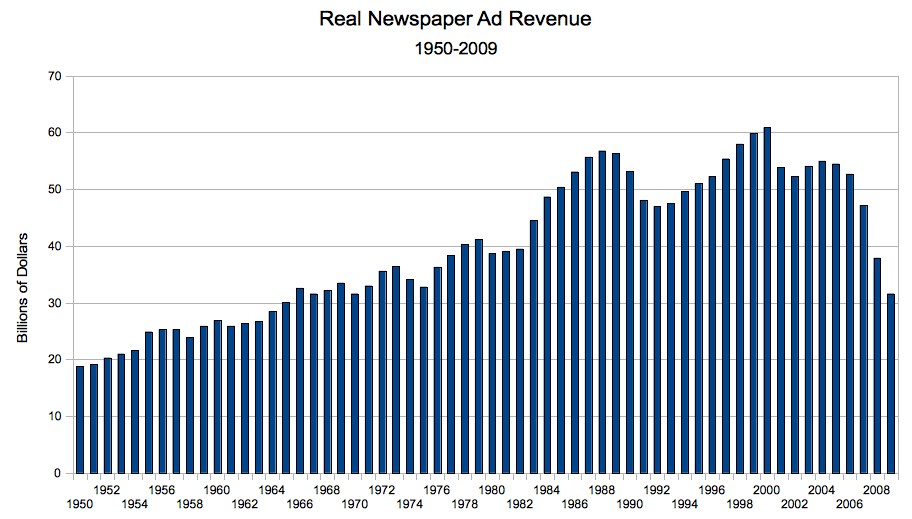
What stands out immediately to me looking at real dollars (which are all that really matter), is that the peak of the last recovery, in 2004, with $55 billion, never got close to the peak of the previous recovery, 2000—when real ad revenues hit $60.9 billion. To make matters worse, the 2002-2004 recovery never reached the peak of two recoveries ago, in 1988, when real ad dollars hit $56.8 billion. Recall, this year ads are projected at just $31.6 billion—if they’re lucky—a 44 percent decline from twenty-one years ago.
That folks, is secular decline, and the vast majority of those dollars are not coming back.
You’ll see, as well, if you trace a line across the chart, that the last time ad revenues were lower than the estimated 2009 total was forty-four years ago (they tied it in the recession of 1970), when they were $30.1 billion.
This is the state of the business today. One recent study by Borrell Associates (see chart below) predicts that newspaper ads have hit bottom and will edge up in the next few years. That would be great, but nobody can predict a bottom in any market, especially one with as many unknowns as the newspaper industry—and in an economy as uncertain as this one.

- 1
- 2

Mr. Chittum:
You say, "...the classified-ads business of newspapers, which has been walloped by eBay and craigslist..."
It would be terrific if you could point us to any data showing how many classified dollars moved from newspapers to eBay and Craigslist. So far, it seems you and many others are driving this urban myth. Clearly, classifieds are down in revenue and lines, but that may or may not have anything to do with the companies you mention. Take a look at http://www.cjr.org/short_takes/craigslist_straw_man_1.php
-tj
#1 Posted by Tom Johnson, CJR on Wed 19 Aug 2009 at 08:57 PM
It gets worse, actually, if you examine the share of total advertising dollars garnered by newspapers. Newspapers are back to 1965 in real ad dollars, but other media like TV, Cable and Internet have grown since that time.
I've posted a graph of newspaper share of market through 2008:
http://1.bp.blogspot.com/_yYPmb23CO4w/SWLBrDNcIlI/AAAAAAAAABs/CftcOgU4LjU/s1600-h/MediaShare.png
(related post: http://newsafternewspapers.blogspot.com/2009/01/can-news-sites-get-their-slice-of.html )
On this basis, newspapers in 2008 were at about half the market share they had in 1965.
#2 Posted by Martin Langeveld, CJR on Wed 19 Aug 2009 at 09:05 PM
You say, "...the classified-ads business of newspapers, which has been walloped by eBay and craigslist..."
... So far, it seems you and many others are driving this urban myth.
It's not an urban myth - it is a reality. People are using the internet to search for items they want and or need. Classifieds are useful but not as significant when we now have the ability to post photos/videos to sell something faster, makes much better sense to me. We have the ability to post cars, houses, items for sale on the internet without having to go to the newspaper classifieds any longer. Its not just eBay and craigslist...what about Cars.com, Homefinder.com and Sawbuck.com.
#3 Posted by Ashley D, CJR on Thu 20 Aug 2009 at 10:01 AM
I am the managing editor of a small newspaper in Colorado. In 2006 we actually had businesses on a waiting list for up to 5 months waiting for space to advertise in our paper. We didn't have to go out and solicit for a single display or classified ad. Since 2007, there has been a sharp decline in both with many clients forced to close businesses and therefore pull advertising or having to cut way back on the size and/or frequency of their ads. Some advertisers stopped their ads only to come back months later saying they couldn't really afford it, but they had to re-establish their visibility through advertising because their business was down. I've held ad rates steady for three years and am now in the position of determining how to structure rates for 2010. We have to maintain our bottom line, but at what cost (literally)?
#4 Posted by Mary H, CJR on Thu 20 Aug 2009 at 12:30 PM
presupposing that ad revenue will return is a fool's errand. that "yin and yang" relationship is over and somebody will have come up with a new model.
#5 Posted by brian w, CJR on Thu 20 Aug 2009 at 01:08 PM
presupposing that ad revenue will return is a fool's errand. that "yin and yang" relationship is over and somebody will have come up with a new model.
#6 Posted by brian w, CJR on Thu 20 Aug 2009 at 01:09 PM
presupposing that ad revenue will return is a fool's errand. that "yin and yang" relationship is over and somebody will have come up with a new model.
#7 Posted by brian w, CJR on Thu 20 Aug 2009 at 01:10 PM
stupid captchas. sorry that posted three times
#8 Posted by brian, CJR on Thu 20 Aug 2009 at 01:17 PM
How does this comparison deal with the demise of so many 2nd newspapers in major markets through the years?
Does it assume all ad revenues should have rolled into the remaining daily?
Or not?
#9 Posted by Jeanne Devlin, CJR on Thu 20 Aug 2009 at 02:55 PM
Brian W: It's not CAPTCHA that is stupid. It didn't post 3 times by itself!
#10 Posted by David B., CJR on Thu 20 Aug 2009 at 03:32 PM
Lots of moving parts here, but always start with the simplest case first. Now go back to 1950 -- or 60 -- or 70 -- or even 80, and search a few newspaper microfilm files. Make note of the great retailing names that aren't any long in existence. Hudson's ... Dayton's ... F&R Lazarus ... Bamberger's ... A&S ... create your own list of the honored dead. Thirty years ago all these names, and a couple score others, were alive and well. What's more, they were expanding into each other's territory, triggering big advertising expenditures. As I used to tell people, Everyone's in everyone else's back yard ... and pocket book.
#11 Posted by Lee Templeton, CJR on Thu 20 Aug 2009 at 04:54 PM
Mr. Johnson is certainly welcome to believe that Craigslist's effect on newspaper classifieds is an "urban myth." But let us look at the facts:
Craigslist was founded in 1995. Three years later, newspaper classifieds reached their historical peak -- 40.7 percent -- as a percentage of all newspaper revenue. I calculated the percentage using non-inflation-adjusted numbers from the National Association of Newspapers.
If Alan Mutter's projections hold true for 2009, classified's percentage will have fallen to about 22 percent -- roughly half what it was 11 years ago. In fact, Alan's 2009 Q1 projection of $1.7 billion for classifieds turned out to be optimistic. The actual NAA-reported number was $1.6 billion, a record-smashing 42 percent drop from the first quarter of Q1 of 2008.
"Secular" change doesn't quite capture the spirit. A phrase including "Jesus" might be more appropriate.
As newspaper classified penetration plummets, Craigslist rules the roost. Just this week comScore released its monthly rankings that show Craigslist's 47 million unique visitors in July conducted 673 million searches -- up 8 percent from the month before.
If you don't believe the numbers, just ask your family, friends and neighbors. Heck, ask the people who work at your local newspaper where they advertise. They'll whisper the answer in your ear -- and I can pretty much guarantee it won't be the name of their employer.
The bottom line: It's a waste of time debating whether Cragslist did or didn't damage newspapers. Time is better spent acknowledging a future without significant classifieds and devising the revenue sources that will replace them.
#12 Posted by Steve Woodward, CJR on Thu 20 Aug 2009 at 05:42 PM
I work for a chain of weekly papers in Virginia. Our focus has always been local, local and we don't carry AP or other national newswire services. The communities that we serve are primarily rural but we are also in close proximity to Washington, D.C. so, there are times, when our local news is national news.
Certainly the national dailies are taking a hit but what's the sense out there about the prognosis for smaller, local papers. We have many loyal readers and while ad revenue has declined we haven't seen a big movement on the part of advertisers to flock to online advertising. Thoughts?
#13 Posted by Anita Sherman, CJR on Thu 20 Aug 2009 at 11:27 PM
Newspapers aren't just newspapers...they are a diversified portfolio delivering audience. Newspaper.coms in most markets are at the top of the food chain in local page views and uniques. Very powerful digital plays with in the local market. This about delivering audience. Delivering new audiences, younger audiences and more affluent audiences will pay big dividends.
#14 Posted by Joe Sollaccio, CJR on Fri 21 Aug 2009 at 09:02 AM
Craig's List and Ebay certainly steal a lot of consumer-to-consumer ads classified ads. But don't forget that Monster.com and specialized help-wanted sites now get all the help-wanted advertising. Zillow and realtor's own sites get the home ads. Edmonds and Cars.com get the auto dealer ads. And who does personal ads on paper anymore?
Some of the sites even charge for the ads, unlike Craig's List. Local newspapers might attract some of that classified advertising to their on line sites, but it's pretty unlikely that even an economic boom would bring much of it back to newspapers.
#15 Posted by Bill Bulkeley, CJR on Fri 21 Aug 2009 at 09:45 AM
This article and follow up comments are fascinating. I agree that the dollars that have left newspaper are not coming back.
Anyone notice the map and listings on Google when you search for a pizza, golf course, or jeweler? Currently, Google does not charge for this, and oddly, retailers think this is owed to them. One day, I do not know when, Google will start charging for these listings and placement on the map. First $10, then $20 per month. And you know what, every single one will pay for it.
More money sucked out of the local ad spend and moving to Google. Craigslist charges for employment ads now in many markets. Not a lot, chump change really. And you know what, employers pay it.
#16 Posted by Jay Fredrickson, CJR on Sat 22 Aug 2009 at 12:07 PM
Are the projections for print-only ads, or also newspaper industry online ads?
If the former, then we need to also factor in how many of those readers moved online and quantify that revenue.
#17 Posted by Tim, CJR on Tue 25 Aug 2009 at 03:53 PM
When you compare the percentile of the ad drop for newspapers with the percentiles for prices of homes, cars, oil, stocks in general, the newspaper ad amount can look better than most. Those prices will most likely not come back either. They were raised in speculators' markets and they have packed up and gone home or changed the items they are spending Wall St money on. Also, with the changes of selling magazines and possible most newspapers, advertising may decide to split its action with internet and paper. Many magazines can not be read on line in total unless the reader has an annual subscription--i.e.New Yorker, Harpers and Atlantic Monthly. Others that I read online I see only 3-5 items that I can read there but then have to pay per article or subscribe for the year. Also subscriptions allow the reader to go into the archives on any subject they so desire. I can copy 100 items per month with NY Times subscription. All these things plus advertising are going to have to decide who is their main audience. Twitter just found out that the 15-18 year olds are not their main users--but those 30-45 are. Everything is scrambled at the moment and no one should make any permanent changes but try a variety of ways to see what works for them. Adults may find that the print paper will do them better since they have 2-3 kids that use the one computer from 3pm to midnight and everyone was gone to work or school prior to. Getting the paper allows one parent to read it on the MTA or when they arrive at work. Besides the 27% profit margin in news that investors were demanding a few years back was ridiculous. No one but Ponzi users could cough up that much money annually. It will be worse before it gets better--in all areas. Just listen to Pres. Obama. It's not just applicable to workers and corporations, but also reading materials of all sorts. Good luck but don't lose sleep over it. You can;t change it tomorrow anyway. It will take time.
#18 Posted by Patricia Wilson, CJR on Thu 27 Aug 2009 at 01:57 AM
Finally, the 60's radicals get their butts kicked. Quit managing the news and start reporting it. Isn't it terrible to be working for an evil, capitalist venture called a newspaper where you actually have to please....duh....customers? Who have fled you in droves to Talk Radio where the truth is actually reported?
#19 Posted by Bobby Z, CJR on Sun 27 Sep 2009 at 06:10 PM
"Isn't it terrible to be working for an evil, capitalist venture called a newspaper where you actually have to please....duh....customers? Who have fled you in droves to Talk Radio where the truth is actually reported?"
As a moderate-conservative, my response to the above this is: you are an embarrassment. Don't ever talk again until you understand a lot more than 1% of what you're talking about. I think the best part of this comment is, you probably got your completely unoriginal, ignorant, perfunctory response from one of your radio shows. FYI: those radio hosts are on the air to say outrageous things, its called entertainment. They are as close to being real journalists as a porn star is to being a real actress. And...no one went from 60's radical to talk radio...and... I could go on all night with how backwards your statements are.
#20 Posted by c roche, CJR on Sun 18 Oct 2009 at 08:33 PM
Various people in the world receive the mortgage loans in different banks, because it is simple and comfortable.
#21 Posted by AvisGibbs, CJR on Fri 12 Aug 2011 at 06:39 PM