For those of us of a certain small-but-growing subset—the blogging, commenting, techno-savvy, early-adopting, extreme-news consumers—it’s sometimes easy to forget that most people don’t live like we do. They don’t use RSS. They don’t Twitter. They don’t read twenty blogs a day. They (some 100 million or so) still actually pick up the newspaper and read it.
Martin Langeveld published a fascinating analysis a few months ago on how much reading of a newspaper is done online versus in print and came up with a shocking estimate: 96.5 percent print, 3.5 percent online.
Seeing Editor & Publisher’s monthly Nielsen story on time spent on the top newspaper Web sites got me to thinking there’s another way to get at this metric. If you take the average time spent per user per month for a site and multiply that by the number of unique visitors, you come up with a rough estimate of how much total time is spent on a site in a month— a number that seems pretty important if you want to sell attention, as they say.
I came up with several scenarios using the top five newspaper sites and found that the highest proportion of time spent reading their content online was 17.6 percent and the lowest just 8.3 percent.* And you wonder why publishers are still so concerned about their print products.
E&P reported the other day that The New York Times, for instance, had 17.4 million visitors to its Web site in June. It reported yesterday that the average visitor spent 14 minutes and 29 seconds on the site that month (this appears to be an anomaly. That Times stat is usually about twice that).
That means that readers collectively spent about 4.2 million hours on the Times site in June.
The second biggest newspaper site, the Los Angeles Times, had 10.3 million visitors in June who spent an average 10 minutes and 53 seconds there. That works out to 1.9 million hours spent on latimes.com in the month.
So how does that compare to time spent reading the paper? The New York Times has 1.1 million subscribers (I averaged in Sunday circulation, which is higher than daily) who the company says spend more than thirty minutes a day with the paper. That’s 16.5 million hours per month, nearly four times the total time spent on New York Times Online.
But even this huge disparity underplays the print advantage. The Newspaper Association of America says each copy is read by 2.2 people a day (again, I averaged in Sunday to come up with that figure).
Now the NAA’s a trade group with an interest in high numbers, so let’s be conservative and say it’s being optimistic by half and that 1.6 people read each copy per day. That brings the total time spent with the print NYT to 26.4 million hours.
New York Times Media Group brought in $1.08 billion in advertising last year. Of that, I’ve estimated about $150 million last year came from online ads. That would mean nearly $860 million came from print advertising. The print-to-online-ad ratio is 5.7 to one.
That lines up pretty well with the ratio of time spent with the paper versus online, which is 6.3 to one, using the readership numbers. That’s surprising to me, because from everything I know, print ads have much more impact than those on newspaper Web sites.
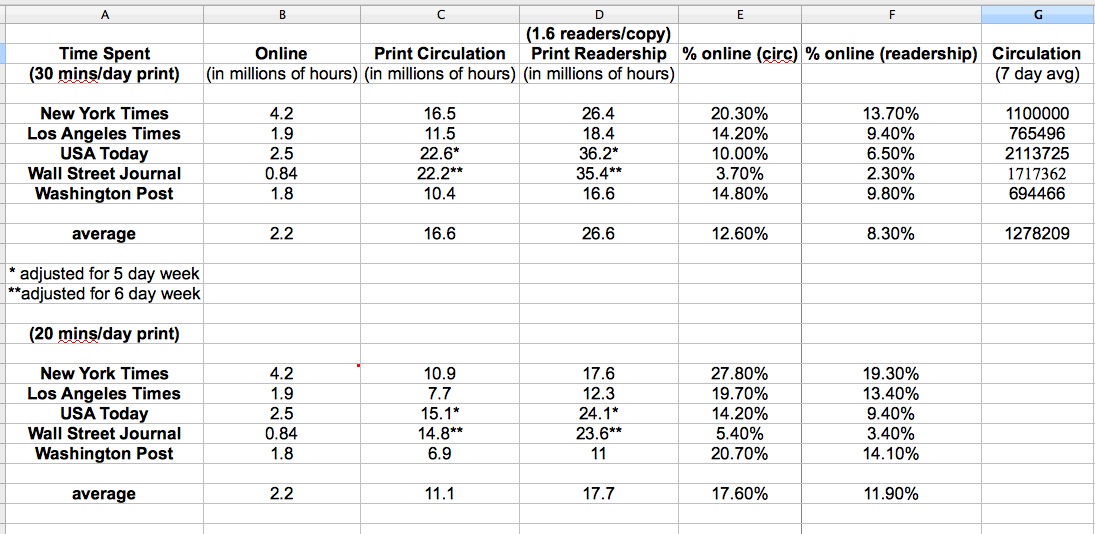
I ran the numbers for the top five newspaper websites in the country and put together a chart with the information for each. Note that the disparity between print and online time spent is even greater than it is at The New York Times.
In the top part of the chart I used the thirty-minute per reader per day assumption for print. To satisfy those who will surely bellow that’s too high, I did another chart using twenty minutes per reader per day.
Now this is a blunt instrument for estimating this stuff—some papers are going to be read by more people per copy than others. Some papers will have more time spent per reader per copy than others. But this is the data we’ve got.
My take on this is that this analysis shows that publishers aren’t exactly fools to not throw everything into online. Print is where the eyeballs are; it’s where their best customers are.
Of the top five newspaper websites the average reading time online is 12.6 percent to print’s 87.4 percent. That widens to 8.3 percent online, 91.7 percent print when considering that more than one person reads each print copy.*
Advertisers like readers who pay to subscribe more than they do those who don’t, which benefits print. That’s counterbalanced by the fact that online readership presumably skews younger, more educated, higher income, which itself points to a major problem for newspapers.
At the same time, it shows the downside of a paywall strategy like that of The Wall Street Journal. Its online reading is miniscule compared to papers with free sites. Of course, the Journal does have that nifty $60 million or $70 million in subscription revenue to ease the pain.
This analysis doesn’t take into account the fact that once readers go online, they start getting their news from other sources, like blogs, aggregators, and, say, MSNBC.com. Clearly newspapers are missing a ton of traffic and attention time. It also doesn’t take into account the impossible-to-quantify amount of time spent reading newspapers’ remixed content on those same places, which anyway doesn’t much matter to newspapers if they can’t monetize it.
Also these online numbers are volatile from month to month. For example, if I had used The New York Times’s time spent online from May (which was twice the June time for some reason), its total hours would have been 8.4 million. Some numbers don’t pass the smell test, like The Wall Street Journal content being read online just 3.7 percent. That is probably from the weakness of the Internet data. I find it hard to believe that average time spent on The Boston Globe’s site, for example, soared 300 percent from May to June.
But the bottom line is, using this method of getting at print versus online reading time, the numbers, while not as shocking as Langeveld’s estimates, are still disproportionately stacked toward print. They support his point. This, despite the fact that publishers have incentivized their print customers to become online ones.
This analysis doesn’t present any trendlines, which are moving away from print and toward online. But this is fifteen years into the age of the online newspaper—and going on a decade into the high-speed Internet era—and you can spin it a couple of ways: It points to the surprising resiliency of print, or it signals the pitiful job newspapers have done online.
I’d say it’s some of both.
UPDATE:
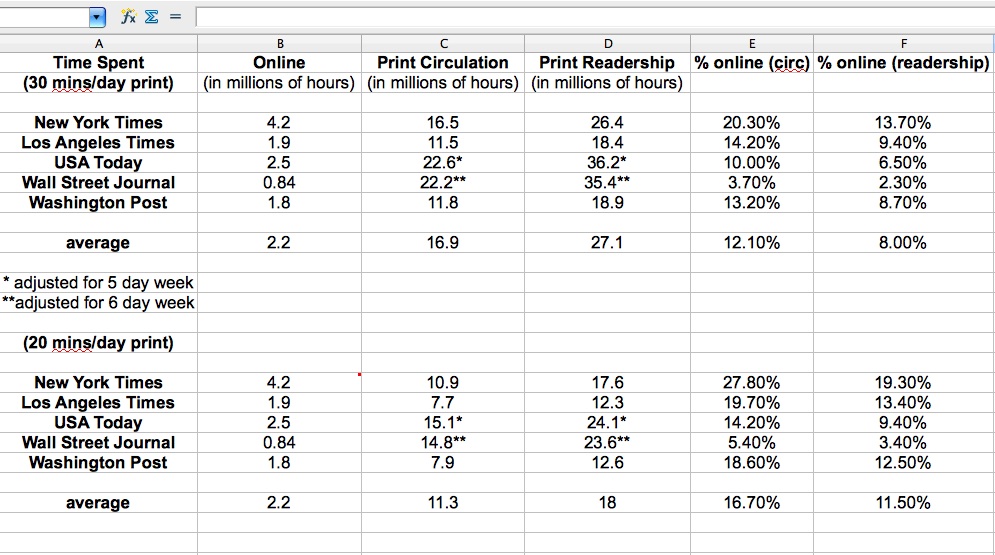
* I’ve updated the chart to fix an out-of-date circulation number I used for the Washington Post. Using the correct number makes the WaPo’s online-to-print ratio slightly more favorable to online and has tiny impacts on the averages for the five, which I’ve also corrected—as signaled by an asterisk. I’ve also included the circulation numbers I used to calculate print reading time. I averaged in Sunday circulation to get a seven-day average.
You can see the original, uncorrected chart here.
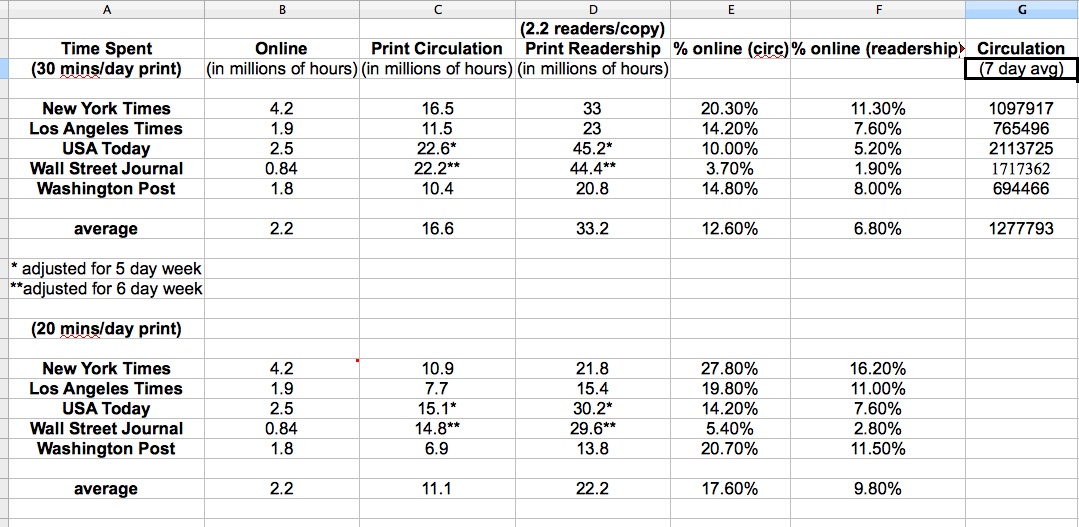
Jeff Mecklin, in comments below, questions why I didn’t use NAA readership numbers. I used 1.6 readers per copy to be conservative, as I explained in the post. But he has a point, so I ran the numbers using the NAA’s 2.2 readers per copy figure. See below:


Very interesting post. I'd add a trendline based solely on my personal experience - I used to read 4 print newspapers a day as recently as 2003: WSJ, NYT, FT and WashPost (I lived in DC area at the time). Now, I rarely read print papers at all, and get virtually all my news online (with Twitter and blogs being a major source of informing me of news that's relevant to me, with respect to my role as a blogger). There's a couple reasons for why my own print reading time is down, mostly because:
- more time spent online to do my work, means less time for 'reading'
- hard copy delivery of some papers ceased when I renewed, but I found I didn't miss hard copy as I had less and less time to read print edition (although I still subscribe to numerous papers online)
- but the biggest possible trend in this is that in 2003, I commuted to work on the Metro in DC, which gave me a good half hour to read virtually all 4 papers (WSJ cover to cover, FT the same, NYT and WashPost Business Sections). Now: I drive to work, and of course I can't read and drive! (Not that I haven't sometimes had the NYT bus section in the passenger seat for an occasional glance.) Similary, when I lived and worked in NYC in the late 80's-early '90s, I'd read 2-3 papers a day on the train on my way to work. So there may be some correlation between mode of commuting (and time of commute) and extent of readership of print newspapers vs. online.
Posted by Edith Orenstein on Thu 30 Jul 2009 at 08:23 PM
I'm always amused/annoyed when I read someone treating the newspaper pass-around rate as if it were magic conjured by newspaper propagandists. Newspaper readership is determined by surveys. Those surveys are conducted by a number of entities; one I'm familiar with is The Media Audit, which surveys about publications in 80 American markets. In those surveys, consumers are asked a whole raft of questions, some about how often they read a variety of publications in that market. The surveys are based on random sampling; that is, they are scientific. So the results can be generalized to the population of the city/market in question. These kinds of surveys have consistently shown, over a period of many years, that the number of people who say they read a particular metro daily newspaper is between two and three times as great as the paid circulation of said newspaper. Ergo, you can multiply the circulation of a metro paper by some number between 2 and 3 and get the readership. Or, you could also go to the Media Audit or Scarborough Research or any number of other demographic research groups and get actual readership numbers for the various newspapers you're writing about. What you can't logically do is say the NAA general estimate of pass-around is 2.2, but the group must be biased because it represents the newspaper industry, so to be safe we'll just arbitrarily reduce their figure by 30 percent. That would just be ... wrong.
Posted by John Mecklin on Thu 30 Jul 2009 at 08:43 PM
John,
Consider that a blogger's license.
I wanted to be as conservative as possible with these numbers and I clearly spelled out what inputs I used and why.
But it's an entirely reasonable point, and tomorrow I'll post an update with the full 2.2 readers per copy NAA figures.
Posted by Ryan Chittum on Thu 30 Jul 2009 at 11:05 PM
Statistics are a difficult thing. I'm not sure the gap between print and online audience attention is as wide as this piece makes it look.
Read why here.
I appreciate the dialogue, as always, Ryan
Posted by Jeff Sonderman on Thu 30 Jul 2009 at 11:10 PM
Sorry, bad link above.
http://www.newsfuturist.com/2009/07/second-look-at-print-online-attention.html
Posted by Jeff Sonderman on Thu 30 Jul 2009 at 11:14 PM
I think you're missing the point, and comparing apples to oranges. News consumer behavior is shifting rapidly to reliance on and sampling of multiple brands. The more an individual gets into using the web and mobile for news consumption, the more news brands (and blogs) he/she views in a day. For many of us it's the norm to be at NYTimes.com and check some of its stories, then also read news from dozens of other major news organizations and blogs -- and we're led to this variety of news content in many ways, from friends' e-mails, to e-mail alerts, to blog post references, to Twitter referrals, Digg, Google News, and on and on. The trend toward that becoming the norm for the masses is unmistakable, especially as the older generation dies off and the digital generation matures.
Comparing the web or mobile experience of news to the newspaper print experience via stats is silly. The newspaper is a self-contained box of news content; you can't go anywhere else. A newspaper website is a different animal. While print remains with a huge (but shrinking) audience, by its nature the stats will show more aggregate hours spent on the NYT print edition than on NYTimes.com even with many more website unique visitors, because the print edition doesn't have a million other things to distract your attention elsewhere.
I'm not sure how we can intelligently compare the statistics for the newspaper print edition to the newspaper website. But I find the statistical comparison above to be unconvincing.
I prefer to watch the trends of consumer media-consumption behavior and where advertisers are shifting their money, and to focus on the future rather than waste much time propping up the past.
Posted by Steve Outing on Fri 31 Jul 2009 at 12:42 AM
Do we need a new word for the new-fangled kind of "reading" we do on screens?
by Dan Bloom
Are you reading this -- or -- are you screening this? How you answer
this question will determine whether you get to the bottom of this
column.
Alex Beam, writing in the Boston Globe on June 19, fired the first
volley in this now-national
discussion. "Do we read differently on the computer screen from how we
read on the
printed page?" Beam asked rhetorically. His column was headlined by a
savvy Globe copyeditor: "I screen, you screen, we all screen."
The answer to Beam's question is, of course, yes. From most of the
research that has come in so
far from academics in
North America and Europe, the answer is clear, although not everyone's
in agreement with what it all means.
For me -- as a veteran author, editor and now a daily blogger hunting
and pecking my way around the blogosphere -- what the current research
means is that we need a new word for reading on plastic, pixelated
screens (PPS).
I have quietly suggested "screening", as Mr. Beam quietly noted in his
column. Yes, screening has multiple meanings, as everyone and his
brother has pointed out to me in over 1000 emails this year since the
brouhaha began. We screen movies, we screen job candidates, we screen
patients for medical problems, we do a lot of "screening" in this
world of ours. And now, you will be hearing a lof about a new kind of
"screening" -- so-called reading on plastic, pixelated screens.
I did some homework. I asked Dr. Anne Mangen at the
University of Stavanger in Norway what she thought about the word
"screening" for reading on a screen, she told me by email: "My first
impression is that the term 'screening' is adequate in some
respects, but not in others. It's adequate to the extent that it
points to certain differences in the reading mode which has to do with
the display nature, the central bias of a screen compared to a page of
print text (our gaze is naturally oriented towards the center), and
the image-like character of modalities (we tend to read a screen
spatially, in contrast to the page which we linearly)."
Dr Mangen, in a published academic paper published in Britain last
December, listed a few reasons that reading on paper
and reading on a screen are two very different animals.
* Reading on a screen is not as rewarding -- or effective -- as
reading printed words on paper.
* The process of reading on a screen involves so much physical
manipulation of the
computer that it interferes with our ability to focus on and
appreciate what we're reading.
* Online text moves up and down the
screen and lacks physical dimension, robbing us of a feeling of
completeness.
* The visual happenings on a compter screen and our physical interaction
with the entire device and its set ip can be distracting. All of these things
tax human cognition and concentration in a way that a book or
newspaper or magazine does not.
* The experience of reading a book or a newspaper or a magazine is
both a story experience and a tactile one.
The jury's still out on just how different reading on paper is
from reading on a screen, but the public discussions in the blogsphere
are getting interesting -- and heated. But more and more, top experts
in the computer and Internet fields, as well as typeface designers and
readability gurus, are in agreement with me that we need a new word
for reading on screens, and that the word should be "screening." For
now. A completely new word might come down the information highway in
the future and take the place of screening. But for now, you screen, I
screen, we all screen.
I asked Kevin Kelly, the well-respected maverick of Wired magazine,
what he felt about this
new word for reading on screens, he told me by email in one short sentence: "I
would be happy to see screening become a verb (for this)."
Mim Harrison, a book editor in New York, told me: "I find the
distinction between reading and screening to be intriguing, and it
certainly gives us all pause to consider just what it is we're doing
with our eyeballs these days."
"Screening, of course, is not a new term," a top expert in predicting
the future told me in a recent email, but this might just be the
time that it catches on in the way you suggest. Screening is a clever
and useful term capturing the fact that the
experience of reading on a screen is fundamentally different from reading
on paper. Not a priori worse or better; just different."
And then he added this important note: "It is the right word for the
moment in terms of drawing people's attention to the vast literary
shift about to wash over us."
Another Web philosopher told me: "Keep going in the direcetion you are
going. Eventually, people will listen to you. Of course, 'screening'
has multiple meanings already. But your new way of putting it ...is
very interesting and it provokes thought. I assume that is your
intention."
When I asked technology reporter John Markoff at the New York Times
about this idea, he replied in a one-word email note: "Hmmmmmmm."
I asked David Pogue at the New York Times the same question, and he
said: "Very interesting."
But when I asked a top technology editor at the Times if he could blog
about this issue, he replied: "You have a noble crusade, sir, but
we'll will not be writing about this until 'screening' is actually in
use. You cannot just go out and create a new meaning for an old word.
Who are you, anyways?"
I told the New York Times editor (Damon Darlin, if you want to know
his name): "I am just Dan Bloom, tilting at windmills.
Tufts 1971. A seasoned reader and writer. I've been reading the New
York Times on paper for over 50 years!"
Bill Hill, a former Microsoft typeface designer from Scotland who is
now based in the Seattle area, told me that one reason that "reading"
on screens is still a bit problematical is because "we are still
paying the price of an engineering shortcut taken sixteen years ago."
I asked Mr Hill to explain this to me, and he replied: '' Sixteen
years ago, when the programmers at the NSCA were creating Mosaic, the
first Web browser, they made an engineering decision based on
expediency. They took an easy option --for which we're all still
paying a huge price in terms of the readability of the Web."
The engineers asked themselves:"How do we display content?"
They said: "Pagination's hard. The easy way is to display it all in a
bottomless window, so the reader can scroll through it. Then it
doesn't matter how much content there is on a Web page."
But according to Mr Hill and most other Web readability experts,
scrolling is much less suited to the way humans read than paging
through content.
"The human visual system -- the eyes, the muscles which control them,
the optic nerve and the brain -- operates like a high-speed,
high-resolution scanning machine," Mr Hill told me. "When reading, it
scans four targets per second, taking only 25ms to move from one
target to the next, each target about 5-7 characters wide."
"Type, and layout, has evolved over the 5500 years since writing
systems first appeared," Mr Hill continued, "and especially since the
widespread adoption of Gutenberg's moveable metal type -- to optimize
for the way human vision works. Sure, you can learn to make do with
scrolling to read, if there's nothing better. And there's no choice on
the Web today.
And that's what we need to fix to make reading -- and design --
first-class citizens on the Web."
Mr Hill, who believes in the power of printed books and in a rosy
future for e-books as well, says fixing the Web's readability won't be
easy, but that it can be done.
"It'll mean re-educating the design community in a new paradigm," he
said. "But it'll be worth it."
So, Dear Reader, er, Dear Screener, if you have scrolled all the way
down to the bottom of this seemingly bottonless guest column, let me
ask you one more time (and your comments and feedback are very welcome
in the comments section below): Were you reading this commentary, or
were you screening it?
-------------------------
Dan Bloom is the author of over a dozen books
in English, Japanese and Chinese. A freelancer writer and blogger
based in Taiwan, he does not own a computer and has never even seen a
Kindle or BlackBerry or an iPhone.
Posted by Dan BLoom on Fri 31 Jul 2009 at 08:14 AM
I screen, you screen, we all screen
By Alex Beam
June 19, 2009
Do we read differently on the computer screen from how we read on the printed page? It’s an interesting question.
Before hearing from the experts, let’s review what we think we know. Even the best computer screens are harder on the eyes than the paper page is. Jakob Nielsen, a Web usability researcher, reports that we generally read 25 percent more slowly on the screen. I read more quickly on the screen and edit out about 40 percent of what appears before my eyes. If you haven’t told me what you want by line four of your e-mail, trust me, I didn’t get the message.
A Norwegian researcher, Anne Mangen, recently weighed in with an interesting paper in the Journal of Research in Reading, asserting that screen reading and page reading are radically different. “The feeling of literally being in touch with the text is lost when your actions - clicking with the mouse, pointing on touch screens, or scrolling with keys or on touch pads - take place at a distance from the digital text, which is, somehow, somewhere inside the computer, the e-book, or the mobile phone,’’ Mangen writes.
Her conclusion: “Materiality matters. . . . One main effect of the intangibility of the digital text is that of making us read in a shallower, less focused way.’’
When writing about digital reading - blogger Danny Bloom is pushing the neologism “screening,’’ for reading on the screen - Mangen, Nielsen, and others focus on the issue of distractibility. How can schoolchildren really read at computer terminals, scholars argue, knowing that more interesting Web pages are just a few clicks away? But don’t dedicated reading devices like the Sony Reader or the Amazon Kindle change this equation?
Nielsen agrees that Kindle is trying to out-book the book. He argues that Kindle reading can be even more immersive than book reading: “All you are aware of is the next page, you don’t get this feeling that you are coming to the end of the book. It’s like being plunged directly into the author’s content.’’
I asked Mangen via e-mail if she thought there might be a future convergence of Kindle reading and Gutenberg reading. “Reading digital text will always differ from reading text that is not digital (i.e., that has a physical, tangible materiality), no matter how reader-friendly and ‘paper-like’ the digital reading device (e.g., Kindle etc.),’’ she answered. “The fact that we do not have a direct physical, tangible access to the totality of the text when reading on Kindle affects the reading experience. When reading a book we can always see, and feel with our fingers and hands, our progress through the book as the pile of pages on the left side grows and the pile of pages on the right side gets smaller. At the same time, we can be absolutely certain that the technology [the book] will always work - there are no problems with downloading, missing text due to technical or infrastructure problems, etc.’’
She says the e-reader experience introduces “a degree of unpredictability and instability’’ that influences reading, even if we are not aware of it.
Two years ago, media critic William Powers wrote a romantic defense of the ancient medium I publish in. His essay, “Hamlet’s BlackBerry: Why Paper Is Eternal,’’ was widely quoted by journalists, of course. Mr. Paper - he not dead, Powers wrote: “There are cognitive, cultural, and social dimensions to the human-paper dynamic that come into play every time any kind of paper, from a tiny Post-It note to a groaning Sunday newspaper, is used to convey, retrieve, or store information.’’
Paper will never die, Powers concluded: “It becomes a still point, an anchor for the consciousness. It’s a trick the digital medium hasn’t mastered - not yet.’’
Two years ago, I might have agreed. If I had a daughter, yes, I would send out her wedding invitations on paper, not on Evite. (America has many daughters, hence a future for mail carriers.) But for books, magazines, and newspapers, “eternity’’ is a long time. When Kindle-like readers cost less than $50 and the e-Ink technology is not just very good, but excellent, there may be more “screening,’’ and less reading, in our future.
Alex Beam is a Globe columnist.
Posted by Dan BLoom on Fri 31 Jul 2009 at 08:16 AM
Nielsen Netratings changed from their small RDD panel to their much larger Open/RDD panel in June.. so everyone's numbers changed since it was a completely different group of people being measured... That's why you see such a difference between may and june for NYT, boston.com, etc.. June to July should put the month-over-month numbers back on track.
Posted by Jim Wilson on Fri 31 Jul 2009 at 11:32 AM
Does the 30-minute per offline reader figure of the NYT include people who do the Times crossword puzzle? Would it make a difference?
Can we really compare offline time with online time? Online newspapers are streamlined for snacking on information and filled with lists of recent and popular articles as well as very capable search engines. There's arguably less time spent online looking for the right articles.
In addition, offline readers tend to be more loyal, sticking to their favorite news source, while online readers tend to sample a larger number of sources. More sources to read (and less content from each source) would lead to less time spent per source.
Posted by Carlos Granier-Phelps on Fri 31 Jul 2009 at 12:24 PM
How I knew print was still alive was the other day when I saw a dishevelled gentleman who was driving an even more dishevelled car pull up to the gas station, jumped out to buy our local newspaper. He didn't look like he could afford much, but that's what he went in to buy. I was stunned.
Posted by Sara on Fri 31 Jul 2009 at 12:47 PM
I was e-reading it.
Posted by e-reader on Fri 31 Jul 2009 at 01:31 PM
Steve,
I don't think so. I'm comparing the newspaper apple to the online-newspaper apple. I very clearly said that this doesn't track all news reading:
"This analysis doesn’t take into account the fact that once readers go online, they start getting their news from other sources, like blogs, aggregators, and, say, MSNBC.com. Clearly newspapers are missing a ton of traffic and attention time. It also doesn’t take into account the impossible-to-quantify amount of time spent reading newspapers’ remixed content on those same places, which anyway doesn’t much matter to newspapers if they can’t monetize it."
And you're missing the point of this, which is to look at the newspaper industry--not news overall--with the data we have. It's a pretty simple exercise, really. You can find it unconvincing--the numbers are stunning to anyone mentioned in my lede--but then tell me a better way to measure it.
You say this:
"Comparing the web or mobile experience of news to the newspaper print experience via stats is silly. The newspaper is a self-contained box of news content; you can't go anywhere else. A newspaper website is a different animal. While print remains with a huge (but shrinking) audience, by its nature the stats will show more aggregate hours spent on the NYT print edition than on NYTimes.com even with many more website unique visitors, because the print edition doesn't have a million other things to distract your attention elsewhere."
Would you rather compare print vs. online via anecdote, intuition, or prediction? Or can we just not compare them at all? I think we ought to look at the numbers if we're talking about how best a business can make the transition to a new world. It's got to know what it faces.
And what does this exercise have to do with "propping up the past"? I didn't know what I'd find when I started crunching these numbers, and I'm hardly suggesting that print is the wave of the future. I bent over backwards to be conservative with these numbers, as John Mecklin points out above.
I'll agree that these numbers do point to the fact that the "past" is still with us, perhaps more than you'd like. But you can't dismiss the data because you don't like them.
Posted by Ryan Chittum on Fri 31 Jul 2009 at 01:59 PM
Ryan, thanks for linking to my post and helping to validate my point, which was met with a bit of incredulity at the time. I disagree with the criticism that we are comparing apples to oranges. Time is time, it seems to me. In my post, I was applying NAA and Nielsen data to the aggregate readership time for all U.S. newspapers in print and online, while you looked at the top five papers individually. It’s logical that those five would have a bigger share of their readership on the digital side of the fence, while the online readership of smallest papers in the country is virtually nil. There are a lot of small papers in that long tail; therefore the average in my analysis came to 3.5 percent of newspaper reading time being on newspaper Web sites and 96.5 percent in print. People can argue with a few of my assumptions, and yours, but its hard to nudge that percentage even close to double digits.
The other aspect of this problem is the total time spent at newspaper Web sites, as a percentage of total time online, is dismally small. From February stats I reported in April (http://www.niemanlab.org/2009/04/online-newspaper-audience-growth-good-news-not-really/), the average web user spend 61 hours and 12 minutes online that month, but only 43 minutes and 9 seconds at newspaper sites — so only 1.2 percent of all online attention is on newspaper sites. Measured in page views, the picture is the same: newspapers got 3.5 billion page views, less than 1 percent of the total U.S. page views of 386 billion.
Newspaper execs, looking at all this, might say: if nearly all the reading still happens in print, we need to “protect” that in some way. And certainly, that massive print readership is still an asset. But newspaper print advertising (as a fraction of total U.S. ad spending) has been dropping steadily for 50 years, while the consumer’s media preference for news and almost everything else is clearly moving to the Web. So if newspapers have a future, it needs to be increasingly digital. The challenge newspapers have is to grow their inadequately small share of online attention, and they won’t do it, of course, by erecting paywalls around most of their content. The answer can perhaps be found by studying Facebook, which (also in February, per Compete.com’s blog) all by itself got 6 percent of all U.S. time spent online, or 5 times the entire newspaper industry, and by realizing that one of the keys is in leveraging social networking around news.
Posted by Martin Langeveld on Fri 31 Jul 2009 at 02:53 PM
Hello Ryan,
"...most people don’t live like we do. They don’t use RSS. They don’t Twitter. They don’t read twenty blogs a day. They (some 100 million or so) still actually pick up the newspaper and read it."
This is misleading, and may be the cause of some of the confusion and debate. It says (perhaps without the author's intent) that most Americans read newspapers. (most people... they still actually...) The country, however, has an estimated population of 300 million - which, based on the statistics provided, means that about one out of every three Americans reads a newspaper.
With the statistics you provide you can certainly argue that most newspaper news consumers still get their news from print. I also don't doubt that most Americans don't get their news from an RSS feed or Twitter. But while several (or many) do read newspapers, it's certainly not most.
Furthermore, Alex and Martin are correct in that the real story isn't that some/several/many Americans still read newspapers today - it's in the circulation trends and the number of new outlets for news. Publishers need to be preparing for tomorrow as much as they are worrying about today.
Posted by Ian Hill on Fri 31 Jul 2009 at 07:14 PM
Circulation Inflation? never fudge the number of readers, the pass-around rate, 30 minutes a day reading the papers much less the actual paid circlation. it would never happen
Advertisers Sue 'Minneapolis Star Tribune' Over Circulation Inflation
- http://www.freerepublic.com/focus/f-news/1433311/posts
Hoy - http://www.prweekus.com/Reuters-circulation-inflation-and-CBS-News/article/54948/
More circulation inflation uncovered at New York's Newsday. - http://www.accessmylibrary.com/article-1G1-119351542/more-circulation-inflation-uncovered.html
Chicago Tribune's circulation inflation tab: $15 mil. - http://www.highbeam.com/doc/1P2-13542541.html
Dallas Morning News - http://www.npr.org/templates/story/story.php?storyId=4628368
Posted by E on Fri 31 Jul 2009 at 07:17 PM
Good points, but one to note here is that this whole issue may say as much about the fact that newspaper content on a website may have limited appeal in the first place. If there is validity to the hours-spent metric for websites and print, the results may state that newspaper websites have not captured the audience, period. Time on site for newspaper websites has continued to be suspect, some due to the simple ways in which news is delivered/received, but also because these same websites are less compelling than some pure plays and less functional than some aggregators.
Print is not dead; its reason for living is changing. Comparisons between the value of news "papers" and their affiliated websites really should take into consideration that they are starting to serve similar audiences, for dissimilar reasons; therefore, common metrics are going to be harder to nail down
.
Posted by David Prizer on Sun 2 Aug 2009 at 05:36 PM
I subscribe to the Seattle Times and the New York Times, seven days a week for both papers. I also buy a Korean language paper from a vending machine five days a week, Monday through Friday, which are the only days the local Korean language papers publish in this area (Seattle, WA).
I have a high speed internet access, which I use to access the papers online to pick up articles whose links I send to my e-mail contacts. The articles are primarily news about music (classical) and Korea.
I am a retired information systems specialist, having worked with computers for 35 years before I retired. But, I still don't like to read news articles online.
I don't like to scroll screens while I am reading. As far was I am concerned, I still want newspapers in my hand when I read them. Old fashioned? Yes, most definitely. Yun-kuk (Ted) Kim, Edmonds, Washington.
Posted by Yun-kuk Kim on Tue 4 Aug 2009 at 04:29 AM