

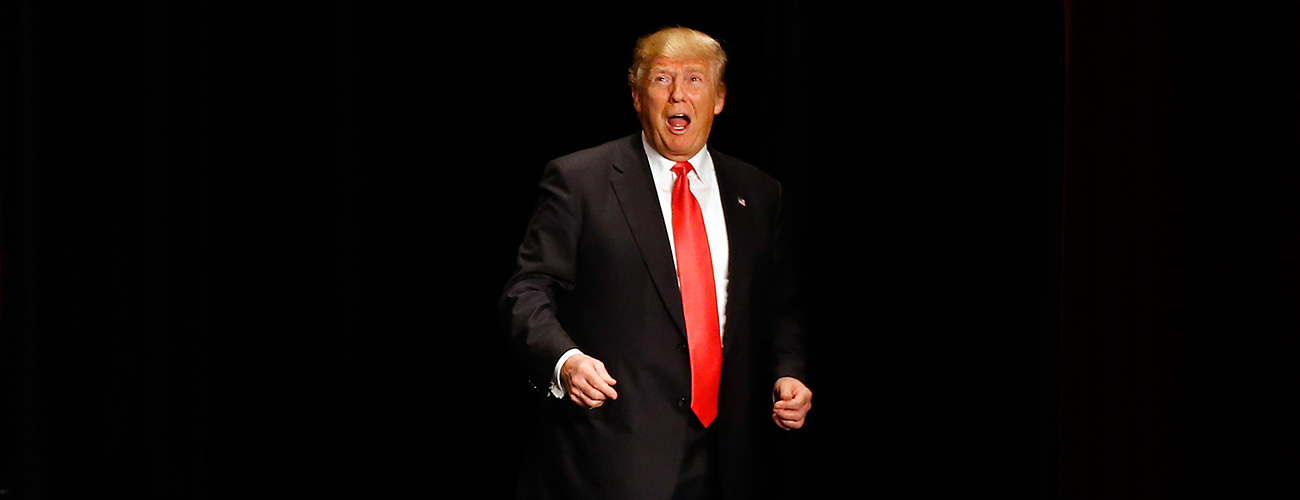
Donald Trump and the political media have become this election season’s odd couple. So it’s fitting that this week, which saw the one-year anniversary of Trump’s descent by escalator into the presidential campaign, has been something of a best-hits celebration of the relationship.
Journalists took familiar battle stations after Trump’s self-congratulatory and conspiracy-riddled response to a terrorist attack on a gay nightclub in Orlando last weekend. They aggressively needled the patchwork alliance between Republicans and their standard bearer. They painted increasingly vivid portraits of a campaign—if Trump’s effort can be called as much—run by amateurs. And they once again raised questions of the reality TV star’s true motives behind his presidential bid.
The kneejerk reaction may be to file away this potential inflection point with all the others that have come before. A year of now-quaint predictions of Trump’s downfall has created a sort of muscle memory to downplay the impact of any particular bad news cycle. If 2016 has taught us one thing, it’s that anything can happen.
But the game has changed. The general election’s political and media dynamics suggest Trump will be on the receiving end of more sustained and aggressive press coverage over the next five months. A more diverse general election audience, meanwhile, ups the probability that stories will land with impact. Trump’s no-good, very bad week of coverage is one of the first times these new rules of engagement have been in play. The episode isn’t so much an echo of its fleeting predecessors as it is evidence of a new chapter in the Trump-media relationship.
The real-estate mogul’s media domination over the past year was bolstered in large part by a sprawling and fragmented field that divided news organizations’ attention. No other candidate could fully introduce themselves on their own terms with Trump as the loudest voice in the room.
Republican counterparts shied away from attacking him so as not to alienate his supporters. Breathless coverage of his rise in notoriously inaccurate primary surveys obscured much of the accountability work being done in the campaign’s early stages. By the time Republican primary voters hit the polls, his victories over a divided field provided yet more fodder for inherently positive coverage.
That’s over now. For one, general election polls are bad news for Trump—at least for the moment. He’ll also have no opportunities to declare electoral victories between now and November.
While Trump will likely receive a majority of attention in a head-to-head matchup with Hillary Clinton, who needs no introduction, his relative advantage will be far slimmer. More importantly, she and other Democrats have a well-funded and cohesive communications strategy to push negative narratives in traditional and nontraditional media alike. Even Republican leaders have begun calling out his more radioactive nonsense. For journalists who are digging up damning stories independently (see: Trump and misogyny; Trump and deadbeat boss; Trump and conspiracy theories), it’s becoming harder to report any piece without including some sort of political denunciation.
Of all the storylines emerging from Trump’s recent spate of negative press, the most peculiar is his campaign’s inability or unwillingness to adapt to this new media environment. As MSNBC reported earlier this month:
There is no communications team to deal with the hundreds of media outlets covering the race, no rapid response director to quickly rebut attacks and launch new ones, and a limited cast of surrogates who lack a cohesive message…
The lack of organization is becoming more and more glaring as Trump faces a tough stretch that’s included a fight over his donations to veterans, renewed scrutiny of fraud allegations against Trump University and a withering offensive from Hillary Clinton over his fitness to be president. In each case, Trump has been left to respond almost entirely on his own via social media and interviews, with little obvious support from his campaign, his party or his top backers.
Instead of staffing up his media team, it appears Trump is relying on his own preternatural ability to be the center of attention, for better and for worse.
“@VoteTrumpMAGA: The media attack on @realDonaldTrump is relentless. They are desperate. But, they keep #Trump in the news – a good thing.
— Donald J. Trump (@realDonaldTrump) June 17, 2016
This spray-and-pray media strategy—reach a wide audience with outlandish remarks in the hope of igniting a small segment of true-believers—is inherently less effective with the general electorate. Perhaps the Republican base is comfortable when the presumptive GOP nominee kinda, sorta implies that President Obama is in league with ISIS. But the majority of America is not: Just a quarter of respondents to a CBS News poll said they approved of Trump’s response to the mass shooting in Orlando.
That such a reasonable majority exists is a basic premise of journalism, and Trump challenged that foundational belief as the right man in the right spot at the right time. But primary season is over, as are the conditions that allowed Trump to efficiently campaign through media.
His bet that he can continue doing so places the ball firmly in the political press’s court. And after a year of squabbling over the media’s role in creating Trump, that’s a welcome opportunity for Year 2.
David Uberti is a writer in New York. He was previously a media reporter for Gizmodo Media Group and a staff writer for CJR. Follow him on Twitter @DavidUberti.