Phil Gramm and Columbia B-school Dean and Romney economic adviser Glenn Hubbard take to the op-ed pages of The Wall Street Journal to repeat just about every canard of the crisis.
Not many people have more responsibility for the crisis than Gramm, but guess who he and Hubbard, last seen under Inside Job’s klieg lights, blame:
The more recent recession resulted from excessive government intervention to increase homeownership by expanding subprime housing loans, on which substantial leverage was built.
That’s the zombie lie of the 21st century. It just won’t die no matter how many times it’s been debunked.
There’s so much disingenuousness here it’s hard to know where to start. Take Gramm and Hubbard’s comparison of the 2007-09 recession to the 1981-82 one Reagan inherited (emphasis mine):
Fifty-three months after the start of the 1981-82 recession, total employment in the U.S. was up 7.5 million, or almost 7.5% higher than when the recession began. The labor-force participation rate rose to 65% from 63.8%, as optimism about the future pulled potential workers into the job market. Real per capita gross domestic product increased by $2,870 and was 11% higher than when the recession started.
Morning in America and all that. But back up a bit and look at the trendlines. Here’s labor force participation from 1960 to this year, via the Bureau of Labor Statistics:
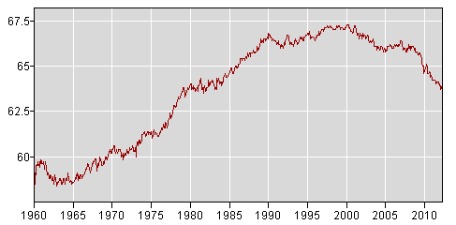
Funny how Gramm and Hubbard would never think of crediting the Great Society with the massive labor participation rate’s run-up, even though it started on Lyndon Johnson’s watch. The real credit goes to demographics: women joining the workforce en masse and the giant Baby Boom generation beginning to turn 18 in 1964. This is also a big reason why labor participation has dropped in Obama’s term (Gramm and Hubbard, who chaired the Council of Economic Advisors under George W. Bush, don’t mention the rate also fell under Bush).
Beyond that, comparing the 1981-82 recession to 2007-2009 is foolish or worse. The 1981 recession was created intentionally by the Federal Reserve, through huge rate hikes, to break the back of inflation. It, along with deregulation, helped bring on the S&L collapse.
The 2007-2009 recession, particularly the part where the economy fell off a cliff in the fall of 2008, was due to a housing crash of colossal proportions and the collapse (or near-collapse) of the financial system that caused the housing crash.
Back in 1982, Volcker could end the recession by slashing interest rates. Today interest rates are as low as they can go, which is why the Fed has to resort to things like quantitative easing. Beyond that, Reagan’s big government spending was a significant player in the recovery (helped along by the crashing price of oil). Here’s a Paul Krugman chart that shows how much more Reagan (boosted by cities and states) spent in his first term than Obama has:
But here’s how Gramm and Hubbard get around Reagan’s record of big government stimulus to imply that austerity did the trick:
By reducing domestic discretionary spending, setting out a three-year program to reduce tax rates, and alleviating the regulatory burden, Reagan sought to make it profitable to invest in America again. He clearly succeeded.
Later in the column Gramm and Hubbard say there is “growing evidence that government spending and mounting government debt are not stimulating growth.” But Reagan, of course, more than made up for those domestic discretionary cuts with military spending.


"Columbia B-school Dean and Romney economic adviser Glenn Hubbard"
This must be a near record for a false title.Takes quite a while to get to the fact that you're referring to Glenn Hubbard.
#1 Posted by barney kirchhoff, CJR on Fri 8 Jun 2012 at 11:33 AM
Well, they seem to know that women entering the workforce and the maturation of the baby boom affects BOTH the numerator and denominator in labor force participation. That alone puts them one up on Ryan.
Then, there's the little matter of the housing boom ending in 2006, not in 2008.
#2 Posted by Patrick R. Sullivan, CJR on Fri 8 Jun 2012 at 12:40 PM
Also, is Ryan denying the accuracy of this;
'...government intervention to increase homeownership by expanding subprime housing loans, on which substantial leverage was built.'
If so, what part of it is untrue?
#3 Posted by Patrick R. Sullivan, CJR on Fri 8 Jun 2012 at 12:43 PM
On the off chance that someone actually interested in legitimate scholarship might stumble in here;
http://papers.ssrn.com/sol3/papers.cfm?abstract_id=1923829
'In this paper we explore the role of cash flow uncertainty on corporate employment and corporate investment. We develop a novel approach towards measuring cash flow risk, and we consider investment in both tangible and intangible assets. We find that our measures of cash flow uncertainty have a significantly negative impact on corporate employment and corporate investment in both tangible and intangible assets. Economically, if cash flow uncertainty were to revert to levels observed back in 2005, corporate employment would increase by more than 1.89 million jobs, investment in tangible assets would increase by more than 10%, and investment in intangible assets would increase by more than 19%. Furthermore, we document that our risk measures have had a more negative impact on corporate employment and corporate investment in tangible and intangible assets during economic recessions than during economic expansions. These findings have significant policy implications. To wit, if policy makers would like corporations to increase their employment and investment, they should focus on policies that decrease corporate cash flow uncertainty.'
#4 Posted by Patrick R. Sullivan, CJR on Fri 8 Jun 2012 at 01:01 PM
Patrick, you're just wrong on women entering the workforce affecting both numerator and denominator.
And while that does apply to Boomer overall, you're missing the fact that Boomers had higher labor force participation than preceding generations *because* of women working.
#5 Posted by Ryan Chittum, CJR on Fri 8 Jun 2012 at 01:33 PM
Glenn Hubbard and Phil Gramm. What is the Economic Legion of Doom headquartered at the WSJ, now?
Gramm was responsible for the REPEAL of Glass Steagal and the deregulation of derivatives. (Oh and Senator Enron, lest we forget)
Hubbard was responsible for the Bush tax cuts and helping push the failed social security privatization project and the ownership society garbage which led to increased amounts of house ownership by overleveraged and under-qualified borrowers. (Basically, "the government looks away and whistles" strategy of finance) His supply side stupidity led to a recent cbo report where, under a scenario in which we keep his policies:
"Federal debt would grow rapidly from its already high level, exceeding 90 percent of GDP in 2022. After that, the growing imbalance between revenues and spending, combined with spiraling interest payments, would swiftly push debt to higher and higher levels. Debt as a share of GDP would exceed its historical peak of 109 percent by 2026, and it would approach 200 percent in 2037."
These are the guys deemed best to lecture us on economic matters? It hurts the brain to think about it.
"Then, there's the little matter of the housing boom ending in 2006, not in 2008."
Plateauing in 2006. Not crashing. Ugh.
"Also, is Ryan denying the accuracy of this;
'...government intervention to increase homeownership by expanding subprime housing loans, on which substantial leverage was built.'"
It depends on what you mean by government intervention. If you are doing the old "Community Reinvestment Act" two step to claim it was government intervention, and not a massive movement of wall street money into unregulated sub-prime then yeah, it's false.
"cash flow uncertainty"
boy that's a lot of words used to say 'demand'. That's what's holding back investment. Not healthcare reform (without which you lose to cost contained countries like Canada), not cap and trade (which is dead, but even if it weren't it would make a negligible difference), demand.
And demand will remain depressed while people have assets which are worth less than the debts upon them. Debt drags on consumer demand.
And on that note, must run.
#6 Posted by Thimbles, CJR on Fri 8 Jun 2012 at 02:12 PM
And now I'm back to talk more about demand and to ask questions of patty about the "uncertainty" of corporate spending.
Your paper, which seems to have attracted a lot of attention from AEI, seems to make the case that the increase of 'cash flow uncertainty' is a result of healthcare reform, possible corporate tax hikes, and possible cap-and-trade.
Let me ask you, what are the costs of no healthcare reform?
"According to CBO’s projections, if current laws remained in place, spending on the major federal health care programs alone would grow from more than 5 percent of GDP today to almost 10 percent in 2037 and would continue to increase thereafter...
This scenario also incorporates assumptions that through 2022, lawmakers will act to prevent Medicare’s payment rates for physicians from declining; that after 2022, lawmakers will not allow various restraints on the growth of Medicare costs and health insurance subsidies to exert their full effect; that the automatic reductions in spending required by the Budget Control Act will not occur (although the original caps on discretionary appropriations in that law are assumed to remain in place)..
Many budget analysts believe that the extended alternative fiscal scenario is more representative of the fiscal policies that are now (or have recently been) in effect than is the extended baseline scenario. The explosive path of federal debt under the alternative scenario underscores the need for large and timely policy changes to put the federal government on a sustainable fiscal course."
What are the costs of bad tax policy:
Almost all expiring tax provisions are assumed to be extended through 2022. Specifically, for this scenario, CBO assumed that the cuts in individual income taxes enacted since 2001 and most recently extended in 2010, which are now scheduled to expire at the end of calendar year 2012, would be extended; relief from the AMT for many taxpayers, which expired at the end of 2011, would be extended; the 2012 parameters of the estate tax (adjusted for inflation) would continue to apply, preventing increases in rates and in the share of assets that is taxable; and all other expiring tax provisions (with the exception of the current reduction in the payroll tax rate for Social Security) would be extended...
Under those [health and tax] policies, federal debt would grow rapidly from its already high level, exceeding 90 percent of GDP in 2022. After that, the growing imbalance between revenues and spending, combined with spiraling interest payments, would swiftly push debt to higher and higher levels. Debt as a share of GDP would exceed its historical peak of 109 percent by 2026, and it would approach 200 percent in 2037."
#7 Posted by Thimbles, CJR on Fri 8 Jun 2012 at 06:09 PM
Corporations are sitting on more than a trillion in cash and we're supposed to think that cash flow worries are preventing them from investing?
Yeah, right.
#8 Posted by Harry Eagar, CJR on Fri 8 Jun 2012 at 06:10 PM
What about the economic costs of global warming?
Turns out there's a cbo paper for that:
http://www.cbo.gov/sites/default/files/cbofiles/ftpdocs/105xx/doc10573/09-17-greenhouse-gas.pdf
"The most comprehensive published study includes estimates of nonmarket damages as well as costs arising from the risk of catastrophic outcomes associated with about 11°F of warming by 2100.
That study projects a loss equivalent to about 5 percent of U.S. output and, because of substantially larger losses in a number of other countries, a loss of about 10 percent of global output."
And the cap-and-trade costs which are causing soooo much uncertainty?
"Reducing the risk of climate change would come at some cost to the economy. For example, the Congressional Budget Office (CBO) concludes that the cap and trade provisions of H.R. 2454, the American Clean Energy and Security Act of 2009 (ACESA), if implemented, would reduce gross domestic product (GDP) below what it would otherwise have been—by roughly ¼ percent to ¾ percent in 2020 and by between 1 percent and 3½ percent in 2050. By way of comparison, CBO projects that real (inflation-adjusted) GDP will be roughly two and a half times as large in 2050 as it is today, so those changes would be comparatively modest."
The cost of being
stupidrepublican vastly outweighs the cost of doing the right things. If you think corporations are "cash flow uncertain" about health care reform, corporate taxes, and cap-and-trade now? Wait until health care costs consume 20% of gdp, federal debt exceeds 90% of GDP, and climatic instability starts shaving off 3 to 5% GDP in catastrophic costs.Get real, you damn lunatics.
#9 Posted by Thimbles, CJR on Fri 8 Jun 2012 at 06:30 PM
Neat! On the topic of corporations and why they aren't investing:
http://www.nakedcapitalism.com/2012/06/neo-liberalism-de-capitalizationde-industrialization-and-the-res-publica.html
"One of the first links Neil provides is to a stunning March 2012 report, Worse Than the Great Depression: What Experts Are Missing About American Manufacturing Decline, by the Information Technology and Innovation Foundation, which refutes the common wisdom that the loss of U.S. manufacturing jobs is because of gains in productivity. If new, more productive manufacturing technology is the primary reason for the loss of manufacturing jobs, then we should be seeing a pattern of rising capital investment in that technology. But there is no such pattern. In the chapter entitled, “Capital Investment Trends in U.S. Manufacturing”, the study notes:
…a more accurate measurement of U.S. manufacturing output suggests that superior productivity was not principally responsible for the loss of almost one-third of U.S. manufacturing jobs in the 2000s. If it were, we would also expect to see a reasonable increase in the stock of manufacturing machinery and equipment...
Over the past decade, as Figure 45 shows, the overall amount of fixed capital investment (defined as investment in structures, equipment, and software) made by manufacturers as a share of GDP was at its lowest rate since World War II, when the Department of Commerce started tracking these numbers.
...But if these were adjusted to a per capita basis, the trend would be even worse, because of growing population. This is important, because it means that as a nation, the United States is becoming less capital intense. It is becoming, in other words, less capitalistic. This is a symptom, as well as a function, of the U.S. economy coming to be dominated by rentiers and usurers, rather than producers.
Palley’s overall schema of the shift from an economy based on rising wages and increased productivity, to one based on inflation of assets and increased debt, is another way of describing how the U.S. economy is being made less capital intense, or de-capitalized. If a corporate raider or “private equity partner” is able to gain control of an industrial company for $1 billion, and is able to break it apart and sell it piecemeal for $1.2 billion, the nation’s capital intensity has NOT been increased. The stock of capital did NOT increase by $200 million, contrary to all the numbers on all the financial statements dutifully reported by the dupes of the financial press. And this is an extremely simple example. Reality is more often characterized by complex financial arrangements that, when boiled down, amount to asset stripping and outright de-capitalization through imposing debt. These are not new tactics: Donald Bartlett James Stewart detailed this financial piracy in a nine-part series originally published by the Philadelphia Inquirer in October 1991, which was published as the book America: What Went Wrong?. (Look especially at Chapters 8 and 9.)"
This, and the sections where Charles Duhigg talks about Apple and Robert Cringly talks about IBM in my 'demand' link, tells why corporations aren't investing.
We're now a place where people shop, people dig, and people borrow. China is where people make. That was a bipartisan policy decision to empower rentiers & finance and to trash unions & the middle class, not a "natural law" of economics or a fear of "regulations hiding under the bed".
#10 Posted by Thimbles, CJR on Fri 8 Jun 2012 at 08:00 PM
Ryan, do you read your own links? You addressed critics of the 2009 increase by quoting "The spending surge this year doesn’t stem from a permanent expansion of government."
But now you're saying the opposite. Every year Obama brings us a brand-new TARP ad stimulus package already "baked into the cake."
Obama is being wildly disingenuous about his increases in spending. And the lapdogs at CJR swallow it.
#11 Posted by JLD, CJR on Fri 8 Jun 2012 at 08:25 PM
No that's not how it worked, JLD. The 2009 increase had "1.2 trillion baked into the cake":
http://capitalgainsandgames.com/blog/bruce-bartlett/1200/why-economy-needs-spending-not-tax-cuts
"According to the Congressional Budget Office's January 2009 estimate for fiscal year 2009, outlays were projected to be $3,543 billion and revenues were projected to be $2,357 billion, leaving a deficit of $1,186 billion. Keep in mind that these estimates were made before Obama took office, based on existing law and policy, and did not take into account any actions that Obama might implement.
Therefore, unless one thinks that McCain would have somehow or other raised taxes and cut spending (with a Democratic Congress), rather than enacting a stimulus of his own, then a deficit of $1.2 trillion was baked in the cake the day Obama took office. Any suggestion that McCain would have brought in a lower deficit is simply fanciful.
Now let's fast forward to the end of fiscal year 2009, which ended on September 30. According to CBO, it ended with spending at $3,515 billion and revenues of $2,106 billion for a deficit of $1,409 billion.
To recap, the deficit came in $223 billion higher than projected, but spending was $28 billion and revenues were $251 billion less than expected. Thus we can conclude that more than 100 percent of the increase in the deficit since January is accounted for by lower revenues. Not one penny is due to higher spending."
"Every year Obama brings us a brand-new TARP ad stimulus package"
If Only. Obama has cut spending and taxes, and tax revenues were already cut from the recession to begin with. He should be borrowing and building, and instead we're muddling.
But he's muddling fiscal conservatively!
#12 Posted by Thimbles, CJR on Fri 8 Jun 2012 at 09:50 PM
And would it be me if I didn't follow up with a kruggie link?
http://www.nytimes.com/2012/06/04/opinion/krugman-this-republican-economy.html
"What should be done about the economy? Republicans claim to have the answer: slash spending and cut taxes. What they hope voters won’t notice is that that’s precisely the policy we’ve been following the past couple of years...
What do I mean by saying that this is already a Republican economy? Look first at total government spending — federal, state and local. Adjusted for population growth and inflation, such spending has recently been falling at a rate not seen since the demobilization that followed the Korean War.
How is that possible? Isn’t Mr. Obama a big spender? Actually, no; there was a brief burst of spending in late 2009 and early 2010 as the stimulus kicked in, but that boost is long behind us. Since then it has been all downhill. Cash-strapped state and local governments have laid off teachers, firefighters and police officers; meanwhile, unemployment benefits have been trailing off even though unemployment remains extremely high...
Put it this way: Republicans have been warning that we were about to turn into Greece because President Obama was doing too much to boost the economy; Keynesian economists like myself warned that we were, on the contrary, at risk of turning into Japan because he was doing too little. And Japanification it is, except with a level of misery the Japanese never had to endure.
So why don’t voters know any of this?
Part of the answer is that far too much economic reporting is still of the he-said, she-said variety, with dueling quotes from hired guns on either side. But it’s also true that the Obama team has consistently failed to highlight Republican obstruction, perhaps out of a fear of seeming weak. Instead, the president’s advisers keep turning to happy talk, seizing on a few months’ good economic news as proof that their policies are working — and then ending up looking foolish when the numbers turn down again. Remarkably, they’ve made this mistake three times in a row: in 2010, 2011 and now once again."
#13 Posted by Thimbles, CJR on Fri 8 Jun 2012 at 09:56 PM
"By reducing domestic discretionary spending... Reagan sought to make it profitable to invest in America again. He clearly succeeded"
Lie!
http://krugman.blogs.nytimes.com/2012/06/07/real-government-spending-per-capita/
With pretty graphs if you like that sort of thing.
Doesn't anybody on the conservative economist side suffer a loss of academic respectability for either lying or being provably dumb about the truth?
#14 Posted by Thimbles, CJR on Fri 8 Jun 2012 at 10:04 PM
"The Disingenuous WSJ Opinion Pages" is a redundancy.
#15 Posted by William Beyer, CJR on Sat 9 Jun 2012 at 09:27 AM
Paul following up on the "we should be spending like Reagan" argument.
http://www.nytimes.com/2012/06/08/opinion/krugman-reagan-was-a-keynesian.html
If you want wasteful spending, vote for a fiscally conservative republican. They love starting wars, expanding police state powers, cutting interest rates, and wasting money.
If you want fiscal conservatism, vote centrist democrat. They will cut spending in a recession(Obama & Clinton), raise interest rates(Carter & Clinton), deregulate(Carter & Clinton), raise taxes(Clinton), and push to balance the budget(Obama & Clinton). And they will do it over the protests of their base because centrist democrats can barely stand the bongo druming hippies, like Paul Krugman, making all the fuss.
There is no reason to vote republican unless you hate America and love corrupt, bought, radical, anti-imperical, lying, hate mongering, wasteful bullies who've shown a talent for driving their country into the ground. If you're a conservative, vote centrist democrat and be pleased you've got a party that represents you.
If you're conservative and you vote republican, it's because you enjoy getting conned.
#16 Posted by Thimbles, CJR on Sat 9 Jun 2012 at 11:59 AM
No real mention of Fannie or Freddie's role in the financial debacle.
Are there real adult editors at CJR?
#17 Posted by Voter One, CJR on Sat 9 Jun 2012 at 04:18 PM
"No real mention of Fannie or Freddie's role in the financial debacle."
It's ">been done. To ">death.
Search the archives and you'll see.
#18 Posted by Thimbles, CJR on Sat 9 Jun 2012 at 04:40 PM
Oh RAGE at the html mangler.
Links
http://www.cjr.org/the_audit/the_big_lie_of_the_crisis_call.php#comments
http://www.cjr.org/the_audit/yet_again_fannie_and_frannie_d.php
#19 Posted by Thimbles, CJR on Sat 9 Jun 2012 at 04:44 PM
Yeah..
It's been done a lot, alright.
Everybody but Ryan, Thimbles and their far-left brethren knows that Fannie and Freddie contributed to the subprime crises.
Just like everyone but them knows that the financial meltdown didn't result from systemic fraud.
But you'll never see these little slices of reality published here.
#20 Posted by padikiller, CJR on Sat 9 Jun 2012 at 05:16 PM
Anybody who reads that first paper will a) see lots of examples of systemic, incentivized fraud. Fer instance:
"The soundness and the sustained prosperity of the financial system and our economy rely on the notions of fair dealing, responsibility, and transparency. In our economy, we expect businesses and individuals to pursue profits, at the same time that they produce products and services of quality and conduct themselves well.
Unfortunately—as has been the case in past speculative booms and busts—we witnessed an erosion of standards of responsibility and ethics that exacerbated the financial crisis. This was not universal, but these breaches stretched from the ground level to the corporate suites. They resulted not only in significant financial consequences but also in damage to the trust of investors, businesses, and the public in the financial system.
For example, our examination found, according to one measure, that the percentage of borrowers who defaulted on their mortgages within just a matter of months after taking a loan nearly doubled from the summer of 2006 to late 2007. This data indicates they likely took out mortgages that they never had the capacity or intention to pay. You will read about mortgage brokers who were paid “yield spread premiums” by lenders to put borrowers into higher-cost loans so they would get bigger fees, often never disclosed to borrowers. The report catalogues the rising incidence of mortgage fraud, which flourished in an environment of collapsing lending standards and lax regulation. The number of suspicious activity reports—reports of possible financial crimes filed by depository banks and their affiliates—related to mortgage fraud grew 20-fold between 1996 and 2005 and then more than doubled again between 2005 and 2009. One study places the losses resulting from fraud on mortgage loans made between 2005 and 2007 at $112billion.
Lenders made loans that they knew borrowers could not afford and that could
cause massive losses to investors in mortgage securities. As early as September 2004, Countrywide executives recognized that many of the loans they were originating could result in “catastrophic consequences.” Less than a year later, they noted that certain high-risk loans they were making could result not only in foreclosures but also in “financial and reputational catastrophe” for the firm. But they did not stop.
And the report documents that major financial institutions ineffectively sampled loans they were purchasing to package and sell to investors. They knew a significant percentage of the sampled loans did not meet their own underwriting standards or those of the originators. Nonetheless, they sold those securities to investors. The Commission’s review of many prospectuses provided to investors found that this critical information was not disclosed."
b) know that the boston fed paper is full of crap, like I mentioned the last time you brought it up.
You cannot take both papers seriously. Either the FCIC report is correct and the boston fed guys are full of crap, or the boston fed guys are right and you're just willing to cite anything to pin the crisis on a donkey's ass, even stuff you haven't bothered to read. Sad.
#21 Posted by Thimbles, CJR on Sun 10 Jun 2012 at 03:51 AM
And considering the last time a boston fed paper by Christopher L. Foote, Kristopher S. Gerardi, and Paul S. Willen showed up on cjr, it's safe to say they're full of crap and the FCIC report is right.
#22 Posted by Thimbles, CJR on Sun 10 Jun 2012 at 03:56 AM
LOL...
The Boston Federal Reserve study is "crap" because it doesn't fit into Thimbilitistic Chittumism's Black Helicopter Theory.
Too, too funny.
Now hmmm... Whom to believe?.. A bunch of highly educated and experienced economists? Or Thimbles?
Tough one!
Well, if you want to treat the FCIC report as gospel, be careful what you're asking for, Thimbo!:
Yet we do not accept the view that regulators lacked the power to protect the financial system. They had ample power in many arenas and they chose not to use it. To give just three examples: the Securities and Exchange Commission could have required more capital and halted risky practices at the big investment banks. It did not. The Federal Reserve Bank of New York and other regulators could have clamped down on Citigroup’s excesses in the run-up to the crisis. They did not. Policy makers and regulators could have stopped the runaway mortgage securitization train. They did not.
There you have it! Plenty of blame for the Gubmint in the FCIC report too!
#23 Posted by padikiller, CJR on Sun 10 Jun 2012 at 05:28 AM
"Well, if you want to treat the FCIC report as gospel, be careful what you're asking for, Thimbo!:
Yet we do not accept the view that regulators lacked the power to protect the financial system. They had ample power in many arenas and they chose not to use it. "
You know you're full of it. You know you can't make the argument that Freddie and Fannie were to blame for the crisis, so you use the weasel phrase "contribute".
Which I dealt with in the "big lie" thread above: "The fact is when you say a party is responsible, you imply that party is a cause. In that sense the GSE's were not responsible since the crisis would have occured with or without their 500 billion.
But the crisis would not have occured without wall street marketing defective products to investors with abandon while betting against their products' long term performance."
Weasel.
Now you're doing it here. You can't make the argument off the FCIC paper that government action is responsible for the crisis. This is the argument you've been pushing, because it takes responsibility off your banker buddies and puts it on "ebil gubmint intervention", but you know you can't make it based on solid evidence since:
a) it was your Bush administration and the deregulatory republicans in charge of regulating. They refused to regulate and blocked others from doing so.
b) it was your Bush administration and the deregulatory republicans in charge of making/removing law. And yes, deregulatory democrats signed to the rule removals and got paid for it.
Therefore the government is responsible in the way a negligent teacher is responsible for allowing his student to walk on his 3rd floor classroom's window ledge. The government did not intervene. They contributed by looking away and preventing anyone else from looking. You had the free market and it blew up because the free market believes people with power can be trusted, so long as perfectly informed consumers have a choice between crooks.
But you don't like that argument so you try to stick a period after the phrase "government is responsible".
Weasel.
I, Ryan, Taibbi, several great economists who predicted the bubble (unlike the ass coverers who did nothing timely at the Boston Fed) have made the argument for a long time that the government was negligent and did not intervene enough, as argued in the FCIC paper.
And you know who pipes up and says things like "5000 Black Helicopters" "government intervention never, never, never improves any economic process. PERIOD, Commie!" "Indeed, as history proves, the more that governments intervene in economies to provide services, the more misery and oppression ensues"?
You. Weasel.
The FCIC report you haven't read does not support your argument in any way, which was why the weasel republicans on the commission split the report rather than sign off on a document which destroys their anti-government, anti-regulatory world view. Because evidence doesn't matter to conservatives. If it were based on evidence, you people wouldn't be allowed to run the hen house anymore.
Because you can't trust a weasel.
#24 Posted by Thimbles, CJR on Sun 10 Jun 2012 at 01:53 PM
You know Thimbo is out of ammo when the name-calling starts.
Better luck next thread!
#25 Posted by padikiller, CJR on Sun 10 Jun 2012 at 08:37 PM
"You know Thimbo is out of ammo when the name-calling starts."
You know padi's out of ammo when he starts pointing out name calling.
Because, you know, we "commies" just can't keep it civil.
Not with a bang, but with a whimper, comes the surrender of a shameless lawyer.
#26 Posted by Thimbles, CJR on Sun 10 Jun 2012 at 08:54 PM
Back on the topic of the economic legion of doom:
http://krugman.blogs.nytimes.com/2012/06/11/reagan-obama-recovery/
#27 Posted by Thimbles, CJR on Mon 11 Jun 2012 at 02:10 PM
Last bit on this topic..
A story of fraud, brought by Joe Nocera:
http://www.nytimes.com/2012/06/02/opinion/nocera-the-mortgage-fraud-fraud.html
"I got an e-mail the other day from Richard Engle telling me that his son Charlie would be getting out of prison this month. I was happy to hear it...
Perhaps you remember Charlie Engle. I wrote about him not long after he entered a minimum-security facility in Beaver, W.Va., 16 months ago. He’s the poor guy who went to jail for lying on a liar loan during the housing bubble.
There were two things about Charlie’s prosecution that really bothered me. First, he’d clearly been targeted by an agent of the Internal Revenue Service who seemed offended that Charlie was an ultramarathoner without a steady day job. The I.R.S. conducted “Dumpster dives” into his garbage and put a wire on a female undercover agent hoping to find some dirt on him. Unable to unearth any wrongdoing on his tax returns, the I.R.S. discovered he had taken out several subprime mortgages that didn’t require income verification. His income on one of them was wildly inflated. They don’t call them liar loans for nothing.
Charlie has always insisted that he never filled out the loan document — his mortgage broker did it, and he was actually a victim of mortgage fraud...
[It] seemed incredible to me that with all the fraud that took place during the housing bubble, the Justice Department was focusing not on the banks that had issued the fraudulent loans, but rather on those who had taken out the loans, which invariably went sour when housing prices fell.
As I would later learn, Charlie Engle was no aberration. The current meme — argued most recently by Charles Ferguson, in his new book “Predator Nation” — is that not a single top executive at any of the firms that nearly brought down the financial system has spent so much as a day in jail. And that is true enough.
But what is also true, and which is every bit as corrosive to our belief in the rule of law, is that the Justice Department has instead taken after the smallest of small fry — and then trumpeted those prosecutions as proof of how tough it is on mortgage fraud. It is a shameful way for the government to act.
“These people thought they were pursuing the American dream,” says Mark Pennington, a lawyer in Des Moines who regularly defends home buyers being prosecuted by the local United States attorney. “Right here in Des Moines,” he said, “there was a big subprime outfit, Wells Fargo Financial. No one there has been prosecuted. They are only going after people who lost their homes after the bubble burst. It’s a scandal.”..
Think back to the last time the federal government went after corporate crooks. It was after the Internet bubble. Jeffrey Skilling and Kenneth Lay of Enron were prosecuted and found guilty. Bernard Ebbers, the former chief executive of WorldCom, went to jail. Dennis Kozlowski of Tyco was prosecuted and given a lengthy prison sentence. Now recall which Justice Department prosecuted those men.
Amazing, isn’t it? George W. Bush has turned out to be tougher on corporate crooks than Barack Obama."
#28 Posted by Thimbles, CJR on Tue 12 Jun 2012 at 08:08 PM
A rather hysterical blog. The author finds a better comparison between Argentina in 2001 and Sweden in 1991 then the US in 1982.
At this point the current US recession has eclipsed them all. Even those comparisons show the recovery to be lame or non-existent.
#29 Posted by DavidNJ, CJR on Mon 28 Jan 2013 at 12:44 AM