The New York Times Company looks set to exit the content-farm business, with AllThingsD’s Peter Kafka reporting that the company has signed a letter of intent to sell About.com for $270 million.
It was never clear how a low-quality content farm like About.com fit into a stable dominated by the august New York Times. The site’s home page yesterday had pieces on “5 Tattoos You’ll Regret,” “How to Play Blackjack,” and one that asked, bafflingly, “What’s Wrong with My Toes?!”
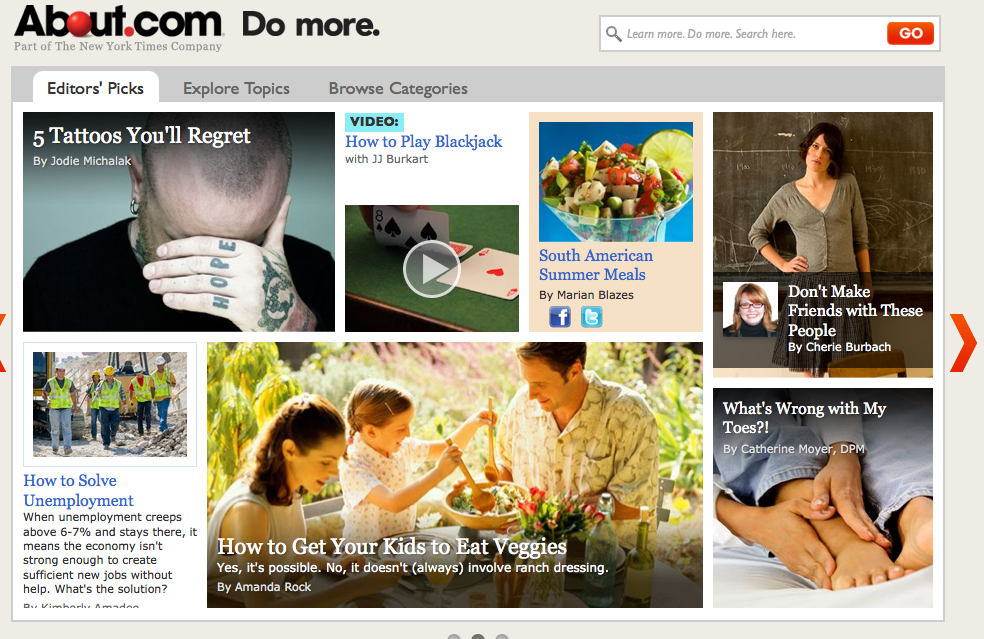
Here was another top story:
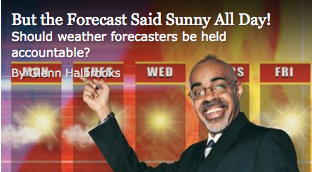
With About.com soon to be gone, the NYTCo. will have unloaded most of its non-New York Times businesses in a relatively short time. In the last thirteen months, the company has unloaded its Boston Red Sox stake and the sixteen smaller newspapers in its Regional Media Group. All that’s left are the Times, the Boston Globe, the International Herald Tribune, and The Worcester Telegram & Gazette. You have to guess the Massachusetts papers are up next.
It’s a big bet on the future of the NYT, and all these sales have shored up the company’s balance sheet for at least a few years. It’s also evidence that the Times believes its future lies in journalism people will pay for.
News accounts are calling About.com “struggling” and a “trouble spot” and “a costly and ill-fated attempt to extend its online publishing business.” And so it is.
But it’s worth noting that the NYT’s return on About.com is less bad than the headline number and some of these stories would lead you to believe. While it’s selling it for $140 million less than it paid seven years ago, About.com has brought in more than $270 million in operating profits in the seven years the Times has owned it (it lost $187 million last quarter, but that was due to a $195 million writedown of goodwill, a non-cash cost).
About.com has been and still is an extremely profitable division, even as its revenue has plunged in the last year and a half. Last year, its operating profit margin was 37 percent and backing out that whopping accounting charge, was probably still north of 30 percent in the second quarter. To put that in perspective, Exxon Mobil’s operating margin last year was 15 percent.
That said, About.com is a declining business whose low-quality information niche is hardly a natural fit with The New York Times, and it’s dependent on the whims of another company. Its fortunes turned in February 2011 when Google altered its search algorithm to deemphasize content farms like About.com. Since then, the unit’s sales have plunged more than a quarter and are still falling at nearly a double digit clip. By selling now, the NYT is saying that it doesn’t have any answers for About.com. And really, why should it?
So now the spotlight turns to what the NYT will do with the cash it gets from the sale. This JPMorgan analyst quoted in the NYT’s own story is a good example of Wall Street tunnel vision—who not to listen to:
Ms. Quadrani said she thought the sale was a good move for the company because it produces cash that can be used to reinstate a dividend for shareholders. It also lets the company focus on its core business.
The NYTCo would be really dumb to succumb to Wall Street (and, presumably, Sulzberger family) pressure to declare a dividend just yet. The cash infusion is a one-time event, and the company’s revenue and profits will decline because of the sale. Last year, a bad year for the news division, About.com brought in just 5 percent of the company’s total revenue but three-quarters of the company’s operating profit. Even in 2010, it brought in 28 percent of the company’s operating profit.
The cash from this sale should go to pay down long-term debt or to shore up its pension plan, not to mollify shareholders. The health of the company is far too fragile and its near-to-medium-term outlook is far too uncertain to start handing over cash to shareholders anytime soon.


So, in essence, you are saying people's toes don't matter? I love my toes!
#1 Posted by Dan, CJR on Thu 9 Aug 2012 at 11:40 AM
I happen to work as a writer for About.com, and although the site is unfortunately perceived as a "content farm," I take exception to the "low quality" assessment.
About.com actually employs many fine, highly educated writers (a number of whom hold master's degrees and Ph.D.s, not to mention many that have authored books and are leaders in their fields of endeavor) who uphold very high standards and take great pride in their work. I am one of them.
The great thing about working for this company is that we are free to write content that is lively, fun and even quirky when appropriate. In fact, we are encouraged to write articles that are authoritative, yet enable the readers to feel as if they are speaking with a trusted friend. This gives we About writers distinct personalities, which is rare in the realm of the Internet.
That said, the site has a tremendous amount of potential. I am hoping that the new owner realizes and capitalizes on this. Otherwise, I am very proud and honored to work as a writer for About.com, and I look forward to a long, continued association with the company.
#2 Posted by Alissa Wolf, CJR on Thu 9 Aug 2012 at 12:11 PM
I also don't know where you get the idea that About.com is a "low-quality" content site. I often end up there when I'm looking for info on something -- less so since Google changed its algorithm, but still fairly frequently -- and once I'm there, I can browse around for a long time on all the related articles each item links to.
Try clicking on the item about British cooking that's up on the home page now and see where all it takes you, just for instance. Or go look up some home repair issue, or pick any topic you're interested in.
The writing is quite good, not just informative but often entertaining, and the writers seem to know their stuff.
As a user, I'm with Alyssa above in hoping the new owners recognize its value and potential and keep it going as strongly as it has for the last few years.
#3 Posted by Jane, CJR on Thu 9 Aug 2012 at 12:29 PM
I believe this is the British cooking item Jane is referring to. Let me know if that's wrong.
#4 Posted by Dean Starkman, CJR on Thu 9 Aug 2012 at 01:22 PM
Someone who writes for the Colombia Journalism Review ought to try practicing some actual journalism before smearing hundreds of his fellow journalists. About.com may have plenty of content, but much of it is produced by professional journalists (myself included) and all of it is the product of hard work by real experts in their topic area. More than a cursory review of any About.com site would have revealed this fundamental truth. Instead, the author chose to base his entire characterization of About.com based on ... some headlines on the home page? Embarrassing.
#5 Posted by Robert Curley, CJR on Thu 9 Aug 2012 at 05:08 PM
As a writer for About.com, I too, am disappointed with this article's characterization of About.com as a "low-quality, content farm." I have written an article in defense of About.com, which details why many of us guides choose to work for About.
#6 Posted by Melanie Renzulli, CJR on Thu 9 Aug 2012 at 05:22 PM
I thought sites like Demand Studios or Squidoo were content farms. From what I understand, you have go through an editorial try-out process to be an About.com writer and get paid once you're in. I don't read it all that often, but I'm surprised to see all the negative press about it. What's the big deal?
#7 Posted by Susan, CJR on Thu 9 Aug 2012 at 05:28 PM
Content "farm"? Rubbish! As far as I can see About.com is one of the most authoritative and informative sites on the internet. I often use it when I'm looking for something and am always impressed by the quality of the information. These aren't some anonymous writers toiling away to pump out articles for Google. They are real people who are passionate and knowledgeable and (from the sites I have seen) professional in their field as well.
Shame you didn't do any real research for this article - unlike the About.com writers you're bagging.
#8 Posted by Andrew Smith, CJR on Thu 9 Aug 2012 at 05:42 PM
One could cherry-pick a few frivolous items from any medium and then label it rubbish. I suspect that could be done with "august" outlets like the New York Times and Washington Post.
The writer has failed to research About.com beyond the spreadsheets and a few headlines. His readers deserve better.
For example, he fails to mention that many About.com writers are respected, published authorities in their fields. This is particularly true in health-related areas of the site, but many of the topic editors (called Guides) have graduate degrees and years of experience writing and researching their chosen subjects.
Frankly, I expected a lot more from CJR. This is the kind of editorial laziness that this publication excoriates when found in others.
#9 Posted by Steve, CJR on Thu 9 Aug 2012 at 06:35 PM
I've never thought of About.com as a content farm because it has original content, often quite well researched and written by people who have some expertise in their field. I think of content farms as providing impersonal - often anonymous - writing that merely aims to answer as briefly as possible frequently Googled questions.
#10 Posted by Rebecca, CJR on Thu 9 Aug 2012 at 09:13 PM
As a former WSJ reporter, perhaps you should have dug a little deeper with some research into the site that you slammed as a 'content farm' instead of taking random headlines from the front page?
About.com employs more than its fair share of knowledgeable professionals. Maybe writers for the CJR don't have to worry about nuances such as management, advertisers, Google algorithm changes, and internet traffic trends?
A corporate balance sheet is hardly a fair representation of the writers behind a site.
#11 Posted by Greg, CJR on Fri 10 Aug 2012 at 05:36 AM
There is absolutely nothing wrong with a creative headline. If you clicked through, you might have actually learned something and had an interesting read. No one at About.com claims to be hard nose news reporters, except maybe the news sites. About.com encourages its writers to be creative and engaging, but still requires high quality researched writing. What's with bashing the About.com journalists as whole? Shows ignorance and lack of integrity on your part.
#12 Posted by Suzie, CJR on Fri 10 Aug 2012 at 12:15 PM
I'm a writer for About.com as well, and join my colleagues in insisting that you have misqualified the network by clumping us in with the recent crop of content farms paying unspecialized writers a pittance to churn out articles based on automatically generated keywords. Many of us, myself included, are professionally trained journalists who work for About.com alongside other freelance assignments, or in addition to full-time reporting jobs elsewhere. All of us have been vetted in a boot-camp style, three-week training course in which we have to prove our writing, editing, and technical skills. I have had many talented friends apply for positions at About, and not get accepted.
My colleague and expert in the Journalism topic at About.com has laid out an eloquent defense of About.com and its writers here, making all the points I would make if I weren't so busy researching and writing for my own site. While I will admit that quality across the network varies (due to a model in which site editors or "Guides" re-read their own work and do not have editors in the true sense of the word), there is much excellent, well-researched, and quality content on About.com, including news analysis, exclusive interviews, and pointed expertise in hundreds of topics. Your article, with all due respect, misrepresents us terribly.
#13 Posted by Courtney, CJR on Fri 24 Aug 2012 at 10:32 AM