Bloomberg’s Jonathan Weil wrote a swell column last week on the SEC’s latest Citigroup wrist-slap. Weil noted that one of the terms of the settlement was that Citi not violate the law again and reported that it was the fifth time in eight years that the same Citi subsidiary had settled with the SEC for violating the same law, each time promising not to do it again.
Which is a great catch.
Today The New York Times takes it on, broadens it, and gets a very good page one story out of it. Here’s what Edward Wyatt found:
A Times analysis of enforcement actions during the past 15 years found at least 51 cases in which the S.E.C. concluded that Wall Street firms had broken anti-fraud laws they had agreed never to breach. The 51 cases spanned 19 different firms.
First, why make somebody promise not to break the law? “Okay, copper. I promise I’ll never rob another bank again if you just let me go this time.” Lawbreaking is illegal. I suppose the only possible reason is so you can come down harder on subsequent violations—like a probation.
The problem is, there’s no “or else” here. The Times notes that Judge Jed Rakoff, who’s been highly skeptical of the SEC’s weak approach, asked it if it’s filed contempt charges against any repeat violators. The answer:
The S.E.C. said in a court filing Monday that it had not brought any contempt charges against large financial firms in the last 10 years.
So what’s the point? The Times asks Robert Khuzami, the former Deutsche Bank top laywer (who dealt with at least some CDO stuff) turned SEC enforcement chief (emphasis mine):
Robert Khuzami, the S.E.C.’s enforcement director, said never-do-it again promises were a deterrent especially when there were repeated problems. In their private discussions, commissioners weigh a firm’s history with the S.E.C. before they settle on the amount of fines and penalties. “It’s a thumb on the scale,” Mr. Khuzami said. “No one here is disregarding the fact that there were prior violations or prior misconduct,” he said.
A promise is only a deterrent if you know violating it will incur increasingly unpleasant consequences, as any child could tell you.
As far as disregarding prior violations, here’s Weil on Citi:
The commission already had two cease-and-desist orders in place against the same Citigroup unit, barring future violations of the same section of the securities laws that the company now stands accused of breaking again. One of those orders came in a 2005 settlement, the other in a 2006 case. The SEC’s complaint last month didn’t mention either order, as if the entire agency suffered from amnesia.
Perhaps from now on the SEC should list in its complaints every violated promise by those with whom it’s settling.
Because there are a lot of repeat offenders, and the Times is smart to put them in a graphic.
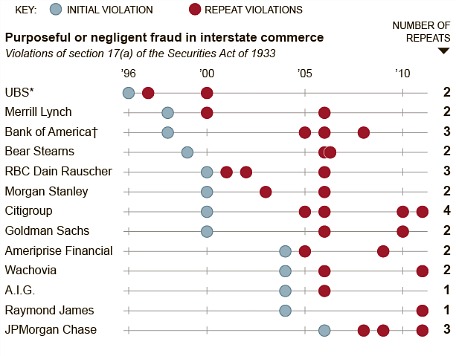
Click through to see the whole thing.

Barry Ritholtz makes a construction which I think gets to the heart of the matter.
The problem with the modern financial system is that it's filled with corrupt institutions lead by corrupt people. These people have bankrupted the banks and have made bankruptcy much more costly by rigging other institutions with default bets. One falls they all fall.
Therefore the emphasis of policy has been to save the banks to save the system, but it doesn't work that way.
http://www.ritholtz.com/blog/2011/11/once-again-its-sweden-sweden-showing-the-way/
"The banking system is more important than any single institution; If you as a banker are so incompetent as to blow up yourself and your firm, you should not be saved; instead, prepackaged bankruptcy, a/k/a temporary nationalization, is the preferred route to protect the overall system.
The choices are stark: Emulate either Japan or Sweden....
The Japanese approach — Save the Banks! — is a result of their Keiretsu, and is the model embraced first by the Bush White House, and the Federal Reserve, than by Congress, and lastly by the Obama White House. I have argued this approach is in large part why the post-crisis economy has been so moribund, with sub-par GDP and Employment the rule."
Why were the banks saved in Japan? Because they were linked to other industries through shares and their failure would bring down the economy.
Why are the banks being saved in America? Why are the same corrupt people left in charge to risk public and depositor money? I think part of the reason is because of nationalization = socialism demagoguery, partly because it's a huge task for government institutions like the FDIC to take over bankrupt BOA, Citigroup, and others, but also partly because these institutions might be linked to eachother by derivatives and their failures would bring down the economy.
In which case, the policy focus should be to
A) neutralize the derivatives using law to make them retroactively inert and the parties they're signed with should refund the premiums and tear up the contracts
B) save the system.
Reporters really should be looking into these CDS derivatives to try and find how many are out there, who's failures they're betting on, and who's exposed to the risks should failures start happening.
Otherwise the banks are always going to get pats on the wrist with their dollops of free money because they have fiscal dynamite wrapped around their chests and everyone who matters knows it.
#1 Posted by Thimbles, CJR on Fri 11 Nov 2011 at 03:03 AM
A fun little read on the Greeks who should default but can't because the markets have rigged them with cds's. So the ECB is trying to write down debt without our and out saying it's a default
http://globaleconomicanalysis.blogspot.com/2011/10/credit-default-swaps-useless-as-hedge.html
And I learned a new term:
"Language Arbitrage: You’re Not a Sucker, You’re a Customer
Banks that play this game call it “language arbitrage.” Anyone that bought sovereign credit protection on Greece after accepting ISDA “standard” documentation without modifying the language now finds that they are on the wrong side of an “arbitrage.” An arbitrage is a riskless money pump. In this case, it means that money has been pumped out of credit default protection buyers with no risk to their counterparties, the financial institutions that ostensibly sold them credit default protection on Greece."
I guess average consumers and investors had better learn how to play the bank's arbitrage games.
#2 Posted by Thimbles, CJR on Fri 11 Nov 2011 at 03:31 AM
Another day... Another case of the government not working.
Government regulation simply doesn't work.
#3 Posted by padikiller, CJR on Fri 11 Nov 2011 at 07:14 AM