Story length in journalism by itself doesn’t mean much. We read too many news stories that are just too damned long.
But, on the other hand, without going long, it’s hard to achieve greatness. It sure makes harder to tell a story or lay out evidence, much less capture nuance and complexity. A longer story signals to readers that this story is important and that more work went into it.
This is to say that your average 4,000 word piece is just going to be reported more deeply and edited more heavily than your average 400-word FT news story, say. It’s possible there’s a great business journalism haiku poet out there, I suppose. Let us know if you spot one.
The Wall Street Journal’s page one has long been the standard-bearer for business writing and reporting, at least for newspapers. It took news and turned it into narrative nonfiction, everyday, twice a day, for decades. But Rupert Murdoch made it no secret that he disdained the Journal’s page-one tradition of long-form journalism, and it’s been de-emphasized under his ownership. That’s our qualitative impression, anyway, based on reading the paper, following the tealeaves, and talking to former colleagues.
I wondered if you could quantify it, though, so I turned to Journal corporate cousin Factiva to put together these charts showing the drop-off in long-form reporting on page one of the paper.
Here’s the number of A1 stories longer than 1,500 words in the last decade (note that I annualized all the 2011 numbers in this post since we’ve still got eleven-plus weeks left this year):
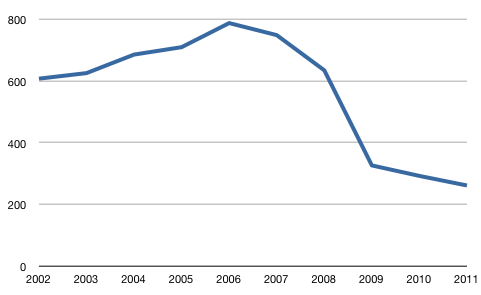
Murdoch took over at the end of 2007, defenestrated Marcus Brauchli four months later, and these stories have plunged a stunning 70 percent in the Murdoch era.
Naturally, shorter stories have replaced them. Here’s a chart of under-1,500-word stories on page one going back a decade (not including the What’s News columns):
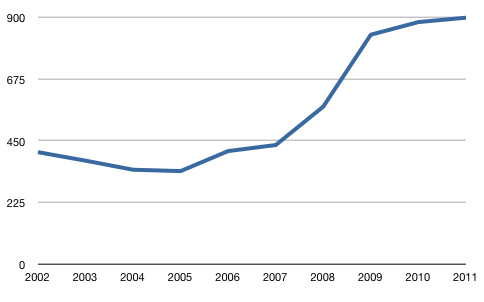
Shorter stories have doubled under Murdoch and Thomson. It’s worth noting that almost all of the short stories in the pre-Murdoch years seen on these charts were aheds. If you removed aheds, this jump would be much more dramatic.
Really long stories—the special ones given lots of space—basically don’t exist under Murdoch. Here’s a chart of 2,500-plus word stories on page one:
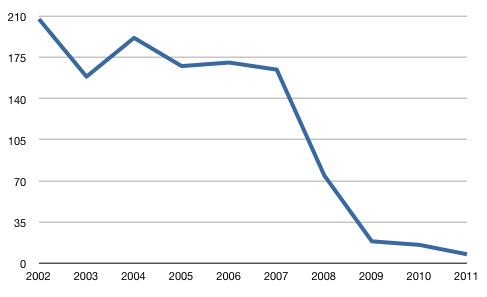
That’s a roughly 95 percent drop.
It’s not just page one, either. Here’s the number of 1,500-word stories throughout the paper:
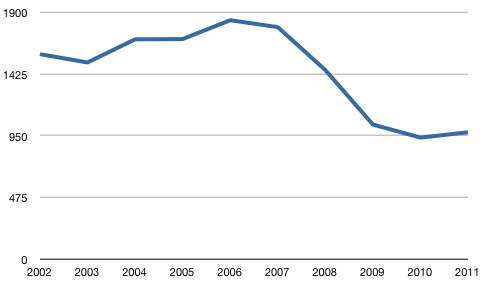
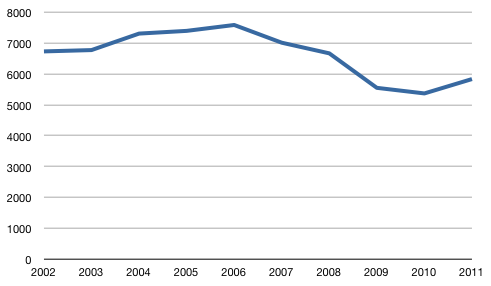
Even thousand-word stories are down significantly:
This isn’t because total stories have been decreasing. Story counts in the paper have been steadily going up, even before Murdoch took over, as Audit Head Veterinarian Dean Starkman wrote last year in “Hamster Wheel“—and that’s not including things like blog posts, video hits, and early news stories for WSJ.com or “speedys” for Dow Jones Newswires.
Certainly, the Journal still does lots of top-flight work, and most stories don’t need 2,500 words. But many do, and how does going short as a policy help readers understand the really important stuff like systemic problems, corporate misbehavior, business innovation, or sweeping economic change?
UPDATE:
Felix Salmon responds here in favor of Murdoch’s move toward shorter stories.
I’d suggest that what he misses in saying that readers “want their news-delivery mechanism to be as efficient as possible” is that these old WSJ stories, for the most part, weren’t news stories at all—at least in the traditional sense of “this happened yesterday so we’re reporting it today.”
Most of the time they weren’t something you had to read. They were something you wanted to read. Somwhere between a long newspaper story and a magazine piece, and now they have been diluted or have disappeared.

This is actually meaningless unless you also include figures on the Journal's circulation/paid subscribers or however it is they measure readership over the same period.
#1 Posted by Anbes, CJR on Tue 11 Oct 2011 at 02:56 AM
Hi Anbes,
Thanks for this, but I don't follow the logic. Why would we need to include circulations figures? The point of the post isn't about what's popular, but about story length as indicator of quality.
#2 Posted by Dean Starkman, CJR on Tue 11 Oct 2011 at 07:38 AM
"But many do, and how does going short as a policy help readers understand the really important stuff like systemic problems, corporate misbehavior, business innovation, or sweeping economic change?"
It gives them more information, faster. More stories, less detail.
This is just the way of the world. If you did a similar analysis on any major paper in the last 20 years that has undergone a similar management transition and remained successful, I suspect you would see similar results.
People want volume and if they need depth they look to other sources - in the business community in particular they turn to specialized trade publications.
#3 Posted by padikiller, CJR on Tue 11 Oct 2011 at 08:20 AM
Oh, yeah, trade pubs -- they'll really delve into the issues of declining middle-class incomes, wage inequality, health care failings, institutional corporate fraud and the legalized bribery of campaign fundraising. Sure. Remind me of where exactly all those stories ran in CFO Journal, Modern Grocer and Vending Machine Times?
As I was always told in journalism school, "Auto Services Operator Magazine" IS the Fourth Estate. And I believe it was Thomas Jefferson who vowed, "Were it left to me to decide whether we should have a government without International Water and Irrigation magazine, or International Water and Irrigation magazine without a government, I should not hesitate a moment to prefer the latter."
So, yeah, in trade pubs we trust. Thanks for that.
#4 Posted by Brian O'Connor, CJR on Tue 11 Oct 2011 at 10:34 AM
Take it down a notch, Brian..
You're griping about coverage of commie talking points - social issues.
Dean was writing about, and I was talking about, in depth business coverage.
Most people today just want to know if Liberian rubber production will make target. They don't want to know about the intertribal strife that is keeping the rubber workers from showing up on the plantation. The few people who do care about the underlying details can turn to myriad sources of information instantly available to them that simply weren't there 20 years ago, including online trade publications, subscription services, academic journals, local news operations, etc...
Mainstream portals need volume to survive. I'm not saying the loss of in-depth analysis is good thing - I'm just agreeing with Dean that it is a real thing.
If anything, where social and business stories converge, I think we're getting too much slanted coverage of these politically charged stories from the leftists with axes (like yours) to grind. The government programs that have created the mess are largely ignored, while "corporate greed" stories (except for Solyndra, of course) abound.
#5 Posted by padikiller, CJR on Tue 11 Oct 2011 at 10:56 AM
Paddy boy, you're the best argument against your own opinion. Getting all your insights from Douche-Nozzles Today just doesn't work.
#6 Posted by Brian O'Connor, CJR on Tue 11 Oct 2011 at 11:04 AM
Yap to Dean about th opinion. It's his, not mine. I'm just agreeing with him.
#7 Posted by padikiller, CJR on Tue 11 Oct 2011 at 11:22 AM
I'm not sure, but I think Anbes (first comment) point is that he feels that if lower word count leads to higher circulation then it's a good thing. More sugar after all delivers more calories to the body. Sadly, just as sugar leads to diabetes, the shorter stories and the TL;DY mentality of today is leading to an epidemic of surface understanding and we're now seeing the results as society has been hijacked by those who know how to take advantage of the stupid.
http://theendisalwaysnear.blogspot.com/
#8 Posted by nahummer, CJR on Tue 11 Oct 2011 at 12:15 PM
This is why I stopped renewing my WSJ subscription in 2009 after about 15 years of subscribing. They've replaced these stories with news on subjects you can in many other publications..
#9 Posted by Greg Andrew, CJR on Tue 11 Oct 2011 at 02:21 PM
Going back a few years, when a big story happens, the FT always had a habit of running three or four stories about it, to capture all the angles. Meanwhile the WSJ would organize it all into one longer story.
DId the WSJ start following the FT style in this, or did it just lose depth. That's not clear from the story length numbers. Perhaps in the age of the internet, having four stories on different aspects of a subject is easier to navigate through on the web, and thus the WSJ is just breaking up what used to be very long stories into pieces.
#10 Posted by Beancounter, CJR on Tue 11 Oct 2011 at 02:43 PM
Beancounter (comment #10) hits the nail right on the head. It is no secret that Murdoch wanted WSJ to look and read more like the FT — that is, with more short stories, but covering more angles. One often now sees an ahed story in the WSJ that includes notes at the bottom to several other stories throughout the paper (including in other sections) that provide different angles to the same story.
And in a time when news impacts different industries and different readers in far more nuanced and micro ways, I think it makes more sense to have the multi-angle, shorter story approach rather than the big, 2,500-word piece that bogs people down in more words than substance.
#11 Posted by Keith Trivitt, CJR on Tue 11 Oct 2011 at 03:29 PM
After Murdoch bought the WSJ I did not renew my subscription. I'm looking for thoughtful journalism, something that looks at a number of different perspectives so I can learn, compare other positions and be better informed.
It simply astounds me that the WSJ was sold to someone like Murdoch, but given the state of journalism today, I should not really be surprised.
#12 Posted by Mike Malter, CJR on Tue 11 Oct 2011 at 08:38 PM
Beancounter and Keith Trivitt,
I think you're making the same mistake Felix did in his response. See my update above.
#13 Posted by Ryan Chittum, CJR on Wed 12 Oct 2011 at 12:12 AM
I have argued this point with my conservative brother. Not only is he a Murdoch supporter but also believes Fox is truly the #1 in news. I said than that the WSJ would soon become a financial tabloid like the Sun or the late News of the World.
Looks like I have been proven right.
Too bad, I used to really enjoy the stories, the detailed information given by the long format stories. Now I rarely read the WSJ, It's just not the same as the old paper.
#14 Posted by Admiral j, CJR on Wed 12 Oct 2011 at 01:35 AM
Ryan,
First, good to know CJR writers view the comments of readers that they disagree with as a "mistake." I'd suggest it is that exact mindset that has gotten American media into such a mess in the first place.
But beyond your condescending response that my observation and opinion are a "mistake," allow me to make one more point before I bow out of what seems more and more to be a pointless discussion of article word counts:
You can still have a great, in-depth, forward-looking analysis piece in fewer than 1,000 words. The FT does it every day, as when it publishes multiple, side-by-side stories that cover a single topic from several angles. And that is exactly why the FT is growing, while NYT and others struggle on the print side (among several other factors).
#15 Posted by Keith Trivitt, CJR on Wed 12 Oct 2011 at 04:35 PM
Keith,
I don't see how "mistake" is condescending, actually. It's just a turn of phrase, not an expression of old media arrogance.
Speaking of which, American media may have had serious editorial problems and may have indeed been arrogant. Let's say they were, for the sake of argument. But their mess is directly attributable to the collapse of advertising models, not editorial issue, be it journalistic snobbery or anything else. That's not to say that the journalism was good or bad, but it is a fallacy (mistake), and a common one, to say, they're in trouble because of editorial sins. They may have sinned, but they're in trouble for other reasons.
And, I like long stories.
#16 Posted by Dean Starkman, CJR on Wed 12 Oct 2011 at 06:52 PM
The closer newspapers get to publishing soundbites, the more they marginalize themselves.
Why pay for a newspaper for a little information when you can listen to the radio or watch TV for free?
Meanwhile, those who want to read more, not less, flee to magazines and academic journals.
#17 Posted by keith roberts, CJR on Fri 14 Oct 2011 at 05:49 PM