Sign up for the daily CJR newsletter.
Alan Mutter’s post the other day—“The incredible shrinking newspaper audience”—got me thinking: is the newspaper audience really shrinking?
So I called him up, and we’re going to disagree. A lot depends on what you call an audience.
But, really, it’s growing.
Alan cites studies from Pew and elsewhere that say (I’m condensing for the sake of brevity; go ahead and click through): The percentage of people who used a print newspaper in the last week to get local news ranged from 36 percent in metro areas to 42 percent in small cities (much lower than during print’s heyday); and Web penetration isn’t much better; that 44 percent of Americans own smartphones and 22 percent own tablets, a doubling of tablet penetration in just one year; and that two-thirds of consumers go to “three or more sources” for local news each week.
He also cites an NYT study that says while 53 percent of the Boomer generation (those 55 and older) said they read print newspapers, only 22 percent of Millenials (ages 18-34) and 32 percent of Generation Xers (ages 35-54) used the medium and that “smartphone use is far higher in the younger cohorts than among Boomers.”
There are handful of vague perceptions flying around about newspapers these days. There’s the general idea that newspapers are going to hell in a handbasket and increasingly irrelevant. There’s the idea held by a segment of the newspaper business that believes that while subscriptions are down, readership as measured by traffic is up, way up, and takes some comfort in that. And there are the experts like Mutter who believe that the industry is kidding itself. There’s actually truth in all of them, but the question today is about audience size.
Let’s start with figures from the not-disinterested Newspaper Association of America, which keeps the circulation numbers and passes along ComScore and Nielson Nielsen traffic figures. The data say:
—Daily print newspaper circulation is indeed down, 20 percent, to 44.4 million, from 55.4 million in 2000 (aka “back in the day”).
—Newspapers’ unique visitors number about 110 million/month this year, up modestly (7 percent) from 103 million or so in late 2010, using comScore data. (The NAA previously used Nielson Nielsen data before, which isn’t comparable, apparently, but those figures rose also rose to 69 million in early 2010, up 72 percent, from about 40 million in 2004. That’s as far back as it goes).
Alan argues there is a huge amount of noise in those Web numbers, and there is. “Uniques” are a famously problematic metric—if I read the Chicago Sun-Times on my phone and my computer, I count as two.
You don’t want to lump print subscribers and Web visitors together because they could be the same people, and often are. What’s more, and Alan’s point is undeniable, this isn’t the loyal “audience” of yore. People zooming by via a Facebook link are not the same as print subscribers and in fact are much more likely to be loyal to Facebook than to the source of the link.
So, you need to discount the NAA’s Web figures, but to what? Unknown, but something well above zero.
Alan sends a link that quotes analyst Greg Harmon who has spent a lot of time on newspaper Web traffic:
As Harmon has discovered in studying the website traffic at dozens of newspapers for several years, online news consumers are not created equal. The audience, he says, falls into three distinctly different categories:
:: 25 percent of the unique visitors consist of loyal readers who visit a newspaper site an average of 20 times per month and sometimes multiple times a day. :
:: 21 percent of the audience comprises incidental readers who visit between one and three times a month. :
:: 54 percent of the visitors are what Harmon calls “fly-bys” – people who may come once a month in response to a link on another website that steers them to the newspaper.
Clearly, many of the 110 million people who visit newspaper websites, probably half, aren’t print subscribers, and many do so regularly. And all I need are 11 million Web readers to get newspapers’ audience back to where they were in 2000. I’m ready to discount Web traffic a lot, but not by 90 percent.
So in a technical sense, and in a real sense, newspapers’ audience is expanding.
Alan says in a note:
It is proper to say that lots of people look at newspaper articles from time to time. But occasional perusal – driven by a search engine or through social media – is not the same as consistent, persistent paid readership.
No doubt. Let’s call it a disagreement over the definition of audience.
I’m not saying that those numbers are something to write home about; just that the audience for local newspapers is larger than it used to be, including Web traffic, and probably significantly larger.
Does this make newspapers great? No. Does this make their future bright? No. Does the industry use its comScore figures to kid itself? No doubt it does.
And it’s undeniable, as Alan suggests below, that on a relative basis, newspapers are indeed shrinking.
But the absolute numbers count, too, and here are a couple things to consider when considering newspaper audience and influence.
When Pew, or anyone else, says that people surveyed said they used the “Internet,” “social media,” “mobile devices,” or digital media as a “source” for local news, it does not mean that the news itself came from a non-legacy news organization. As we’ll see, the opposite is much more likely to be true.
Pew says, for instance:
Urban and suburban residents also use a wider variety of local news sources on a regular basis. Close to half of urban (45 percent) and suburban (51 percent) residents use a combination of traditional, online and mobile local news media to get their local news, compared with 38 percent of those living in small cities and 27 percent of rural residents.
But, the “online and mobile” local news media refers to the delivery device, not the source. The same goes for aggregators, described as “Web native” sources in the New York Times study.
As Pew’s Tom Rosenstiel tells me in a note:
Getting a precise count of how many people are getting content that originated in newspapers from survey data is quite difficult for a host of reasons.
If people are going to an aggregator such as Yahoo News or even Huffington Post, they may not recognize the original source for the content they access.
Similarly, if they are reading a wire service story they may not know how to categorize that. If they are accessing content through a search engine, such as Google, and clicking on multiple links, they similarly may not be able to recall or identify the “source” that produced that story.
Add to the challenge of separating source from platform is the challenge of language and categorization…who is an aggregator now? Who is an originator? As the technology expands, even describing different platforms or making sure that people understand the question becomes challenging.
Finally, there is the challenge that people do not do consume media the same way each day. Most Americans read newspapers and watch TV. What is shrinking is the daily or seven day a week consumer, because people have so many more options. Digital technology is a delivery system. It is sometimes, less often, a source. But these are difficult conceptual differences to capture in a national survey of a representative sample of the public.
Got it. Obviously, since newspapers still earn much more from print operations than digital, the fact that many may be getting news from mobile phones or tablets is not necessarily great news for them. The fact that newspapers’ core audience is aging and that only a fifth of younger readers get their news from print (though, as we’ll see, there’s a catch here) does not bode well either.
On the other hand, it doesn’t mean their audience is shrinking. The opposite is true.
Why is this important?
The answer is in Pew’s underappreciated 2010 study of the Baltimore news eco-system, “How News Happens” (a great piece of work, and not just because it supports my hunches), which traced where “new information” actually originated for six important local stories across subject areas (a police shootout, the governor announcing budget cuts, the closing of a local theater etc.) The answer was of course the (hobbled) Baltimore Sun, other newspapers, local TV stations and other “traditional” sources, while new media pitched in a fraction.
The big graphic is here:
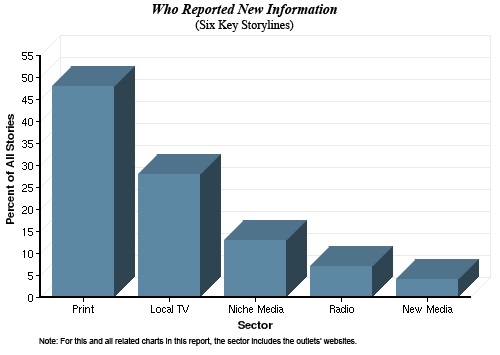
And, if you read the report, you’ll see the social media share looks bigger here than it actually was. For instance, it gets credit for a Tweet sent by a Sun reporter.
The bottom line is that the overwhelming amount of “new information” on major local stories came from newspaper and TV.
That’s the stealth influence of legacy media in the news ecosystem. Whether they can make a nickel off of this influence, I don’t know.
Looked at from another way: What appears to be a flourishing news environment rests on a severely weakened news gathering system.
Of course blogs have broken important stories, including in Baltimore . And it is true that people now turn to many sources for local news, about 300 in Chicago, according to this new study by the Chicago Community Trust.
But the Baltimore study, Rosenstiel tells me, is the only one to trace the information back to its original source, and the source is legacy news organizations.
A final word from Alan:
I agree that newspapers have influence that goes beyond their own brands, but they always did, being to this day the primary source of most broadcast news reports. Because the audiences of both newspapers and broadcasters have been fragmented in the digital era, none of them have the market share, mindshare or commercial power that they had prior to the arrival of the Net.
Fair enough.
Listen, the fact that the overwhelming amount of actual new information originates from desiccated newspaper newsrooms is decidedly not good news for anyone.
As a measure, the 2010 Baltimore study also found that the “trigger” for stories—precisely who set the news agenda, as it were—was the government (62 percent of the stories).
But that’s a separate question.
If I’m right that newspapers’ audience is growing, not shrinking, and if the Pew study is at all representative, then newspapers and legacy news organizations still underpin the news-eco system.
This is worth recognizing for its own sake. Another question becomes what can local newspapers do to bring their commercial power and mind and market share into closer alignment with their influence?
Has America ever needed a media defender more than now? Help us by joining CJR today.