Sign up for the daily CJR newsletter.
LAKE JACKSON, Texas — When Lisa Kelly learned she had leukemia in late 2006, her doctor advised her to seek urgent care at M.D. Anderson Cancer Center in Houston. But the nonprofit hospital refused to accept Mrs. Kelly’s limited insurance. It asked for $105,000 in cash before it would admit her.
Sitting in the hospital’s business office, Mrs. Kelly says she told M.D. Anderson’s representatives that she had some money to pay for treatment, but couldn’t get all the cash they asked for that day. ‘Are they going to send me home?’ she recalls thinking. ‘Am I going to die?’
Re-reading Barbara Martinez’s recent page-one story in The Wall Street Journal about a Texas woman’s Kafkaesque experience with the U.S. healthcare system, even proponents of long-form journalism can see the obstacles that story presents to a reader.
The first is the subject, the U.S. healthcare system, which we already know is screwed up. So the chance of finding a surprise in the story, that is, some news, seems scant.
The second is its length: 2,408 words, about fifty-three newspaper inches, which cover about half a page in gray type.
The third obstacle is the reader’s natural skepticism: a nonprofit hospital asks for $100,000 in cash that very day before it will admit a very sick patient. That can’t be completely right, can it?
But it can.
There has been a lot of talk recently about the replacement of one editor at The Wall Street Journal with another.
One goes, another comes. What of it?
Good coverage of the greased exit of Marcus Brauchli, including in the Journal itself, revealed that the dispute, for all its media-power-play aspects, is in the end actually an argument over journalism, of all things—more esoterically, even, over journalism forms.
Sure, there were some turf issues, but in the main Brauchli had tried—half-heartedly, it turns out—to mediate between the Journal’s tradition of longer-form, fully developed stories and demands from News Corp.’s Rupert Murdoch and the publisher he appointed, Robert Thomson, for something else:
The new owners were demanding newsier stories and more general news. Mr. Thomson, who took the floor after Mr. Brauchli, noted that some Journal stories appeared to have the ‘gestation period of a llama’ (that is, nearly a year). He said ‘the New York Times and the Financial Times are the enemy, but the real enemy is time’—by which he meant the risk of wasting the reader’s time. He said stories needed to be shorter and more alluring, and warned of ‘articles unread, jumps un-jumped, wisdom untapped.’
And here is the Journal editorial rank-and-file’s reaction to Brauchli’s exit, nicely summed up by The New York Times:
The news cast a pall over the newsroom, where Mr. Brauchli is liked and respected, and his exit reinforces fears that The Journal is retreating from its focus on business and sophisticated, in-depth reporting.
And they’re right. The Journal is retreating from sophisticated, in-depth reporting.
It’s not hard to see what Murdoch and Thomson have in mind for the new Journal. A blizzard of shorter stories that don’t jump and that take no more than a day to report, with a heavy emphasis on scoops, adds up to…
John Gapper, the Financial Times’s chief business commentator, has it right: the FT itself.
He wants, in other words, to put shorter and pithier news stories on the fronts of the news sections. This is destined to cause huge uproar at the Journal because it conflicts with tradition but, to be honest, I think he is right.
This is an Anglo-Australian newspaper model—straight, wire-service-type business news coupled with extensive and often smart analysis inside.
That’s fine, except what’s lost in this scenario is what makes American newspapers distinct from and superior to their Anglo-Australian counterparts: fully developed features, investigations, and just plain original reporting—that is reporting that takes longer than a day.
These stories aren’t about deals, typically.
They do more than report what some institution did yesterday.
They don’t offer warmed-over political analysis you can get anywhere.
The American model offers—requires—the kind of reporting that won The Washington Post three of its six Pulitzer Prizes this year: investigations of deplorable conditions at Walter Reed hospital, Vice President Cheney’s behind-the-scenes influence, and unaccountable security contractors in Iraq.
Prizes aside, it is also a form that American readers across the country have understandably come to expect, indeed demand.
It is why the Charlotte Observer embarked on a massive project—yes, it took a year—exploring soaring foreclosure rates in its communities.
It’s why the Palm Beach Post spent two years—two llamas worth, by Thomson’s metric— exploring corrupt land deals involving local public officials.
It’s why the Los Angeles Times scrutinized U-Haul’s unsafe practices.
It’s just, if you are an American newspaper, what you do. For me, it’s the key part.
Read all about them on The Washington Post’s inaugural Top Ten Investigations list.
The Brauchli vs. Thomson debate, such as it was, is a version of the quality/quantity dispute that has been around newsrooms since Gutenberg. It has taken on feverish intensity lately thanks to the Internet, which has two essential attributes—it is wrecking newsprint fundamentals and it is always on, allowing (and often demanding) publication at a moment’s notice. Believe it or not, it even takes place at the Columbia Journalism Review, where, contrary to widespread belief, we do not sit around on bamboo mats clinking finger cymbals all day. That’s what administrators do.
The Thomson position—more, faster—isn’t always wrong, but in this case it is.
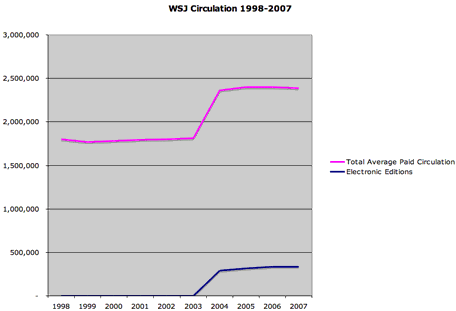
First, you’d think from the hysteria surrounding the debate that the Journal, like the newspaper business generally, has been bleeding circulation, hence the urgent need for change.
Quite to the contrary, actually. Despite what I and at least one other person see (1) as a period of journalistic decline over the last 10 years or so, at least on page one, subscription levels have held their own, the Audit Bureau of Circulations says:
Second, Thomson has misdiagnosed the problem.
Nick Denton over at Gawker reports that Thomson recently gave a bizarrely off-the-mark dressing down to the Money & Investing staff, the Journal’s core financial section, for laziness and arrogance, or something:
According to two attendees, Thomson berated the assembled reporters for their lack of aggression in reporting news and their arrogance. The Journal, he said, took this attitude: ‘If we haven’t written about it, it’s not news.’
Denton mistakenly goes along with Thomson’s analysis, but says it was poorly communicated.
Actually, Thomson misunderstands his own organization, particularly that particular section, which is about as laid back as your average chicken-processing plant. If the anxiety level in the Journal newsroom, always sky-high, got any higher they’d need a Prozac dispenser near the vending machines. What I’m saying is, that place is tight.
If the staff has been beaten on some deals lately it’s not a laziness problem. It’s just that—thanks largely to the Journal itself raising deal-worship to near cult status—everyone is now killing themselves to get those stories. It’s just going to happen.
And I know it’s heresy these days, but I also find absurd the idea that the world’s business-press readers—outside of Wall Street—are clamoring for the next Mars-Wrigley scoop.
Does it really make a difference to most readers who aren’t trading in the stock in question who had that story first? It really doesn’t. Really, it matters to them only slightly more who makes their candy bar at all.
Look, deals are fine, great even. But it is/was the genius of the Journal—what made it different and better—that it treated deals and all routine business news as a given on its way to offering much more.
This was the insight of Barney Kilgore, the post-World War II editor and executive who created the modern Journal: The paper would pay business-press readers the compliment of believing that if they had a minute, they might also be interested in the struggles of an inner-city honors student; how the tobacco industry used ammonia to boost cigarettes’ impact; or whether Bobby Thomson was stealing signs when he hit the most celebrated homerun in baseball history (2).
The editorial changes now under way represent the ascendance of a cramped, deal-centric vision of a business newspaper over an expansive one.
This outcome was predictable and predicted by me, repeatedly, along with Slate’s Jack Shafer, and maybe a million other people.
The biggest surprise, in fact, is the lack of defense out there for the idea of an expansive Journal.
Shafer now believes “what’s done is done” and even finds some principle in the idea that a newspaper owner ought to have his way, no matter what agreements he may have signed as part of the deal.
Denton buys into the idea that the Journal had gotten old, fat, and complacent:
Let the Columbia Journalism Review and other tenured hand-wringers bemoan the decimation about to be visited on the editorial ranks at the Wall Street Journal. In any war, a high casualty rate among officers means battlefield promotions for the ranks; some turnover is what the gerontocracies of the American newspaper industry most need.
He writes of “self-indulgent feature writers” and endorses the idea that the Journal needs to compete “more fiercely” for scoops.
Gapper of the FT also goes along with the idea that long-form daily journalism is outmoded and the world is clamoring for a world of FTs:
The world has changed since Kilgore and readers have less patience and spend less time with their papers. They want more easily accessible and clearly organised and illustrated news articles.
As I’ve said, the drop-off in the quality of the Journal’s page one in the past decade has been real, and it clearly hurt. For one thing, it left an opening for the Thomsons, Dentons, Gappers, the Australians and Brits, to argue that the old Journal model was tired and out of date.
I say—in fact, I know—it wasn’t the model but the execution.
Great stories will always keep the cynics and bean counters at bay.
My favorite part of the Martinez story, by the way, is the chemo bag bit; I add emphasis because I like the detail:
One day, Mrs. Kelly says, nurses wouldn’t change the chemotherapy bag in her pump until her husband made a new payment. She says she sat for an hour hooked up to a pump that beeped that it was out of medicine, until he returned with proof of payment.
Someone (Nick? John? Robert?) please remind me: Why do we think readers don’t want this?
1. “The Path That Led To Murdoch
David Ignatius
The Washington Post
Aug 2, 2007
pg. A21
2. “Inside Baseball: Giants’ 1951 Comeback, The Sport’s Greatest, Wasn’t All It Seemed — Miracle Ended With `The Shot Heard Round the World’; It Began With a Buzzer — `Papa’s’ Collapsible Legacy”
By Joshua Harris Prager
The Wall Street Journal.
Jan 31, 2001.
pg. A1
Has America ever needed a media defender more than now? Help us by joining CJR today.