Sign up for the daily CJR newsletter.
“Information wants to be free. Information also wants to be expensive. Information wants to be free because it has become so cheap to distribute, copy, and recombine—too cheap to meter. It wants to be expensive because it can be immeasurably valuable to the recipient. That tension will not go away…. Each round of new devices makes the tension worse, not better.”
—Stewart Brand, The Media Lab
“The Internet is the most effective means of giving stuff away for free that humanity has ever devised. Actually making money from it is not just hard, it may be fundamentally opposed to the character and momentum of the net.”
—John Lanchester, London Review of Books essay, 2010
When The Wall Street Journal decided to charge for its online edition in 1996, the company did so without a great deal of deliberation. Rather, as Peter Kann, who was then the chief executive officer of the Journal’s parent company, Dow Jones, would later recall, “I didn’t know any better. I just thought people should pay for content.”
That was a novel idea at the time—that people should pay for news they got on the web. Today, after years of declining print circulation and disappointing online ad revenue, many news organizations have begun pondering whether to institute a subscription system for their online sites.
Pondering is still all most companies have done, though increasingly they are warming to the idea of charging for at least some of their digital content. Their hesitation stems from several concerns. Some are fearful they will lose so much web traffic that their online advertising revenue will fall significantly; others are daunted by the technological hurdles involved in getting a new online subscriber system to work in tandem with the one that has served print customers for years.
Also, subscription revenue has historically been such a small factor in the ad-driven media business that many news organizations wonder if they would ever get much return on the investment.
Publishers usually cite three reasons to charge for online products. One, of course, is to increase subscription revenue. Another, less obvious, is to stanch the erosion in legacy operations: That is, since their readers now get the content they want for free online, why would they pay for a print subscription? If you start charging for digital access, shouldn’t that protect your more profitable print business? Finally, there is evidence that a paying audience is more valuable to advertisers because it demonstrates deeper commitment by those readers.
A few online-only news organizations have tried pay schemes, usually to charge for premium content beyond their free websites. Politico launched its “Pro” version in early 2011, charging $2,495 a year for in-depth coverage of such topics as energy or health care. That puts Politico into competition with older publications like Congressional Quarterly, now owned by the Economist Group, and newcomers like Bloomberg Government. At a much lower price, ESPN.com offers access to its “Insider” site, with exclusive blogs, videos, and tools, at prices ranging from $30 to more than $70 a year. And to ensure there’s a bundle, online subscribers also get ESPN The Magazine, a biweekly print publication.
The paywall issue is especially acute for newspaper sites. In the months leading up to publication of this report, most of the attention of journalists was directed at The New York Times‘s new digital subscription service. Before that, though, the conversation about paywalls in the U.S. had focused on two staunch believers in the digital subscription business: The Wall Street Journal, which began charging in 1996 shortly after its website launched, and the Arkansas Democrat-Gazette, which started imposing online subscriptions in 2002.
Walter Hussman, publisher of the Arkansas paper, has portrayed his site’s paywall as a way to protect the more lucrative print edition. The online subscription service “does not justify itself as a revenue stream,” Hussman has said. Print subscribers get the online edition for free.
The Wall Street Journal sees it differently and has consistently charged print subscribers extra for digital access. And the difference between those strategies is manifested in the publications’ number of digital subscribers: WSJ.com has around 1.1 million subscribers (including those who also get the print edition), or a bit more than half of its print base. The Democrat-Gazette has around 4,400 subscribers to its “electronic edition”—about 2 percent of its daily circulation base. Its print circulation, though, has remained remarkably steady while that of other papers has declined precipitously. In 2006, the Democrat-Gazette’s daily circulation was 176,910. Daily circulation now is listed at 186,962, though some of that strength is due to a merger of operations with some small Arkansas papers whose subscribers are now counted in the Democrat-Gazette’s total.
But how replicable are these two models? The Wall Street Journal provides content geared toward financial decision making and reaches a more elite and affluent audience than most news organizations. The Arkansas paper is the dominant news organization in its state.
To see how news executives figure out whether to charge online, we examined the decision-making processes at two large metro newspapers—The Dallas Morning News and The Miami Herald. Each thought about the same issues, relied on similar data—and then embarked upon completely different strategies.
Both papers have histories as journalistic powerhouses in their home markets. The Herald, which has been owned by McClatchy since 2006, has won twenty Pulitzer Prizes, on subjects ranging from local election fraud to the Iran-Contra scandal. The Morning News has won nine Pulitzers and has dominated the Dallas market since its parent company, Belo, bought and closed the rival Times Herald in 1991.
But both have experienced significant declines in their print circulation, and both had reason to believe that their free websites might be partly to blame.
At the Herald, circulation had been steadily declining for years. The Herald and its Spanish-language sibling, El Nuevo Herald, fell from a combined daily circulation of 393,382 in 2005 to 261,657 in 2009. Most of the decline was outside the Herald’s “city zone”—its core in Miami-Dade County. The Herald has also cut back discounted bulk circulation to schools, hotels, and other institutions.
The trend has been similar in Dallas, where the Morning News has dropped from 373,586 daily circulation in 2007 to 264,459 in 2010. In part, that is also because the paper began to focus on its most loyal print subscribers a few years ago. The News trimmed back most of its delivery beyond a 100-mile radius of Dallas, though it still circulates in Austin, the state capital, which is 200 miles away. “We reduced footprint in the state,” says John Walsh, senior vice president for circulation at the Morning News. “Advertisers were saying they’re not interested outside the core market.” That helped eliminate some extraneous expenses. It took so long to get newspapers to Odessa, about 350 miles west of Dallas, that the delivery person “had to spend the night in a motel after delivering the paper,” Walsh says. “It was like the Pony Express.” The Morning News also eliminated much of its single-copy sales effort, removing 9,000 of its 10,000 newspaper racks around the metro area.
A few years ago, the News began doing studies about the price sensitivity of its subscribers. Executives wanted to know if the remaining readers were now a core of the faithful who would be willing to pay much higher prices for home delivery. One study indicated that a 40 percent hike in the price of a subscription would result in a loss of around 12 percent of its subscribers, says publisher James Moroney. That emboldened executives to raise the price of a monthly subscription aggressively, from $21 to $30 in May 2009 and then to $33.95 in 2011—one of the highest prices for any metropolitan paper in the country.
In those days, Moroney was convinced that free digital access was the way to go. In May 2009, he told a U.S. Senate committee holding hearings on the state of the newspaper business that “if The Dallas Morning News today put up a paywall over its content, people would go to the Fort Worth Star-Telegram.”
Within a few months, though, Moroney began reconsidering his aversion to a paywall. In remarks in the fall of 2010 to a small group at the Carnegie Corporation, Moroney provided this analysis: “The Morning News does 40 million page views a month. If we could sell out three ad positions on every page every day at a $7 CPM, we would yield $10 million” a year. That, he noted, would cover less than a third of his editorial costs—even as those costs have dropped as newsroom staffing has fallen from 660 at its peak to around 400.
More fundamentally, Moroney had concluded that a focus on volume—either in the form of cheap print subscriptions or of web traffic that generated insufficient revenue—had damaged the news industry’s economic vitality. “What I most fear about this obsession with volume is it underlies the persistent belief that if we will just grow sufficiently large audiences online, then eventually we will sell enough advertising to be sustainably profitable,” he told the group. He added, “There is more supply [of online ads] than there is demand. And the explosive growth of social media only ensures this imbalance of supply and demand will persist for a considerable period of time.”
Others at the Morning News noticed that traffic to the website had grown as print subscription rates rose. Why pay more for print, some readers seem to have reasoned, when you can get the same news free online? “We found when we raised the price of the paper, a lot of people migrated to dallasnews.com,” says executive editor Bob Mong.
The News launched an aggressive pricing scheme for its digital content in February 2011. People who don’t subscribe to the paper must pay $16.95 a month to get access to the web, iPad, and iPhone versions of the Morning News. Print subscribers already paying $33.95 a month get unlimited access to any digital edition.
It is a paywall, but not an absolute one. Stories that strike the editors as “commodity” journalism—such as breaking news, or weather and traffic updates that could easily be found elsewhere—are free to all. More proprietary or exclusive journalism requires a subscription. (Currently, about half of the stories on the site’s home page have open access.)
When Moroney announced the pay plan, he and his staff were predicting that page views would drop by 40 to 50 percent. “I’m not confident we’re going to succeed,” he told Nieman Journalism Lab. “But we’ve got to try something.” In an interview a few weeks before the paywall launched, he portrayed the strategy as a way to help return journalism to one of its former, and highly profitable, roles as a one-stop storehouse of local news. “At least for a period of time, you can restore the bundle,” he said.
In late April 2011, six weeks after the pay plan launched, the News did see traffic declines—though less, so far, than Moroney had predicted. Unique visitors were down 17 percent, and page views declined 28 percent, compared to the same period in 2010. Mark Medici, director of audience development for the News, declined to disclose how many new digital subscribers had signed up, but did say that 27 percent of print subscribers had enrolled for digital access.
Traffic declines were also on the minds of Miami Herald executives when they debated whether to institute a pay plan.
The Herald did a survey on its site in October 2009 to determine users’ willingness to pay for its content. It was a voluntary and thus unscientific poll; nevertheless, the results didn’t inspire a great deal of confidence. Fifteen percent said they’d pay for unlimited access; an additional 23 percent said “maybe.” The dollar amounts weren’t meaningful, though; less than 5 percent said they would spend more than $10 a month.
Another survey question asked readers if they would make a “voluntary financial payment” to support the Herald’s site. Nearly a third said they were very or somewhat likely to do so, and so a few weeks later, the Herald’s site instituted a “tip jar,” attaching this plea to many pages on the site: “If you value The Miami Herald’s local news reporting and investigations, but prefer the convenience of the Internet, please consider a voluntary payment for the Web news that matters to you.” Says Armando Boniche, the Herald’s circulation director: “We got about $1,000 to $2,000 total. McClatchy [the Herald’s parent company] had us pull it after six weeks.”
Meanwhile, the Herald increased print subscription prices, though not to the extent that Dallas did, and stopped discounting the paper in Broward County, just north of its home market. And the Herald made a few smaller price-enhancing moves, such as charging fifty cents a week for an insert with TV listings and $1 extra for the ad-filled Thanksgiving Day newspaper. (Still, old habits die hard. In January 2011, the Herald was offering six months of seven-day delivery for just seventy-seven cents a week—a whopping 83 percent discount from its stated price.)
The Herald also did some paywall calculations, modifying formulas provided by the Newspaper Association of America. In 2009, when the study was prepared, miamiherald.com was attracting around 3.88 million unique visitors and
25.2 million page views a month. Its advertising mix was typical of many news organizations of its size. The Herald’s own ad department sold 42 percent of the total space available on the site, at prices averaging slightly over $13 per 1,000 views. An additional 36 percent of the available advertising space on the site was sold as “remnant”—very cheap—ads, under $1 CPMs. And 22 percent of the ad inventory on the site went unsold altogether.
The Herald first modeled what would happen if it imposed what Boniche calls a “10-foot wall” that would require a ninety-nine-cent monthly subscription for anyone to read anything on the site. The company predicted page views would fall by
91 percent, and total revenue from the site would drop by 76 percent. In other words, new subscription revenue wouldn’t come close to compensating for the ad dollars that would vanish as the audience contracted.
Herald executives mapped out several scenarios in which they could institute a paywall and match the results they were getting with a free site whose income was entirely from advertising. But all of the ideas required substantial leaps of faith.
One scenario, charging just ninety-nine cents a month for digital access, would require the Herald to attract 335,000 subscribers—about 30 percent more than the combined daily print circulation of the English- and Spanish-language newspapers. Another option: The Herald could make do with only 50,000 digital subscribers, but it would have to charge them nearly $120 a year—almost as much as a Wall Street Journal online subscription. Or, the site could enroll 50,000 subscribers at a more reasonable price (99 cents a month), but the paper would have to get advertisers to pay an impossible six to ten times its current rates for online ads.
Given how remote any of those possibilities seemed, the Herald analysis suggested that the most sensible approach to a paywall would be a hybrid model with 1 percent of users—about 38,000—paying $1.99 a month for unlimited access, and nonsubscribers getting a great deal of access as well. That would preserve the site’s traffic and advertising. But the revenue boost from digital subscriptions would be less than $1 million a year, and that sum, which represents less than 1 percent of the company’s overall revenue, didn’t seem worth the investment in time, marketing, and other costs.
One publisher whose digital subscription base has grown substantially is the Financial Times.
The FT started charging for access in 2001 and had a modest number of online subscribers for many years, getting to 126,000 online subscribers in 2009, slightly less than a third of its print subscription base. Subscriptions leapt to 207,000 in 2010, or more than half the number of print subscribers. And digital access isn’t cheap—the FT charges $259 a year for a standard subscription and $389 for premium access to more content deep within the site.
The growth is tied to a change in strategy. Nonsubscribers used to be able to come to FT.com and read ten free stories without registering; after registering, they could get thirty more stories a month before the subscription requirement kicked in. (This is similar to the “metered” approach that was put into effect in 2011 by The New York Times.) The FT toughened its policy in 2007 by preventing nonsubscribers from getting any stories without registration and limiting them to ten stories a month before the paywall rises.
So the wall has become less permeable. But Rob Grimshaw, managing director of FT.com, says there is a more fundamental change at work: Managers “used to approach it as newspaper marketing;” now they realize they “are direct Internet retailers.”
That means using behavioral targeting to determine which of the nearly three million nonpaying, registered users are most likely to subscribe and directing appeals to them. “What topics are people reading? We developed a dynamic model to determine readers’ propensity to subscribe”—one that is constantly shifting, with changes being made “on a daily basis,” Grimshaw says. “We’re spending the same amount on marketing as we used to, but we more than doubled our rate of acquisition.”
The FT has also been aggressive about shutting down “leakage,” as Grimshaw puts it—that is, unauthorized copying of stories. And when it comes to offering free content, “we’re more controlled than WSJ.com,” which offers free access to most of its stories via Google News and many stories at no charge on its home page.
The FT’s approach is a testament to the possibilities of paid content, but it also demonstrates how hard it is even for a premium publisher to extract revenue from digital advertising. When the FT’s parent company, Pearson, reported results in early 2011, it noted that for the FT Group, 55 percent of its revenue comes from “content/subscriptions” while 45 percent comes from advertising. A decade ago, the FT earned 74 percent of its revenue from ads, and only 26 percent from subscriptions.
“The outlook for the ad business online is quite bleak,” says Grimshaw. “There’s just not enough money there.” As a subscription site with a select audience, FT.com can charge higher rates for ads than general-interest sites. “We can create scarcity in a marketplace that has no scarcity,” he says. “In that light, subscriptions and ads are complementary.” But given that FT.com doesn’t use networks to fill up unsold ad space at discount prices, Grimshaw says “I’d be surprised if we sell 50 percent” of the site’s inventory.
After years of internal debate, The New York Times has entered the realm of pay-for-access. If its audacious and complex plan succeeds, that will likely encourage many other publishers to follow suit.
This isn’t the first time the company has tried online subscriptions. In 2005, the Times launched its TimesSelect service, charging those who didn’t get the print edition $49 a year to access opinion pieces. After a fast start, with more than 120,000 subscribers signing up in two months, the plan stalled, and the Times closed it down two years later; executives said the $10 million a year the service was generating wasn’t enough to compensate for the lost traffic and ad revenue.
So why would the Times take a new gamble to charge for digital access? Part of the answer lies in how dramatically the company’s revenue mix has changed in recent years.
In 2005, the New York Times Media Group, which is composed primarily of the Times’s paper and website, generated nearly $1.9 billion in ad and subscription revenue; about a third of that came from circulation. Five years later, ad revenue had dropped by nearly $500 million, while circulation revenue had increased because of aggressive price hikes for home delivery and newsstand sales. Today, circulation revenue for the group almost equals advertising revenue.
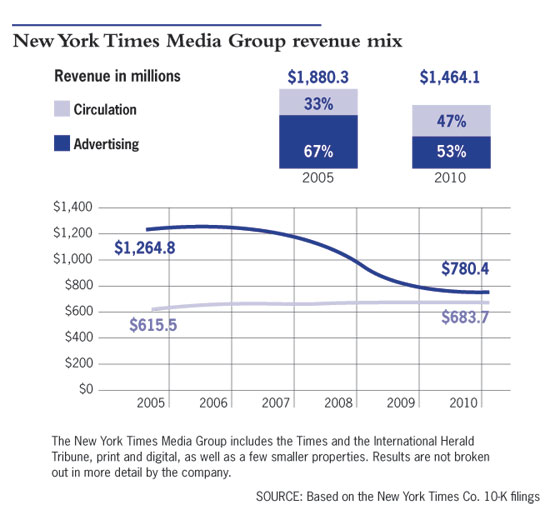
The Times‘s website is tremendously popular, but digital ads have been growing unevenly and don’t come close to making up for the shortfall in print ad sales. Indeed, the site, with more than 30 million monthly unique users in the U.S., contributes less than 20 percent of the Times‘s overall revenue.
So the Times devised a pay scheme that it hoped would be porous enough to allow occasional readers (around 85 percent of the total) to browse the site for free, but priced aggressively enough to generate significant revenue from its most devoted readers. It was a difficult plan to execute—requiring more than fourteen months, and reportedly costing tens of millions of dollars.
When the Times introduced the plan in March 2011, many found it to be unnecessarily complex. Users are supposed to be limited to twenty stories a month before they hit the wall. But because there are so many exceptions depending on how one accesses the site—for example, via Google, Twitter, or a blog—even some experts are befuddled by the plan. Staci Kramer, editor of paidcontent.org, which covers the digital media industry, wrote that “the logistics are far more complex than anything should be that doesn’t require a degree in quantum physics.” There are different rates for online, smartphone, and tablet access, ranging from $195 to $455 a year for the full package. Consumers can’t get annual, or even monthly, subscriptions, because everything is priced in four-week increments. And it’s expensive—more than twice as much as WSJ.com for full access. The price led one commentator to headline his blog post, “The New York Times is Delusional.”
The Times is unusual among big publishers in that it doesn’t require print subscribers to pay anything to access its digital editions. Both WSJ.com and FT.com have long charged everyone for online access, on the theory that digital editions offer utility, archives, and tools that the print edition can’t. And the Times is offering its print readers a sweet deal: weekend-only subscribers can pay as little as $327 a year, and in the bargain get a digital package worth almost a third more. Times executives insist this isn’t an effort to prop up the company’s more lucrative legacy revenue. “We didn’t make this decision to bolster print,” Janet Robinson, the Times’ Company CEO, said shortly after the pay plan debuted. “We made this decision to create a new revenue stream.” But given the way the offer is structured, it’s hard to argue that the two aren’t closely tied. The pricing—which is higher for tablets than for the web—also reflects Apple’s decision to take a 30 percent cut of subscriptions purchased through iTunes.
A few weeks after the Times instituted the pay plan, Robinson reported that more than 100,000 people had signed up for digital subscriptions. Most of those were enrolled for the introductory offer of 99 cents for the first four weeks, according to a person close to the situation, so it isn’t clear how that will play out when those subscribers start getting billed up to $35 for every four weeks of unlimited access.
In the Times‘s own story on its plan, a senior editor called the plan “essentially a bet that you can reconstitute to some degree the print economics online.” In fact, though, it is as much an effort to restore print economics to the print edition, by providing extra value to subscribers and giving them one less reason to forgo the lucrative newspaper for the digital edition.
And then there is the Newport Daily News, a 12,000-circulation newspaper in Rhode Island.
In 2009, the News decided that it was almost impossible to make money from digital ads. “The people we hired to sell advertising on the Internet just never did very well,” the paper’s then-publisher, Albert “Buck” Sherman, told Nieman Journalism Lab. So the News took an unusual step: print subscriptions were priced at $145 a year, print/online combos at $245, and online-only access would cost $345.
In other words, by forgoing the paper, a digital subscriber was on the hook for an additional $100. And Sherman wasn’t coy about the rationale: “Our goal was to get people back into the printed product.”
Some online-only content, such as videos and blogs, is outside the paywall; the same goes for columns like “Clergy Corner” and “Advice on Pets.” But anyone who wants access to the electronic edition, which reproduces the day’s paper, must pay. The company also operates a free site, newportri.com, designed to appeal to tourists and others looking for recreational or entertainment information.
In early 2011, the News dropped the price for print and online to $157, or a dollar a month above the print-only fee. But online-only access remains at
$345—a price that current publisher William Lucey III says, in an interview, “is more of a deterrent.” The amount was based on a scenario in which,“if everyone wanted only a digital product, this is what it would cost.”
The paper’s site, newportdailynews.com, gets around 80,000 visitors a month. Especially with online ad rates “dropping 20 percent a year,” that’s not enough to sustain the operation, which includes a newsroom of twenty-two people, Lucey says. Indeed, online ad revenue accounts for only 2 to 3 percent of total advertising for the paper.
After the change was put into effect, “our single-copy sales went up about 300 a day”—a bit less than 10 percent of overall single-copy sales. As the economy improves, “print is coming back. February [2011] was up 35 percent over last year” in ad sales.
And even with AOL’s free Patch site moving into town, Lucey says there are no regrets. “We found our comfort zone, and we stopped agonizing about it.” AOL, which launched the Patch site in Newport in July 2010, is sanguine: “The Newport Daily News does great work and has been a staple in Newport County for generations,” says spokeswoman Janine Iamunno. “There is room for all of us.”
So, which approach is best, free or paid?
Pay proponents often put it this way: High-quality journalism costs a great deal to produce, so users ought to pay to get it. Pay opponents have a counterargument: Paywalls cut sites off from “the conversation” online and will deprive them of the attention they need from blogs, aggregators, and social media.
We prefer to frame it as a business issue—and in that respect, it’s possible that neither side has it exactly right. In fact, pay plans may have little immediate impact on sites that are just getting into the business. The reason is that most companies are likely to have only small streams of online circulation revenue, which could roughly match advertising declines from lower traffic. Digital subscriptions may pay off in the years to come, but only if media companies can persuade consumers using new platforms—like smartphones and tablets—to adopt a pay plan.
Even before the Internet, subscription revenue didn’t amount to much for most news organizations. Print publications often underpriced subscriptions because they believed they could lose money on circulation and make it up on advertising from larger audiences. Broadcast TV and radio were free, and fees for cable stations like CNN are buried in bills that make it impossible to discern the true costs of content. So in the old world, Americans weren’t used to paying much for news; in the digital world, news organizations have spent fifteen years training their consumers to be freeloaders.
As a result, most people are happy to pay nothing at all for news, even as they have come to accept paying for other forms of digital content. A 2010 study of 1,000 adults commissioned by AOL showed that about four in ten people pay for “online content”—but that was a broad definition, including music and video.
Only 4 percent said they pay for online news. A Pew Project for Excellence in Journalism survey in January 2010 found little interest in paying: among “loyal news consumers, only a minority (19 percent) said they would be willing to pay for news online, including those who already do so and those who would be willing to if asked.” Another Pew study in January 2011 showed 23 percent of respondents who say they would pay $5 a month to get full access to a local newspaper online; that dropped to 18 percent when asked if they would pay $10 per month.
Some say such surveys miss the point. Porous pay systems like The New York Times‘s are being erected precisely so they will capture only the most devoted users. And a hypothetical question in a poll might not capture true sentiment. “Don’t survey based on what people say they would pay,” says Aaron Kushner, an investor who is mounting a bid to buy The Boston Globe from the New York Times Co. “No one expects to pay for news, so why would they answer differently?”
But even if pay schemes attract users, it’s hard to charge enough to produce a great deal of revenue. Kushner argues that most publishers are making the same mistake now that they made years ago. “The problem is they’re basing the price on cost or history rather than value. Forget pricing on cost,” he says. If anything, he says, digital editions should be more valuable because of their archives and interactivity. “Figure out what is the value of the product and then price against it. Publishers have been undervaluing their product for too long.”
There is, in some publishers’ pay plans, an aura of frustration over the inability to convert large online audiences into advertising revenue. Moroney, of Dallas, is simply being more candid than most when he notes that much of the News‘s online ad space goes unsold, and so a cut in traffic to the site will have little financial impact. Others, such as Albert Sherman of the Newport Daily News, frame a paywall as a way to protect the print edition, but some print circulation has already been lost because of free alternatives.
The best chance to make headway with pay schemes is likely with a device that people can hold in their hands. For most mobile phones and tablets, a commerce system is already in place, and the transaction is straightforward. Moreover, consumers have shown a willingness to pay for content on mobile devices, whether that involves ringtones or sports videos. So if publishers really hope to expunge the “original sin” of giving away content free online, they may be best positioned to do so not on the computers where they first gave away their wares, but on mobile devices that offer a more welcoming environment.
To continue to Chapter Six, click here.
To download this chapter as a PDF, click here.
Has America ever needed a media defender more than now? Help us by joining CJR today.