Nary a word has been spoken about climate change on the presidential campaign trail, and it’s a silence that some journalists find deafening.
In the last few weeks, a variety of reporters have called out the candidates for utterly ignoring the issue. The Associated Press’s Steven R. Hurst, for instance, reminded readers that just four months ago, Barack Obama told Rolling Stone that he suspected climate change would become a major point of debate.
“I will be very clear in voicing my belief that we’re going to have to take further steps to deal with climate change in a serious way,” Obama said. But that promise has come to naught, Hurst reported. Instead, Obama is fighting Republican challenger Mitt Romney “over the struggling American economy and stubbornly high unemployment.”
The New York Times’s Felicity Barringer observed that the candidates are willing to talk about energy policy (as they did last week), largely because it is intimately related to the jobs debate. But “climate change has been the issue that national politicians seem to avoid at all costs,” Barringer wrote. That’s a problem, National Journal’s Amy Harder argued, since “the next president will have to address [global warming], no matter who wins in November.”
Apart from the heat waves, droughts, and wildfires that have “thrust climate change back into the spotlight,” Harder wrote, “the State and Transportation departments must address a European Union cap-and-trade law aimed at forcing airlines to pay fees for greenhouse gases emitted by all flights to and from Europe. Yet neither candidate is addressing these unavoidable realities—at least not yet.”
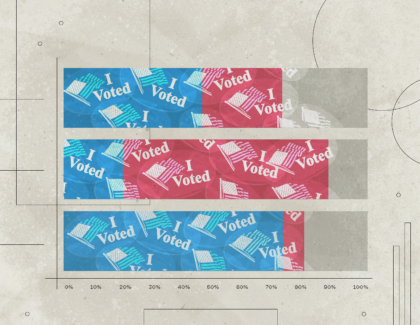
Last week, the Yale Project on Climate Change Communication released the results of a national survey conducted in March, which suggested that “taking a pro-climate stand appears to benefit candidates more than hurt them with registered voters.” According to the report:
- •  A majority of all registered voters (55 percent) say they will consider candidates’ views on global warming when deciding how to vote.
- •  Among these climate change issue voters, large majorities believe global warming is happening and support action by the US to reduce global warming, even if it has economic costs.
- •  Independents lean toward “climate action” and look more like Democrats than Republicans on the issue.
- •  A pro-climate action position wins votes among Democrats and Independents, and has little negative impact with Republican voters.
- •  Policies to reduce America’s dependence on fossil fuels and promote renewable energy are favored by a majority of registered voters across party lines.
- •  These patterns are found nationally and among 10 swing states.
Polls are murky, though. A survey conducted in June by The Washington Post and Stanford University also found that most Americans accept that climate change is real and want the government to take corrective action, but that they don’t think it’s the country’s biggest environmental problem. Moreover, there are a lot of other, non-environmental problems that people would like to see politicians address first, Gallup has consistently found.
The public might show more concern if the presidential candidates would only debate climate policy, or if the media could get them to do so, Drexel University sociologist Robert Brulle suggested in post for the Bulletin of the Atomic Scientists. In a recent study, Brulle and his colleagues found that statements by “elite” figures were the largest single factor influencing how much people worry about climate change. Quoting US Sen. John Kerry, Brulle accused Obama and Romney of a “conspiracy of silence,” pointing out that:
Citizens use media coverage of controversial issues to gauge the positions of elites they find credible, and then interpret the news based on ideology and party identifications.
It may still be true, as the AP’s Hurst put it, that “there is little chance that the few undecided American voters who will decide the razor-close election will cast their ballots based on the candidates’ position on climate change,” but taken together, the recent polls do suggest that climate change is an issue that deserves more attention on the campaign trail.
- 1
- 2
The climate is not the president's — or the government's — responsibility. Stop worshiping at the alter of the State. They are not gods. They are humans. Very flawed humans who prey on your gullibility. They are lying, scheming politicians. And that was a redundancy if there ever was one..
#1 Posted by Dan A., CJR on Wed 22 Aug 2012 at 03:48 AM
The biggest reason that nobody cares about climate change, is that climate, at least in terms of global temperature change, hasn't changed since 1998.
Indeed, according to NASA, the following years were warmer than 2011:
1998
2002
2003
2005
2006
2007
2009
2010
Indeed, the data indicates a very slight 14 year COOLING trend, following a pronounced warming trend that ended in 1998.
As for the "extreme" weather argument - the silly notion that AGW is evidenced by increased extreme weather conditions - where is the data? Where are the hurricanes?
Indeed it has been more than 5 years since a major (Cat 3 or higher) hurricane has made landfall in the U.S. This has been the longest period on record without a major hurricane.
But Hey! Why let the mere data get in the way of a leftist leverage point, right?
Well, the people aren't buying it. The effort to link the purported (and utterly corrupt) "science" of Warmingism to politics puts people off - especially true scientists (even those who lean to AGW theories).
If and when the global temperature starts increasing (and it might) and if and when climate change proves to be deleterious instead of beneficial, then, and only then, will anybody care about "climate change"
#2 Posted by padikiller, CJR on Wed 22 Aug 2012 at 08:12 AM
Padi, that's a fascinating table you link to, and my congratulations on your exercise in cherrypicking to try to avoid the obvious implications of the data. You did a fine job.
A good discussion of the technique as it has been applied to global temps by the deniers is found here:
http://www.nybooks.com/articles/archives/2012/mar/22/why-global-warming-skeptics-are-wrong/
It's a good read.
#3 Posted by garhighway, CJR on Wed 22 Aug 2012 at 08:33 AM
On the broader point of this piece, I am amazed that Newsweek offers up that much space (and its cover) to a piece that they don't bother to vet.
Is that normal? Or is Newsweek an outlier in deciding that accuracy no longer matters?
#4 Posted by garhighway, CJR on Wed 22 Aug 2012 at 08:37 AM
The "fascinating table" to which I linked is IN FACT the dataset published by NASA. If you have a problem with it, talk to them. The data is what it is.
As for "cherrypicking" - ANY analysis of the temperature record is cherrypicking.
Out of the 4.5 billion year history of the Earth, an accurate temperature record exists for only the last 130 years.
Forecasting a trend based on this record is the precise logical equivalent of looking at last year's temperature record and making conclusions with a purported accuracy of 0.01 degree K based only on temperature records taken in the last second of the last day of the year.
Which is STOOPID.
You can "cherrypick" to suit your cause - from 1900 to 1976 what do we have? Cooling.
From 1944 to 1993? Cooling.
From 1998 t present? Cooling
All the Warmingists are claiming that the "hot" July of this year is sort of proof of Warmingism, but what does the data say? In FACT, it says that in a 130 year temperature record, July has been warmer than this year in 13 prior years, the first of which was TWENTY YEARS AGO.
The FACT according to NASA is that the Earth has not warmed since 1998. This is just one of those true-thingies that won't go away just because liberals want it to.
The "implications of the data" (accepting the NASA data as valid) are that the Earth did in fact warm by about 0.8 degrees K over a 130 period, and that the warming peaked in 1998 and that we have seen a very slight cooling trend since then.
What we're talking about is a rise from 288.0 K to 288.8 K or an increase of 0.27% over more than a century.
So why the scary looking "hockey stick" graphs with steep slopes? Because the Warmingists deliberately scale a miniscule increase (outside of the margin of error of most thermometers, in fact) to a crazy slope in order to overstate their claims. That's why.
A 0.27% rise, when graphed at a reasonable scale over a 130 year period is almost indistinguishable from a flat, horizontal line.
I'm not saying Warmingism is wrong, any more than I would say Islam or Catholicism is "wrong". However, I won't become a believer until and unless I see incontrovertible data and open and logical methodology.
The name of the computer model that accurately forecast the average temperature of the Earth based on atmospheric CO2 concentration is ___________________.
When I get a defensible response, I'll convert to Warmingism.
Until then, color me skeptical.
#5 Posted by padikiller, CJR on Wed 22 Aug 2012 at 11:06 AM
Padi: On the table, you miss my point. Of course the data is from NASA. It's good data. (And I appreciate your not going full-hog denier and saying that NASA is cooking the books. Some of your denier buddies are in the full-thottle conspiracy theory, "Man never landed on the moon" mode.) But a cursory look at it shows the trend, and cherrypicking like yours ignores not only the overall trend but the basics of statistics when there is both signal and noise in the numbers. (I note your studious refusal to coment on Nordhous's piece which explains the math perfectly well. I don't blame you.)
On the topic of record highs and lows, you do get that they happen all the time, right? But it is Hansen's point (in his recent PNAS paper, which, because it is real, honest-to-God published science you will also ignore) that the frequency of severe events is increasing in a way consistent with AGW. (More energy in the atmosphere will manifest itself in uneven, inconsistent and volatile ways.)
On your model question, please define your parameters. What exactly are you looking for? A model that predicted termperature rise from when to when? Within what margin of error? There's a bunch of models out there, and many of them have done well, although most have been conservative.
Cheers.
#6 Posted by garhighway, CJR on Wed 22 Aug 2012 at 12:56 PM
You'll have to forgive Valois. She's unfortunately not all that smart when it comes to climate science and the implications of an approaching doubling in concentration of a well established green house gas.
She's rather clueless in this area, as she full throatedly admits.
http://www.cjr.org/the_audit/audit_notes_wsj_forgets_climat.php#comments
#7 Posted by Thimbles, CJR on Wed 22 Aug 2012 at 02:25 PM
I don't need to ignore the PNAS paper...
Talk about "cherrypicking"!
The paper compares 2006-2011 "extremely hot outliers, more than three standard deviations (3σ) warmer than the climatology of the 1951–1980 base period. This hot extreme, which covered much less than 1% of Earth’s surface during the base period, now typically covers about 10% of the land area."
And this 1951-1980 "base period" was selected how?
Arbitrarily. To promote Warmingism
WHY?
Well lets see why the authors claim they selected the base period..
"First, it was a time of relatively stable global temperature, prior to rapid global warming in recent decades. Second, it is recent enough for older people, especially the “baby boom” generation, to remember. Third, global temperature in 1951–1980 was within the Holocene range, and thus it is a climate that the natural world and civilization are adapted to."
OK... So HOW does a "relatively stable temperature" change the statistics?
And WHAT difference does it make, mathematically speaking, if old people can remember things?
And WHAT THE FRICK are these guys babbling about the "Holocene range"? FIRST of all, the difference in temperature now is only a fraction of a degree higher than it was in the base period..Certainly within the "Holocene range", But more importantly - WHY does it make any mathematical difference to have the base period temperatures confined to particular range?
The answer is clear... The "base period" was cherrypicked to provide the desired outcome.
Indeed, if we use a LONGER base period (1931-1980) incorporating even more time "prior to global warming in recent decades" (which is the first criteria, according the the PNAS paper for selecting a base period) we find that the 10% result gets knocked down to less than 3%.
There you go, Gar... Simply adding 20 years to the "base period" shoots the premise of the PNAS paper to Hell...
#8 Posted by padikiller, CJR on Wed 22 Aug 2012 at 03:16 PM
I don't know who you think you're intimidating or bullying with your false and idiotic jackass nonsense, Thimbles...
But it's on you, Dude. Not me.
If and when the crap hits the fan, don't blame me for your own stupidity and juvenile thug tactics.
If you can find some way to show that the Earth hasn't gotten cooler since 1998, I'd sure like to see it.
#9 Posted by padikiller, CJR on Wed 22 Aug 2012 at 03:25 PM
"The climate is not the president's — or the government's — responsibility."
The subject is human-caused climate change, not climate. Do try to keep up.
#10 Posted by Desertphile, CJR on Wed 22 Aug 2012 at 04:10 PM
Ps. Curtis, you can't blame the public for ranking climate lower on their priorities nor political campaigns for avoiding it when the news, predominately tv news, won't mention it.
Unless it's fox and other skeptics who only mention it by way of giving a kidney shot to the science.
So one of the major problems in the climate science community is that journalists can't communicate these issues effectively with the public, as shown in this study:
http://www.eci.ox.ac.uk/publications/downloads/boykoff07-geoforum.pdf
"Scientific findings constitute a specialized mode of knowledge that is almost always packaged in professional language. Scientists generally employ a lexicon of caution and speak in a language of probability, which usually does not translate smoothly into the crisp, unequivocal commentary that is valued in the press. In other words, the very language scientists employ plays into scientific uncertainty as a salient theme in media coverage (Weingart et al., 2000; Zehr, 2000). Therefore, scientific findings usually require translation into more colloquial terms in order for it to be comprehensible."
Professional Skeptics don't need to qualify their language with uncertainties because they aren't engaged in real science. Their game is persuasion not accuracy. The other issue is the coverage of the issue tends to be big and fatalistic. The public cannot get proactive about an issue which they feel society is unable to affect without unavoidable and unacceptable sacrifice. When framed like that, the environment on which we depend seems like an unavoidable and neccessary cost. As Margret Thatcher would have said T.I.N.A.
The media and the public has this framing backwards. The expense of a fossil fuel dependant society is unacceptable. Environmentally, we cannot sacrifice our food supply for our fuel supply. Climatic instability is an unacceptable cost. Fiscally, we cannot sacrifice an increasing share of our household budget for a finite resource that is increasingly scarce. Our gas bills are an unacceptable cost. Habitatually, if that is a word, we cannot continue to use increasingly dirty and risky means to extract difficult resources from our drinking water supplies and the bottoms of our oceans. Poisoned land is a byproduct of extraction. Cleanup bills are an unacceptable cost. T.I.N.A. Something has to be done about climate.
And it's up to government, academia, and industry to do that something. This is where public pressure can result in public policy and private innovation that turns societal adaptation into something that costs little and profits much. The public is pretty much unaware of these realities because environmental framing always pushes the responsibility for action onto the least responsible individuals - the individual. That approach ensures nothing will change.
And the coverage doesn't have to be that way. Folks at Columbia university have written paper demonstrating how to write about climate issues:
http://www.csc.noaa.gov/digitalcoast/_/pdf/CRED_Psychology_Climate_Change_Communication.pdf
This is something you, Mr. Brainard, should be pushing journalists to refer to. Journalists need to take into account the psychology of their audience in order for their coverage of an issue to translate into meaningful information for their audience. News, particularily TV news, can barely bring itself to mention climate unless some simpleton skeptic is there to present their skeptical case in simpleton terms. While that is principle is operative nothing is going to change and things that fail to adapt have an all to common ending to their story. We have a choice right now of how to end the human story - let's not end it with suici
#11 Posted by Thimbles, CJR on Wed 22 Aug 2012 at 04:39 PM
And of course these links would also be a good place for journalists to start learning how to report this issue in a way that makes a difference:
http://grist.org/article/why-climate-change-doesnt-spark-moral-outrage-and-how-it-could/
http://uoregon.academia.edu/EzraMarkowitz/Papers/1314311/Climate_change_and_moral_judgment
#12 Posted by Thimbles, CJR on Wed 22 Aug 2012 at 05:45 PM
"The subject is human-caused climate change, not climate. Do try to keep up."
Oh!
Pardon me!
In that case: Allegedly human-caused climate change is not the president's — or the government's — responsibility.
What other oh-so relevant technicalities do you wish to insert?
#13 Posted by Dan A., CJR on Wed 22 Aug 2012 at 06:54 PM
Argh. Markowitz paper's a dead link.
Here's a live one.
http://www.climateaccess.org/sites/default/files/Markowitz_Climate%20Change%20and%20Moral%20Judgement.pdf
And for those who prefer 20 minutes of video:
http://www.youtube.com/watch?v=4UWzRGEpHWU
#14 Posted by Thimbles, CJR on Wed 22 Aug 2012 at 08:19 PM
Of course if you prefer something really bite sized, tv folks, here's a blog post:
http://bigthink.com/age-of-engagement/why-few-americans-view-climate-change-as-a-moral-problem
"Azim Shariff and I (among others) have been exploring what research in the field of moral psychology can tell us about public (dis)engagement with climate change, another topic that has seen an explosion of research in recent years. In particular, we have been interested in why—despite a growing chorus of moral philosophers, political theorists, religious leaders and others calling for recognition of climate change as a moral imperative...many people appear to lack strong moral intuitions about the issue, the kinds of feelings that drive concern and compel us to action.
Why doesn’t climate change trigger the moral judgment system? The answer, we think, has a lot to do with the interaction between certain features of climate change on the one hand and how the human moral judgment system operates on the other. As Azim and I lay out in a recently published paper in Nature Climate Change, at least six distinct yet closely related processes likely contribute to weak moral intuitions about climate change."
Of course those problems aren't a problem for the people in the Valois community. As I have detailed in past conversations, they do not object to climate science on scientific grounds. The burden of proof has been met, the only objection they have is political in that a government structure "YARGH! COMMUNISM!" may be required to avert the end of human civilization. And these selfish people do not care if the world burns, so long as "the communists" are the first things on the bonfire.
http://www.thenation.com/article/164497/capitalism-vs-climate
"Equally significant has been a shift in emotional intensity. Climate change used to be something most everyone said they cared about—just not all that much. When Americans were asked to rank their political concerns in order of priority, climate change would reliably come in last.
But now there is a significant cohort of Republicans who care passionately, even obsessively, about climate change—though what they care about is exposing it as a “hoax” being perpetrated by liberals to force them to change their light bulbs, live in Soviet-style tenements and surrender their SUVs. For these right-wingers, opposition to climate change has become as central to their worldview as low taxes, gun ownership and opposition to abortion. Many climate scientists report receiving death threats, as do authors of articles on subjects as seemingly innocuous as energy conservation. (As one letter writer put it to Stan Cox, author of a book critical of air-conditioning, “You can pry my thermostat out of my cold dead hands.”)
This culture-war intensity is the worst news of all, because when you challenge a person’s position on an issue core to his or her identity, facts and arguments are seen as little more than further attacks, easily deflected. (The deniers have even found a way to dismiss a new study confirming the reality of global warming that was partially funded by the Koch brothers, and led by a scientist sympathetic to the “skeptic” position.)"
And we really can't live in a society with people who consider a 78 percent of land area drought as just another part of "the climate communist conspiracy".
#15 Posted by Thimbles, CJR on Wed 22 Aug 2012 at 08:35 PM
That Naomi Klein article in the nation link above is actually quite relevant to Curtis's subject, on second read.
"Days into his presidential campaign, with his home state literally burning up with wildfires, Texas Governor Rick Perry delighted the base by declaring that climate scientists were manipulating data “so that they will have dollars rolling into their projects.” Meanwhile, the only candidate to consistently defend climate science, Jon Huntsman, was dead on arrival. And part of what has rescued Mitt Romney’s campaign has been his flight from earlier statements supporting the scientific consensus on climate change.
But the effects of the right-wing climate conspiracies reach far beyond the Republican Party. The Democrats have mostly gone mute on the subject, not wanting to alienate independents. And the media and culture industries have followed suit. Five years ago, celebrities were showing up at the Academy Awards in hybrids, Vanity Fair launched an annual green issue and, in 2007, the three major US networks ran 147 stories on climate change. No longer. In 2010 the networks ran just thirty-two climate change stories; limos are back in style at the Academy Awards; and the “annual” Vanity Fair green issue hasn’t been seen since 2008.
This uneasy silence has persisted through the end of the hottest decade in recorded history and yet another summer of freak natural disasters and record-breaking heat worldwide. Meanwhile, the fossil fuel industry is rushing to make multibillion-dollar investments in new infrastructure to extract oil, natural gas and coal from some of the dirtiest and highest-risk sources on the continent (the $7 billion Keystone XL pipeline being only the highest-profile example). In the Alberta tar sands, in the Beaufort Sea, in the gas fields of Pennsylvania and the coalfields of Wyoming and Montana, the industry is betting big that the climate movement is as good as dead...
All of this means that the climate movement needs to have one hell of a comeback...Just as climate denialism has become a core identity issue on the right, utterly entwined with defending current systems of power and wealth, the scientific reality of climate change must, for progressives, occupy a central place in a coherent narrative about the perils of unrestrained greed and the need for real alternatives.
After years of recycling, carbon offsetting and light bulb changing, it is obvious that individual action will never be an adequate response to the climate crisis. Climate change is a collective problem, and it demands collective action. One of the key areas in which this collective action must take place is big-ticket investments designed to reduce our emissions on a mass scale. That means subways, streetcars and light-rail systems that are not only everywhere but affordable to everyone; energy-efficient affordable housing along those transit lines; smart electrical grids carrying renewable energy; and a massive research effort to ensure that we are using the best methods possible...
Traditionally, battles to protect the public sphere are cast as conflicts between irresponsible leftists who want to spend without limit and practical realists who understand that we are living beyond our economic means. But the gravity of the climate crisis cries out for a radically new conception of realism>, as well as *thimble_note: READ THIS/*thimble_notea very different understanding of limits."
#16 Posted by Thimbles, CJR on Wed 22 Aug 2012 at 10:14 PM
Obama already has enough problems defending his poor record. The last thing he wants to do is attach his wagon to the climate change scam. As for Romney he know that people are so sick of the climate change scam that even a mention of it will cause people to tune out. He doesn't want people to tune out to his message.
#17 Posted by Robert G, CJR on Sun 26 Aug 2012 at 05:37 PM