Sign up for the daily CJR newsletter.
Oil has always been a big story for obvious economic, environmental, political, and technological reasons. For decades, Americans have read about tanker spills, rising oil prices, shortages at the pumps, and delicate trade relations. More recently, the press has swarmed the story of prices topping $100 a barrel and OPEC’s refusal of President Bush’s request to increase production. But throughout the history of oil reporting, there has been one major aspect that the press has remained largely silent on: peak oil.
“Peak oil” is shorthand for the understanding that there is a finite amount of oil in the world and at some point we will hit a production peak, after which oil production will steadily decline until supplies are effectively exhausted. Present oil reserves took nearly 550 millions years to form and with current consumption rates, there is no possible way to replenish the resources before they are used up. However, the concept of peak oil is not only about the decrease of production, but also the end of cheap oil. As oil fields are depleted and the discovery of new fields decreases, oil becomes harder and thus more expensive to produce.
M. King Hubbert first introduced the concept in 1956 when he accurately predicted that U.S. oil production would peak in 1970. Since Hubbert’s calculation, hundreds of researchers have attempted to predict when the world’s peak will occur. Estimations have ranged over decades, but some place the peak in 2007. Production rates have leveled off for the past three and a half years at eighty-five million barrels per day, but with perennial growth in India and China especially, the International Energy Agency estimates demand will increase by two million barrels per day, potentially reaching ninety-eight million barrels per day in 2015.
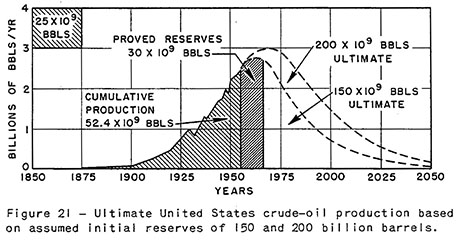
[Figure taken from Hubbert’s original 1956 peak oil paper.]
Peak oil is a relatively straightforward concept and it does get limited attention. A front-page article in The Wall Street Journal yesterday noted that it is influencing the maneuvers of billionaire oil trader John Fredriksen and the growth of oil field services companies:
Helping to fuel their rise is a growing fear that the world’s oil production may be about to plateau and decline. “Peak oil” anxiety has contributed to the steep increase in the price of crude, which has nearly tripled since 2004. Peak theory is now feeding into wider concerns that demand for all the world’s resources — not only oil but wheat, copper and other commodities — is increasing faster than supply, creating new limits to global growth.
Beyond isolated paragraphs such as this, however, journalists have been slow to explore its connection to current oil issues. Are rising prices at the pumps a result of the weakening U.S. dollar, low petroleum supply, or both? Could OPEC’s decision to not increase production rates be an acknowledgment of limited field capacities and diminishing reserves? While we won’t know that we have reached the world’s oil production peak until years after it happens, these questions are worth asking and the concept worth exploring.
The falling dollar has been made the culprit in many stories around the globe about rising petroleum prices. A March 4 article in the Los Angeles Times claimed market trading and the Federal Reserves’ interest-rate cut, which affected the value of the dollar, were to blame for $100-plus barrel prices. Peak oil was not mentioned once in the entire article. Articles the same day in USA Today and The Washington Post also concentrated purely on the stumbling dollar as the cause of rising prices.
A flood of articles about OPEC rebuffing President Bush’s plea for higher production also failed to mention peak oil. A March 6 New York Times article goes so far as to say: “Most energy analysts agree there is no shortage of oil.” Maybe, but to what degree does-or should-an undetermined, but almost certain, future shortage weigh on decision makers in the present?
“Discussing supply limits to the rate of oil production, much less the possibility of declining rates in the future, has been almost taboo,” says Sally Odland, an administrator at the Lamont-Doherty Earth Observatory in New York, who wrote her MBA thesis on strategic management of peak oil. “Since November 2007, with oil consistently above $90-$100 per barrel, the peak oil concept is breaking into the mainstream. The media now routinely mentions tight supplies, ‘looming limits to production’, the ‘end of cheap oil’, the tradeoffs of growing corn for fuel versus food, etc. Some reporters, especially in the investment community, even mention ‘peak oil’ matter-of-factly. But I’d say the majority of reporters covering the energy story still avoid the term, or include it only to debunk it.”
So why is it so hard to discuss peak oil in today’s news stories? One of the main reasons may be mixed signals coming from the scientific and oil communities. At a London conference in October 2007, chief executives from Total SA and ConocoPhillips announced that they believe oil production cannot go above 100 million barrels per day because of supply and technology limitations. The former head of exploration and production for Saudi Arabia, Sadad Ibrahim Al Husseini, agreed with the industry executives. However, other industry leaders from BP and ExxonMobil Corp. continue to deny supply limits. Within the science community, controversy surrounds when we will hit peak oil and what production rates will be at the time.
What is a journalist supposed to do with such a topsy-turvy issue? How soon is too soon for the press to really dive into peak oil? Can we learn anything from how reporters handle other unsettled environmental issues, like the rising sea levels? Odland thinks so:
Peak oil is going to drive many of our economic choices and our foreign policy over the next few decades. Sure, much of last year’s price rise is due to monetary inflation and depreciation of the U.S. dollar. But it still comes down to too much money chasing a relatively fixed amount of yearly oil production.
The oil industry is a tough beat. In order to fully comprehend the story, it seems one must be an expert in economics, science, and international relations. Synthesizing all these relationships and explaining them to a general audience is a lot to ask. A couple of notable projects have accomplished this – in particular, the Cleveland Plain Dealer‘s Crude Awakening series, which began in 2005. Still, peak oil is an extremely important piece of the modern oil story, and we need more journalists to sort through the competing claims and help us understand it.
Has America ever needed a media defender more than now? Help us by joining CJR today.