



Media attention to climate change has had its highs and lows; different parts of the world have covered the story in different ways. Keeping track of it all is Bruno Takahashi, associate professor of environmental journalism and communication at Michigan State University and research director of the Knight Center for Environmental Journalism. Recently, he spoke with CJR’s Lauren Harris on when, how, and where the climate crisis is reported. This interview has been condensed and edited for clarity.
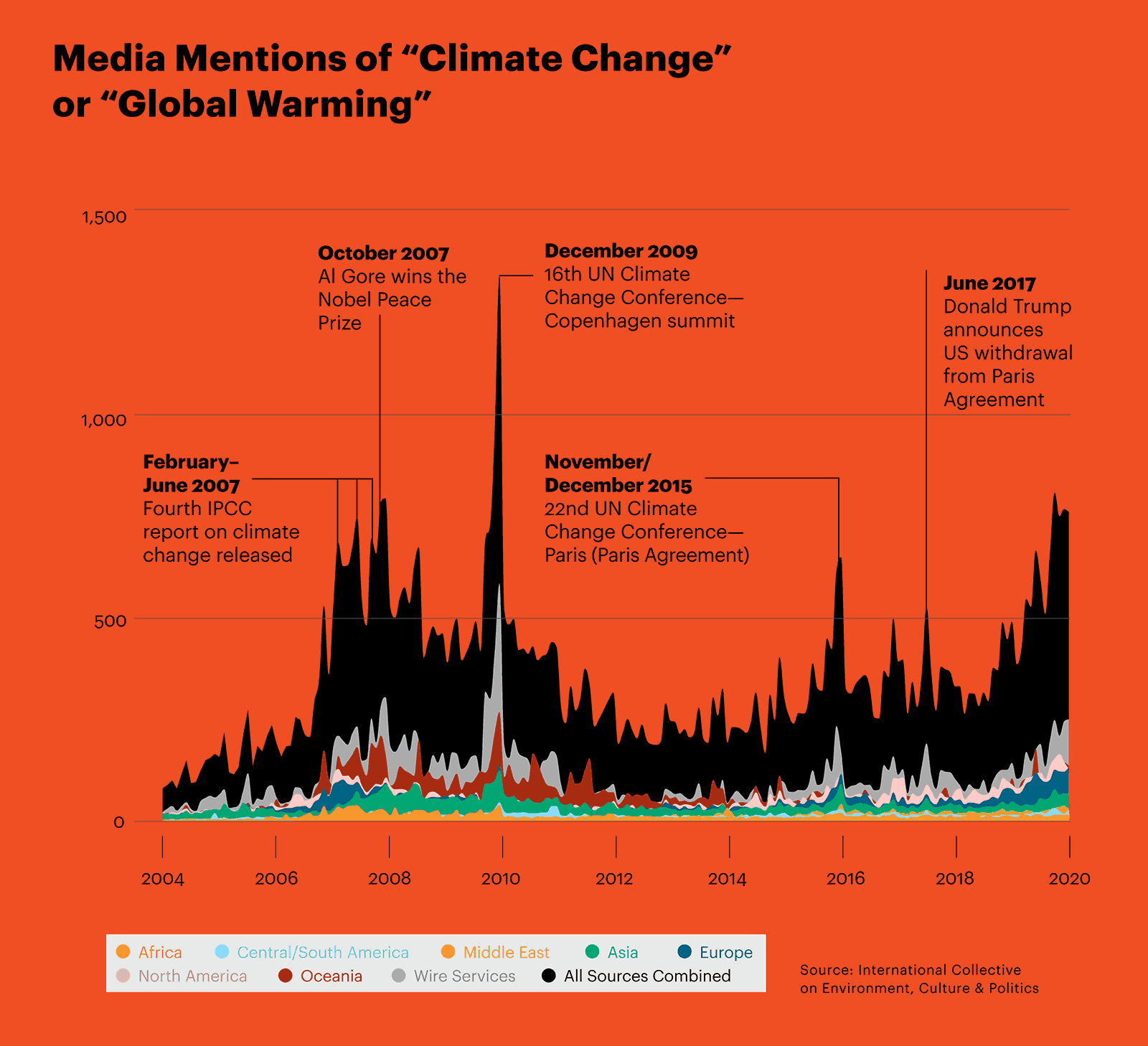
Q: What trends do you see in global coverage of climate change?
Coverage in developing countries tends to follow international trends in developed countries. The US and European coverage—that tends to dominate—really sets other media agendas around the world, particularly in volume. Overall, globally, there’s an overemphasis on mitigation as opposed to adaptation; that’s a big problem in the coverage everywhere.
In terms of framing, if there is a cultural affinity between two countries or commercial trade between two countries, or spatial proximity between two countries, they’re more likely to cover each other and to cover each other in a certain way. I think the framing that different countries use when they cover people who have a similar culture or shared economic interests tends to prioritize certain stories. When you look at a lot of Amazon rain forest coverage from places that are culturally different and geographically distant from the Amazon, there was basically no coverage of the people who live in the Amazon. Most of the coverage was, “Oh, let’s save the world.”
Q: What factors influence the focus of global news coverage?
Globally, it’s important to consider the role of wire services: the AP, Reuters in the UK, the Spanish agency EFE—which, because of the language, tends to dominate coverage in Latin America. The French have AFP. Wire services are becoming more and more dominant, because of the crisis in the business of news media around the world. It’s just cheaper for smaller outlets to purchase content as opposed to hiring their own reporters. That makes a lot of the coverage homogeneous and doesn’t allow more fine-grained coverage. Wire services are pretty neutral, pretty basic, and appeal to everyone, so they’re not specialized to your region.
But at the same time, there are more specialized news outlets out there than there used to be, covering just climate or just environmental issues. In Latin America, we have seen some smaller online organizations—Mongabay Latam, for instance, or OjoPúblico, in Peru—do in-depth coverage about deforestation and its relation to climate change, which we didn’t see before.
Q: What are some of the threats to climate coverage?
There’s certainly a lot of pressure when it comes to covering extractive industries—fracking, drilling for oil, logging, mining—which are obviously connected to climate change. There’s a nonprofit project by a consortium of journalists called Forbidden Stories—founded by the Freedom Voices Network—with reports about journalists who have been murdered or harassed or attacked because of their coverage of extractive industries. The stories aren’t necessarily about climate change, but they are certainly related to climate change. There can be a lot of political, economic, and physical pressure on the media to stop reporting or report stories differently in some regions.
Q: So if there’s a region where there’s a lot of financial power invested in some of those industries and it’s also a region that doesn’t have a strong record of press freedom—that’s probably a bad environment for climate coverage, right?
Absolutely. There’s research on this happening in places like the Philippines or Brazil. There are other countries where this has been documented, too, but with less specific research around threats to climate coverage.
Q: How does the tone of climate coverage vary in different parts of the world?
In considering tone, I look at whether or not the coverage says climate change is actually happening. And whether it says humans play the main role in the warming of the planet. In looking at Australian media or the coverage in the US, you can see some inconsistencies—nervous or skeptical or downplayed, or coverage that doesn’t highlight the catastrophic potential of climate change. But in the Global South, you don’t see that as much. That’s related to the level of skepticism that exists in governments that are more polarized, like the US.
Q: So, in the Global South, there used to be less coverage of climate change in general. But there never was much coverage that said “climate change isn’t real”?
Yeah. In developed nations, when you’re talking about reducing emissions and changing the energy grid, you’re really talking about changing lifestyles. When it comes to the Global South, I don’t think that those connections have been made, meaning that the discussions about climate change haven’t challenged the status quo or challenged the dominant industry, whatever it is in any particular country. Many of these countries—with the exception of the brics countries, Brazil, Russia, India, China, and South Africa—outside of those, the contributions to emissions are so small that that doesn’t really matter. But if a developing country starts talking about cutting back on our logging industry or cutting back on our fisheries? Then the discussion goes differently.
Lauren Boersma Harris is a freelance journalist. She writes CJR's weekly newsletter for the Journalism Crisis Project. Follow her on Twitter @LHarrisWrites.