Sign up for the daily CJR newsletter.
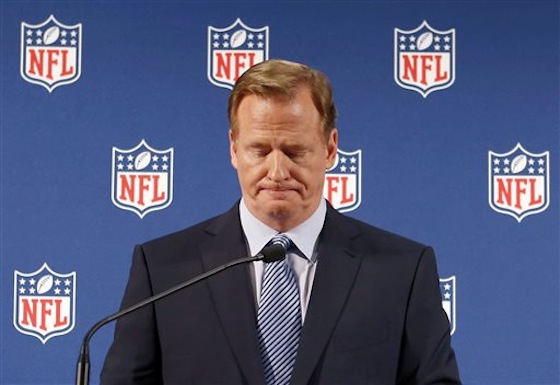
League of denial? NFL Commissioner Roger Goodell speaks at a press conference in New York on Sept. 19. (AP Photo/Jason DeCrow)
1. Checking the NFL’s numbers:
In the wake of the fallout over National Football League Commissioner Roger Goodell’s handling of his players’ domestic violence arrests, there have been multiple reports by journalists, who read the league’s filing of form 990 with the Internal Revenue Service, that Goodell was paid $44 million in the fiscal year ending March 31, 2013.
But there are lots of other leads for reporters to pursue based on what is in that filing, which is a report that every tax-exempt nonprofit organization has to file with the IRS.
For starters, there’s the existence of the form in the first place. How could the NFL — which helps negotiate billions in media and promotion deals for its member teams and which itself reported an operating profit of more than $9 million and $326 million in “program service revenue” — be given nonprofit tax-exempt status?
According to the filing, the NFL claims its tax exemption under section 501c(6). The IRS regulations define eligible 501c(6) organizations as the following:
Business leagues
Chambers of commerce
Real estate boards
Boards of trade
Professional football leagues
Huh? How did that happen? Neither the National Basketball Association nor Major League Baseball have that valuable status. What’s the story behind that?
n addition, is that status now in jeopardy in light of the NFL’s recent nosedive in public standing?
In fact, that same form 990 hints that the NFL has long been worried about at least the possibility of losing its special tax-exempt status. A footnote to a section related to the league’s liabilities states that the organization, since 2009, does an annual review to “determine whether a tax position of the League Office is more likely than not to be sustained,” and that, based on the review conducted for this report (the year ending March 31, 2013), the league believes its tax position will continue as is.
The next filing is due this February. I wonder what the footnote will say then.
Other items worth pursuing in the NFL 990:
The league reported $1,276,000 in lobbying expenses, plus another $7,139,000 in fees to Covington & Burling, the powerhouse Washington law firm (on top of $9,030,000 to Paul Weiss, Rifkind, Wharton & Garrison, its New York firm). That’s a lot of money being thrown around in Washington. What issues was the money spent on?
In addition to Goodell’s $44-million paycheck, the league’s “executive vice president for media,” Steve Bornstein, took home $26 million, and general counsel Jeff Pash received $7,862,000.
That is an unusually high salary for a general counsel — let alone one working for a “nonprofit.” It might be a good hook for a story reviewing the NFL’s multi-front legal problems — from head injury litigation, to disciplining players accused of domestic violence, to maintaining the status of that tax exemption.
In all three cases, most of the money the executives received was listed as bonus compensation — $40 million for Goodell, about $23 million for Bornstein and $4.8 million out of $7.8 million for the general counsel. In light of the league’s current troubles, a reporter — or a member of Congress at a hearing — ought to ask the league owners who set these executives’ compensation, what the bonus criteria have been and whether they will now be changed to reflect the league’s obvious need to worry about issues other than money.
Under “grants,” there’s a $20,000 donation to the National Association of Black Journalists. Should groups of reporters be seeking and accepting money from an organization they cover, especially one that is so much in the news?
Finally, there’s a $15,000 grant “to support 2012 convention” for something called “Association Women in Sports,” which on the form 990 lists an address in Neptune, New Jersey. I could not find any trace of that organization on the Internet, and its address appears to be a residence. Who is this group? And is it going to send back the $15,000?
2. Lobbying over livers:
This editorial from Bloomberg View makes a cogent argument about an arcane issue: allocation of organ transplants, in this case donated livers.
The Bloomberg editors support a proposal to reform how donated livers are distributed that takes advantage of advances in travel logistics and medicine that now allow organs to be transported from regions farther away than contemplated under the current system.
“Under the existing system, managed by the United Network for Organ Sharing,” the Bloomberg editors explain, “donated livers are prioritized for use in the geographic regions from which they come. In regions where the organs are relatively plentiful — in the South, for instance, where death rates are higher — they sometimes go to people who could easily wait longer for a transplant, rather than to sicker patients who may die without them. … A new system … would redraw the map of liver-donation regions to create just four large ones in place of the 11 smaller ones that exist today. Mathematical models suggest that sharing livers within these broader zones would save 554 [lives] over five years.”
As the Bloomberg editors put it, “What’s not to like about the change?”
The answer is that people needing livers in regions like the South would have to wait longer if their need isn’t urgent because they would be competing on a priority list with a larger pool of donees.
Two hospital presidents from different parts of the country and one senior official at the Department of Health and Human Services recently mentioned this controversy to me — and all three wondered why it has not gotten more press.
First, there’s the obvious story about who is producing the new mathematical models referred to in the Bloomberg editorial. And, more generally, who is lobbying whom to push for or block the proposed changes.
Second, what is the United Network for Organ Sharing that Bloomberg says manages the existing system? Its website says it is the “Organ Procurement and Transplant Network (OPTN) for the federal government.”
What does that mean? Who oversees it? How is this decision about changing the geographic regions going to be made?
This is an organization that not only makes life-and-death policy decisions, like the one about organizing the regions, but also makes daily choices about who gets a life-saving donor organ and who doesn’t.
This story, a regular feature, was originally published on Reuters.com.
Has America ever needed a media defender more than now? Help us by joining CJR today.