Sign up for the daily CJR newsletter.
Crossing what has become the acceptable boundary for discussion about health reform, the media turned out last Thursday to cover rallies in nineteen cities—organized by numerous groups that support a Medicare For All approach to curing the nation’s health care ills—marking a National Day of Action against insurance companies. (All but ignoring the activities of single payer advocates, the media have instead largely allowed the presidential candidates—none of whom have expressed much love for the concept—to dictate their health care coverage.)
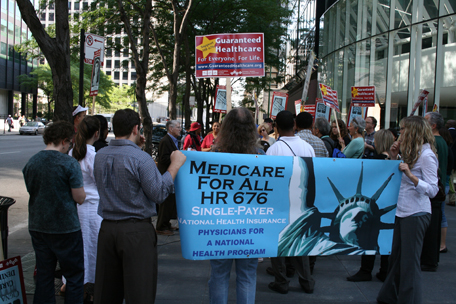
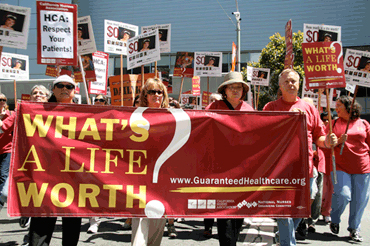
Supporting a single-payer bill sponsored by Michigan Rep. John Conyers, hundreds rallied in cities where large insurance companies are located: Louisville (Humana); Pittsburgh (Highmark); New York (GHI); Jacksonville (Florida Blue Cross Blue Shield); Philadelphia (Cigna). Evoking protests of old, they held signs—“Patients First-Not Profits”—and chanted slogans—“Insurance companies, you’re no good; get a conscience like you should.” The biggest event, attended by more than 1000 people, took place outside San Francisco’s Moscone Center, where AHIP (America’s Health Insurance Plans), the insurance industry’s trade association, was holding an executive summit featuring speakers like ex-senator Bill Frist, D.C. Democratic bigwig Terry McAuliffe, and former Secretary of Health and Human Services Tommy Thompson.
The AP issued two small stories that were picked up by many California outlets. Places like Forbes, CNNMoney.com, Condé Nast Portfolio, and MSNMoney also covered the rallies. In New York, a camera crew from Bill Moyers Journal came to shoot some video of Ralph Nader, standing on a shaky stool and proclaiming that America has “a commercialized health care system that is a pay or die system.” In Jacksonville, the Florida Times-Union noted that “some passing motorists honked to the demonstrators’ invitations to acknowledge problems with health insurance.” Non-traditional media weighed in too: A Detroit woman named Adrian picketed Michigan BlueCrossBlue Shield and put footage of her protest sign on YouTube; bloggers like like Arun Prabhakaran at opednews.com captured the spirit of the Philadelphia rally.
Most stories played it straight, presenting basic, objective event reporting—simple coverage that alerted audiences to a topic they’ve heard little about. Some outlets quoted insurance company officials, who delivered the same predictable message: They support universal access to care but not single payer. Praising the current private-market system, a spokeswoman for Florida Blue Cross Blue Shield said this: “We support universal coverage but not a single-payer system.” In Maryland, a representative of CareFirst Blue Cross Blue Shield in Maryland said that the protests “do little to advance the national debate regarding viable ways to increase access to health care coverage.” KCBS-AM, San Francisco’s main news radio station, reported that AHIP spokesman Mike Tuffin said the U.S. would not benefit from government control of health care. Tuffin added: “In other countries that have done this the quality of care goes down,” an assertion objective research has challenged and which reporters should examine.
The Pittsburgh Post-Gazette’s reporter interviewed an Ohio woman who had come to protest on behalf of a relative stuck with a big bill her insurer refused to pay. The story then veered in a different direction, raising questions about the kind of debate—or, more accurately non-debate—we’ve had so far. It summarized the proposals of the two Presidential candidates—fine—but then quoted Washington policy wonks who threw cold water on whole notion of single-payer, as if to diminish it as something unworthy of discussion. Director of the Urban Institute’s Health Policy Center John Holahan told the Post-Gazette that the tax increases necessary to cover everyone “almost make it a nonstarter.” So ends the story.
Single-payer may not have a shot next year or the year after, but the candidates’ proposals may not either, and they’ve gotten a lot of ink. Over at the Neiman Watchdog blog, Saul Friedman summarized the predicament of single-payer coverage. Friedman lamented the absence of stories about the Conyers bill, especially in press accounts of a recent day-long forum held by the Senate Finance Committee. “I know,” Friedman said, “it’s a rule of the mainstream press. If the issue is not going anywhere, it’s not worth much of a story. Of course, if it’s not given much of a story, it’s not going anywhere. It’s like that old conundrum about the tree falling in the forest.”
Has America ever needed a media defender more than now? Help us by joining CJR today.