

In the Republican presidential debate Monday, Mitt Romney came out in favor of a “premium support program, which allows people to buy either current standard Medicare or a private plan.” He said he supported the proposal made by Wisconsin congressman Paul Ryan, which, he believed, “is absolutely right on.”
“Give people choice,” Romney said. “Let competition exist in our Medicare program by virtue of the two things that I’ve described: higher benefits for lower-income people, lower benefits for higher-income people.” What is premium support anyway? So far, the mainstream media has done little to explain the concepts and terms being tossed around by politicians on all sides. Campaign Desk sat down with Henry Aaron, a senior fellow at the Brookings Institution, to sort all this out.
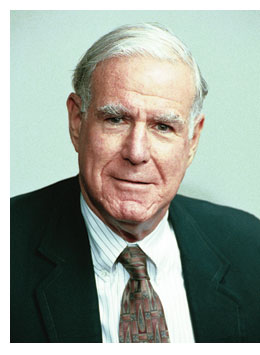 Trudy Lieberman: What is a voucher or a premium support?
Henry Aaron: It is a check from the government to a recipient for a single purpose, in this case paying for health insurance. In the case of Medicare, the check would have to be used in one of two ways. It could be signed over to an insurance company to buy private insurance. Or, if the plan allows it, the voucher can be returned to the government to pay for traditional Medicare. The voucher would cap Medicare’s growth in spending.
TL: How would this cap work?
HA: Suppose that Medicare costs $100 when the new program begins, and that Congress sets the value of the voucher at $100 and ties the future value to a formula that grows five percent a year. Thus, the value of the voucher will be $105 in the next year, whatever happens to the price of health care. The initial voucher allows Medicare enrollees to stay in traditional Medicare at no added cost. Or they can buy private insurance at the same price. If enrollees choose a more costly private plan, they have to pay all of the added cost themselves. If they choose a cheaper plan, they can pocket the savings.
TL: But what happens in the future?
HA: A critical question is whether enrollees will be able in the future to afford coverage as good as Medicare provides. If the cost of health care rises less than five percent, enrollees will continue to enjoy coverage with no loss of benefits. But if the cost of health care rises more than five percent, they will face a dilemma: suffer a progressively deeper loss of health insurance coverage or pay continually larger amounts for coverage that does not change.
TL: So how serious is the risk that coverage will erode or out-of-pocket costs will go up?
HA: That depends on the plan. If the voucher is tied to overall health costs, there is little or no risk. But under most so-called ‘premium support’ plans, the voucher is tied to an index that has in the past grown much more slowly than the cost of health care. That gap adds up fast, and can quickly erode coverage.
TL: What guarantees will there be that the voucher will keep up with health care cost inflation?
HA: Well, as I say, most plans are designed not to keep up with health care costs. But whatever formula Congress adopts at the outset, there can’t be a guarantee. Under pressure to hold down spending, Congress could restrict the voucher even more. Under pressure from beneficiaries, Congress might raise the voucher.
TL: But is there still a concern about what the adjustment formula is?
HA: You bet! When you set a rule, that becomes the status quo, and the status quo is hard to change.
TL: The term “voucher” is sometimes used interchangeably with “premium support,” a more benign phrase. Where did the term “premium support” come from?
HA: Bob Reischauer and I coined it in 1995. [Reischauer, president of the Urban Institute, was director of the Congressional Budget Office from 1989 to 1995.] We published the idea in a Health Affairs article as a way to distinguish it from other proposals that were floating around, which proposed simply to replace Medicare with vouchers that were designed to grow more slowly than the cost of health care. Those plans also paid little or no attention to how the quite vulnerable Medicare population should be helped in their dealings with insurers and how to structure insurance offerings.
One of the great claims of vouchers at that time was that they would unleash the power of competition. The jury is still out on that. Our proposal called for aggressive governmental regulation, and would take the marketing of insurance policies out of the hands of insurance companies and put them in the hands of a non-governmental agency that could outlaw deceptive sales practices and techniques.
TL: How does Paul Ryan’s plan fit with what you once proposed? What about the value of the voucher under Ryan’s plans?
HA: One of Ryan’s plans would tie the value to consumer prices. Prices of most goods have risen more slowly than income and even more slowly than health costs. Under another of Mr. Ryan’s plans, the voucher would be tied to the same index that is already set as the target for Medicare in the health reform act, which Ryan proposes to repeal. That target is in the most recent proposal, of which Rep. Ryan and Sen. Wyden are co-sponsors. It contains some serious ambiguities and unfortunately, they have said they will not put the proposal into legislative language. As a result, it’s impossible to tell just what the rather vague, press release-style language really means.
TL: How will the Ryan-Wyden plan work?
HA: Starting in 2022, private insurers would be asked to bid on how much they would charge to offer benefit coverage as valuable for average people as that offered by Medicare. Everyone turning age sixty-five in that year or later who is eligible for Medicare would be given a voucher set at the second-lowest price offered in each geographic area. Recipients could use that voucher to buy private insurance or to buy into traditional Medicare coverage.
If enrollees chose a more costly plan, they would have to pay the diffierence themselves. If they chose a less costly plan, they could pocket the difference. The voucher would be reduced for upper income enrollees. People in Medicaid would continue to have protections offered by that program. Growth of the voucher would be capped at the rate of growth of income per person, plus one percentage point. Insurers would have to insure everyone regardless of age or health status.
TL: What will happen to the private market if vouchers come to pass?
HA: It will grow, but it’s not clear how much.
TL: You supported Medicare vouchers once. Have you changed your mind?
HA: I supported premium support with the protections that Bob Reischauer and I listed. But I always felt that simply dropping cash on the elderly and the disabled in an unregulated insurance market was a recipe for disaster. Given the current resistance to adequate regulation, no one is talking about the sort of premium support plan I once found attractive. But even if they were, times have changed. Now is not the time to be talking about massive and possibly disruptive changes for fifty million Medicare beneficiaries.
TL: Why?
HA: A couple of reasons. First, the argument that premium support would lower costs seems to me much weaker than it did sixteen years ago.
TL: Can you expand on that point?
HA: There are comparative data on private plans versus traditional Medicare.
Private plans get a fourteen percent bonus to give extra benefits or lower premiums and less cost-sharing. Only a quarter of all beneficiaries have opted for these plans.
Even if one ignores these extra payments, the private plans cost more than traditional Medicare does.
TL: How much more?
HA: In urban areas, private plans cost twenty percent more than traditional Medicare and six percent more in rural areas. To date, private plans have not lowered costs.
TL: But we have a lot of competition in that market, right?
HA: There’s plenty of competition in the Medicare program. As I’ve said, most Medicare enrollees can choose among many competing private plans. If you think that competition will do the trick, it hasn’t done so yet. It could be that current Medicare rules discourage plans from competing on price and that private plans might lower prices under a different set of rules. But traditional Medicare has a big advantage. It has so many enrollees that it can dictate prices the way no insurance plan can. And it doesn’t have selling costs or need to generate a profit so that it can pay dividends to private stockholders.
TL: Are there any other reasons you have changed your mind about the wisdom of vouchers?
HA: The political climate has changed. In the mid-1990s, it was a different world in health policy. The Clinton health plan had just gone down and general health care spending was rising faster than Medicare spending. It seemed like vouchers might go somewhere. They were a chance to reform one part of the system. Today everything is different. Medicare spending is growing significantly less rapidly than private spending, in part because Medicare can set hard limits on how much it will pay for certain services and private plans in general cannot do that.
But the biggest change is the Affordable Care Act, which has created an enormous agenda for the health policy community, and which promises to generate information that will help the nation decide whether something like premium support is a good idea.
TL: What sort of information?
HA: The key to the success of premium support is the effective regulation of insurance offerings in a way that allows some very vulnerable people to choose intelligently among competing plans and the efficient provision of subsidies. The Affordable Care Act is setting up health insurance exchanges to just that for roughly twenty-nine million people. The population to be served under the Affordable Care Act is much easier to deal with than the Medicare population. It is less frail and it is much smaller than the fifty million who are now in Medicare. Yet states are having real problems fielding the exchanges, and we don’t know how we are going to get them up and running by 2014. It’s close to wacky to repeal the exchanges called for by the Affordable Care Act, which will serve twenty-nine million comparatively healthy people, and then in the next breath propose to create something like them for close to fifty million people who are much sicker and frailer.
TL: What are some of the other factors that are bringing vouchers back to the national agenda?
HA: Everyone has been persuaded that the nation faces a long-term deficit problem. Making sure Medicare spending doesn’t rise too much is being pushed by people who care more about the deficit than protecting access to health care by vulnerable populations.
TL: Does Medicare have a cost problem?
HA: Absolutely. The number of Medicare enrollees is going up and is projected to rise faster than incomes.
TL: Don’t official projections show a slowdown?
HA: Yes, they do. Official projections assume continuation of the limits enacted several years ago on payments to physicians. But Congress is not likely to stick to those limits. One force slowing down spending is real but temporary. As baby boomers retire, the age of the Medicare population is falling, and that holds down costs per person. Of course, those baby boomers will grow older, and as they do the per beneficiary costs will rise.
TL: So then Medicare does have a cost problem over the long haul. Is the Hospital Trust Fund, which pays seniors’ hospital bills, adequately funded?
HA: No. It’s projected to be exhausted in 2024. But action will be needed before then to avoid that outcome. But there is a bit of a Perils of Pauline character to watching the Hospital Trust Fund. In the past, projections have indicated that it would be exhausted in as little as two years. Each time, Congress has stepped in to make changes that prevent that outcome.
TL: What has Congress done to make sure that doesn’t happen?
HA: It has injected revenues from taxation of Social Security benefits. It has reformed payments. It has shifted costs from the Hospital Trust Fund to other parts of Medicare. It has increased payroll taxes, and tightened enforcement to avoid fraud.
TL: What is the long-term solution?
HA: I think it takes a lot of things. It takes more enforcement dollars, as there is still a lot of fraud. It takes administrative dollars, so that Medicare can make sure that physicians and hospitals follow established guidelines for delivery of care. It takes more payments, in premiums or cost sharing, by those who can afford them. It takes reform of the supplemental coverage that most people have so that this coverage does not shift costs to Medicare. And even after all of those measures, it will also take higher taxes.
Current payroll tax revenues, which fund hospital care, cannot possibly pay for the flood of Baby Boomer beneficiaries. There’s no way to provide standard benefits for the tens of millions who will become eligible for benefits in the next few years without raising payroll taxes and general revenues for Part B (medical benefits). Just now, few are willing to acknowledge that we are going to have to raise taxes or that we should actually spend more on administration.
TL: Will more means testing in the program—that is, making those with more income pay more for their Part B and Part D benefits—make much of a dent?
HA: Well, technically speaking, we don’t have means testing, which means denying benefits to people with more than a certain amount of income or assets. But those with comparatively high incomes have to pay extra for benefits. And there is somewhat more room for such charges. But not a lot, since only a small proportion of the elderly and disabled can pay much more than they do now for health care without suffering genuine hardship.
TL: How about raising the Medicare eligibility age?
HA: Most people now go on Social Security well before they become eligible for Medicare at age sixty-five. Right now, many have no health insurance between when they leave work and become eligible for Medicare. That gap is a problem. Raising the age of eligibility for Medicare would make it worse. If and when the Affordable Care Act is enforced and operating smoothly, it would be much less of a problem. Currently there is an additional problem with raising the age of eligibility. It would actually increase total health care spending because the private plans into which people would move are more costly than Medicare is, and it saves less for the federal budget than one might suppose, because of the added payments that cutting people out of Medicare generates in such programs as Medicaid. This change needs to remain on the table, however, as part of a long-term effort to encourage people to remain economically active to a later age than they do now. That trend is already underway.
TL: Medicare has low administrative expenses, about 3 percent of outlays compared to private insurance carriers. You’ve said they might be too low. What do you mean by that?
HA: Medicare collects several dollars for each dollar it now spends on enforcement. It should spend more to find cheats. Medicare has too little money and staff to make sure, when it approves a drug or a procedure for a particular condition but not for others, that payments are made only in the approved cases. Medicare now mostly pays bills, but it should also be collecting data to support comparative effectiveness research. Spending more on administration would lower total program costs and improve quality.
TL: How well has the press covered Medicare?
HA: Health policy and social insurance in general are not well covered. Health policy analysts spend their lives trying to understand the staggering complexity of the U.S. health care system. Reporters and editorial writers don’t have that luxury. They are largely at the mercy of one or another self-interested party to whom they may speak. This is an area where it’s extraordinarily difficult to do a good job, unless you specialize to some degree.
TL: So do you have any advice for the reporter who may not be an expert but covers these subjects sporadically?
HA: They should be careful of politically committed groups using the trappings of science not in the pursuit of truth but to make a case. Understand that even honest organizations are going to be attacked from both sides.
TL: Any other advice?
HA: Try to identify sources of honest analysis. If you want some suggestions, give me a call.
Trudy Lieberman is a longtime contributing editor to the Columbia Journalism Review. She is the lead writer for CJR's Covering the Health Care Fight. She also blogs for Health News Review and the Center for Health Journalism. Follow her on Twitter @Trudy_Lieberman.