Sign up for the daily CJR newsletter.
My article in our latest print issue on political science and the political press noted that the two camps offer very different explanations for the rise of partisanship in Congress. While researchers explain polarization as a consequence of long-term political trends or procedural changes, press coverage often suggests it’s caused by a decline in backroom bonhomie on Capitol Hill.
The standard journalistic view—and the way it reflects the experiences of the people journalists spend their time talking to, which is to say politicians—is distilled perfectly by a recent article from McClatchy, selected as Thursday’s “Top Story” by editors at the chain’s D.C. bureau. Here’s how it opens:
WASHINGTON — Trent Lott never saw partisanship permeate the very fabric of Congress during his 35-year tenure there the way it divides Capitol Hill today, the former Senate majority leader lamented on Wednesday.
Today’s bitter partisan culture is a long cry from his days serving leaders of the “Greatest Generation,” said Lott, a Mississippi Republican who served in the House of Representatives from 1973 to 1989, and in the Senate from 1989 to 2007.
…”It’s not the rules. It’s not the institutions. The problem is us,” Lott said. “The generational leaders now are those that came out of the ’60s and ’70s, which were turbulent times — you had Vietnam, the civil rights movement, Watergate, impeachment — we became such partisan warriors.”
While Lott practiced plenty of hard-edged partisan politics in his day, he also often cut deals with Democrats. In those days, he said, it was normal to have a friendly dinner with members of the opposing party.
…Lott, now a lobbyist, grew accustomed to a bipartisan culture soon after he began his political career in 1968 as an administrative assistant to Rep. Bill Colmer, a Mississippi Democrat. Lott said he frequented the medicine room of the Capitol, where Colmer, House Speaker John McCormack of Massachusetts and others convened to play late-night games of gin rummy.
“My job was to pour the bourbon and light the cigars,” Lott said. “These guys talked — Republican or Democrat, conservative or liberal.”
Set aside the implicit assumption that partisanship is a bad thing. Is Lott’s account—to which reporter Andrew Seidman dedicates more than half of his 19-paragraph story (the first nine grafs, plus the kicker)—consistent with the historical record? More important, does it offer readers an adequate explanation for why polarization has occurred?
Let’s take a look at what some of the relevant political science has to say. To start with the first question: we really are in a period of high, and rising, partisan polarization in Congress (there is also evidence that ideological polarization among the public, and especially among elites, is also increasing, though not as sharply). But references to “today’s bitter partisan culture” tell only part of the story. Take a look at this chart produced by Nolan McCarty, Keith T. Poole, and Howard Rosenthal, authors of Polarized America, which shows the distance between the parties as measured by roll call votes:
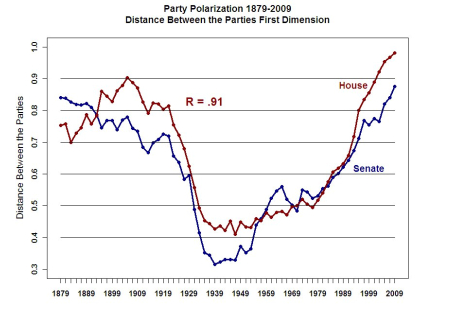
This shows a couple things: one, that polarization is as much the historical norm as the exception, and two, that the current trend toward polarization began in the mid-1970s—in other words, just about the time that Trent Lott joined Congress, and well before those young’uns imbued with the “culture of rebellion” had grown up, put on a suit, and run for office. Maybe that’s because Lott stopped pouring bourbon and lighting cigars when he moved from an assistant’s role to a seat of his own, and the whole social order started to crumble. Or maybe there are other explanations.
For example: the historically unusual period is actually the era of bipartisanship, which lasted from roughly the late 1930s through the 1970s. And what’s remarkable about that period, from the perspective of political parties, is that we didn’t have two of them. We had more like two and a half, or even three. Here’s another chart from McCarty, Poole, and Rosenthal, showing the position of the parties in the House on a liberal-conservative spectrum (the Senate chart is similar):
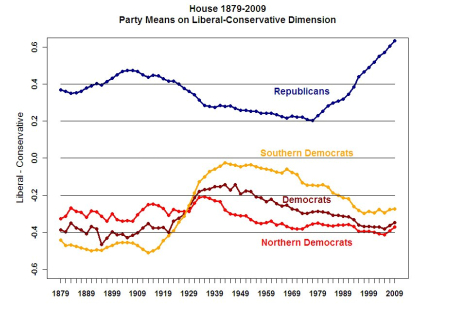
Basically, during the middle of the twentieth century, the Democratic Party was internally incoherent, largely because civil rights legislation split the party into two distinct regional wings. (A chart focused on where the parties stand on civil rights shows even greater discrepancies, with southern Democrats by far the most conservative group.) This divide created an imperative toward bipartisanship whose implications have been described many times, including by Poole in a 2005 essay (PDF):
In Congress all three parties easily formed coalitions with one of the others against the third depending on the issue at hand. The northern and southern Democrats united to organize the House and Senate and thereby seize the spoils due the “majority” party. The northern Democrats and Republicans united to pass the 1964 Civil Rights Act and the 1965 Voting Rights Act, and the “conservative coalition” of Republicans and southern Democrats united to block liberal economic (and in the 1970s, social) policies.
What happened after the major victories on civil rights legislation in the 1960s is that civil rights stopped existing as a separate political debate; instead, racial issues were absorbed into the long-running debate over regulation and redistribution that forms the core divide in American politics. And conservative southern Democrats—the bloc whose existence had made bipartisanship possible, and even necessary—started to disappear.
There’s more to the story. The bipartisan era featured different issue divides and what was, in effect, a third party. But it also featured another factor that made legislating more complex, and cross-cutting alliances more viable, than they are today—much weaker party leadership, and many more power centers within Congress. As the parties became more ideologically coherent, institutional changes gave more power to party leaders. And they exercised that power by creating incentives for party loyalty (and punishments for its absence), and by structuring the agenda accordingly.
Another researcher, Sean Theriault, has documented how procedural votes—which tend to produce more polarized outcomes than substantive votes—account for an increasing share of congressional activity, as anyone who followed the health care debate can attest. Changes to the structure of roll call votes, and the issues decided by those votes, “over the last 30 years, account for roughly half of the polarization in Congress,” Theriault found (PDF). (In the same event at which Lott made his remarks, former House Speaker Tom Foley actually spoke about the role of party leaders in driving polarization. His comments merited two paragraphs in the McClatchy story, about three-quarters of the way through.)
Does all this make Lott wrong, or mean that Seidman is wrong to treat him as an authority on this subject? Not entirely. Of course there’s a personal element to legislating. Of course people who enjoy each other’s company, and who develop some level of mutual trust, will find it easier to work together. And of course Lott is a credible figure on how social mores in Congress have changed since his career began.
But on the much, much more interesting questions—how much of the rise in partisanship do those changing mores explain, and what else might explain them?—Lott really isn’t an authority at all. Treating him as one is sort of like treating a pitcher as an expert on the physics behind a curveball—you might get something interesting out of the conversation, but if you really want an informed perspective, you’re better off asking someone who’s actually studied the issue at hand.
Has America ever needed a media defender more than now? Help us by joining CJR today.