Herewith, a trio of thoughts on the political-media story that won the day on February 1: Mitt Romney’s statement on CNN this morning that he’s focused on the middle class but “not concerned about the very poor,” because they have access to a “very ample safety net.”
Thought #1: We need a better typology of “gaffes”.
One of the media narratives that will be spun out of Romney’s comments is that he just can’t help putting his foot in his mouth. Here’s how Luke Johnson concluded his write-up of Romney’s remarks at The Huffington Post:
Romney’s statement is part of a pattern of previously poorly-phrased remarks that give his competitors fodder to call the former Bain Capital founder—who is worth between $190 million and $250 million—out of touch with the economic recession.
“Don’t try and stop the foreclosure process. Let it run its course and hit the bottom,” he said last October in Las Vegas, the hardest-hit metro area by the foreclosure crisis.
In January, Romney said, “I like being able to fire people who provide services to me” to explain why he favored competition among health insurers. “If someone doesn’t give me the good service I need, I want to say I am going to get somebody else to provide that service to me.”
But other than the potential for “fodder,” none of these things is really like the others. The furor around the “fire people” quote was, as Brendan Nyhan argued here at CJR, pretty much a pure media creation that depended on deliberately taking Romney’s words out of context. Romney’s “foreclosure” remarks, meanwhile, don’t seem “poorly-phrased” at all—they offered a succinct description of his policy. If his policy is unpopular with some voters, that has more to do with substance than word choice.
While, as in the “fire people” episode, there’s some artful truncating by the press at play here—the most common headline seemed to be something like, “Romney: ‘I’m not concerned about the very poor’”—Romney’s comments to CNN Wednesday morning are probably the best example of him undermining his policy position with his own infelicitous words. On the stump, he’s apparently in the habit of saying, “the people who need the help most are not the poor.” That’s a very debatable proposition, but it carries a different valence than a declaration that you’re “not concerned” about the poor.
Thought #2: Romney’s wrong about who benefits from the “safety net.”
Pressed by CNN’s Soledad O’Brien about his unconcern for the “very poor,” Romney said:
We have a very ample safety net, and we can talk about whether it needs to be strengthened or whether there are holes in it. But we have food stamps, we have Medicaid, we have housing vouchers, we have programs to help the poor. But the middle income Americans, they’re the folks that are really struggling right now, and they need someone that can help get this economy going for them.
Set aside housing vouchers and food stamps for the moment, and focus on Medicaid. While it’s true that most Medicaid enrollees are children and adults in low-income households, most Medicaid funds cover long-term care for the elderly and disabled. This Kaiser Commission image published last April by Matt Yglesias tells the tale:
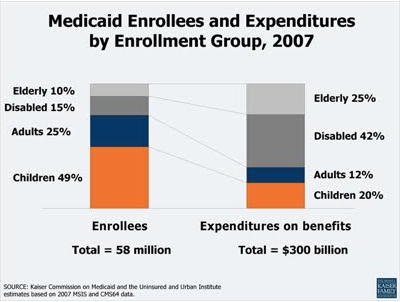
The upshot, as Yglesias wrote, is that many beneficiaries of Medicaid are actually families—middle-class families, and certainly families in that broad “90, 95 percent of Americans” that Romney says he’s concerned about—who would otherwise be stuck with the full tab for care for their elderly and disabled relatives. It’s debatable whether this is a wise arrangement, or whether it works as intended—for example, National Review’s Josh Barro has argued that affluent families game the system and should be paying more themselves. But what’s not debatable is that the universe of Medicaid beneficiaries extends well beyond the “very poor.”
Thought #3: CNN’s O’Brien asked some terrible questions, and not many good ones.
Perhaps Romney’s mistake was in trying to talk about his issue positions, when all O’Brien wanted to talk about was the horse race and hurt feelings.
- 1
- 2
With his Florida victory and these comments, this must prove Mitt Romney is true successor to the Reagan legacy. So time to celebrate “Mormon in America.” Let’s rename the U.S. Capitol as Bain Capital and monitor maternity wards for a surge in double-consonant names like Boss and Hogg, Gutt and Glutt, Fatt and Catt, and… “Ann.” And for those interested in a few bi-partisanship chuckles, enjoy this funny YouTube video entitled "Obama's Secret Service" -- http://tinyurl.com/6sevqsj
#1 Posted by SkitSketchJeff, CJR on Wed 1 Feb 2012 at 06:35 PM
At the end of the day, what the candidate thinks doesn't matter. Witness Obama's shift to the U.S.center, corresponding to the right in other civilized countries, despite his previous playing to the left. Whoever wins the primary, let along the election, has little leeway but to talk up the policies of the party that put them there.
Romney's experience in vulture capital makes him a favorite of the party that would do just the same to government. There was never a contest.
#2 Posted by Jonathan, CJR on Wed 1 Feb 2012 at 06:39 PM
The federal government's Medicaid website states, "Medicaid is available only to people with limited income." https://www.cms.gov/MedicaidEligibility/ Nothing else on the federal government's website seems to contradict that. That seems pretty authoritative.
#3 Posted by RobC, CJR on Wed 1 Feb 2012 at 08:37 PM
@RobC,
Perhaps I was unclear. I'll just quote from Yglesias:
"This is mostly a program for the elderly and the disabled. It’s the main way we finance long-term care in this country. If you don’t directly benefit from it, you very likely have a parent or grandparent who does and whose financial needs will simply tend to fall on you if the program is cut."
The point is that the "people with limited income" who are being supported by Medicaid funds are in many cases elderly people whose children--or disabled people whose siblings--would otherwise bear those costs, and who are being relieved of that burden by Medicaid. So, limited income individuals, but middle class families.
#4 Posted by Greg Marx, CJR on Wed 1 Feb 2012 at 08:56 PM
I have to disagree with Greg Marx in his argument downplaying the Romney gaffes, and I have to agree with NPR's Ari Shapiro in his analysis today that this constitutes a pattern of comments that reinforces a legitimate narrative about Romney:
http://www.npr.org/2012/02/01/146244919/remarks-from-romney-spark-controversy
The remarkable thing is that a national political candidate as experienced as Romney continues to make these tin-ear comments. Skilled politicians know that of course their comments are going to be quoted "out of context" to a greater or lesser degree and they can't open themselves up to this by making it so easy for their opponents.
"I'm not concerned about the very poor," "Corporations are people," and "I like being able to fire people" represent Romney's genuine views and positions and history. There's nothing illegimate about the news media highlighting these statements.
#5 Posted by Harris Meyer, CJR on Thu 2 Feb 2012 at 01:46 AM
I just read Gail Collins' much sharper piece on Mitt's "very poor" gaffe.
http://www.nytimes.com/2012/02/02/opinion/collins-mitt-speaks-oh-no.html?hp
#6 Posted by Harris Meyer, CJR on Thu 2 Feb 2012 at 03:51 AM
@Harris Meyer,
Thanks for the comments, and the links. I'm not sure I agree with your interpretation of the NPR exchange, though. From the transcript:
****
CORNISH: But, Ari, does it really set a pattern? I mean, is this just one or two incidents that build into the narrative or does Romney really have a problem?
SHAPIRO: Well, the truth is, with presidential candidates, the gaffes that stick tend to be the ones that confirm to the negative stereotype of that person. Whether you're talking about Al Gore – I invented the Internet – or John Kerry – I was for the Iraq war before I was against it. The fact is, Mitt Romney does tend to make slips of the tongue. Sometimes they are comments taken out of context, as in when he said I like to fire people, talking about getting rid of health insurance companies who don't give good service. Other times, he means what he's saying. Corporations are people was a statement that he defended. But the problem is, all of these, quote-unquote, gaffes, feed into a narrative that this is a guy with a lot of money who's out of touch. And that's a narrative that conservatives are really concerned that liberals will seize on as this election continues to unfold.
****
That's a fine explanation of how the gaffe-creation process unfolds, but I don't think Shapiro is really evaluating the "legitimacy" of that process, or its outcomes, one way or the other -- he's just saying it is what it is. If you look at the examples he cites, the Al Gore/internet thing was bogus, and as he acknowledges Romney's "fire people" line was taken out of context.
As for whether the news media should highlight these statements – it depends. “Corporations are people” is an expression of a substantive idea that carries a range of important policy implications. Of course reporters should highlight it, as long as they do justice to the underlying idea. Ditto for “let the housing market hit bottom.”
And “not concerned about the very poor” is a meaningful expression of policy priorities – as I wrote, it was the most substantive part of the interview, gaffe aside. Of course reporters should focus on that – just as they should have focused on Romney’s earlier, un-gaffe-y declarations that the poor have all the help they need, and as they should have been focusing on what Romney’s fiscal agenda would do for the safety net he says is important. And if yesterday’s “gaffe” prompts them to do that, so much the better.
But what reporters shouldn’t do is say, “Candidate X’s occasionally inartful words allow Opponent Y to construct a narrative about his true nature, and we are happy to play along.” I agree with Shapiro that that’s how the process works – but I don’t think it’s legitimate.
#7 Posted by Greg Marx, CJR on Thu 2 Feb 2012 at 10:09 AM
@Harris Meyer,
And re: the Collins column, the best part was her accurate note that Romney's charge that Obama-era Democrats spend all their time talking about the plight of the poor is just not true. There's a general consensus that, in rhetorical terms at least, our concern should be saved for the "middle class." (The substantive differences are greater, though probably not as great as Republicans would have you believe.) See: bipartisanship does still exist in Washington!
#8 Posted by Greg Marx, CJR on Thu 2 Feb 2012 at 10:16 AM
I think journalists should be able to engage in the same kind of character analysis that all of us do every day in our personal lives, as long as they tell us what they are basing their analysis on. We all listen to what people say and watch what they do for patterns of clues about their character, competence, virtue, etc. The conventional "view from nowhere" journalism approach doesn't allow for this but journalists are human beings and will find ways to make judgments about character and incorporate that into their reporting and commentary. I think Romney has provided more than enough clues to provide the basis for such judgments.
#9 Posted by Harris Meyer, CJR on Thu 2 Feb 2012 at 01:34 PM
Damage control. There is no way to make the comment," I am not concerned about the poor" sound any better. This guy is Extremly wealthy, Maybe he should of said, I am very concerned about the poor, If they do as I say, they will be taken care of. OR, I love the the poor, Why do you think My capitalism made so manyof them.
#10 Posted by freewill2, CJR on Thu 2 Feb 2012 at 02:17 PM
You say it was a "gaff." What gaff? This is what he really thinks.
I see a problem with the public and the press. The public says they want politicians to be bold and address their problems, tell what they really think.
Yet when George Romney, Williard Mitt Romney's father said he had been "brainwashed" on our policy in Vietnam, he was forced to drop out.
Whatever your politics, I agree with George's statement as fact. When his son tells what he honestly thinks it is a "gaff."
The paradox as I see it is we want politicians to tell us what they think, which really means tell us what we want to hear.
I would like to be wrong, but I don't think I am.
#11 Posted by David Reno, CJR on Fri 3 Feb 2012 at 03:57 PM