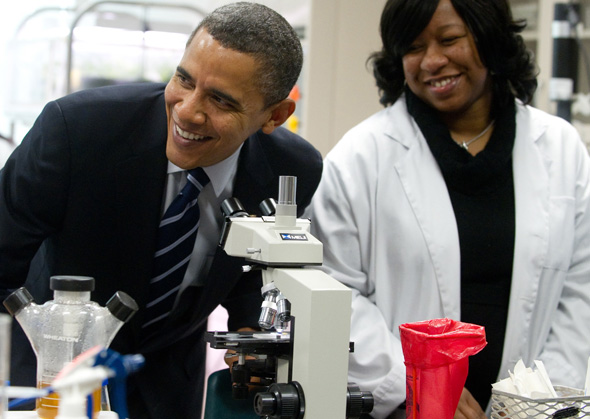
Homegrown President Obama, seen here visiting at technical college in North Carolina, supports bringing more foreign STEM workers to the US, despite high unemployment among US workers. (Saul Loeb / AFP / Getty Images)
In late February, Christine Miller and Sona Shah went to the Capitol Hill office of Miller’s senator, Barbara Mikulski, a Maryland Democrat, to talk about immigration reform and the job market for science, technology, engineering, and mathematics (STEM) workers. Miller, an American-born MIT grad with a PhD in biochemistry, had 20 years of research experience when Johns Hopkins University laid her off in 2009 because of funding cuts. Shah, an Indian-born US citizen with degrees in physics and engineering, had been laid off earlier by a computer company that was simultaneously hiring foreign workers on temporary visas. Proposals to increase admission of foreign stem workers to the US, Miller and Shah told Erin Neill, a member of Mikulski’s staff, would worsen the already glutted stem labor market.
According to Miller, Neill told them this is not the argument “she normally encounters on this issue.” The conventional wisdom is that tech companies and universities can’t find enough homegrown scientists to hire, so they need to import them from China and India. Neill suggested to Miller and Shah that “we would have more impact if we represented a large, organized group.”
Miller and Shah are, in fact, part of a large group. Figures from the National Institutes of Health, the National Academies, the National Science Foundation, and other sources indicate that hundreds of thousands of STEM workers in the US are unemployed or underemployed. But they are not organized, and their story is being largely ignored in the debate over immigration reform.
The two main STEM-related proposals currently part of that debate in Congress would increase the number of temporary high-skill worker visas (also called guestworker visas), and give green cards to every foreign graduate of an American college with a master’s or PhD in a STEM field. Media coverage of these proposals has generally hewed, uncritically, to the unfounded notion that America isn’t producing enough native talent in the science and engineering fields to satisfy the demands of businesses and universities—and that foreign-born workers tend to be more entrepreneurial and innovative than their American-born counterparts. Allowing more stem immigrants, the story goes, is key to adding jobs to the beleaguered US economy.
It is a narrative that has been skillfully packaged and promoted by well-funded advocacy groups as essential to the national interest, but in reality it reflects the economic interests of tech companies and universities.
High-tech titans like Bill Gates, Steve Case, and Mark Zuckerberg are repeatedly quoted proclaiming a dearth of talent that imperils the nation’s future. Politicians, advocates, and articles and op-eds published by media outlets—including The New York Times, Forbes, CNN, Slate, and others—invoke such foreign-born entrepreneurs as Google’s Sergey Brin or Yahoo’s Jerry Yang, as if arrival from abroad (Brin and Yang came to the US as children) explains the success of the companies they founded . . . with partners who are US natives. Journalists endorse studies that trumpet the job-creating skills of these entrepreneurs from abroad, while ignoring the weaknesses that other scholars find in the research.
Meanwhile, The National Science Board’s biennial book, Science and Engineering Indicators, consistently finds that the US produces several times the number of STEM graduates than can get jobs in their fields. Recent reports from the National Institutes of Health, the National Academies, and the American Chemical Society warn that overproduction of STEM PhDs is damaging America’s ability to recruit native-born talent, and advise universities to limit the number of doctorates they produce, especially in the severely glutted life sciences. In June 2012, for instance, the American Chemical Society’s annual survey found record unemployment among its members, with only 38 percent of new PhDs, 50 percent of new master’s graduates, and 33 percent of new bachelor’s graduates in fulltime jobs. Overall, STEM unemployment in the US is more than twice its pre-recession level, according to congressional testimony by Ron Hira, a science-labor-force expert at the Rochester Institute of Technology.
And yet, a bill introduced in Congress last year that would have heeded the NIH recommendation by limiting visas for biomedical scientists was attacked in a Forbes article that suggested it could delay progress on the search for a cure for cancer by keeping out able researchers.
Foreign-born scientists and engineers have, of course, contributed significantly to American society as innovators and entrepreneurs—and the nation’s immigration policy certainly needs repair. But many leading STEM-labor-force experts agree that the great majority of stem workers entering the country contribute less to innovative breakthroughs or job growth for Americans than to the bottom lines of the companies and universities that hire them.
Temporary visas allow employers to pay skilled workers below-market wages, and these visas are valid only for specific jobs. Workers are unable to take another job, making them akin to indentured servants. Universities also use temporary visas to recruit international graduate students and postdoctoral scientists, mainly from China, to do the gruntwork for professors’ grants. “When the companies say they can’t hire anyone, they mean that they can’t hire anyone at the wage they want to pay,” said Jennifer Hunt, a Rutgers University labor economist, at last year’s Mortimer Caplin Conference on the World Economy.
Research by Hira, Norman Matloff of the University of California-Davis, Richard Freeman of Harvard, and numerous others has shown how temporary visas have allowed employers to flood STEM labor markets and hold down the cost of tech workers and scientists doing grant-supported university research. Wages in the IT industry rose rapidly throughout the 1990s, but have been essentially flat or declining in the past decade, which coincides with the rising number of guestworkers on temporary visas.
In his new book, Why Good People Can’t Get Jobs, Peter Cappelli, a human-resources specialist at the Wharton School, concludes that companies’ reported hiring difficulties don’t arise from a shortage of qualified workers, but from rigid recruitment practices that use narrow categories and definitions and don’t take advantage of the applicants’ full range of abilities. Companies so routinely evade protections in the visa system designed to prevent displacement of American citizens that immigration lawyers have produced videos about how it is done. For instance, tech companies that import temporary workers, mainly recent graduates from India, commonly discard more expensive, experienced employees in their late 30s or early 40s, often forcing them, as Ron Hira and other labor-force researchers note, to train their replacements as they exit. Age discrimination, Hira says, is “an open secret” in the tech world.
The temporary-visa system also facilitates the offshoring of STEM work, particularly in the IT field, to low-wage countries. Outsourcing companies use the temporary visas to bring workers to the US to learn the jobs that the client company is planning to move to temp workers’ home country. The 10 firms with the largest number of H-1B visas, the most common visa for high-skill workers, are all in the business of shipping work overseas, and former Indian commerce minister Kamil Nath famously labeled the H-1B “the outsourcing visa.”
These practices have helped to reduce incomes and career prospects in STEM fields drastically enough to produce what UC Davis’s Norman Matloff calls “an internal brain drain” of talented Americans to other, more promising career opportunities such as Wall Street, healthcare, or patent law.
The proposal before Congress to automatically grant green cards to all STEM students with graduate degrees—regardless of field, origin, or quality—would exacerbate the problem of already overcrowded markets, according to new research by Hal Salzman of Rutgers University, Daniel Keuhn of American University, and B. Lindsay Lowell of Georgetown University. It also would benefit universities facing tough financial times by dramatically increasing the allure of American graduate schools, and thus the income potential to universities. And, as Republican Senator Chuck Grassley said at a 2011 hearing, it would “further erode the opportunities of American students. Universities would in essence become visa mills.”
Academic departments generally determine how many graduate students they admit, or postdocs they hire, based on the teaching and research workforce they need, not on the career opportunities awaiting young scientists. Unlike companies, universities have access to unlimited temporary-worker visas. This allows universities to hire skilled lab workers and pay them very low, “trainee” wages. Postdocs are an especially good deal for professors running labs because they don’t require tuition, which must be paid out of the professors’ grants, notes Paula Stephan, a labor economist at Georgia State University, in her book How Economics Shapes Science.
Immigrants constitute the nation’s “only shot at getting a growing economy,” because they “start more jobs than natives,” declared New York Times columnist David Brooks on Meet the Press in February. “Every additional 100 foreign-born workers in science and technology fields is associated with 262 additional jobs for US natives,” he had written in the Times, adding that “a quarter of new high-tech companies with more than $1 million in sales were also founded by the foreign-born.”
These claims, cited by Brooks and many others, arise from a body of research that has been the subject of scholarly dispute—though you’d never know it from the media coverage of this issue. The overwhelming majority of coverage presents the conclusions reached in studies like the one conducted by Duke University’s Vivek Wadhwa, who publishes widely in popular media and speaks frequently on immigration issues. About a quarter of the 2,054 engineering and technology companies that responded to Wadhwa’s telephone survey said they had a “key founder”—defined as a chief technology officer or a CEO—who was foreign-born. Extrapolating from that figure, the study credits immigrant-founded companies with employing 450,000 people nationally in 2005.
But a nationwide survey by political scientist David Hart and economist Zoltan Acs of George Mason University reached a different conclusion. In a 2011 piece in Economic Development Quarterly, Hart and Acs note that between 40 and 75 percent of new jobs are created by no more than 10 percent of new businesses—the so-called high-impact firms that have rapidly expanding sales and employment. In their survey of high-impact technology firms, only 16 percent had at least one foreign-born founder, and immigrants constituted about 13 percent of total founders—a figure close to the immigrant share of the general population. But the more fundamental problem with Wadhwa’s study, Hart and Acs suggest, is that it does not report the total number of founders at a given company, making conclusions about immigrants’ overall contribution impossible to quantify.
Evaluating the issues of statistics and sample selection that divide the academic researchers is beyond the purview of most general media, but informing readers that reputable researchers reached different conclusions is not. Though real, the immigrant role in high-tech entrepreneurship could be considerably less dramatic than many writers claim. Research on Silicon Valley entrepreneurs in 1999 by AnnaLee Saxenian, for example, found that 36 percent of high-tech companies owned by Chinese immigrants were doing nothing more groundbreaking than putting together computers for sale from components.
As Erin Neill, of Senator Mikulski’s staff, pointed out, no one in the immigration debate speaks effectively for US-born STEM workers. The IT world’s libertarian ethos, the relative poverty among young scientists and their unemployed and underemployed peers, and a fear of antagonizing present or potential employers all hamper efforts to organize these workers. National scientific associations and advocacy groups sponsored by industry and universities, meanwhile, represent the interests of those who benefit from the system—tenured faculty, university administrators, and company executives, including those at companies whose donations support scholarly conferences and other association activities. These organizations and their lobbyists frame their policy arguments with feel-good abstractions about the inherent value of science and research and innovation, suggesting they are a panacea for America’s economic ills.
Which brings us to the story of Xianmin Shane Zhang, a software engineer in Minnesota. According to his LinkedIn page, Zhang earned his BS in engineering in his native China, one MS in physics at Southern Illinois University, and another in computer science at the University of Houston. His profile next lists a series of IT jobs at US companies. In 2005, 43-year-old Zhang was one of a group of workers over 40 who sued their former employer, Best Buy, for age discrimination, when the company laid them off after outsourcing their jobs. The suit ended in an undisclosed settlement.
After being laid off by Best Buy, Zhang eventually fulfilled the rosy forecast of those advocating increased STEM-worker immigration by becoming an entrepreneur, though hardly following the innovation and jobs-for-Americans script. His Z&Z Information Services in St. Paul helps US companies outsource their IT and programming needs to China. “Giving green cards to foreign students can lead to offshoring as well,” notes Norman Matloff, who uncovered this tale. That’s because young scientists and engineers from abroad get older, and wind up facing the same age discrimination and glutted market as their native-born colleagues. Why isn’t that reported, too?

Everybody has known for years that the worker shortage isn't true but truth and facts are not used by our government when making decisions that destroy thousands and thousands of families across the nation.
#1 Posted by A Cabrera, CJR on Wed 1 May 2013 at 03:07 PM
Congratulations again to Ms. Benderly on another terrific piece that exposes the obvious truth, when most of the press is mesmerized by PR nonsense from the tech giants.
#2 Posted by S. Apfelroth, CJR on Wed 1 May 2013 at 03:15 PM
Thanks for this article. I have worked in IT for nearly 40 years and allthough I'm nearing retirement I keep fighting this guest worker program with my Senator and Congressman. These were good paying jobs that our government is allowing corporations to raid with cheap labor. The guest worker program (H1-B) was designed to bring over from other countries their "best and brightest" but instead we are bringing over below average workers at a discount. There is no shortage we should put our college grad to work before guest workers. Unfortunately my complaints always land on deaf ears.
#3 Posted by Greg Sherman, CJR on Wed 1 May 2013 at 04:04 PM
The key driver for these harmful policies is the economic benefits that accrue to the liberal immigration advocates. A recently-published estimate is that each work visa admission yields a salary and benefit avoidance of about $150,000 over the life of the visa. The key concept is to substitute a young imported worker who labors under a visa system akin to indentured servitude for an experienced American citizen. Often the American is forced to train their imported replacement as a condition for receiving their meager outplacement benefit. Furthermore, the soon-to-be-ex-employer also forces the American to sign a nondisclosure document that they will not inform the media about the employer conduct. Since there have been over 37 million cumulative visa admissions in just five higher-skilled work visa programs between 1975-2010, the economic harms to the American middle class are denominated in the trillions of dollars. To learn more, please search by title for the PDF version of the 2012 report, "How Record Immigration Levels Robbed American High-Tech Workers of $10 Trillion."
While I'm pleased overall with Beryl's expose, she misstates the fate of most experienced Americans once they are displaced from STEM fields by employer's abuse of work visa programs. Most are "extorted into oblivion" and are forced to take work that makes scant use of their training and work experience. The trend is big enough to show up in the 2002 Census bureau ACS Survey data cited in the above article. The result is that for all except the economic elite, for all workers, including Ph.D.s that their peak earning years are between age 40 and age 50. This is significant, as it underscores the historically unprecedented size of the "internal brain drain" that Matloff has discussed in several recent articles and presentations.
The fundamental problem is that the U.S. immigration-induced overpopulation leads to most of the economic benefits being privatized while the huge costs are socialized. Since U.S. citizen professionals are being harmed, they should be calling for an immediate termination of these work visa programs. Free-market advocate and Nobel economics laureate Milton Friedman summed it up well when he was discussing the H-1B Visa program in a 2002 article. He called the visa program a "government subsidy" program as it allowed employers to obtain higher-skilled workers for below-market wages.
#4 Posted by Dr. Gene Nelson, CJR on Wed 1 May 2013 at 04:16 PM
Could someone @ CJR fix the URIs in this article? Several have "www.cjr.org/essay/" infixed, e.g., "http://www.cjr.org/essay/www.nsf.gov/statistics/indicators", which fails. The correct URI is obviously "http://www.nsf.gov/statistics/indicators" (which in fact resolves), but less web-aware folks might find the 404s off-putting (or, worse yet, to somehow compromise Benderly's position).
#5 Posted by Tom Roche, CJR on Wed 1 May 2013 at 06:46 PM
The big companies whining about "a dearth of talent" are not just lying, they are WRONG about where their own self-interest lies.
The H-1B crowd are usually dreadfully underqualified, in most shops today they may make up 50% to 95% of the staff, and do 1% to 10% of the work.
Hey journalists, get your face out into the real world, hang out in a real IT shop for a few weeks, IT'S NOT HARD TO SEE.
#6 Posted by JRStern, CJR on Wed 1 May 2013 at 09:01 PM
The push for more stem visas is just another ploy to get cheap labor by the big corperations.
#7 Posted by Rick Ensor, CJR on Wed 1 May 2013 at 10:53 PM
I'm not in the STEM field, so I really appreciate Beryl Benderly's careful marshaling of the facts and avoidance of inflammatory remarks or exaggeration. This article is a valuable contribution toward understanding an issue of major importance for STEM professionals and for our country. Thank you, Ms. Benderly, for an outstanding article.
#8 Posted by GA Goldberg, CJR on Thu 2 May 2013 at 01:37 PM
Hi Tom --
All the links should be fixed now. Thanks for the heads-up!
#9 Posted by Sara Morrison, CJR on Thu 2 May 2013 at 05:35 PM
1 of 2.
“STEM” careers are challenging, -engaging, -valuable to humanity, and vital to America’s strength. However, “the conventional wisdom” regarding our STEM-workforce is flawed. Actually – the USA is “sinking its own boat.”
NPR once aired a story on an MIT-developed suit which acquaints a younger wearer with the physical challenges of an aged body. Q: Why not just walk-across-the-hall and tap the perspective of an OLDER scientist/engineer? A: “Because there are increasingly-fewer of them around.”
Actually –
• America HAS A SUFFICIENT SUPPLY of STEM graduates NOW.
• Corporate USA is consciously FORCING STEM graduates OUT of these fields.
Web searches for the phrases “older engineer” and “unemployed engineer” will reveal informed testimony- and reader comments such as:
• “The United States has arranged to produce more knowledge workers than we can employ, creating a labor-excess economy that keeps labor costs down and productivity high.”
• “One might ask why, in the face of such evidence, we still hear spirited claims that there are too few engineers. …What you are hearing is simply the expressions by interest groups and their lobbyists.”
• “…Companies often create the very shortages they decry by insisting on applicants who meet EVERY item on a detailed list of qualifications.”
• “In some engineering fields, the 40-year level is becoming almost as much a turning point for some engineers as it is for professional athletes. In the software area, it certainly happens at 35 and often lower…”
• “Salary curves as a function of age routinely show salary decline after age 45.”
• “The fastest-growing group of unemployed people is the experienced and educated in the 45-to-54 age range…”
• “One of America's dirty little secrets is that most engineers over 50 are underemployed or long-term unemployed.”
• “No one says they don't want to be operated on by a doctor who is too experienced but an engineer who has too much experience can't get hired…”
• “Why would someone want to become an engineer? Years of brutally tough coursework followed by 60-70 hour workweeks and the constant threat of a layoff? All for the same or less money you could make as a business major, where you drink your way through college and complain about the engineers that work for you.”
• “Seniority and experience seem to count for little, and good work offers no protection...”
And this is just a SAMPLE.
Consider the following:
• Americans would be STUNNED at the number of ex-scientists- & engineers now driving trucks or working at Lowe's & Radio Shack.
• We’re now at a point where many of our best-&-brightest can be SHOT-AT (in the military) for a longer term than they can employ their brains/creativity in designing our WEAPONS…
• This isn’t just about “supply-&-demand;” it’s a NATIONAL SECURITY ISSUE. We haven’t prevailed in military conflicts solely due to the number (or caliber) of our troops; we’ve also benefitted GREATLY from having “better toys.”
• Q: If a foreign aggressor successfully mounts our shores because our tech lags behind, will it matter that we’ve become a nation of investment bankers?
• “Strong backs” don’t design “smart”-bombs; strong MINDS do. The contributions of Scientists & Engineers facilitate America’s safety- & standard-of-living – yet U.S. companies now routinely overwork-, underpay-, demoralize-, and discard many of our best minds (…at the peak of their powers…) at a time when competition has never been more fierce nor the stakes higher.
• Rest Assured: If someone is truly interested in a STEM field, s/he WILL love it – as long as the individual doesn’t expect a STEM career to be the lucrative-, trouble-free “vehicle-to-retirement” of yore. Today’s STEM grads must (a.) “raise the periscope” at age 35 and
#10 Posted by Kenneth Davis, CJR on Thu 2 May 2013 at 07:09 PM
2 of 2.
Lastly –
(1) a comment to an article entitled “Why Students Are Leaving Engineering” –
“You know what? [Everytime] I cross a bridge, ride an elevator, or fail to be crushed by a collapsing building, I'm thankful that engineering schools work the living crap out of engineers. Engineering is too important to be easy. The right way to get more engineers into circulation would be better pay -- it's basic supply and demand. When demand exceeds supply, prices must go up. It's funny how corporations love economics right up until the point where it involves paying intelligent people higher wages.”
and --
(2) how “Crash54” (a respondent to a recent web article entitled “Do Layoffs Target Older Workers?”) describes himself:
“Graduate degree in EE, Summa Cum Laude from undergraduate institution, 58 years old and now changing oil and tires at an auto shop for 1/5th what I used to make. I've got a job, but it feels like such a waste.”
The impact of age discrimination (and other “MBA-proffered lunacy”) on our technical workforce is truly hobbling the Republic. Sadly, "wisdom" is no longer held in high esteem – just how “the bottom line" looks for the next Quarterly Report. (Think About It: Many who DIDN'T necessarily apply themselves in school are now (a.) running companies and (b.) systematically-discarding those who DID. Now THAT's a prescription for the long-term survival of a NATION...) This country’s love-affair with “cheap labor” is going to be its downfall – and Corporate America needs to own-up to the problem it has created (and continues to stoke). The H-1B visa is one of Coprorate America's favorite "Weapons of Mass Dismissal." Tragically, I cannot in-good-conscience encourage a young person to pursue a STEM-career. PLEASE find-out the truth about America’s STEM situation – otherwise, our grandchildren will face a MUCH bigger problem than “excessive debt.”
From a Long-Term-Unemployed-, 52-Year-Old-, STEM-Degree-Holder.
#11 Posted by Kenneth Davis, CJR on Thu 2 May 2013 at 07:17 PM
NOTE: Though my posts DID meet the 4,000-character-limit, the following got chopped from my initial comment:
...“raise the periscope” at age 35 and (b.) devise- and be ready to execute a “Plan B” by age 40. Unfortunately, they will have no choice.
• Greed is achieving what NO foreign force could – the systematic destruction of U.S.-based STEM superiority.
#12 Posted by Kenneth Davis, CJR on Thu 2 May 2013 at 07:26 PM
Fellow Americans, a majority of our engineers beyond their mid-40s are now either unemployed or underemployed. Half of our nation's graduates with STEM degrees are unable to find work in STEM fields. Yet 30-50% of all new IT jobs go to foreigners on temporary US work visas.
These FACTS are well-known in corporate boardrooms. But cheap labor has been a boon to their profits (at a six decade high# and massively profitable to foreign interests #the top ten users are off-source outsourcing companies and six headquartered in India).
But these are NOT the best interests of our nation or citizens.
Tens of thousands have written their representatives, many have testified and every unbiased study PROVEN that corporate claims of "skilled labor shortage" are a LIE. And that there is indeed an abundance of Americans with every bit of smarts, skills, and education to fill any and all job openings -- past, present and future.
Yet our voices are NOT HEARD – and our representatives mysteriously deaf. And rather than ABOLISH this damaging, ill-considered and highly corrupt policy, Congress now proposes MASSIVE expansion.
Our Declaration of Independence states clearly “Governments are instituted among Men, deriving their just powers from the consent of the governed”
And that “whenever any Form of Government becomes destructive of these ends, it is the Right of the People to alter or to abolish it, and to institute new Government.”
I submit the time has come. I submit we no longer have a government that represents the best interests of our nation and citizens. Rather one that is captive and responsive only to corporate, financial and foreign interests. And that it is time for an earnest dialogue on how best it should be replaced.
And for those hiding behind walls and private security while opposing the interests of this nation and citizens, I would only remind you these are the minds that armed the strongest military in the world and created nuclear weapons. You are naked -- and have nowhere to hide.
#13 Posted by NoGig, CJR on Mon 13 May 2013 at 01:36 PM
The other terrible trend that is crippling academic STEM at our universities (particularly the non-flagship state schools) is cronyism. and i will be specific: cronyism due to the non-assimilation of Chinese-born faculty. There is even a term for this important concept in Chinese culture: guanxi.
Many of these Chinese faculty are great scientists, but somebody frankly needs to point out to them that guanxi is not appropriate in America. If they want guanxi, they should "self-deport", Romney-style....
it used to be that in a field such as physics there would be conflicts between the subdisciplines in a department (say higher energy physicists vs. condensed matter)... Now it is common to see Chinese-born scientists invoking guanxi across these tradiational boundaries to help each other out. Guanxi also extends to both NIH and NSF review panels where it is making significant inroads into the traditional old boys network. Not a good time for STEM in America... I can't say if I would encourage my young daughters to pursue Science or Mathematics as a future career.... same with Law & Medicine.....i think an engineering discipline where creativity and originality are valued will be a bastion against guanxi. and might be worth doing..
#14 Posted by Mateo Luiz, CJR on Fri 7 Jun 2013 at 12:35 AM
As an unemployed PhD in EE for 2 years from a top 15 school, I can tell you their is no shortage of STEM graduates. 10 years ago, foreign PhD went to university as post-docs (40-50K/year) do to job security. The tech companies figure that out and started to prefer to hire foreign workers and now American born STEM PhD's are killing time in academia with no professorships opening up. The one interview I had, they were overly concerned with what kind of debt I was in (I had now). As the interviewer explained, if he wad to work me too hard (i know they work 70+ hours a week), I could quit. If I was in financial debt or a foreign born (requiring a green card to stay in the US), I would be desperate and unable to quit. That is the problem. Now they are trying to flood the market with more foreign PhD to further drive down the cost. Its BS.
#15 Posted by Sam, CJR on Tue 9 Jul 2013 at 12:15 AM
This is one of the few articles I've found in any media, much less the corporate media, telling the truth about how ostensibly American companies use cheap immigrant employees to end run their fellow Americans. The idea that this country of 330 million people, with the greatest universities in the worls, is unable to produce enough qualified STEM workers is laughable on its face. The only reason this ridiculous and insulting argument gains any traction is that our politicians have been legally bribed. None are so blind as those whose continuation in office depends on not seeing the obvious.
#16 Posted by EJS, CJR on Thu 18 Jul 2013 at 10:32 AM
I am an early middle-aged, "obsolete", "unemployable", American programmer - and agree with this article.
#17 Posted by swampwiz, CJR on Sat 27 Jul 2013 at 06:21 PM
Wow. This article is amazing. And to think I was believing what Forbes, NYT and other BS corporate media were saying while beginning to plan my career. Thank you CJR. Brilliant article. This is investigative & productive journalism!!
#18 Posted by DAVEcrockett, CJR on Sun 28 Jul 2013 at 03:06 AM