Sign up for the daily CJR newsletter.
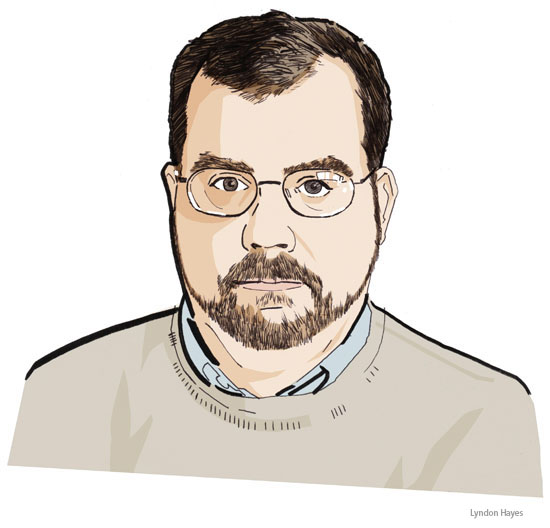
Since he began reporting full-time, in 1991, Ken Ward Jr. has embodied the credo of Ned Chilton III, The Charleston Gazette’s late publisher, that the “hallmark of crusading journalism is sustained outrage.” In his twenty years covering the coal business in Appalachia, the forty-four-year-old Ward has exposed regulatory and enforcement breakdowns, as well as the corruption of corporations and individuals. In person he can be quiet, even shy, but his reporting is fierce and his sense of injustice unwavering. His work has been cited by everyone from Andrew Revkin at The New York Times to The Washington Post, PBS, and NPR. He is a three-time winner of the Scripps Howard Foundation’s Edward J. Meeman Award for Environmental Reporting. He also has received the Livingston Award for Young Journalists, an Investigative Reporters and Editors medal, and an Alicia Patterson Foundation Fellowship. In 2009, he launched Coal Tattoo, a blog on the Gazette’s website that takes its name from a Billy Ed Wheeler song. Coal Tattoo, driven by Ward’s smart, data-driven coverage, quickly became a must-read for reporters who want to understand the coal industry in the United States. CJR’s
Brent Cunningham interviewed Ward in Charleston earlier this year.
Bearing Witness
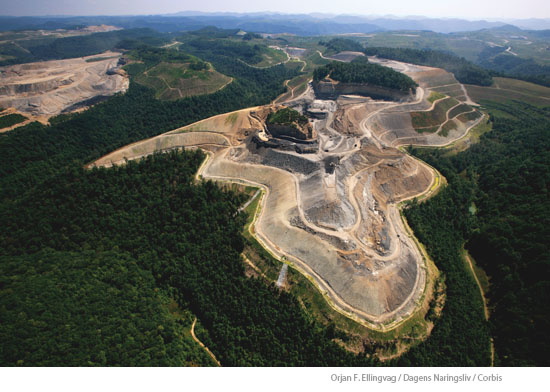
Maybe fifteen years ago, I drove up Cabin Creek hollow. This is twenty miles from the capital in Charleston, and one of the poorest areas in Kanawha County. It was Earth Day, I think, and there was some coal company-sponsored event where they were going to plant some trees. This is where the big mine at Kayford Mountain is. You’ve seen photos of Kayford Mountain, showing the effects of mountaintop removal, on the front of The New York Times and any number of places. I’m driving up there and there are kids playing along the side the road, by open sewers, because at the time they didn’t have city water and sewer service. I did a calculation—I can’t remember the numbers now but I put it in a story at the time—of how much coal is hauled out of that particular hollow every year. It was like a billion dollars. I mean, who would stand up and say that’s okay? Would the president of the company that’s mining that coal really say it was okay that he was pulling a billion dollars’ worth of coal out of there and the kids who live there are playing in open sewers? I don’t think so. But yet, if it’s kind of hidden away and the story isn’t told, then it makes it okay.
I don’t think I knew for sure I wanted to be a reporter until I interned at the Gazette in 1989. That was the summer of the Pittston coal strike, and for some reason the editors decided it was a good idea to send an intern who had never been to southern West Virginia and didn’t know anything about the coal industry to cover the strike. They had a business writer covering it, and they sent me to do a color feature on the striking miners re-enacting the Blair Mountain march. Somehow that morphed into me being the main person covering the strike. They used to joke that, you know, “We’ll send you out to the picket line, and it’ll be okay, because you’re not on the company health plan.” I spent the summer riding around with Jim Noelker, who was a photographer at the Gazette, talking to coal miners. And that was it for me. There was something about meeting a group of people who were different from people I’d grown up with, yet the same, because, you know, coal miners in southern West Virginia are really a lot like the people who worked at the paper mill that was the big employer in my hometown. Just working people who wanted to get done with their day and go home and be with their families. Standing on picket lines and talking to coal miners, hearing stories about the last time they were on strike—I was a little naïve, but there was a romanticism to it. But also the Pittston strike was about a coal company trying to break the union and not have a big contract with good benefits, and particularly good health-care benefits for their pensioners. The injustice of all of that, that these broken-down old miners who had given their health and in some cases their lives for coal were being robbed essentially of the health care they’d been promised. I really liked telling that story. And it seemed to me that if what was happening was laid out for people clearly, they would see that it wasn’t right.
Big, Dumb Projects
One of the first stories that I took on was this out-of-state garbage story. There’d been a number of proposals, framed as economic development, for these big garbage dumps, and most of them had been beaten down. But when I came to the Gazette there was one that was being proposed for McDowell County, the poorest of the poor in West Virginia, and the whole view in Charleston was, “Well, the people in McDowell County want it.” I knew some people from McDowell County, and they told me that wasn’t true. There was an environmental reporter at the Gazette at the time who was convinced that the people there wanted it, so he wasn’t writing about it. I remember going in to [editor] Don Marsh—and this wasn’t my beat—and I said, “We need to write about this.” I’d been there like three months, and I’m challenging these people who had been there a long time. I was one of Marsh’s boys, you know; he hired me, and he always kind of had my back, and he said, “Okay, go down there, see what you find out.” I ended up writing probably two dozen stories about it over the course of the next six, eight months, and they ended up building a landfill but it was a much smaller one than what was originally planned; it wasn’t this giant, out-of-state thing. And then we took on this thing about a big pulp mill that was proposed in Mason County, and I wrote hundreds and hundreds of stories about that. Well, it never got built. That was the beginning of a series of stories about big, dumb projects. And there was something satisfying about that. But at the same time, there was a guy who worked for the PR agency that was promoting that McDowell County landfill. I remember him giving me this lecture about how if I was going to be a successful investigative journalist I needed to find something that I was in favor of, instead of just writing about things that are wrong. And that still sticks with me; he was twisting what was really going on. Because you’re against something doesn’t mean you’re not for other things. Saying that economic development for southern West Virginia need not mean taking everybody else’s trash—inherent in that is the idea that there are other kinds of economic development that might be better.
I think that most journalists, certainly in America today, are dishonest with the public by telling them that they’re objective. I used to go give talks at some of the trade groups in West Virginia, and I’d use this Hunter S. Thompson quote—that objective journalism is a pompous contradiction in terms—and people would always say, “A-ha! That proves it! Ken Ward’s biased, we knew it all along.” And then I would say, “Well, let’s talk about my biases.” And I would say things like, “You know, I think everybody should be able to earn a living so they can take care of their families. I think everybody should have clean water to drink. I think everybody should have clean air to breathe. I think every kid deserves to have a chance at a good education. I think that everybody ought to share in the wealth of our nation.” Nobody ever really wanted to disagree with any of that. But they didn’t really like how it manifested itself in stories.
I guess somebody could say I’m being pompous, that if everyone would just see it my way… And maybe there’s some truth to that. But there’s a difference between an inherent, emotional bias against something and really looking at it in a scientific sort of manner. I guess that’s one way my own thinking about some of this has evolved—and it goes back to my dad. He was a high school chemistry and biology teacher, and he used to preach scientific method sort of stuff. If you’re going to go at journalism the way I do, that there are injustices that need to be exposed, then you also need to do what scientists do and rigorously examine whether there’s evidence that shows that your hypothesis is wrong. These days I probably spend more time trying to read what the coal industry says about mine safety or air pollution or whatever than I do reading what environmental groups say about it. Because I want to understand what they’re saying.
True Facts, False Facts
I did this thing not long ago on my blog, I went to hear Congresswoman Shelley Moore Capito at the Coal Association Meeting. She was waving some piece from some right-wing columnist about how the EPA was going to regulate spilled milk. It flows great with Republican ideas, you know, but it’s not true. And so I wrote about how she was doing this and it wasn’t true, and with the blog I can link to the Federal Register notice so readers can see for themselves. But at the same time, that guy’s column got linked to on a bazillion websites, and anyone that types “EPA and milk” in Google News, the first thing they see is his column. There’s a lot of noise today, obviously, and it is harder to cut through and get true facts out there. But it’s even harder to dispel or debunk false facts.
There is a group called Climate Ground Zero—they’re the ones doing all the tree-sitting and stuff against mountaintop removal. They have their own blog, and they are forever putting out information that’s just not accurate. I get bombarded with these e-mails: “Why won’t you report about this? Climate Ground Zero’s the only one that will tell the whole story.” Ten years ago I would have ignored it, but it’s out there on the Internet now. But if you spend all your time debunking that stuff then you’re not getting anything else done.
Part of the reason I wanted to do Coal Tattoo was that I saw the growth of pseudo-journalism about these issues, about mountaintop removal, climate change, the coal industry. I saw this pseudo-journalism taking over the public discourse. If real journalism is to survive, I think we have to engage with that stuff to a certain extent. So much journalism that’s considered the best of the best is so self-indulgent. Here’s my three-million-word, seventeen-part series on education, that I had six computer experts and three graphic artists and seven photographers and three librarians and two interns work on with me. Don’t get me wrong, I love doing a big project, but we’ve got to do more than that. And the same kinds of tools and skills that real journalists have to sort out what’s true and what’s not true, and who’s doing what to whom and who’s winning and who’s losing public policy debates—we need to deploy those things for products other than seventeen-part series that win the Pulitzer Prize. I keep trying to get our newsroom to stop calling blog posts “posts,” because I think it makes them these kind of lesser forms of journalism. And they ought not be.
The Why and the How
My city editor always says to me, “You always have these damn documents, you don’t have any people in your stories. Go find some people.” And he’s right. When I’ve done more to get more people into my stories, they’re obviously always better. I did this big thing on how disasters aren’t the only way coal miners die, how they die one by one a lot of different ways. That’s how I learned about Bud Morris, whose picture’s on my blog. Sago [an explosion at an underground mine in Sago, West Virginia, that killed twelve miners] was January of 2006. And 2005 was the safest year ever in the coal industry. And all the stories on January 1 were about how “This has been the safest year.” Well, on December 30th, 2005, Bud had gotten killed. He was the last miner killed in the safest year in history. Then January 2, the day after New Year’s Day, Sago blows up, and all of a sudden people care that coal mines aren’t safe. Well, he had just gotten killed—what about all of these guys like him? cnn isn’t there, there’s no big press conference, the president doesn’t come and speak.
So I understand how important those stories can be. One of the big things in journalism schools now, of course, is multimedia, and everybody talks about “storytelling.” I think that maybe we need to focus a little bit less on storytelling, a little bit less on finding Joe Smith who lives near a Marcellus Shale gas well, and his story about what it was like having that big industrial complex move in next door to him, and do more of giving him information he needs to understand why that happened to him and what he could do as a citizen of this republic to change or resist the situation. I try to do stories that don’t necessarily tell about somebody who’s going through a difficult time, but that tell people who have gone through a difficult time why the hell it happened to them, and how their government let it happen, what powerful institution did it to them, and what can be done about it. Obviously, the best journalism kind of melds those things, but I’ve always been more interested in the latter than the former.
Home
Coal is a very rich topic. It’s brought this endless series of disasters—death, destruction of the land—but at the same time, to a relatively small number of people who work directly for it, it’s brought a good living… with a lot of peril that comes with that living; your life could be choked off at any minute. To an even smaller number of people—a kind of local middleman—it’s brought enormous wealth. People who are lawyers or representatives and accountants for the industry; to Charleston families who are lucky enough to have somehow ended up with significant holdings of mineral rights, it’s brought generations of idle wealth.
I saw these kids when I was growing up, and it wasn’t coal, it was the paper mill. The mill hadn’t been hiring new people for years, and as workers retired they just downsized their work force. But guys I went to school with, their grandfathers had worked there, their fathers were still working there, and they were convinced that when they got out of school they were going to get a job at the paper mill. Things are going to get booming again, it’ll be great. And what politicians in West Virginia are trying to convince people of now is, if we can just stop these crazy Obama people, then we’ll have our next coal boom and we’ll have 100,000 coal miners working in West Virginia again. Then we won’t have to worry about things like how we educate kids for some kind of future where they can live a good life and provide for their families. Because the coal industry will take care of that again.
That’s the kind of false hope that they’re trying to give people.
Way back when Jim Noelker and I used to ride around and talk to people in the coal fields, we never found one that wanted their kid to be a coal miner. They always said, “I’m doing this terrible work so that my kid can go to college.” Now, the politicians have sold this idea that coal is their only way of life, and that they need to fight to make sure their kids can do that. It’s a complete reversal, and that notion is kind of maddening.
I find, reporting about coal over the years, that when you get a really good story, a story that really explains something that isn’t right, when you listen to the criticism you get, it isn’t that the story’s wrong, it’s that you did the story in the first place. You’re disloyal. And it comes from the coal industry, of course, but from the miners too. I’ve known a lot of coal miners and I have a lot of respect for them. They do ungodly difficult and dangerous work and they deserve every penny they get paid for it. But there’s all this romanticism about coal mining. Ten thousand people died of black lung in the last decade. Is that modern?
Working at a paper the size of the Gazette in this economy is not the most fun thing in the world all the time, and on days when it’s not very much fun, it’s like, “God, why did I do this, am I crazy?” I don’t want to wake up in twenty years and think I missed some great opportunities. I’ve had chances to go to other places—bigger newspapers, a lot more money, more readers. I remember one interview, I went in asking this editor a bunch of questions, trying to see if she would convince me that this was a move I should make. I said, “Let me describe to you what I do now. I set my own agenda for what I’m going to do each day. I don’t get assignments, or very seldom get assignments; my editors trust me to sort out what’s important. So basically, I do what I want. Can you offer me a job doing that?” And of course they all say, “Wellll…” And I say, “Okay, when you can offer me that, call me.” I don’t get too many calls like that. I know people who work at bigger places that essentially get to do that; they get a year to work on one story so they can try to win another Pulitzer, or turn it into their next book. And that’s great, and there are people that do that whose work I admire a lot, and who have been great mentors to me. But I also know the kind of fights they have at bigger places, with layer after layer of editors or bureaucracy and, you know, the six months’ worth of investigative work they did gets hacked in half at the whim of some editor who may or may not know anything about the subject matter. That doesn’t appeal to me. My wife would say I’m too bullheaded and don’t like anybody telling me what to do, and she’s probably right.
West Virginia’s my home. I’ve never lived anyplace else. It is impossibly rich with things for a reporter to cover. Right now I’m focusing on coal. I’ve written about a lot of other things, and I have a huge list of things I still want to write about. And I can’t think of many places that are in need of good journalism more than West Virginia is, or what higher calling journalists have than to try to write stories that make their home a better place.
Has America ever needed a media defender more than now? Help us by joining CJR today.