Sign up for the daily CJR newsletter.
On a recent afternoon, I drove down a wooded Maine road, past serene ponds with no people in sight, until I reached a big white barn. I parked, in patchy grass, near a Ford F-350 with a crane bolted onto the back, an American flag, and an idling black SUV. A guy in the driver’s seat of the SUV, whose tattoos peeked out beneath the sleeves of a white dress shirt, sent me thirty feet down the road to another guy, in a large white SUV, who politely told me to wait. Tucker Carlson was still recording.
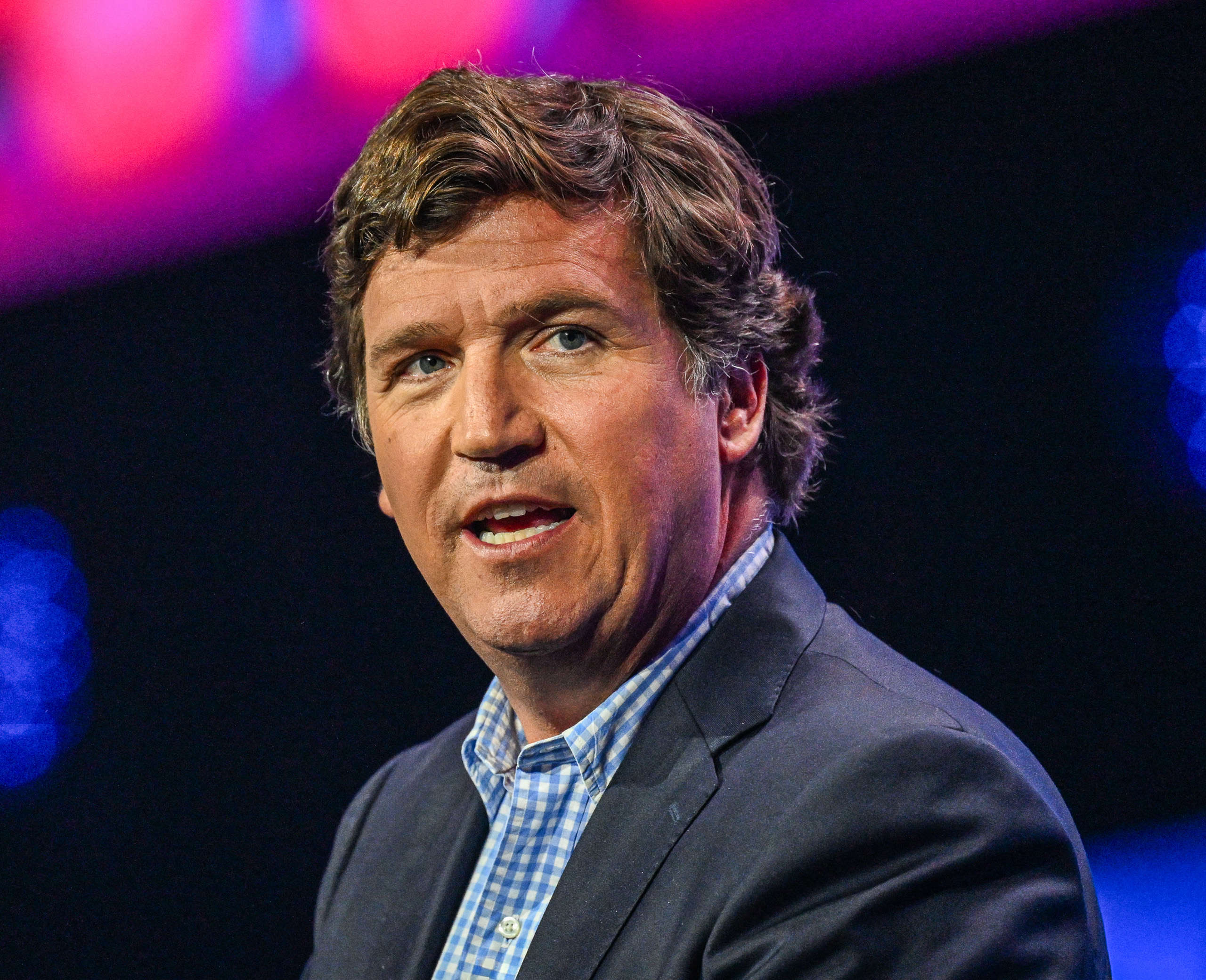
I wouldn’t have been surprised to see anyone—a United States senator? A prison guard claiming to have evidence that Jeffrey Epstein was murdered? Donald Trump?—walk out of that barn. Carlson, who is fifty-seven, occupies a singular space in American media: after decades in corporate television, most famously at Fox News, he now hosts The Tucker Carlson Show, a video podcast, where he can and does follow his every whim, taking his hordes of fans along with him. A recent episode, “The Secret History of Biblical Giants,” has 1.5 million views on YouTube.
Eventually, Carlson—boyish, tanned, wearing an outdoorsman vest and New Balances—welcomed me into the barn. As I entered, I passed that day’s interviewee: Nick Maynard, an English surgeon who has worked extensively treating Gazan victims of Israeli air strikes.
On his show, Carlson advocates long-held hard-line conservative views, which include total opposition to immigration, abortion, and trans rights. He also takes a strong stand against war: Carlson has vociferously denounced the American and Israeli attacks on Iran—during which over thirteen thousand targets have been bombed and more than three thousand people killed—as well as Israel’s post–October 7 assault on Gaza. Carlson has personally lobbied Trump, whom he’s known at least since both were NBC television personalities, not to attack Iran. He’s an imperfect vessel for the anti-war argument, but his reach and influence may make him America’s most prominent crusader for the cause.
Because of his reputation among American conservatives, Carlson can book guests such as Ted Cruz, the Republican senator from Texas, and grill them on their warmongering. In a 2025 interview that went viral, Carlson asked Cruz to tell him the population of Iran; Cruz couldn’t do it. “You’re a senator who’s calling for the overthrow of the government,” Carlson shouted in response, “and you don’t know anything about the country!” It was a rare thing: a complete pantsing of a powerful public figure. “I am always struck by the ignorance of policymakers,” Carlson told me. “I wanted him to feel shame. And he felt no shame.”
Carlson’s relevance is rooted in the fact that he can both book Cruz and embarrass him. It’s also connected to his symbiosis with a subset of Republicans. According to a recent New York Times/Siena poll of self-identified Republicans and Trump voters, nearly 60 percent of those with a “very favorable” view of Carlson say “they want the next Republican presidential nominee to take the party in a new direction.”
What may be most significant about Carlson now is that his campaign against the Iran war and Israel’s influence on the American political system has placed him in strange cultural territory: suddenly, he has fans on the left. Cenk Uygur, the creator of the progressive news show The Young Turks, has cheered Carlson for criticizing Trump’s attacks on Muslims. When Olivia Reingold, a writer for the Free Press, compiled a dossier against Rama Duwaji, the First Lady of New York City, one of Reingold’s ostensibly damning reveals was that Duwaji had liked a Carlson post criticizing AIPAC.
Peter Beinart—the editor-at-large at Jewish Currents and a prominent Israel critic—has pushed back on the left’s support for Carlson, arguing in a recent Substack video that any progressive who is going on Carlson’s show “should not leave your principles at the door. If you’re against bigotry” and “the argument that somehow white Christians are superior to Black and brown immigrants,” then don’t “ignore all of that because you think you’re working with him to try to turn US policy against Israel.” Carlson recently spoke to Lulu Garcia-Navarro, a journalist for the New York Times, who pressed him about his interview with Nick Fuentes, the white-nationalist influencer.
Carlson often starts his podcast episodes with lengthy, showy monologues. He doesn’t write them down, he told me, instead sketching them out in his head during daily sauna sessions. The monologues encapsulate both his appeal and the fear he strikes in people. Whatever the topic—biblical giants, Christian nationalism, Gaza—he is a preternaturally compelling speaker. At one point in our conversation, he fell into a reverie describing all the cigarettes he smoked in Dubai while sitting down with an aide to Benjamin Netanyahu, Israel’s prime minister. “I love smoking so much,” Carlson said. These days, though, he mostly gets his fix via his own nicotine-pouch brand, ALP, which stands for American Lip Pillow.
Carlson’s barn, in the town of Woodstock—his family has owned the barn for years, and their summer home is nearby—feels like a GOP-themed chain restaurant. Nearly every spare inch is covered with taxidermy or Republican memorabilia. Carlson took a seat under a big stuffed bear head and torso, near a Nixon/Agnew sign and a Bush ’88 ashtray. He spit out an ALP, popped in a new one—with twelve milligrams of nicotine, he made sure to point out, making it one of the most potent pouches on the market—and we began talking. Our conversation has been edited for length and clarity.
AB: Fox fired you in 2023. Did you anticipate any of what would come next?
TC: No! I don’t anticipate where I’m going to be after dinner tonight. I’m not a planner. I never have been. A lot of our producers got fired with me. We immediately pivoted from television to the internet. It was actually a lot easier than I thought. We had the Fox studio in the other part of the barn: they came and took all their cameras and the lighting rig and the soundproofing.
I certainly did not anticipate talking about Israel. I had been on TV for thirty years. I don’t think I had ever really talked about Israel. From my perspective, I got pushed into it.
How so?
I felt I had no choice. Early in 2025, Netanyahu showed up at the White House right after Trump’s inauguration, and I thought, “This is a little early to be siphoning off the energy from this campaign and this election for the benefit of another country.” And I resented it. I very quickly began to understand the point of these visits was a regime-change effort in Iran. And that’s something that I talked to Trump about many times over ten years. Fifty times! More! In public, but mostly in private.
The breaking point and the huge change in my life came in June of 2025, with the Twelve-Day War—which was not about Iran’s nuclear program. It was the first salvo in a regime-change effort led by Israel. And that’s just antithetical to everything Trump ran on.
I’ve been to Israel several times, both for work and as a visitor. I love Jerusalem—amazing city—but I’m not interested in Israel. I don’t think it’s significant as a country from an American perspective. It’s not in our hemisphere. It’s got no resources. So I just don’t care. But once you start taking over my political system and destroying my country, then I have a right to care. So now I do care.
When you’re trying to dissuade Trump from going to war, what do you see as your role? Are you speaking as a concerned American or as a journalist?
What category do I occupy? I haven’t the faintest idea. I’m not interested at all in defining it. I’m not a politician, that’s for sure. I’m not a rival to Trump for power. I have no power. I’m someone who knows Trump, and I know him well, and I’ve known him for a long time. I can call him. He often calls me.
Do you still speak to Trump?
I haven’t spoken to him since the regime-change war began. I’m not interested in talking to him. I feel sorry for him. He’s not a man in charge of his own life at this point. I feel sorry for anybody who’s enslaved, including him. I mean, I visited him three times at the White House in the month before the Twelve-Day War, and I told him the same thing all three times: “You’re not gonna see the rise of a democratic, pro-Western government in Tehran. The best you’re gonna see there is just this suppurating wound.” And he said, “I know.”
What is it really about, in Trump’s mind? Why did he destroy himself? His administration? His legacy? The Republican Party and America? I don’t know, but maybe someone at CJR should get on this and find out.
Okay, so, three years after leaving Fox, you’re suddenly one of the most prominent anti-war voices in America—
It’s not hard, because no one else is against it! Where is everybody?
Are you surprised to find yourself in this position?
Well, no. I’ve been against war since December of 2003, when I was in Iraq and I was highly distressed by it. So I’ve had the same views for twenty-three years now, more or less. But I just stayed away from Israel because—and I would say this to people who worked for me at Fox—it’s not worth it. It’s too personal. The unwritten rule is that criticism of Israel is criticism of all Jews, and because I am not against Jews, it’s not worth it.
I’ve been to Israel a lot, so I’m fully aware of the apartheid situation in Israel. I’ve been offended by it going back twenty years. But I would always say to myself, “Okay, I’ve been in a lot of places with injustice.” I’ve seen Nigerians treat Liberians like animals, firsthand, in West Africa, and I was offended by it. But I didn’t organize my life around defending oppressed Liberians.
Occasionally, something would happen and my staff at Fox would bring me a story about Israel. I’d be like, “Nope, I don’t want to do it.” Now, that was probably cowardice on my part, but also the truth was I had mixed feelings about it. I’m not defending this. I’m just telling you the way I thought. I would sublimate it. “Is it really worth it? I don’t want to think about it, and I’ve got all these children, and I want America to be a decent place.” But the Iran war, that was too far.
There’s been speculation that hawks like Marc Thiessen, the Washington Post columnist, have played a part in convincing Trump to continue the Iran war. Do we, meaning the public, have a good understanding of how people in the media influence Trump?
I don’t know if people have a good understanding of it. I don’t know if I always have a good understanding of it. But I don’t believe that Trump is substantially influenced by Marc Thiessen. I doubt Marc Thiessen influences his wife, assuming he has one. I think that Marc Thiessen and others like that are just a sideshow designed to divert your attention away from the people who are influencing the president. And those would include his donors. Those would include John Paulson and Miriam Adelson and Rupert Murdoch, who’s had a huge effect on Trump. Rupert Murdoch would call Trump three or four times a day to encourage him to attack Iran. And I know that because I’ve talked to Trump about it many times.
You and Pete Hegseth, the secretary of war, were both on Fox. Do you have any thoughts about his fitness for the job?
I feel sad about the whole thing. I think it’s disgusting to brag about killing people. It’s totally unchristian and immoral. We should treat death with reverence, period. You can certainly make the case that some people should be killed, but I don’t think anyone should ever celebrate the death of another human being. And by the way, you’re gonna be punished for that.
What do you make of Trump’s lurching attempts to end the war in Iran with the memorandum of understanding?
It’s a humiliating defeat for the United States, but it’s still an improvement over what would happen if we kept going, so I’m grateful for it. Israel is the victim in this. Israel got so far over its skis. Imagine it from Israel’s perspective: you think you’re gonna be the regional hegemon, and then, three months later, Iran becomes a global power. It’s a freaking nightmare!
But there’s no meaningful diplomatic effort; Israel doesn’t even have the capacity for diplomacy. “We’re just gonna explode your pagers.” You can talk yourself into thinking you’re far more powerful than you are, and when you do that, you get hurt. I learned that at twenty-five in a bar fight. And I never punched anyone again, because last time I did, I got the snot knocked out of me, and I had to go on TV with a black eye. I was married. With kids. I was actually thirty-two, now that I’m thinking about it. And my wife was not impressed at all, and my kids were confused. Everything about it was bad. But I realized I’m better at talking my way out of problems than fighting my way out of problems.
I don’t think I’m making complicated points, and I don’t think I’m saying anything radical. Like in that interview with the New York Times. Midway through it she gets kind of emotional and treats me like I’m a dangerous figure. I don’t see myself that way at all. I see myself as thoroughly moderate, and more so as I get older, and I don’t think I have any weird sacred cows that I’m not admitting in public.
The Times reporter, Garcia-Navarro, asked repeatedly about your interview with Nick Fuentes, which seemed to surprise you.
I’m happy to answer questions about Nick Fuentes, but if you’re asking me your eleventh question on Nick Fuentes, I’m gonna have to call it out for what it is, which is a diversion tactic.
I feel like the thing that people are really mad about is the fact that they can’t get jobs that are well-paying enough to build an independent life. Young people are threatened by the promise of AI, which is taking away their futures. And she wants to talk about Nick Fuentes? It is so perfectly representative of the way a certain class of people in America thinks, which is small and narrow. We’re supposed to be running the world! Not with people like you, man.
You did express regret in that Times interview about interviewing Fuentes, at least on the basis that it created too much blowback for you. If you are going to continue to be a prominent anti-war voice and Israel critic, are you thinking about calibrating your approach in any way?
No. I’m not an anti-Semite; if I was an anti-Semite, I would just say so: “I’m against the Jews, here’s why.” I don’t have an employer. I don’t have investors. I don’t even have any creditors, so I can say whatever I think is true, and I plan to.
I find it so interesting that people are unwilling to accept my word. I always say, “Well, why wouldn’t I just say it? What am I going to get? Canceled? I’ve already been fired.” I had the highest-rated show in the history of Fox, and they fired me anyway. So it’s like, what are you going to take from me now?
Maggie Haberman and Jonathan Swan recently reported that JD Vance pitched having you interview Ghislaine Maxwell in prison as part of the Trump administration’s pushback to negative coverage around the Epstein files. Were you involved in this idea?
I was one of the very first, maybe the first person to attack the administration in public last summer for hiding the Epstein materials. Not only was I not involved in a cover-up, I was publicly attacking them. I’ll be happy to interview Ghislaine Maxwell or anybody else. That’s my job. But no, I was not involved in a plot to cover it up.
In an interview recently, Sebastian Gorka, the White House counterterrorism “czar,” name-checked you after being asked about right-wing terror threats.
Sebastian Gorka—he’s not even American. My family’s been here for like four hundred years. And I’m the terror threat because I would like democracy and free speech. I texted him immediately and said, “Let’s have a conversation.” He never responded. He used to invite me over for dinner to his house, and I got such a creepy vibe. I just knew, I’m gonna get over there and he’s going to have me put on a costume.
Sorry, a costume? What kind of a costume?
I don’t know. I’m just guessing. If there’s anybody that has a costume room, it’s Gorka.
Speaking of free speech crackdowns—one of the most famous recent examples when it comes to Israel/Palestine is Mahmoud Khalil, the Columbia student-protest leader detained by ICE.
Even then, I didn’t say anything. So determined was I to stay out of this that I made the—in retrospect, probably foolish and maybe even cowardly—decision to not say anything when they started revoking people’s visas for their political views.
Now, I’m for less immigration. In fact, I’m for ending all immigration today. I don’t know how you can justify immigration when half of all white-collar jobs are going away because of AI. What are people going to do for a living? There’s no economic justification for any immigration in the United States because we can’t even figure out what we’re going to do with all these unemployed people. So it’s crazy. Social-services spending, healthcare, education—who’s going to pay for that? So I’m opposed. And in the case of Sebastian Gorka—like, I would deport him immediately.
Legacy media is in constant flux. Do you see the old-school press being able to navigate this era? Or is it slowly just withering away?
Do I see NBC News making a comeback? No! I don’t know David Ellison, but he’s not a genius, I’ll tell you that. He’s buying CBS. Are you gonna buy RCA Records next? I wouldn’t take CBS News for free. I wouldn’t take CNN for free—maybe CNN International. But, like, Paramount Pictures? This is not the future. It’s not even the recent past. It’s the distant past.
I’m not exactly sure where young people are getting their information, but wherever they’re getting it is the right place, because they are so well-informed. For years, I thought that weed and porn and SSRIs and benzodiazepines have totally disabled young people. But I don’t think that anymore. I employ a lot of them, and they’re the sharpest, hardest-working people. They give me a lot of hope. And boy, they don’t believe anything. And they’re very well-informed. So much better-informed than I was when I was twenty-seven. I thought the CIA was a force for good! I literally thought that!
I think Trump is the last Fox News viewer. I’m so grateful every single day that I got fired. I probably wouldn’t have left, knowing me. I’d just be increasingly unhappy.
And here, you feel like you’ve found your—
I feel totally happy. I mean, I think my influence is overstated. I don’t seem to have influence at all. I couldn’t stop Trump from attacking Iran. And my wife, who is hilarious, literally laughed at me after the war started: “So I guess you weren’t very good at that, Mr. Powerful Influential Guy!” What matters is the ability to affect outcomes. And I have no demonstrated ability to do that. None.
Some have referred to the current divide on the right as being a split between Fox News Republicans and YouTube Republicans. Are you strategically positioning yourself as counterprogramming?
I’m not strategic in any way. I make almost all decisions on the basis of smell and instinct. I have no real idea who watches our show. I’m sure there are people who work here who have, or claim to have, a better sense of who the audience is. I really don’t. I make all decisions about what we air myself, usually without consulting anybody. I have a short attention span. That’s been a huge advantage for me over the years.
One thing I always loved about Rachel Maddow, and I often told her this, is that she just existed in her own universe. She’s off in the Berkshires alone, thinking. She was disconnected from the herd. I’ve always wanted to be that. I haven’t always succeeded. It’s shameful the number of times I’ve covered something because everyone else was talking about it. But I really try not to be that way. And increasingly, especially as I age, I am cut off.
I’ve never posted in my life. I don’t have my password on social media. I don’t read anything. I get almost all my information by text message or phone call. That’s it. It could be every bit as wrong. But I just don’t trust anybody at all, and I don’t want it in my head. I’ve never listened to a podcast. I have some form of intense dyslexia, and something about podcasts and movies and television puts me to sleep almost immediately. I still read books every day.
Are you interested in aligning yourself with other anti-war voices?
I do know what really matters is war and finance. Where does the money come from? Where does it go? And who gets killed? And on those questions, the parties are in lockstep solidarity with each other. That’s not a democracy. That’s a one-party state posing as a democracy, and it needs to be broken, and there’s going to be a third party, and I’m going to do everything I can to bring that about.
And that’s the lesson of the last two and a half months, to me. If you vote for Trump and you still wind up in a regime-change war—if Chuck Schumer is strongly behind Trump’s foreign policy, which he is—then we need options, or else let’s just give up and be ruled by the most unscrupulous people. And I’m just too young to accept that. We need a third party.
And when you say do everything you can—
I’m going to help build a third party. There should be a good-faith effort to figure out what benefits the country. I mean, if you make sixty thousand dollars a year, you’re degraded. Your life expectancy has gone down, and the promise of your children’s lives is likely gone. No one seems to care. It’s not even a factor. “What about Hamas?” I officially don’t care about Hamas. The US government should have, as its first priority, the welfare of its own people.
Would you be a candidate for this third party?
I don’t want to be a candidate. Before I did the Times interview, someone said to me, “They’re going to ask you if you’re running for president.” I was very tempted to say “I am running—on the pro-patriarchy ticket.” Just to make sure I gain no new fans.
What’s your goal in speaking to outlets like CJR or the Times—people who are presumably outside of your direct audience?
It’s the only power I have. I don’t have any tricky plan to win Times readers to my campaign for some office. I don’t have any institutional power. I don’t control a military. So all I have is the power to talk and be heard. And though it’s borne no fruit so far, I remain hopeful.
The headline of that Times interview was “What Does Tucker Carlson Really Believe?” The Atlantic used an almost identical headline for a 2019 profile.
So weird. Like I’m using some kind of verbal magic trick to hide something. From my perspective, I am the least mysterious person who’s ever lived. I don’t think I’ve ever said anything in public that’s complicated or hard to understand. I have a commitment to not doing that. I believe if you can’t explain something clearly, either you don’t understand it, or you’re trying to hide something.
What do I really believe? What do you think I’m hiding? I could talk for twenty-four hours! I’ll tell you everything I believe! I can’t stop talking!
Has America ever needed a media defender more than now? Help us by joining CJR today.