Sign up for the daily CJR newsletter.

Last week, I closed the column with a piece from the Chattanooga Times Free Press about Guillermina Solano-Chala, a local restaurant owner who was deported to Mexico after twenty-seven years in Tennessee. It was an excellent example of what local journalism can do: follow the story of a community wherever it leads, including what happens after someone is forced out. Last Wednesday, I spoke to Alison Gerber, the editor of the Times Free Press, about a letter she published with the story about documenting “a narrative that future historians will consult.” But by the time we published, Friday morning, Gerber was no longer employed by the Chattanooga Times Free Press.
After nearly three decades of ownership, WEHCO Media suddenly announced that it had sold the paper to Craig Fuller, a local freight executive, and his father, Max. Of the paper’s 128 employees, more than fifty were laid off immediately following the sale and another ten chose to leave. Fuller addressed the staff, acknowledging that the transition would not be easy. “It’s going to be uncomfortable. It’s going to be chaotic. You’re going to get very frustrated,” he said in a leaked recording of the meeting.
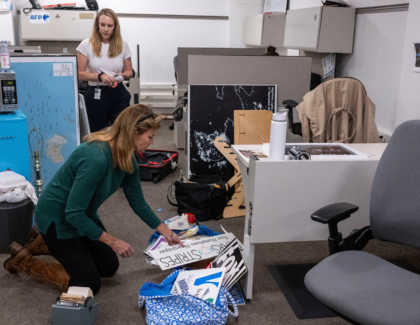
A number of Times Free Press journalists I spoke to this week agreed that the layoffs were chaotic—and beyond that, the way they were handled was cruel. All of the top editors were let go, effective immediately. “The three of them being gone suddenly really left us with no plan and no leadership and no idea how we’re going to get the paper out,” Mary Fortune, an editor who was not laid off but quit in protest, told me. “The plan was for me to jump right into this dumpster fire lit by a bunch of heedless rich guys buying and selling and trading us like baseball cards,” she wrote on LinkedIn when she announced her resignation. (Her full note is worth reading.) Gerber, who had been with the paper for more than twenty-three years, said she first learned she had been let go from one of her reporters.
Initially, Fuller blamed the layoffs on WEHCO. “We literally know very little about your business,” he said at the staff meeting. “We made a lot of decisions with very limited information. WEHCO was very prescriptive about making these decisions before we ever walked in the room.” But when I spoke to him, Fuller said he had decided who would be let go and that WEHCO had simply “executed it” and agreed to carry associated financial costs. “Ultimately the people that we cut was simply a math problem,” he said. “A lot of it was the more expensive resources.” Asked whether he considered retaining any of the paper’s leaders, even temporarily, to help him better understand the newsroom, Fuller said, “We wanted full agency and control of the business.”
On X, Fuller posted another explanation: “I am following the Elon Musk playbook on the TFP (although at a much smaller level), as he did when he acquired Twitter. Immediately cut out massive layers of bureaucracy, and everyone said X was going to break. It didn’t.”
All of the journalists I spoke to disputed that assessment. “The idea that we weren’t working or we were just bureaucrats sitting around is highly, highly offensive,” Gerber said. Siena Duncan, a reporter who was laid off, posted a note on LinkedIn, saying she believed politics might have played a role: “I have no proof my firing was politically motivated. But a reporter’s intuition tells me to think critically.” Fuller was emphatic that politics played no role in his decision-making and said he’s an independent, single-issue voter focused on freight. “There are people who are political diehards that care about that,” he said. “Frankly, I don’t give two shits.”
After we spoke, Fuller emailed me: “We eliminated layers of leadership because we believed that former management should be held accountable for the abysmal economics of the paper. This includes the deterioration of subscriptions, the decline of advertising revenues, and the perception that the TFP no longer served its community, despite having one of the largest newsrooms per capita in the country (and still does). You can invent conspiracies, but these are the facts.”
Gerber rejected that characterization, saying the editorial team was not responsible for the paper’s business decisions. “The Times Free Press was named the best paper in the state six of the last ten years. Our mission in the newsroom was great journalism, and we did that extraordinarily well,” she said.

Last year, The Frontier, an independent nonprofit newsroom in Oklahoma, got a tip about poor conditions at the Tulsa city jail. An editor asked reporter Garrett Yalch to look into it.
The jail was a small, underground seventy-bed lockup run by a private security firm. It was designed to house people charged with low-level misdemeanors. “We thought, since it’s a municipal jail, there shouldn’t be any deaths. We thought maybe there’s some excessive force or lawsuits or overcrowding,” Yalch told me. “But then I thought I might as well pull some records. And we found that there had been five deaths at the time. That was really pretty shocking.”
The Tulsa Municipal Jail is now closed, the direct result of a series of reports from Yalch since March revealing that there had been seven deaths at the jail in just three years, all from preventable causes such as overdoses, suicides, and a treatable infection.
The announcement that the facility would be shuttered came just a day after The Frontier published a video documenting the final hours of a detainee named Justin Benner. When Tulsa police arrested Benner, he was having a mental health crisis. But instead of taking him to a hospital, as department policy requires, officers arrested him for public intoxication and resisting arrest. They took him to the jail, where he was strapped into a full-body restraint, and left him unattended for roughly forty minutes. By the time staff checked on him, he was dead. An autopsy found no alcohol or illicit drugs in his system.
For his investigation, Yalch talked to current and former detention officers, including several who had been fired and retaliated against after raising concerns. “I told them, ‘If this keeps happening, people are going to die. Someone’s going to get hurt. The whole bottom is going to fall out,’” Ivy Morgan, a former detention officer at the jail, told Yalch. “It’s like a mental health facility, but you don’t have any way to actually help them. They shouldn’t be there.”
The city has also announced that it will expedite all of The Frontier’s outstanding open records requests related to the jail, which officials had previously blocked. Benner’s case records were obtained by his family. Benner’s father described him to Yalch as “an endlessly curious, compassionate, and generous person who loved the outdoors and maintained a close-knit circle of friends.” “Justin was one of the kindest guys. He’d just hug you. He was a hugger,” Daniel Smolen, the family’s attorney and a former classmate of Benner’s, said to Yalch. “If this can happen to Justin, it can happen to anyone.”
On June 23, 2020, Antonio Mays Jr. left his home in California for Seattle to participate in Black Lives Matter demonstrations at the Capitol Hill Occupied Protest (CHOP), an eight-block police-free zone that had formed around an abandoned police precinct in the city. “I am not running from home. I am fighting for a cause,” he wrote to his father before he left. Less than a week later, he was dead, shot by members of the movement he had been so eager to join. He was sixteen years old.
In the hours after the killing, a narrative quickly emerged: Mays and Robert West—another teenager, who was injured—were in a Jeep driving toward the CHOP encampment when they supposedly fired at protesters. The protesters returned fire. Six years after Mays’s death, that story had gone largely unchallenged, and the case remained unsolved.
In Embedded: We Keep Us Safe, an eight-part podcast, hosts Sydney Brownstone, an investigative reporter with the Seattle Times, and Will James, an audio documentary producer for KUOW, reexamine the story to ask: How could “something so hopeful, a protest for Black lives, end up turning into this circle of silence surrounding the killing of a Black teenager?”
Over the course of an eighteen-month investigation, a collaboration between the Times, KUOW, and NPR, reporters interviewed nearly a hundred people involved in the 2020 protests, reviewed more than a dozen videos from the night of the shooting, and surfaced crucial new evidence to reconstruct the scene. At a moment when both local and public media are under intense financial pressure, the series is a testament to what they can accomplish when they work together.
Their reporting uncovers that the boys in the car were in fact unarmed, identifies a potential suspect whose name was given to Seattle police in 2020, and reveals a previously unknown witness who said the killing was “an execution.” They also find a video of Mays in the days before his death, speaking with other activists about why he is protesting. “He went up there and identified with professionals and intellectuals at sixteen years old,” Mays’s father tells the hosts when he sees the tape for the first time. “To identify with intellectuals like that and present yourself in a respectful way, you know, in a zone full of chaos and anarchy. And that’s how he resurfaces. Oh, that’s my boy.”
Additional reporting by Riddhi Setty. Hat tip to the Local Matters newsletter for featuring the Frontier story. If you have a suggestion for this column, please send it to laurelsanddarts@cjr.org. We can’t acknowledge all submissions, but we will mention you if we use your idea. For more on Laurels and Darts, please click here. To receive this and other CJR newsletters in your inbox, please click here.
Has America ever needed a media defender more than now? Help us by joining CJR today.