Sign up for the daily CJR newsletter.
In January, Stars and Stripes—which receives Pentagon funding but has covered the military, for the military, with editorial independence since the Civil War—found itself in the crosshairs of the Defense Department. Sean Parnell, the Pentagon spokesperson, announced that the DoD would return “Stars & Stripes to its original mission” by modernizing operations, refocusing “its content away from woke distractions that syphon morale,” and concentrating on “ALL THINGS MILITARY,” instead of repurposing “DC gossip columns” and using stories from the Associated Press. On March 9, without consulting Max Lederer, the publisher, or notifying the newsroom, the Pentagon published a memo barring Stripes not only from using wire services and publishing comics, but also from filing Freedom of Information Act requests and reporting “controlled unclassified information,” a label for material the military leadership considers sensitive. The memo also stated that Stars and Stripes’ coverage “must be consistent with good order and discipline”—a phrase borrowed from the Uniform Code of Military Justice that can be broadly interpreted as a loyalty pledge. In a column in April, Jacqueline Smith, the paper’s ombudsman, criticized the new policy. She was promptly fired. (In June, she filed a lawsuit in the US District Court for the District of Columbia against the DoD, alleging that her dismissal constituted a violation of the First Amendment. The Pentagon has not responded to the complaint.)
Despite the heat, work at Stars and Stripes continued mostly as usual—and recently earned a laurel from CJR. “I’ve never felt pressured to censor myself. I was never told to write a story that I didn’t feel was accurate or newsworthy,” Lara Korte, a reporter based in Germany who has covered the Middle East for Stripes, told me. Korte and Erik Slavin, Stripes’ editor in chief, spoke to CBS for a July 5 report on CBS Sunday Morning. “I’m working for Stars and Stripes. Not for the Pentagon, not for any administration, not for any policymaker,” Korte said on the show. “I’m here to cover the military.”
Following the segment, Korte told me, “my bosses complimented my accurate statements and my levelheaded comments.” But in August, the Pentagon appointed William Urban, an active-duty service member and public affairs officer, as a deputy to Lederer—a move that undermined the paper’s independence. On August 20, Lederer, who was not consulted about the appointment, announced that he would retire at the end of September, telling staff members in a memo that it had “become clear that my philosophy of leadership, and my understanding of the value and mission of Stars and Stripes, differ in fundamental ways from the direction the leadership of the Department of Defense has for the organization.”
The next day, Korte, Slavin, and Lederer were fired for insubordination. Korte told me that the termination email she received linked her dismissal directly to her participation in the CBS segment. On Thursday, the three former employees sued the Pentagon in the DC district court, alleging that the terminations violated their First Amendment rights and asking the court to halt their dismissals. The Pentagon did not respond to my questions about the future of Stars and Stripes, but a spokesperson confirmed the firings in an email and referred me to an open letter that Urban wrote to Lederer, in which he said he was “committed to editorially independent journalism that best serves our most important customer, which is our service members, their families, and our greater military community.”
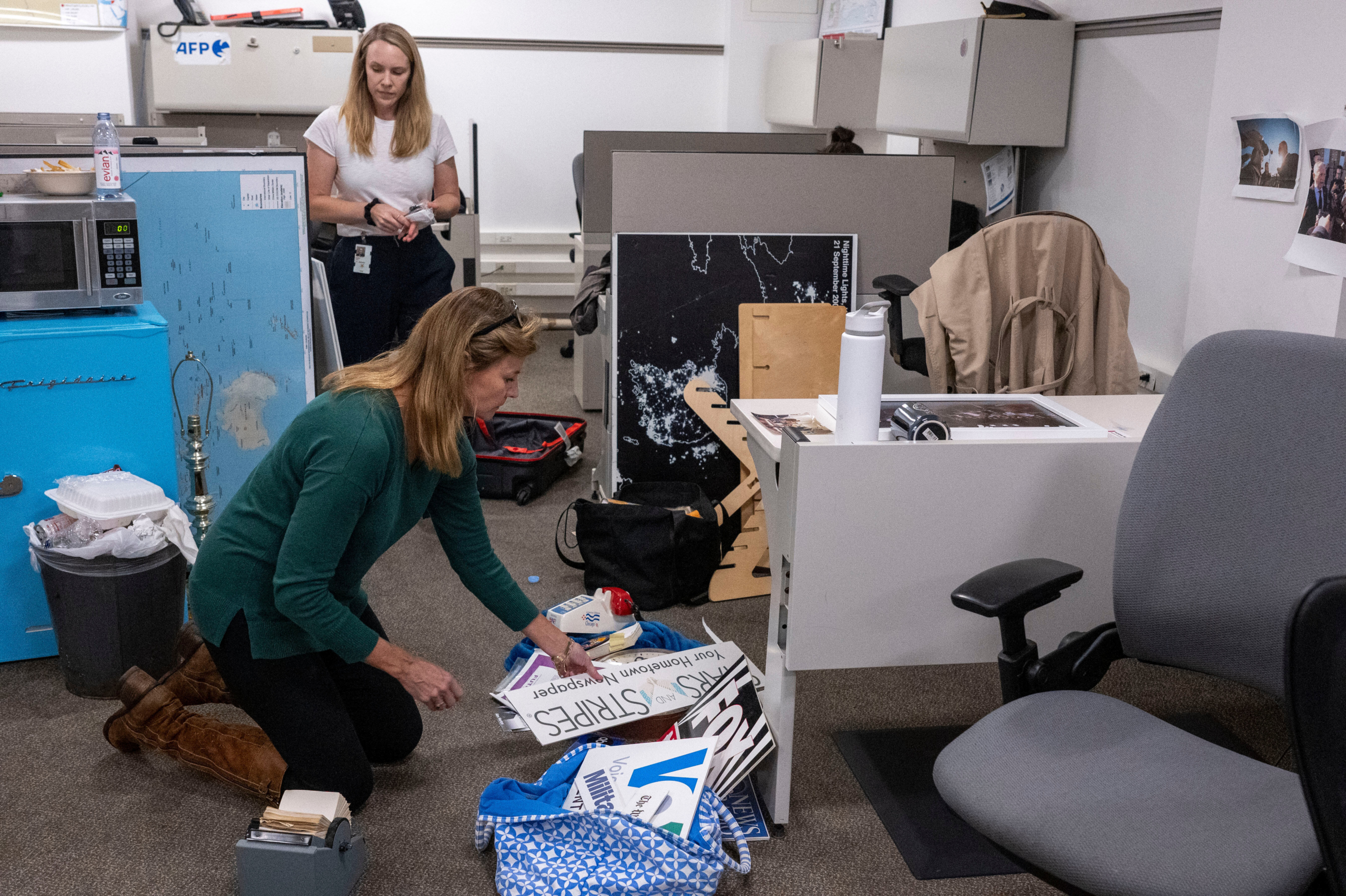
While the Pentagon has been busy dismantling Stars and Stripes, the rest of the press has heard little from the DoD. The last press briefing inside the Pentagon was held on May 5; since then, a ceasefire with Iran has ended, five US service members have been killed and hundreds more injured, Donald Trump left a NATO summit in a catering truck and an unmarked military jet, and sailors on the USS Abraham Lincoln tried to jump overboard as their deployment in the Arabian Sea extended to more than two hundred and fifty days. The Pentagon didn’t respond to my questions about the lack of press briefings.
“Frankly, they don’t even think they owe the public any information,” a reporter who works for a trade publication, and asked not to be named because they fear reprisals from the Pentagon, told me. “They’re hiding behind this idea that they can just say, ‘It’s a war, so we don’t have to communicate with you.’ This is often what we hear from public affairs officers.”
“Officials have become less forthcoming, even with basic details. It feels more restrictive even compared to the beginning of the war,” a reporter for a major national media organization, whose employer didn’t give them permission to speak, told me. A few journalists said that getting even basic information from Pentagon sources—about the injuries and deaths of service members, for instance—has become so difficult that they are forced to rely on statements from US Central Command, which is overseeing military operations in the Middle East. “We’re all writing the same stories now,” the national reporter said.
“There’s an overall push to reduce accountability and transparency throughout the department,” the reporter for the trade publication told me. In July, the New York Times reported that the Pentagon withheld information about US military injuries and published conflicting death counts, while the AP wrote that the Navy had changed its policies to restrict previously public information about sailors (the Navy denied that it was restricting access and said the policy change had been “misinterpreted”). In response, Parnell attacked reporters for the Times and the AP on X. Last week, The Intercept reported that Central Command has a secret “blacklist” of journalists to “disregard.” When I asked about that, the Pentagon referred me to CENTCOM, which didn’t respond to my request for comment.
All the while, Pentagon reporters are right where Hegseth wants them: outside the building, separated physically from sources on the inside. That has been the case ever since the press corps’s exodus last October, when journalists refused to sign a pledge that would have curbed routine reporting practices in exchange for building access. For a few months, a handful of right-wing and MAGA-friendly reporters, selected by the Pentagon, could get into the building, but they are now gone, too. In December, the Times sued the Pentagon for alleged violations of the First and Fifth Amendments. A judge ruled in favor of the Times, but the DoD soon enacted an interim press policy that applied new restrictions, such as moving the press area to an annex and requiring escorts for journalists at all times inside the Pentagon. The court granted a motion from the Times to compel compliance with the court order, but the Pentagon has appealed. (In a separate lawsuit, the Times challenged the escort requirements. A district court agreed with the Times, but approved the Pentagon’s motion to stay the court’s ruling while it appeals, meaning the escort requirements remain in place for now.)
The Pentagon’s legal challenges might end soon, however. After a series of extensions, the DoD has filed its appellate brief at the US Court of Appeals for the DC Circuit. It is appealing both the lower court’s initial ruling about the October policy and its order compelling compliance. Pentagon lawyers have also argued that the escort policy is not unconstitutional because the Pentagon is a nonpublic forum, where physical access can be restricted as long as those restrictions are “viewpoint neutral.” Though the Times successfully argued that the October policy penalized some news organizations while enabling others that were viewed as friendly to the administration, the escort policy applies to everyone. To Jane Kirtley, a professor emerita at the University of Minnesota and former director of the Silha Center for the Study of Media Ethics and Law, the Pentagon’s claims are “a technical and nitpicking argument.”
“Essentially, they are trying to argue that the court misinterpreted the initial rules, so they simply revised and clarified them,” Kirtley told me. “It sounds very appealing on some levels, but it’s difficult to believe, given that both the initial and the revised policies have been designed to cut back on media access and intimidate DoD employees who might want to talk to journalists.” The success of this argument depends on whether the court believes it is “being made in good faith and has merit,” she said, or is “simply an attempt to run around the clear spirit of the injunction.”
The Times’ reply is due in two weeks, after which the Pentagon will have three weeks to respond. That would take the lawsuit well into the midterm election season—which could represent the ultimate test of the Defense Department’s communications policy. The Pentagon leadership seems to think it’s fine to shut the press out; it remains to be seen whether the public agrees.
Other Notable Stories …
By Ivan L. Nagy
- Last Wednesday, flash floods and mudslides killed more than five hundred people along the Trishuli River in Nepal and Tibet; thousands are still missing. The catastrophe has featured on front pages around the world, but independent reporting is only happening on the Nepalese side of the river. Tibet falls under Beijing’s information-control regime, which has led to lackluster coverage of the disaster there. Arjun Poudel wrote an emotional account of the flash flood for the Kathmandu Post.
- After a judge rejected the Trump administration’s request to acquire account information for the YouTube channels of Georgia Fort and Don Lemon—both of whom were arrested in January for covering an anti-ICE protest in a church in Minnesota and were later accused of conspiring with activists to disrupt a religious service—the Department of Homeland Security found a legal work-around, originally intended for customs imports, to request the same information without judicial oversight. Google did not comply with the summons, according to The Guardian, but the same law helped DHS obtain six months of Fort’s telephone records from T-Mobile.
- RedBird Capital, an investment firm that holds stakes in Paramount, among other media ventures, is set to invest in Puck, the newsletter startup founded in 2021. According to Reuters, RedBird, which values Puck at two hundred and fifty million dollars, is planning to buy out the company’s existing institutional investors while keeping founders’ and reporters’ shares intact. Puck, which relies heavily on individual journalists’ online clout to attract audiences, reportedly has fifty thousand paying subscribers.
- Kyle Buchanan, the award-winning culture and Hollywood reporter who built a reputation as an awards season columnist for the New York Times, is leaving to start an independent video podcast called The Kyle Buchanan Show—making him the latest Times journalist to pursue a podcast elsewhere. Buchanan will focus on Hollywood news and celebrity interviews.
- In other Times-related news, the company started to roll out its first generative AI tool to a small subset of readers, as reported by Semafor’s Max Tani. The search engine responds to readers’ queries by offering links and summaries from the publication’s own reporting. The New York Times Guild, the union that represents editorial and business staff, is calling the move a violation of the company’s AI policy, which states that every AI tool must have human oversight.
- Catherine Herridge, a former Fox News reporter who faced a daily court-ordered fine of eight hundred dollars until she disclosed her sources in a Privacy Act lawsuit, spoke about her case for the first time to The Guardian. “I built my career on developing confidential sources, and the day I disclose, my career is over,” she told Jeremy Barr. “The fines are designed to break you as a journalist, mentally and financially.” The payments are on hold for now, pending the Supreme Court’s decision about whether to hear Herridge’s case.
- And last week, Roxane Gay examined the state of the journalism industry for The Bitter Southerner. “A gaping void stretches wider and wider as media’s collapse proceeds apace,” she observes. Even so, she finds “a new breed of journalists” who are “trying to connect with audiences who also want something different, something that feels more honest, and maybe even more human.” Among them: Marisa Kabas, Taylor Lorenz, LA Taco, and Georgia Fort.
Has America ever needed a media defender more than now? Help us by joining CJR today.