Sign up for the daily CJR newsletter.
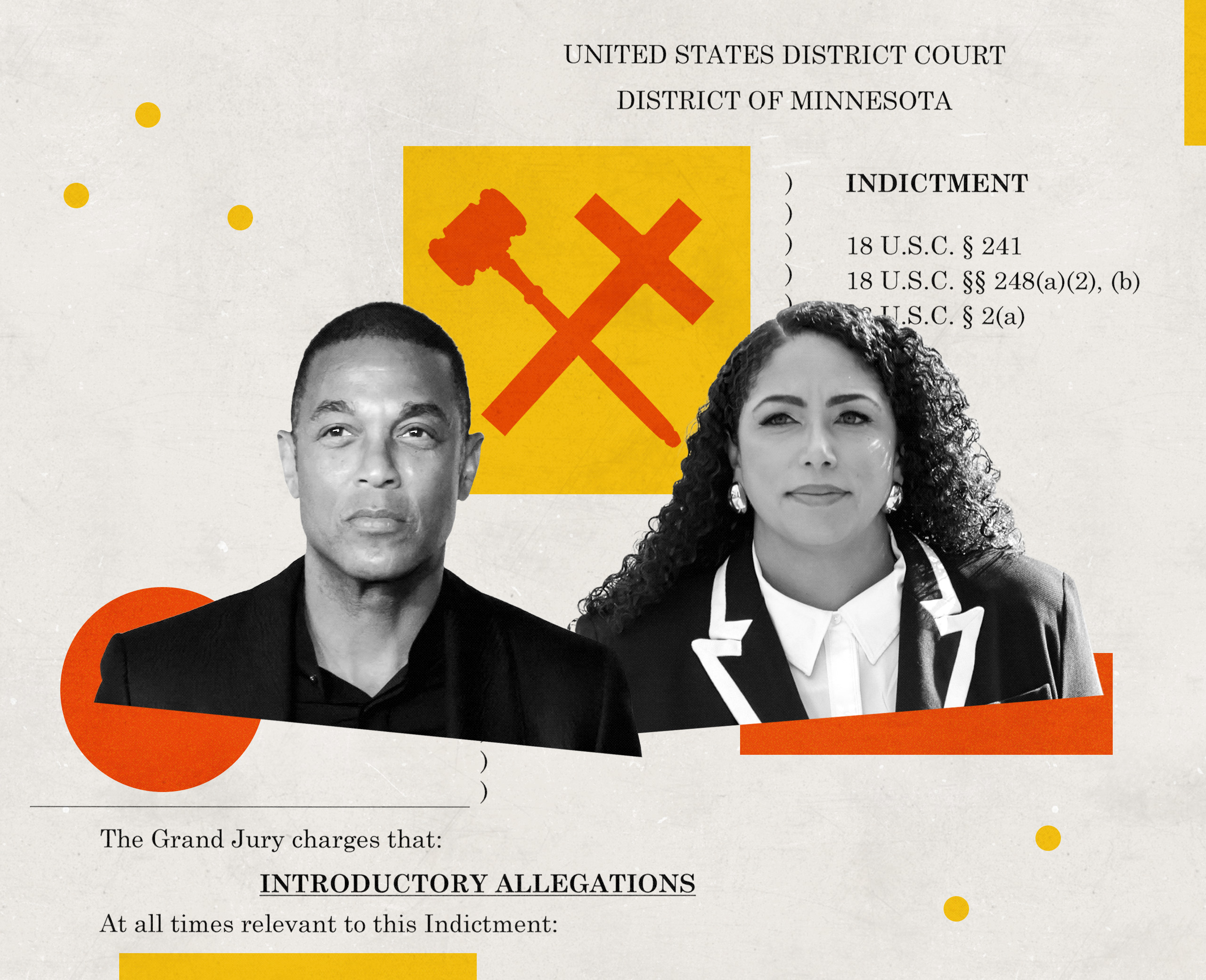
At the end of January, federal officers arrested Don Lemon—formerly of CNN, now host of The Don Lemon Show on YouTube—and Georgia Fort, who spent years as a local television and radio journalist in Columbus, Georgia, and Duluth, Minnesota, before returning to her native Minneapolis and going independent. Lemon and Fort were accused of conspiring with activists to disrupt a religious service at a church in St. Paul whose pastor serves as a regional director for Immigration and Customs Enforcement. Seven protesters were also indicted. Both Fort and Lemon say they were there solely as journalists. Lemon—who is represented by Abbe Lowell, a Washington criminal defense lawyer—and Fort—represented by Leita Walker, a First Amendment litigator in Minneapolis—have since pleaded not guilty to the charges brought against them.
I spoke to both attorneys, and have read through the filings in the case to get a sense of how Lowell and Walker plan to defend their clients against a government prosecution that could bring more than a decade in prison. The filings present evidence that the Trump administration made a deliberate effort to target the journalists, in particular Lemon, whose reporting the White House has gone out of its way to criticize. “You can look back at this last year and see that the administration’s attacks on the media are very much content-oriented,” Lowell told me. “Independent journalists pose a particular threat because they cannot be cowed or bludgeoned or pressured the way media that are owned by companies now can be. And so they pretend it is about something like bias. But that is just a facade.”
Administration officials have been open about their animosity toward Lemon. Donald Trump has called him “a loser” and “a sleazebag.” Pam Bondi, the attorney general, has described him as an “online agitator.” Harmeet Dhillon—the assistant attorney general, who heads the Trump administration’s Civil Rights Division—has called Lemon a “pseudo journalist” who is not entitled to First Amendment protections. Todd Blanche, the deputy attorney general, noted in a Fox News interview that “Freedom of the press extends to a lot of different areas, but it does not extend to somebody just trespassing and being embedded with a group of rioters.” Blanche’s view of the First Amendment is, of course, profoundly troubling, and his statement is misleading. Though it is true that journalists in the United States have on occasion been cited for trespassing while covering newsworthy events, the charges have almost always been dropped. In any case, neither Fort nor Lemon has been charged with trespassing in the church.
Instead they are being prosecuted under two laws that protect religious worship: the FACE Act, or Freedom of Access to Clinical Entrances, which primarily focuses on the rights of women accessing reproductive healthcare, and the KKK Act, which is a Reconstruction-era law intended to protect the constitutional rights of Black Americans from Klan violence. Both are known as “specific intent” statutes, meaning the government must show that Fort and Lemon had a conscious objective to violate rights secured by the law, in this case by disrupting religious worship. Gabe Rottman, from the Reporters Committee for Freedom of the Press, told me the government’s effort was “an extreme overcharge” and added that “the working journalist simply will not have that state of mind.” Walker agreed, noting that Fort “was not going as a demonstrator or an agitator. She was going solely as a journalist. And when she got there, she acted solely as a journalist.”
The government’s evidence to the contrary is outlined in the indictment. It alleges that Lemon and Fort knew about the protest in advance; engaged sympathetically with their sources, including by thanking them; interviewed protest leaders; and held microphones near one of the pastors while asking persistent questions. Certainly, they covered the story from their perspective: Fort compared the church activists to Rosa Parks and Martin Luther King Jr. and said that their protest had “reignited the national conversation around accountability for Renee Good.” Lemon, for his part, explained to viewers that the purpose of the protest was to disrupt and make people uncomfortable. “When you violate people’s due process, when you pull people off the street and you start dragging them and hurting them and not abiding by the Constitution, when you start doing all of that, people get upset and angry,” Lemon said in his report.
But it’s alarming, in my view, what the government’s allegations imply: the Justice Department seems to be suggesting that if Lemon and Fort had covered the protest in a different manner, they might not face legal liability. This notion that prosecutors should be the arbiters of journalistic practice and that anyone accused of bias is not entitled to the same level of First Amendment protections is deeply chilling. “If there is a silver lining in this part of the administration’s attack and the specific charges against Don, it is that what they put into their indictment actually describes the work of a First Amendment–protected journalist,” Lowell told me.
It’s also part of a broader effort by the Trump administration and its legal and regulatory apparatus to strip journalists of their rights. Brendan Carr, as the chair of the Federal Communications Commission, has been using his authority to reshape the public airwaves. Under the 1934 Communications Act, broadcasters in the United States are required to operate in the public interest, a principle that has been broadly affirmed but is hard to define in practice. Carr has seized the chance to go after critics of the president—and at the same time, he has been enforcing the “news distortion” standard, an FCC regulation barring the deliberate manipulation of news. Meanwhile Daniel Suhr, a conservative lawyer who has helped shape Carr’s regulatory doctrine, has been filing FCC complaints against broadcast outlets for violating the public interest standard—as he did, for instance, against Jimmy Kimmel. “My hope is to get back to an actual fair and unbiased presentation of information,” Suhr recently told On the Media. The Trump administration also justified defunding public media based on an alleged liberal bias.
There are plenty of signs that the Trump administration is acting in bad faith in the cases of Fort and Lemon, who have filed a joint motion to unseal grand jury testimony because of the possibility that government lawyers misrepresented the law and the facts in obtaining an indictment. (A federal judge in Minneapolis originally rejected the government’s petition to indict Fort and Lemon, citing a lack of probable cause.) Fort and Lemon are also fighting an effort by the government to obtain a complex-case designation, meaning prosecutors would not have to bring the case to trial within seventy days, as normally required by law. Dragging out the proceedings has the potential to make the judicial process itself part of the punishment.
Rather than backing down, the government is expanding its prosecution. At the end of February, the Justice Department brought charges against thirty additional protesters alleged to have participated in the disruption of the church service. Among those charged is a Los Angeles-based independent photographer and artist who was in the Twin Cities to document the scene: Shane Ryan Bollman, who goes by Junn Bollmann. According to the Committee to Protect Journalists, federal agents seized his devices.
Much is at stake in the defense of Lemon and Fort, a legal battle that is really about pushing back against a broader Trump administration effort to deny First Amendment protections to any journalist or news organization accused of “bias,” which is often just code for critical coverage. Ultimately what matters in the Fort and Lemon case is not their perspective, who they spoke to, who they thanked, or who they interviewed. What matters is their intention to be present where news was being made and to share the information they obtained with the public. This is what journalists do and it is what the law protects. With the Trump administration denying this basic principle of American democracy, it will be left to the courts to hold the line.
Has America ever needed a media defender more than now? Help us by joining CJR today.