Sign up for the daily CJR newsletter.
Last month, when Jimmy Kimmel was briefly taken off ABC as punishment for comments he’d made on air about Charlie Kirk, the move was widely understood to be the outcome of a brazen flex of influence by Brendan Carr, the chairman of the Federal Communications Commission. Appearing on a conservative podcast, Carr had delivered an open warning to the television stations that aired Kimmel, saying, “These companies can find ways to change conduct to take action on Kimmel or, you know, there’s going to be additional work for the FCC ahead.”
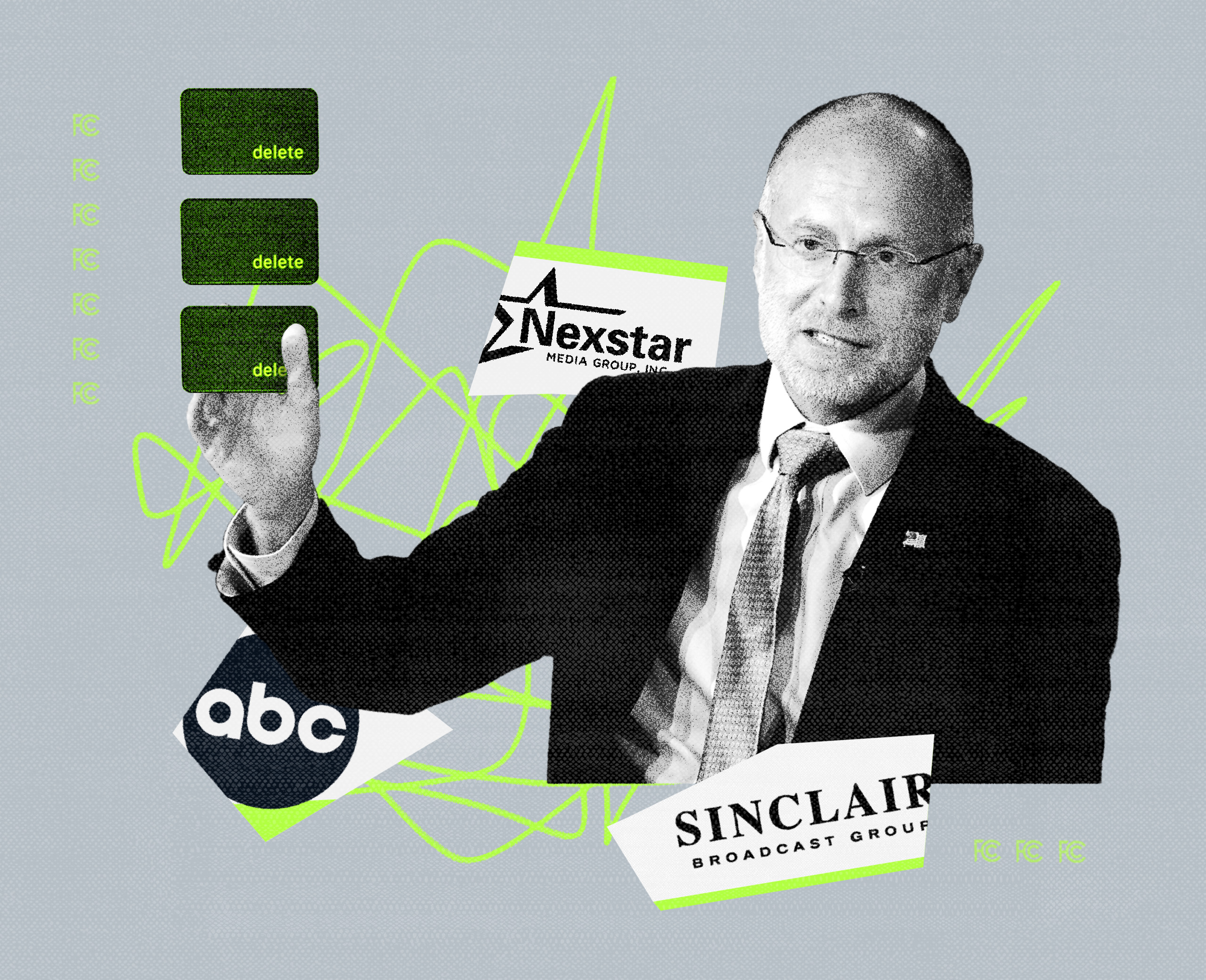
Carr’s threat had teeth. Under his leadership, the FCC is in the midst of a historic deregulation spree he’s calling “Delete, Delete, Delete.” The campaign is currently reviewing the agency’s “multiple ownership” rules, which prohibit any one company from exerting outsize control over the local television market. A loosening of those rules could prove immensely profitable for the owners of local ABC affiliates, including Nexstar and Sinclair, so those companies seem to have viewed Carr’s desire to punish Kimmel as an opportunity to curry favor with the administration.
Kimmel was reinstated after Carr faced criticism from fellow Republicans for acting like a “mafioso.” Still, the whole affair sent a chill through the local-television business. S. Derek Turner, a policy analyst for the advocacy group Free Press, saw it as a perfect encapsulation of how Carr is using his “Delete, Delete, Delete” initiative as a way for the FCC to exert political influence over the companies it’s meant to oversee. “I don’t think it’s much of a surprise that Carr is pushing things as far as he can,” Turner said, noting that Carr wrote the chapter in the Heritage Foundation’s Project 2025 document about the agency he currently leads. “What makes what’s going on right now somewhat unique—and I would say corrupt—is the out and open quid pro quo that Carr is effectuating.”
While Sinclair has long been associated with conservative politics (during the first Trump administration, the company’s CEO told the president “we are here to deliver your message”), Nexstar’s willingness to follow Carr’s lead seems less to do with the ideology of its leadership than with its plan to acquire a smaller rival called Tegna for 6.2 billion dollars. This transaction will only be possible if the FCC’s current rules change, which Carr believes he can do unilaterally even as many lawyers believe Congress would need to get involved.
Complicating matters further for local journalists is the longer-term shift of local broadcast news outlets away from the individual communities they serve. Danilo Yanich, the director of the University of Delaware’s Local Television News Project, told me that Nexstar’s ambition to acquire Tegna threatens to supercharge that trend while at the same time facilitating more interference from corporate ownership. “If fewer places control more information,” Yanich said, “you nationalize the stories.”
When Carr launched the “Delete, Delete, Delete” initiative, in March, he stated that the plan fit with the Trump administration’s government-wide goal of “unleashing a new wave of economic opportunity by ending the regulatory onslaught from Washington.” Six months later, the lone Democrat on the FCC, Anna Gomez, offered a different read on the program. She called it a “Trojan horse” that “could lead to a situation that’s ripe for abuse.” Taken together with the effort to overturn the multiple ownership rules, “Delete, Delete, Delete” looks less like a means of ginning up new economic activity than a pretense for exerting control over the television industry, likely in violation of the law. For Carr, the oversight authority of the FCC is only useful insofar as it can force the nation’s broadcasters into fealty to Donald Trump.
Since the start of “Delete, Delete, Delete,” dozens of regulations have been slashed from the FCC rulebook. Those include regulations concerning outdated technology, as well as proper citation and notification processes for the radio and television broadcasters that are licensed to use public airwaves. This sort of bureaucratic bloat is hard to defend, yet many FCC observers have still raised alarms that Carr is overstepping his authority under the Administrative Procedure Act.
The APA generally requires agencies to undergo a thorough process of review and public comment to change regulations, but this statute also includes a “Direct Final Rule” provision that can allow for an expedited timetable. Carr claims this provision “gives the Commission the authority to fast track the elimination of rules that inarguably fail to serve the public interest”—leaning on the profound legal ambiguity in what constitutes “public interest.” This summer, a coalition of municipal governments rejected Carr’s application of Direct Final rulemaking authority, writing that the process “is intended for extremely simple, non-substantive decisions.” While the FCC rules targeted by “Delete, Delete, Delete” so far have not been substantive, Carr’s assertion of authority to cut them creates a discomfiting precedent.
His more far-reaching effort is the revision of the multiple-ownership rules. Until this summer, no company could own more than one of the top four broadcast stations in any given media market, more than two stations period, or reach an aggregate national audience of more than 39 percent of the country. In June, however, the FCC announced its intention to “refresh the record” on the 39 percent rule. Carr also proposed altering the two-station rule in September, and not long before that the top-four rule was struck down in a court case brought against the FCC by broadcasting conglomerates including Nexstar.
As the biggest broadcaster, Nexstar is uniquely positioned to profit from deregulation under Carr. If, as planned, it adds Tegna’s sixty-five television stations to its current roster of over two hundred, that would create overlap in more than thirty markets, including major cities like Denver, Austin, Tampa, San Diego, and Charlotte. Nexstar would also end up owning three stations in some markets (two of the top four as well as a smaller broadcaster), meaning it would either need a waiver from the FCC for violating the two-station rule, or else for that rule to be eliminated entirely.
Most importantly, acquiring Tegna would catapult Nexstar over the current cap on any one company being able to reach more than 39 percent of American households. The 2004 legislation that set that cap in the first place was passed by Congress as a compromise measure after the George W. Bush FCC’s attempt to raise the ceiling from the previous level of 35 percent all the way to 45 percent was met with a public outcry. By comparison, a combined Nexstar-Tegna would reach an astonishing 80 percent of households.
When I asked Stuart Benjamin, a professor of telecommunications law at Duke University, how Carr could be pushing to unilaterally raise the ownership cap despite it being written into the law, he pointed to previous comments made by the National Association of Broadcasters, an industry lobbying group. “The National Association of Broadcasters has argued that the FCC is totally free to raise the cap because the 2004 law was simply modifying the provision of the Telecommunications Act of 1996 that says, basically, that the FCC has authority to set the cap where it wants,” Benjamin said. “Under that interpretation, Congress was saying, ‘Well, the number we want for right now is 39 percent,’ but there’s no continuing obligation for the FCC to maintain that cap.” Benjamin is hardly convinced by that reasoning, pointing out that “this is the only thing that Congress decided to put a number on.” He noted that many other lawyers who filed comments with the FCC concerning the proposed rule have a strong argument that Congress wouldn’t have bothered writing that number into the law if the agency could just change it later.
In Brendan Carr, President Trump has a flunky who is uniquely suited to manipulating the FCC’s regulatory authority to advance the White House’s agenda.
Taken together, “Delete, Delete, Delete” and the reconsideration of the multiple-ownership rules represents an attempt by Carr to seize authority and advance the interest of corporate media owners. “It’ll be interesting to see what kind of legal justification Carr comes up with,” Turner, from Free Press, said. “It’s probably a dangerous thing when most lawyers can’t really understand how he would even do it.”
Setting aside the inevitable legal challenges to Carr’s plan, the stakes for local media could not be higher. During last month’s FCC meeting, held hours before the agency suspended its day-to-day operations because of the government shutdown, FCC commissioner Gomez took a moment to highlight the practical effect of one company owning numerous stations in a single market. She described a letter she’d received from a resident of Eugene, Oregon, where four out of five stations that broadcast local news are owned by one company, sharing “the same crew, reporters, and on-air personnel—and local news programming. This means that although there are five stations…there are really only two choices.”
Yanich, from the University of Delaware, has dubbed this kind of arrangement “duplication.” “The station groups want to achieve economies of scale,” he told me. “One way to do that is to control as many outlets as you can and duplicate the broadcast. You incur the cost of production once, but you may profit from it as many times as you can broadcast it.”
In a recent study Yanich coauthored with his colleague Benjamin Bagozzi, the researchers tracked the amount of duplication that occurred during a three-month period in 2019 by determining how many times the exact same text was said on air on multiple stations within the same media market. They found that duplication occurred in 84 out of 210 markets, reaching 37 percent of American households—just shy of the current 39 percent cap. The most prolific duplicator? Nexstar.
While most duplication takes the form of a single segment airing at multiple stations in the same market, Yanich told me that the phenomenon can also be observed when the corporate owner of many stations mandates that they all broadcast the same thing. That happened in 2018, when Sinclair—Nexstar’s most prominent rival—distributed a “must run” script about “false news” to its two hundred or so stations. (Sinclair, like Nexstar, clearly sees an opportunity to seize on Carr’s deregulation agenda as the company contemplates its own expansion plan.)
Aside from the Orwellian dangers of more duplication, further consolidation of the industry will almost certainly lead to numerous broadcast journalists being laid off. The union that covers many of those journalists, the National Association of Broadcast Employees and Technicians–Communications Workers of America, responded to Carr’s proposed rule changes by issuing a public comment: “We don’t have to guess what happens with increased consolidation because history and the record have already shown us: a reduced variety of news content, severe cuts to staff, declining newsroom capacity, and enormous harm to local news.”
While local broadcast journalists have plenty of reason to fear further consolidation, last month’s corporate boycott of Jimmy Kimmel Live! provided its own demonstration of the dangers of so many television stations being owned by so few companies. In Brendan Carr, President Trump has a flunky who is uniquely suited to manipulating the FCC’s regulatory authority to advance the White House’s agenda. For companies like Nexstar and Sinclair, keeping both Carr and Trump happy is the clearest path to bolstering their bottom line, never mind what it means for all the journalists and TV personalities who fill the public airwaves.
Has America ever needed a media defender more than now? Help us by joining CJR today.