Sign up for the daily CJR newsletter.
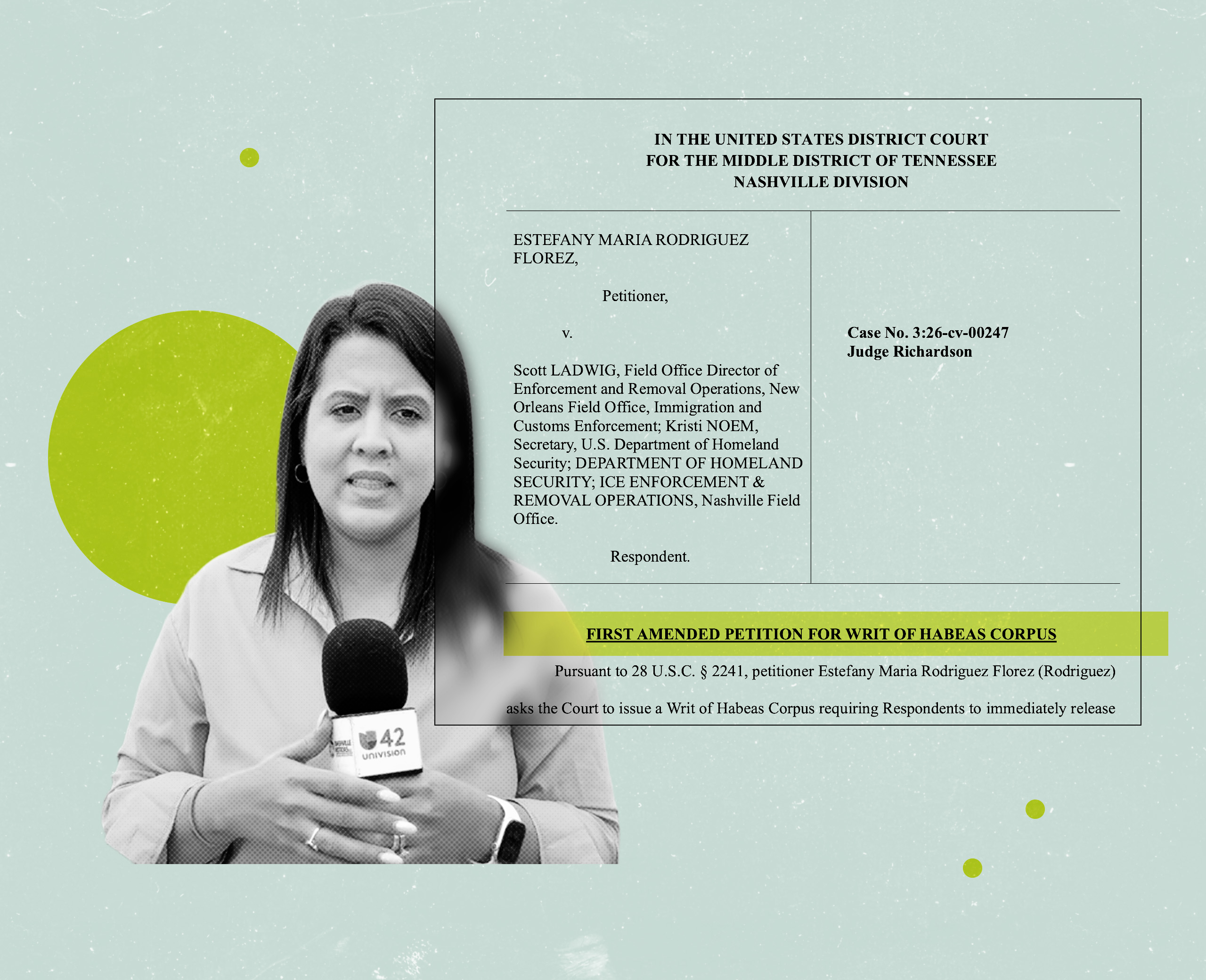
Last Wednesday, Estefany Rodríguez, a journalist based in Nashville, was detained by Immigration and Customs Enforcement and, according to her lawyers, she was not shown a warrant. On Friday afternoon, the Department of Homeland Security submitted to the US District Court for the Middle District of Tennessee, Nashville Division, a photo of a warrant—what’s known as an administrative, or immigration, warrant, signed by an immigration officer, rather than an arrest warrant signed by a judge. That document, dated March 2, appeared crumpled and contained no A-number (a unique seven- to nine-digit code assigned to noncitizens), and its certificate of service section—which outlines when and where the warrant was served—was left blank. Then, on Saturday, DHS posted on X a photo of yet another immigration warrant, dated March 4. Rodríguez and her lawyers had never seen it before.
The back-and-forth, high-stakes and perplexing, has involved a series of responses to the court—and in none of these has DHS submitted the social media warrant. “Our reply explained that an arrest remains warrantless when the warrant was never executed,” Joel Coxander, a member of Rodríguez’s legal team, told me. “The March 2 warrant was not executed because it was never shown or mentioned to Ms. Rodríguez and the certificate of service on the warrant is blank.” Though the certificate of service on the social media warrant was filled out, “it was issued based in part on the post-arrest interview she did at the ICE office,” as Coxander put it—indicating that she wasn’t presented with the document at the time she was taken into custody.
The claim that Rodríguez’s arrest was warrantless was central to the emergency petition that her legal team filed immediately for her release, on Wednesday. Also of importance to their case is the fact that she is a journalist who reports on immigration; on Sunday, her attorneys added a claim for First Amendment retaliation. A day before she was detained, Rodríguez had covered a series of ICE raids for Nashville Noticias, the Spanish-language news outlet for which she works. According to her lawyers, at the time of her arrest, her husband had been driving a car marked with the Nashville Noticias logo, and was pulling into a parking spot outside a gym when they found themselves surrounded by unmarked vehicles. Soon, agents in tactical gear got out and took Rodríguez into custody. She is now being held in a county jail in Gadsden, Alabama, and is expected to be transferred to a detention center in Louisiana.
A federal judge has ordered DHS to demonstrate just cause for Rodríguez’s detention by March 12. Her lawyers have filed a separate motion in immigration court seeking a bond hearing, which will take place in Louisiana on March 16. Rodríguez is married to an American citizen, has applied for a green card, and has a valid work permit. She first came to the US on a tourist visa and later filed a claim for political asylum.
DHS has argued that she has overstayed her visa, denied that Rodríguez is being targeted because of her journalism, and contended that there has been nothing problematic about the warrants. “She will receive full due process and remains in ICE custody pending the outcome of her immigration proceedings,” a DHS spokesperson told CJR in a statement. “A pending green card application and work authorization does NOT give someone legal status to be in our country. Being in detention is a choice.” It has been common practice for DHS to communicate directly with the public online, though the blurring of legal and social media arguments has seemingly distorted the reality of Rodríguez’s circumstances.
Press and human rights groups have rallied behind Rodríguez. “Ms. Rodríguez must be urgently released and returned to her community and journalism work,” Justin Mazzola, the deputy director for research at Amnesty International USA, said in a statement. “The US immigration system must not be weaponized to silence the work of journalists.” Katherine Jacobsen, a program coordinator at the Committee to Protect Journalists, told me, “This administration frequently asks us to not see what is right in front of us. To look at this as something other than an attempt to clamp down on reporting and discourage journalists from covering immigration in their own communities would be to miss the mark entirely.” The National Association of Hispanic Journalists, for its part, denounced “immigration tactics that detain journalists and any efforts to interfere with news coverage of immigration enforcement.”
Organizers and local advocacy groups have also been calling for Rodríguez’s release. On Monday, community members gathered at Tío Fun, a Mexican restaurant in North Nashville, to call elected officials on her behalf. “People showed up who had never called their representatives before,” Karina Daza, a singer-songwriter who organized the event with support from the ReMIX Way, an immigration-focused advocacy group, told me. “We had super young high schoolers walking in the door, and people in college.”
Daza had met Rodríguez: “Any time there was a Latino community event, I could expect to run into her or someone from her team,” she said, referring to Nashville Noticias. In addition to calling local politicians, volunteers were encouraged to contact “national allies” such as Representatives Joaquin Castro and Alexandria Ocasio-Cortez. “Every single factor points to the fact that she should have been released,” Michael Holley, one of Rodríguez’s lawyers, told me, “except that she’s a journalist who reported on ICE.”
Has America ever needed a media defender more than now? Help us by joining CJR today.