Sign up for the daily CJR newsletter.
Look, I know it’s a tough time to be starting a career in journalism. Trust in the news media is historically low. I could list some statistics, but I’m sure you know them already. Jobs are few, and getting fewer. I recently read—in my own newspaper—a quote from an expert declaring the media industry “low hire and some fire.” The rise of artificial intelligence is alarming many newsrooms across the country. I’m hopeful we will find responsible ways to harness this revolutionary tool, but we might not. You’re also graduating at a moment when people in power are taking unprecedented steps to intimidate or silence the free press. (I don’t think I need to specify an example here.) I could keep going with this depressing list. But I don’t want to.
Actually, I want to convince you that you’ve made—or are about to make, after I finish my ultra-inspiring remarks—the best decision of your lives. Because journalism is not only the foundation of our democracy. It’s the most fulfilling work you’ll ever do. And the most fun you will ever have. Let me tell you why. Growing up, I always heard my father say he never worked a day in his life. I was confused, because he definitely left home for his office each morning. He tried to explain: When he was in his lab, conducting scientific research, it didn’t feel like work. Imagine, he said, if you woke up every day just desperate to get started on your homework. That didn’t help. I didn’t get it.
My sophomore year in college, I joined the student newspaper, mostly because I thought it would make me stand out from the other medical-school applicants. I was premed at the time, convinced my future lay in scientific research, like the kind my father did. That fall, the college’s dining workers went on strike, and the newspaper put out a call for volunteers. Intrigued, I raised my hand. Soon, I was traipsing across campus for hours every day, missing classes and meals, shadowing weary workers as they shuffled through picket lines. Along with talented fellow student journalists, I began cultivating sources at the uppermost levels of the workers’ union.
It paid off when, one afternoon, we got a tip that university administrators were beginning secret, earnest negotiations with the union on the highest floor of a random office building. Stay outside, one of our sources said, as the clock ticked toward midnight. This is the real deal. Close to 2am, we broke the news that Harvard and its striking dining workers had reached a “tentative agreement” ending the strike. We scooped everyone, especially the Boston Globe. Yet again, I had skipped all my classes. I had been standing around, doing nothing but waiting, since 2pm. But I wasn’t bored. I wasn’t tired. It was mid-October, in Massachusetts, and I wasn’t even cold. Walking home from the newspaper’s building to my dorm early that morning, I remembered my father’s words. For the first time, they made sense.
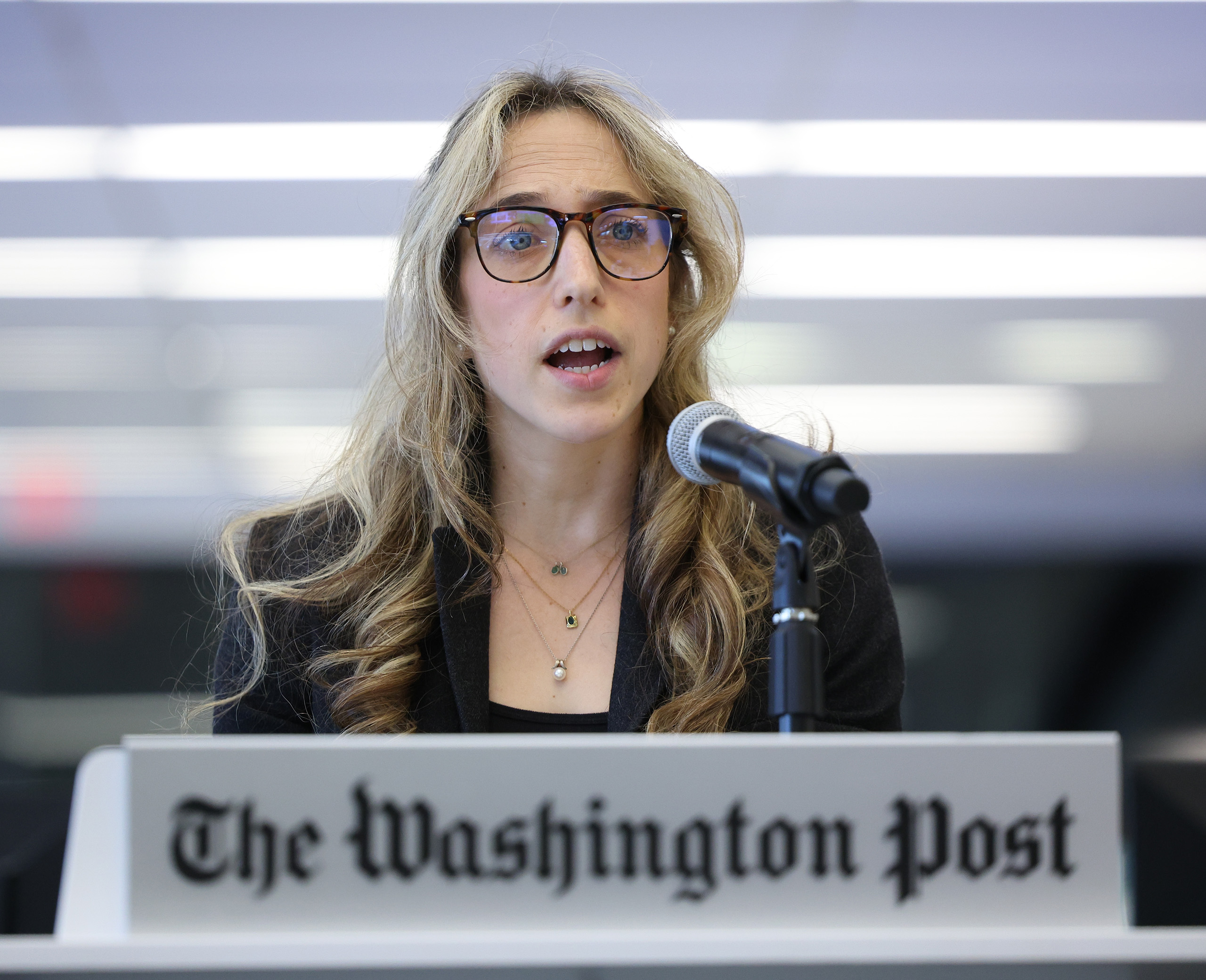
My junior-year summer, I was accepted as an intern on the metro desk at the Washington Post. A colleague passed on a tip about the world’s first online-only church for video gamers. Soon, I was driving hours into remote Virginia, where I crouched like a pretzel on the floor of the pastor’s gaming-room-slash-pulpit. For hours, I listened while he talked to his Twitch followers about God—and how you can see His standards reflected in the game Old School RuneScape. My knees fell asleep. I was riveted.
That summer and the next, still an intern, I got to interview Jane Fonda as she walked out of the DC jail where she’d just spent the night, arrested for protesting climate change. I broke the news that Vice President Aaron Burr had a secret family of color, and I questioned his Black descendants as they gathered in a Philadelphia cemetery. After getting a totally bizarre tip, I wrote a viral story about a Virginia man who left old television sets outside fifty homes overnight—while wearing a TV on his own head. To this day, no one knows why.
After graduation, I was hired to cover education for the Post: first in Virginia, and later nationally. That job found me driving to meet a ninety-two-year-old Black woman who had taught in Loudoun County schools during the Jim Crow era. When her two-room schoolhouse ran out of fuel, she wrote the white superintendent to ask for more coal, in a letter of breathless daring. “All we have left is dirt,” she wrote, “and that doesn’t half burn.” She still lived in the same rickety house, down the road from the schoolroom where she taught. She still had all her old school materials, including the letter to the superintendent. When she pulled out the photos and papers and handed them to me, I couldn’t breathe.
Later, as the education culture wars took off, I flew to Seattle to try to understand why left-leaning, socially progressive teachers had banded together to ban a book. I wrote about a Virginia parent who read, and challenged, one school book a week. I traveled to South Carolina to watch as a teacher, reported by her own students for a lesson on race, weighed whether she could trust her classroom again. And I drove to Tennessee to meet a white teacher who’d been fired for telling his students that white privilege is a fact. He was appealing his firing, and awaiting a judge’s verdict. I was standing in his kitchen when his lawyer called to say he’d lost the appeal. I watched him cry. I opened my notebook.
When the second Trump administration began, I was still an education reporter. We were all hearing rumors about how Trump wanted to shut down the Education Department. After consulting with a colleague, veteran federal affairs reporter Lisa Rein, I decided to post my contact information on Reddit, in a popular forum for federal employees. That one post, listing my number on the encrypted-messaging app Signal, would ultimately lead me to twelve hundred confidential sources across the government. It would lead to a new editor, a new reporting team, and a new beat: Trump’s transformation of government.
It would lead to 202 stories, 150 million pageviews, and bylines shared with more than 130 colleagues throughout the Post’s newsroom. It would lead to a full year of waking every day to between dozens and hundreds of Signal messages from government workers. Some messages became scoops. Some inspired investigations, or narratives.
I drove to Maryland for the funeral of a Social Security worker who died of a heart attack at her desk. I flew to Nevada to chronicle one federal worker’s pain as his job and wife faded away in tandem, eroding his trust in Trump. I traveled to Wyoming to shadow three elderly Forest Service workers who came out of retirement to save their forest after Trump’s staff cuts. I tagged along as one of the workers, aged eighty-one, cleaned five bathrooms. Because of budget cuts, he used exactly one paper towel per toilet.
Many, many more Signal chats stayed just that: conversations. Federal workers were scared, or hurting, or suicidal. All they wanted was someone to listen. I knew I was helping the Post tell stories—about what Trump was doing to the federal government, and the consequences—that the public would never have learned about otherwise.
But. I was working all the time. I was permanently stuck to Signal and my cellphone. I was barely sleeping. I was so worried about getting something wrong, or getting someone in trouble; it was all I could think about. My friends stopped asking to hang out. My parents stopped asking us to dinner. My husband—for painful hours—stopped speaking to me.
So, I know I told you at the start of this speech that journalism is fun. I know that what I’m describing doesn’t sound much like fun. And yes. I admit it. I would be lying if I called much of last year—or, to be honest, much of this one so far—“fun.” And here’s where I want to let you in on a few more deep secrets of the journalism universe. Sometimes, this career is deeply un-fun. Even when it’s most fulfilling. Because sometimes, even knowing you’re producing meaningful work won’t carry you through the darkness. The exhaustion. The fear—for your sources, for the truth, for yourself.
That’s when, if you’re working in the right kind of place, with the right kind of people, you learn something else about reporting. Despite what you may have seen in some movies, journalism is—truly—a team sport. I want to go back to one statistic from last year. I shared bylines with more than 130 other reporters. That’s because, for every single tip that came into my Signal, there was a Washington Post colleague ready and willing to help. We had journalists inside the Defense Department, who could confirm the agency was planning to cut its budget by nearly 10 percent. Other reporters were sourced up at Social Security, able to uncover how Trump officials overrode career staff to list six thousand living immigrants as dead. Still another colleague was a one-woman network spanning the entire intelligence community—and yet another knew what the Education Department was doing before its secretary did.
When I tearfully approached my colleague William Wan to share the flood of suicidal messages from federal workers, he knew what to say: “We have to write about this.” We spent months reporting a feature about government employees’ declining mental health, interviewing families about their worst moments to reveal the human cost of Trump’s federal cuts.
None of this soup could have become stories without our editors, who worked nights and weekends and Christmas Eve to churn out news, features, and narratives. They quashed the less-than-excellent ideas and directed us toward better ones. They—almost always—rushed out scoops faster than our competitors.
Later, after the FBI raided my home, my colleagues showed up in another way. My editor, Mike Madden, answered the phone at 6am and stayed on the line for three hours. The Post’s executive editor, Matt Murray, made clear, immediately, that the newspaper’s full, phenomenal legal team would mobilize to fight for the First Amendment—which they continue to do in court today.
The morning of the raid, an editor drove me to work, dodging paparazzi, on what was supposed to be a day off to celebrate her fiftieth birthday. Still another editor left a necklace of red chile peppers on my desk. A colleague invited me on soul-healing walks in the Rock Creek woods. One day this spring, I opened an Amazon package and found a white watch: someone at the Post had ordered a replacement Garmin for the one federal agents took.
About ten years ago, when I was starting at the Post as an intern, someone gave me a copy of legendary editor Ben Bradlee’s memoir, A Good Life. I reread it recently. You should all read it yourselves. Journalism back then faced its challenges, too. They’re different from what you’re graduating into. But in some ways, they felt just as existential. Bradlee doesn’t sugarcoat the situation. But he doesn’t despair, either. He shares two pieces of wisdom, in particular, that I want to pass to you.
First, he describes the moment after the Post won the 1973 Pulitzer for Public Service for its Watergate coverage. As Bradlee tells it, Bob Woodward and Carl Bernstein “sidled” into his office the morning afterward, saying they wanted “to talk.” Bradlee soon realized they were, as he puts it, “not overjoyed.” They wanted to know why the Pulitzer had gone to the Post, and not to them individually. “The answer was perfectly simple,” Bradlee writes. “Newspapers win the public service Pulitzer prizes, not reporters.” Journalism’s highest honor goes to the institution. To the team. It is a recognition, then, now, and always, that our work is done best, in its highest form, when we do it together.
After canvassing one of the highest moments in Post history, Bradlee moves on to review one of the lowest: the saga of Janet Cooke, who fabricated a story about a heroin-addicted eight-year-old. Cooke’s lies, and the fallout, forced Bradlee to reevaluate what he thought he knew about how to run a newspaper. Bradlee spends several pages listing lessons learned. At the bottom of the last page, he offers one more. “Never get discouraged by how easily things can go wrong, how hard it is to find the truth,” he writes. “Think of something else you’d rather be doing, if you can.” I can’t. I never will. And I promise—you won’t be able to, either.
Has America ever needed a media defender more than now? Help us by joining CJR today.