Sign up for the daily CJR newsletter.
Dan Rather called it “hunting the big game,” and his quarry was in sight. It was February of 2003, and American forces were massed on the Iraqi border. Saddam Hussein was effectively cornered. But he had one last card to play: a sit-down interview with a major American journalist.
The competition was fierce: Tom Brokaw, Peter Jennings, and Barbara Walters were all circling. Rather had spent many years cultivating a source, a young aide who was close to Saddam. In making the case for an interview, Rather positioned himself as a straight shooter, someone who could deliver a big audience and would ask tough questions, but wouldn’t play games.
When word came that Saddam would see him, Rather stayed up all night in his hotel in Baghdad, working and reworking his questions. During the interview, he was matter-of-fact, respectful, and restrained. The two men sipped coffee as Rather asked whether Saddam had a relationship with Osama bin Laden, whether he condemned the 9/11 attacks, and whether he would burn Iraq’s oil fields if hit. Saddam offered to debate George W. Bush, who was then the president of the United States, on the merits of the war (Bush declined) and reiterated his government’s position that he did not have weapons of mass destruction.
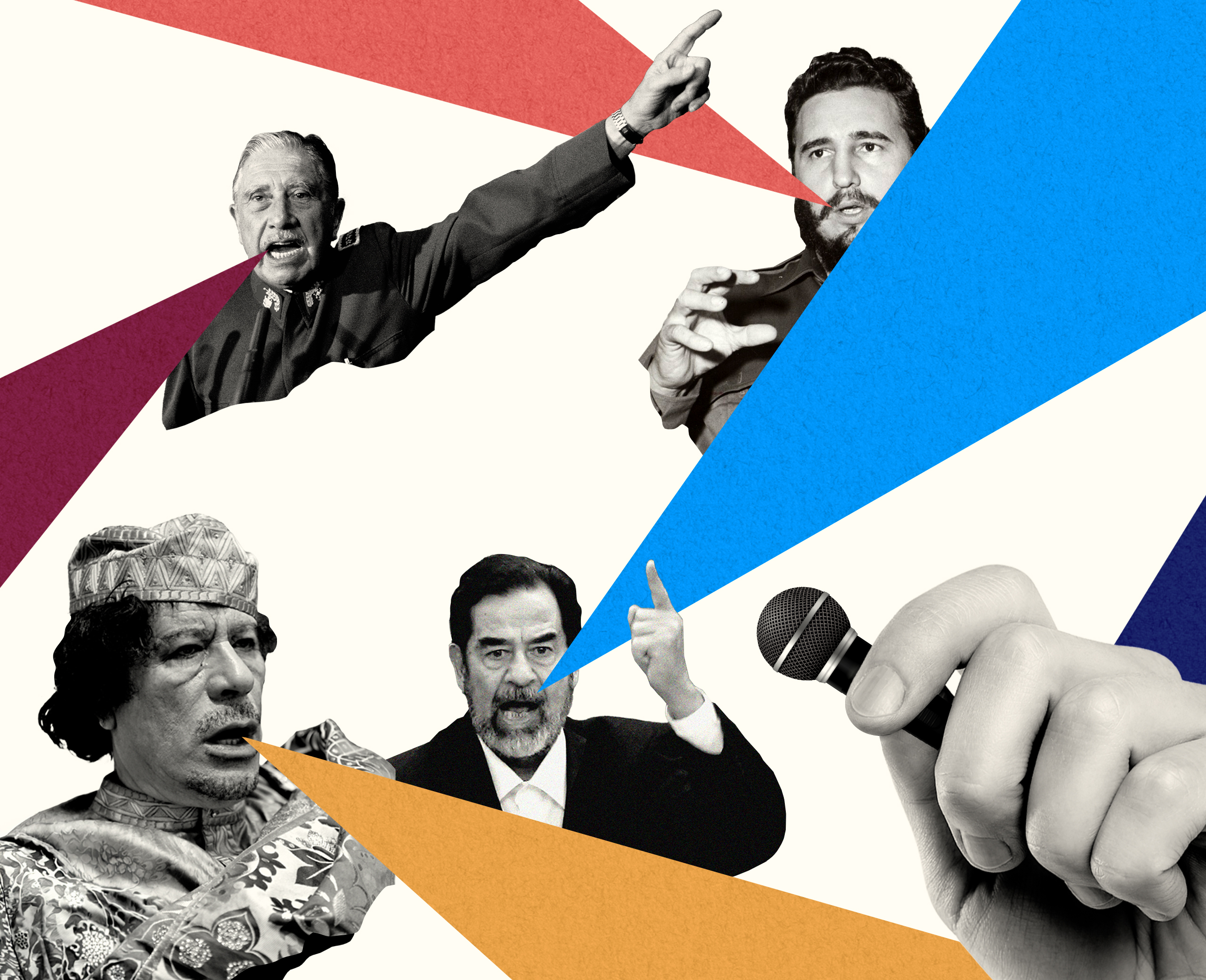
The trope of the dictator interview—presenting a despot as a celebrity, a figure of popular fascination with whom a reporter has managed to secure time—crystallized in the sixties and seventies, when Oriana Fallaci, an Italian journalist and provocateur, confronted Mohammad Reza Pahlavi and Nguyễn Văn Thiệu, among others. In 1979, not long after the triumph of the Iranian revolution, she interviewed Ayatollah Ruhollah Khomeini and—famously—ripped off her chador, calling it a “stupid medieval rag.” Barbara Walters took the opposite tack, humanizing and personalizing repressive leaders such as Fidel Castro, whom she first interviewed in 1977, and Mu‘ammar Gaddhafi, with whom she spoke a dozen years later. In American media, the ethics of dictator interviews have always been fraught: Should brutal tyrants be given a platform? Can journalists whose very lives might be in the hands of those they seek to interview ever truly be independent?
I reached Rather, who is nearly ninety-five and lives in Austin, to get his take. He told me that, as a journalist, he always felt an ethical obligation to speak with anyone he could. “I think it’s always important to talk head-to-head, face-to-face, with the major players on any story,” Rather said. “And what could be a bigger story than the country at war?” He would try to build relationships with officials who could help with access, but maintained a bottom line: no questions in advance and no control over the interview.
Following the sit-down with Saddam, Rather faced criticism from US officials, but he believed the American people benefited from the interview. Ultimately, he said, the segment served as an affirmation of American democracy. “I think it says something about America and what kind of country we are,” Rather told me. “You can well believe that Saddam is not giving George W. Bush any airtime on Iraqi television.” As for Saddam, one of his goals was to reach the segment of the American public that was mobilizing against the war. Iraqi television showed protests constantly; Saddam, it seemed, had come to believe his own propaganda. He also wanted to make a final case that he didn’t have weapons of mass destruction. The American public largely did not hear it, but the truth was revealed eventually: in this case it was the US government, not the dictator, that was lying.
Burgeoning authoritarians and the most brutal tyrants all tend to manage the international media not through fear but through access. I saw this early in my journalism career when I traveled to Cuba as part of a media junket. It was January of 1991, on the eve of the first Gulf War. I was a freelance journalist based in Mexico City. For US journalists, getting into Cuba was complicated, and the embassy doled out visas sparingly. Those who managed to make it had generally invested a great deal of time schmoozing the press attaché and attending parties at the Cuban embassy in Mexico City.
Now, with war looming, the Cuban government had suddenly relaxed its strictures. The entire US press corps in Mexico was invited to Havana. When we arrived, the twenty or so journalists who signed up were given a briefing by a Cuban official who laid down the rules. Our hosts had planned an exciting itinerary—we would visit an agricultural cooperative and the hospital where Cuban doctors were treating Ukrainian children who had been irradiated in the nuclear disaster at Chernobyl. If we all stayed together and did not deviate from the program, we would be rewarded at the end with an interview with Castro, el comandante en jefe.
I quickly did the math and decided: no deal. I was interested in hearing from Castro, but there has never been a more verbose political leader. What could he possibly say that he hadn’t already? And if he did make news, it would be covered by the large media organizations that were part of our delegation. There would be nothing in it for a freelancer like me.
So I decided to wander off and try to find my own stories. One day, while changing money on the black market, I met a man who dressed like a Cuban but told me he was American. It turned out he was a former Black Panther named Charles Hill who, twenty years earlier, had been accused of killing a police officer in New Mexico and hijacked a plane to Cuba. Ever since, he had been living under the protection of the Cuban regime. He invited me back to his home. Soon, some of the correspondents on our trip learned what I was working on and admonished me, saying I was ruining their shot at a Castro interview.
In the end, Castro showed up anyway and spoke with our delegation briefly. Operation Desert Storm had just been launched, and he wanted to have his say. “I felt the same pain and identical bitterness that the whole world feels in this instant,” Castro said. His quote was folded into global news coverage, which meant that the Cuban government had gotten precisely what it wanted. The press had gotten something in return: insights into the Cuban regime that we were able to share with our readers. What, exactly, makes for a good deal? I still wonder.
In 1978, Elizabeth Becker, a correspondent for the Washington Post, interviewed Pol Pot, who ruled Cambodia as the head of the country’s communist movement, known as the Khmer Rouge. Becker had been in Cambodia while covering the Vietnam War, and spoke a bit of the language. As Pol Pot came to power, and reports emerged that mass killings were underway—as many as three million people were ultimately killed—she cultivated Cambodian officials at the United Nations and developed contacts among Quaker activists seeking to bring in humanitarian supplies. Cambodia was completely sealed off from the world at the time, but with Soviet-backed Vietnamese forces poised to invade, the Khmer Rouge believed they could rally the West to their defense. Inviting a few respected journalists appeared to be the best way to achieve this.
Becker—along with another US journalist, Richard Dudman, from the St. Louis Post-Dispatch, and a British academic named Malcolm Caldwell, who was sympathetic to the regime—was selected. Her itinerary in Cambodia, spanning two weeks, was so rigidly circumscribed that even her mildest questions were perceived as evidence that she was a CIA agent. On the last day of the trip, Becker and Dudman were granted an interview with the man himself. Becker barely managed to get a question in—much less one that challenged him—as Pol Pot held forth for two hours.
Later that night, an assassin broke into their guest lodge, threatened Becker with a gun, and proceeded to murder Caldwell. The motive for that killing has never been definitively established, but it may have been part of some sort of government operation. Given her experience—a tightly controlled itinerary, a non-interview sit-down with Pol Pot, and the murder of a member of her delegation—I asked Becker if the trip was worth it. She told me it was. “We need to be witnesses, those who have the opportunity to describe this however much we can,” she told me. “We have to have those benchmarks. I never doubted that.”
Even though Becker was closely monitored during her time in Cambodia, her experience in the country allowed her to perceive what had changed and what was missing—the people in the streets, the religious celebrations, the joys of daily life. She didn’t witness physical repression, much less genocide. But she believed it was taking place. After she got over the shock of the murder, she set out to investigate the regime and ended up writing When the War Was Over, one of the definitive histories of the Khmer Rouge. Her visit to the country was recently turned into a movie, Meeting with Pol Pot. And she has continued to testify and push for justice in Cambodia.
Perhaps the greatest chronicler of dictators and autocrats is Jon Lee Anderson of The New Yorker. Over three decades, he has interviewed everyone from Augusto Pinochet to Mahmoud Ahmadinejad to Hugo Chávez, whom he profiled twice. When I reached Anderson, he told me that when dictators grant an interview they are often thinking strategically. But they are also motivated by hubris, vanity, and a belief in their own persuasive powers.
Anderson feeds their egos. Before sitting down for an interview, he typically spends weeks learning everything he can about an autocrat, visiting their hometown, talking to people with whom they grew up, understanding their beliefs and motivations. “I’m genuinely interested in knowing what they have to say,” Anderson told me. “I suspend a visible judgment or judgmentalism about whatever they’ve done while I’m with them, and that may put them at ease.” Pinochet agreed to an interview with Anderson at the urging of his daughter Lucía; at the time, she was seeking to soften his image while he was facing a possible indictment for human rights violations. Pinochet joked with Anderson that, as a student of history, he understood that “dictators never end up well.” Only days after the piece ran, on October 12, 1998, Pinochet was arrested on charges of genocide and terrorism.
In the case of Ahmadinejad, Anderson spent weeks in Iran in 2008 visiting the president’s hometown and speaking with friends while working on a profile. Anderson intercepted him at public events, requesting an interview, but was rebuffed. The piece ran without Ahmadinejad’s perspective. Nearly a year later, after the Iranian government had suppressed the Green Movement, Anderson’s phone rang. Ahmadinejad was ready to speak. Anderson traveled back to Iran—and, to his surprise, cameras and lights had been set up; his interview with Ahmadinejad would be broadcast on Iranian state TV. Anderson dived in with questions about Iran’s nuclear program, Ahmadinejad’s Holocaust denialism, and the prospect of war with the US. Ahmadinejad was unfazed, answering in placid tones. “He was a man who genuinely believed what he said,” Anderson recalled. “He was a kind of zealot, and believed that I was a kind of ideological foe, but perhaps it wasn’t just the badinage he thrilled to. He felt that he could convince me.”
Chávez, the president of Venezuela, sought something different from Anderson—a kind of personal validation. Anderson had written the definitive biography of Che Guevara, whom Chávez viewed as a personal hero. “When we went to sit down under a tree outside at the palace at night, we talked for three hours,” Anderson said: Chávez peppered him with questions about Guevara’s life and the effort to find his body after he was killed while fighting in Bolivia. “After that, I had great access with him,” Anderson said. “He really wanted to convince me that he was a true revolutionary.”
All of these interactions are based in significant part on negotiating power dynamics. “If it was a Dan Rather or a Christiane Amanpour, a given leader might feel that they’re truly validated once they had been interviewed by that person,” Anderson told me. When I reached Amanpour—CNN’s chief international anchor, as well as the host of Amanpour & Company and a podcast called Christiane Amanpour Presents the Ex-Files—she told me that access is never part of her calculation; her focus is always on doing the best possible interview. She is also prepared to give up interviews when she can’t agree to the terms.
Amanpour told me the story of her would-be 2022 exclusive with Ebrahim Raisi, who was then the president of Iran. This was at the height of street protests in support of Mahsa Amini, a young woman who was arrested for failing to wear a headscarf and then died in Iranian state custody. “Of course I would have grilled him on how she died and the rules on wearing hijab that led to her death,” Amanpour said. “At the last minute his people demanded I wear a hijab for the interview. I refused. He refused to come down for the interview. So I posted a picture of me in front of an empty chair.”
For Jorge Ramos, the longtime Univision anchor who stepped down at the end of 2024, the fleeting nature of the dictator interview creates a sense of obligation. “There are very few opportunities in your career to talk to dictators or authoritarians,” Ramos told me. “You have to take advantage.” He has two rules. The first is that he assumes that he will never talk to the person again. The second is that if he doesn’t ask the tough questions, nobody will. “The worst feeling for a journalist is that you finish an interview with someone powerful and that you didn’t have the guts to ask the tough question,” Ramos told me. He deployed this strategy when he interviewed Nicolás Maduro, in Venezuela in 2019. Maduro tried to make small talk beforehand, asking about Ramos’s wife, who is from Venezuela. Ramos refused to engage. They sat in awkward silence. Then Ramos asked his first question: How should he address Maduro, since he was not a legitimate president, but had stolen the election through fraud? When Maduro divagated, lecturing on the Venezuelan constitution or the depth of his popular support, Ramos cut in and persisted in his questions.
The interview went back and forth for a while, until Ramos pulled out an iPad that showed hungry Venezuelans eating out of garbage cans. Maduro had had enough. He stood up, ended the interview, and tried to take away the iPad. Security guards detained Ramos and his crew, confiscated their footage and equipment, and deported them. The footage would never have become public—except that, months later, a copy of the interview was leaked by someone in Maduro’s government. “When you’re talking with a dictator or an authoritarian, you want him to show his true colors,” Ramos told me. “In all those cases, I wanted to prove that they were corrupt and abusive.”
The relationship between journalist and tyrant has, to an extent, been recalibrated by new technologies. “They have social media, they have their own microphones, they have Twitter in their pockets,” Anderson said. “They can dictate and concoct their own image. They can do their own image-making without necessarily needing journalists.” This means that when an autocrat decides to sit for an interview, they are increasingly able to set the terms—as Vladimir Putin did when he spoke with Tucker Carlson, in February of 2024. To even call that an interview may be a misnomer; Putin made this point, bristling when Carlson interrupted a historical lecture to ask a question. “I understand that my long speeches probably fall outside of the genre of the interview,” Putin said, at one point. “That is why I asked you at the beginning, are we going to have a serious talk or a show?” Carlson failed to probe Putin, though the exchange did have value in demonstrating Putin’s profound sense of grievance. (I reached out to Carlson but did not hear back.)
Lately, fewer interviews with autocrats are happening at all. From the perspective of leaders, why talk to a traditional reporter when you can talk to someone like Carlson or a podcaster such as Lex Fridman—someone who will not interrupt, or cut you off, or challenge you aggressively? Just as important, an independent podcaster can help provide the reach and the audience you need, with the ability to shape American public opinion and influence the White House. Fridman, for one, has had hours-long conversations with Javier Milei of Argentina and Narendra Modi of India, among others. “Rather than simply interviewing me, I feel you’re trying to deeply understand India,” Modi told Fridman. “I strongly feel there’s genuine honesty in your sincere effort to uncover the truth. I genuinely congratulate you.”
Since speaking with Carlson, Putin has not given an interview to an American journalist. Maduro never did one after his interview with Ramos. In Iran, which maintains severe press restrictions, Ayatollah Mojtaba Khamenei, Iran’s new supreme leader, has issued statements via state channels and on his X account, but has steered clear of journalistic questioning. (He is reported to have been badly injured in the Israeli air strike that killed his father.) I asked Amanpour about the challenge of speaking to leadership in Iran. “As for leadership interviews there, the first issue is self-evident,” she said. “They are all targets, and the Israeli intelligence on their whereabouts is highly accurate.” She added: “Iranian government officials have always been difficult to access. They do give interviews to international organizations when they need to communicate to specific audiences.”
Of course, the line between a dictator, an autocrat, and an authoritarian is fluid, as is the line between an interview and a conversation. When I asked Ramos to name authoritarians with whom he’d conducted interviews, he included Chávez and Daniel Ortega, of Nicaragua, as well as Carlos Salinas de Gortari, the former president of Mexico, and Donald Trump, whom he confronted at a press conference in 2015. “I was assuming that I would never talk to him again,” Ramos said of his decision to shout out a question on immigration. “And that has been the case.”
Has America ever needed a media defender more than now? Help us by joining CJR today.