Sign up for the daily CJR newsletter.
On November 8, 2023, Jeremy Bowen, the BBC’s international editor, climbed into the back of an Israeli armored vehicle and set off for Gaza. Driving down the Mediterranean coast, past a heavily guarded fence that marked the border, Bowen looked over a vast wasteland: mounds of rubble, residential towers with their facades blown off, streets devoid of humanity.
Hours before, an official with the Israel Defense Forces (IDF) offered to show Bowen what he claimed to be a workshop used by Hamas—the militant group that controlled Gaza and had launched the October 7, 2023, attack against Israel—hidden inside an apartment building in the northern suburbs of Gaza City. Bowen knew what he would be getting into: since the attack, Israel had barred journalists from entering Gaza except on embeds—short tours led by its military spokespeople. His visit would be tightly controlled, and the BBC would have to submit the footage it intended to air, without voice-over, to military censors ahead of the broadcast. It would be “an acceptable price to pay for access,” Bowen told me. Two months into the war, virtually no video, save for footage taken by professional Palestinian journalists, had emerged from Gaza. “The benefit then was it was new and fresh,” Bowen said.
Upon his arrival, Israeli soldiers showed Bowen a lathe in a ground-floor apartment and laid out weapons parts they had found nearby. They brought him upstairs to another unit and pointed out belongings, including children’s dolls, left behind by residents who had fled. This amounted to proof, the Israeli officials said, that Hamas militants operated among civilians, thus justifying Israel’s decision to strike a residential building. But Bowen harbored some doubts. “It was an unconvincing workshop; essentially it was just metalworking equipment,” he said. Still, the BBC report from Gaza City aired the next day, at a moment when international attention was laser-focused on Israel’s push into Gaza and the scale of its destruction.
“We know the intelligence; we know exactly what we hit,” an IDF officer tells Bowen in the segment. “It’s not like I wake up and my objective is to ruin the city. I aim for the enemy and the enemy only.”
“Judging by the destruction here, the enemy is everywhere, you’d say?” Bowen asks.
The officer nods. “Yes.”
At the time, Bowen saw value in reporting the IDF’s perspective and in seeing Gaza with his own eyes. Like many journalists, he believed that reporters would eventually be allowed to roam. Today, he looks back on that visit with frustration. “I would be a little bit more wary” of joining another IDF trip, Bowen said. “Unless there is something really specific I wanted to see, I would not want to be part of the information effort of the Israel Defense Forces.”
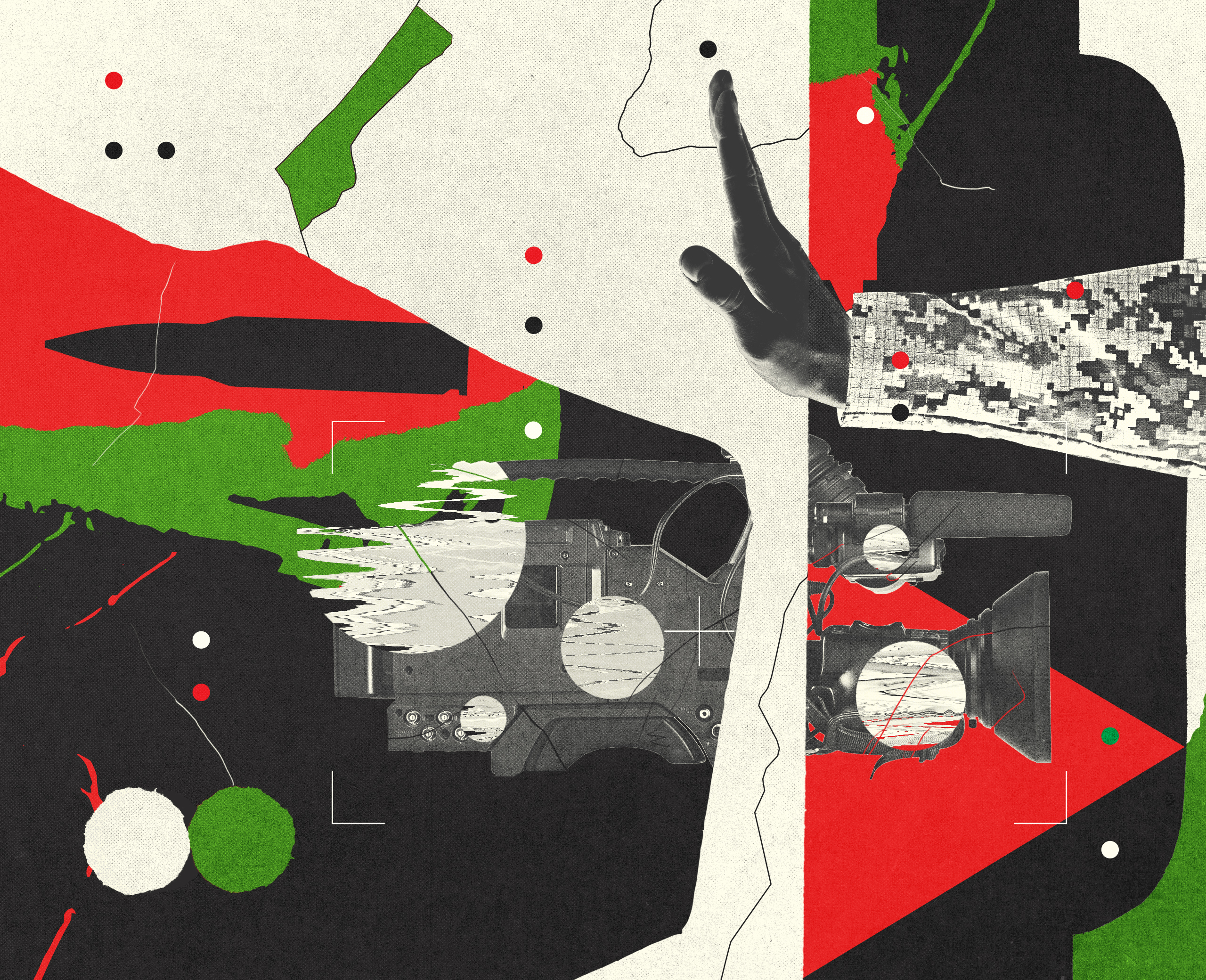
Bowen isn’t alone. Two and a half years after October 7, foreign journalists, including me and my colleagues at the Washington Post, remain locked out. Over that time, we’ve been confronted with a Faustian bargain: either cover the conflict from afar, or accept the terms of access that Israel demands.
Even journalists who have embedded with the IDF in Gaza and found the experience worthwhile say the system is problematic. The IDF spokesperson’s unit chooses outlets to participate in embeds—often, influential English-language television networks and mainstream organizations, such as CNN and the New York Times, as well as alternative, pro-Israel organizations like Newsmax. Led by IDF spokespeople, the tours last no more than a few hours, and broadcast journalists must submit the resulting footage to the censor. (The military censor routinely checks video footage; the IDF contends that this aims to prevent the disclosure of sensitive information, such as Israeli troop positions, and does not seek to impose editorial changes. Broadcast journalists with whom I spoke didn’t feel that they had been forced to remove anything meaningful from their coverage. Foreign text journalists do not submit their notes or finished pieces from embeds to the censor.)
While the Israeli military readily facilitates visits to sites that allegedly implicate Hamas—tunnels running under hospitals, the purported weapons workshop Bowen saw—its ban on journalists’ entering Gaza means that investigations into other subjects, including possible Israeli war crimes, become far more challenging to execute. Interviewing eyewitnesses to an air strike or mass shooting, which might normally take an afternoon, instead require days of painstaking, frequently dropped phone calls. Even establishing the amount of food available inside Gaza during Israel’s full-spectrum blockade last year, which top international experts warned was creating famine-like conditions, was now difficult.
Given the blanket Israeli ban on Gaza access, some outlets do not participate in IDF embeds on ethical grounds. After October 7, a correspondent with The Guardian joined a trip and filed a piece, sparking vigorous internal pushback, three staffers at the publication told me. Since then, the paper has not joined another embed. A Guardian spokesman declined to comment. Decision-makers and correspondents at major international TV networks say they’ve become more selective about these trips over time, increasingly declining invitations to Gaza and Israeli-occupied Lebanon and Syria.
The Foreign Press Association in Israel (FPA), which represents some ninety international outlets, has sued the government in Israeli courts to gain full access to Gaza. In the FPA’s WhatsApp group chat and in-person meetings, reporters have debated proposals to refuse embeds. “All sorts of proposals have been bounced around, from not participating in embeds to some people calling for boycotting the army altogether. But it’s very difficult to get dozens of international news organizations on the same page,” Josef Federman, the news director for the Associated Press in Jerusalem and the deputy chairperson of the FPA, told me.
The AP weighs the merits of each individual embed opportunity. If its reporters participate, their editors will add disclaimers to the resulting stories noting “that these [embeds] are highly controlled and that everything has to be cleared by the military censor.” Federman estimated that the AP has joined ten to fifteen embeds into Gaza, amounting to less than 2 percent of the days of a war that has lasted more than nine hundred days. “These embeds are clearly no substitute for proper access,” he said. “But the general thinking is even a little bit of access is better than no access, as long as we are being as transparent as possible with our clients and readers.”
To be sure, many international news outlets have employed Gazan staffers and contributors who send reporting, photography, and video from inside. But many of the most experienced local journalists left Gaza after October 7, and those who remain face enormous danger. According to the Committee to Protect Journalists (CPJ), since October 7, Israel has killed at least 205 members of the press in Gaza, including those working for the AP, Reuters, Agence France-Presse, and Al Jazeera, often in targeted assassinations. In many of these instances, Israel has justified the killings by alleging the journalists had collaborated with Hamas, even though under international humanitarian law, journalists—regardless of which outlet they work for—should be protected as civilians unless they participate directly in hostilities.
Since the CPJ began collecting data, in 1992, the IDF has killed more journalists than any other military, said Amelia Evans, the organization’s advocacy director. She added that no Israeli criminal investigation has ever been launched into any of the cases. The targeted killings of local journalists inside Gaza, combined with the ban on international media entering, except on IDF-escorted trips, form a double whammy that strengthens “state control over a narrative,” Evans said.
“The whole situation is completely unacceptable,” Jo Floto, the BBC’s Middle East bureau chief, told me. “We all know why we’re not allowed into Gaza: it’s because the impact of our reporting would be so much greater.”
As the Washington Post Jerusalem bureau chief beginning in January of 2025, I participated in IDF embeds and often facilitated visits for my colleagues. Like Bowen, I thought it was worth seeing the scale of Gaza’s devastation and the totality of Israel’s logic, which often revealed itself in minor details. Bowen told me he noticed how the Israeli military had systematically uprooted every palm tree lining a major boulevard in Gaza City and wondered about the army’s motivations. I remember riding in an IDF vehicle on the outskirts of Rafah late last year and being struck by the unexpected, geometric neatness of what I saw in the distance: piles of pulverized cement and mangled steel, evenly spaced as if set on an invisible grid of sand. IDF bulldozers had demolished every Palestinian home and swept the rubble to the middle of every plot before it would be removed. There, amid chaos, I saw order, a methodical process to erase a swath of southern Gaza from the earth.
At the Post, as with other publications and wire agencies with which I spoke, editors sometimes decided to send a photographer when the IDF extended an invitation. The briefings that IDF officials gave journalists inside Gaza were not always newsworthy enough to report, or the information would be packaged as part of a larger story. But the photographs that emerged were often revealing. In one instance, a photo by Heidi Levine, a Post photographer, showing Gaza City reduced to ruins, landed on our homepage. During the mid-2025 hunger crisis, Levine joined the Royal Jordanian Air Force on a humanitarian airdrop. Despite Israeli pressure on Jordanian officials to block aerial photos, she captured a striking shot of Gaza that went viral around the world.
Still, many Western reporters say there is value in joining IDF trips, as long as those notes are supplemented by other reporting or analysis. Shortly after Israel and Hamas reached a ceasefire, in October of 2025, Daniel Estrin, NPR’s correspondent in Jerusalem, was offered a visit to an IDF outpost near the Yellow Line—at the time, little more than yellow paint slathered on concrete blocks placed on the ground, delineating where Hamas-controlled territory ended and IDF-held territory began. Estrin’s initial thought, he recalled, was that Hamas might see his embedded report and later deny him access to its half of Gaza. But, Estrin said, “I don’t see embedding with an IDF tour as tantamount to supporting the IDF or taking their side. Everyone in the journalism business understands: if you want to see the massacre site in Bucha, you go on the bus tour of the Ukrainian army.”
Estrin’s visit, though brief, was informative. He recalled seeing a soldier wearing a T-shirt that read “Hamas Hunting Club.” He was struck by the fact that soldiers, including an IDF spokesman, struggled, from their distant vantage point, to point out the exact location of the Yellow Line. At the time, numerous reports had surfaced of Israeli forces shooting Palestinians who allegedly posed a threat, including civilians who strayed near the line. “You got a sense of how that line is not demarcated clearly,” Estrin told me. “Reporting is always about putting together all the puzzle pieces you can gather, and embeds are just one piece.”
But Nicolas Rouger—a freelance reporter for Libération, the French newspaper, and an FPA board member—said he and many other correspondents no longer see any value in joining the tours. Rouger has often told the IDF that he would do a “real embed” with an Israeli army unit if given the opportunity. But simply “going to see a tunnel, not being able to talk to soldiers or Palestinian people, and then leaving is a kick in the face of journalism.” Rouger told me that participating in the embeds can create an ethical dilemma: Israeli officials use them as examples of how the government facilitates reporting from Gaza, a blatant subversion of reality.
In January, after a protracted, two-year legal battle, the Israeli Supreme Court heard arguments for the first time about the FPA’s petition to overturn the Israeli ban on journalists entering Gaza. Yonatan Nadav, a lawyer for the government, stuck to its long-standing argument that freely roaming reporters posed a security risk for Israeli troops—and to journalists. In any case, Nadav told the judges, the IDF had escorted dozens of reporters in Gaza. The case remains undecided. The embeds are “a fig leaf,” Rouger said, “in a democracy where freedom of information is supposedly necessary.”
Benjamin Netanyahu, the prime minister of Israel, has personally faced demands from foreign journalists seeking access to Gaza. At times, he and his spokespeople have offered vague promises to open up, especially when cameras are rolling. At a press conference on August 10, 2025, Netanyahu assured reporters that he had already ordered the military to bring “a lot” more foreign journalists into Gaza. Later, an IDF spokesperson told me that the political leadership was referring to coordinating more embeds—not opening the gates for independent reporting.
That night, hours after Netanyahu’s press conference, Israel killed five Al Jazeera journalists, including a prominent reporter named Anas al-Sharif, in an air strike, alleging without substantial evidence that they had ties to Hamas.
Israel is hardly the first country to tightly control journalists’ access to conflict zones. But its system of embedding is unique. During World War II, the US military offered credentials—and even the equivalent of a military rank—to correspondents such as Ernie Pyle, who traveled with soldiers and chronicled their experiences. Vietnam was an aberration: the US military allowed correspondents including Neil Sheehan and David Halberstam to roam freely in conflict zones and speak to mid-level officers; gradually, they reported damning pieces that contradicted the upbeat official line from the American and South Vietnamese military brass and helped turn US public opinion against the war. After media outlets agitated against a lack of access during the 1991 Gulf War, when the US military allowed relatively few reporters to visit the front lines and kept the rest in hotels, the Pentagon instituted a formal embedding mechanism during the 2003 invasion of Iraq that let journalists attach themselves to a unit for weeks at a time. The practice drew scrutiny from media critics who argued it encouraged overly sympathetic reporting on the US military, but major outlets also sent journalists out to report among civilians or opposing militias on the ground. In Gaza, the only side accessible to foreign journalists is the IDF’s.
Dion Nissenbaum, a former Wall Street Journal reporter who covered Israel and the Palestinian territories for the McClatchy and Knight-Ridder newspapers from 2005 to 2010 and has participated in embeds with the US military in Iraq and Afghanistan and with the Saudi military in Yemen, said the IDF’s press tours are uniquely restrictive. In Afghanistan, for instance, Nissenbaum spent hours with US Marines during their downtime, getting unvarnished accounts of the war and interacting with local Afghans on US bases or during patrols—which frequently generated valuable leads for stories, often ones that resulted in public relations headaches for the military. Yet the Pentagon continued to give him access. The IDF press tours are completely different, Nissenbaum said. “The Israeli tours are highly regulated. You cannot see or talk to anybody other than those they say you can talk to,” he told me. “A lot of times, the reporters don’t know Arabic or Hebrew. They can’t have unregulated conversations or even know what they’re seeing or hearing.”
Publicly, Israeli officials argue that they ban journalists out of concern for their own safety—and the safety of Israeli troops. In relaxed or private settings, they are often more candid about the rationale. Senior Israeli officials have told me and other correspondents that Israel had nothing to gain from letting images flow, unfettered, out of Gaza. One official once told me that Al Jazeera, for instance, was heavily sympathetic toward Hamas and other Islamist groups, and that its reporting was inflaming public opinion in the Arab countries with which Israel sought to normalize diplomatic ties. (An Al Jazeera spokesman declined to comment but referred me to previous statements issued by the network that categorically rejected Israel’s portrayal of its journalists as terrorists and denounced Israeli officials’ criticism of the network as a “blatant attempt to silence the few remaining journalists in the region, thereby obscuring the harsh realities of the war from audiences worldwide.”)
Even if Israeli officials have long sought to control the spread of images from Gaza, they have never maintained a ban for so long. Israel enacted a similar ban in late 2008, when its forces first fought with Hamas. But the FPA challenged the ban in the Israeli Supreme Court, which ruled in the journalists’ favor. When the two sides fought again in 2014, international journalists flooded in.
During that conflict, Anne Barnard, who has reported for more than a decade from the Middle East for the New York Times and the Boston Globe, called the Israeli government press office to make sure the IDF knew she was staying at a seaside Gaza hotel and not to strike there. The Israeli official repeatedly assured her that the IDF knew that journalists were there and would not hit that location. For Israel to argue that it is banning reporters out of concern for their safety is “nonsensical,” she told me. “If anyone needed protection from danger, it’s danger from themselves.”
Barnard said that it was during the 2014 war that the level of destruction and civilian deaths reached new highs and that the way Israeli officials spoke about waging war began to change. She said that the tenor changed again after October 7, when Israeli officials characterized their retaliatory operation as total war against the Gazan population. Netanyahu cited a biblical commandment to annihilate Israel’s enemy, reportedly telling lawmakers that the army was destroying “more and more houses” so that Gazans couldn’t return. Yoav Gallant, who was then his defense minister, said Israel was fighting “human animals” in Gaza. The reason Israel never allowed journalists in, Barnard surmised, was that “they knew from the beginning there was going to be wholesale leveling of civilian areas, and they didn’t want that on camera.”
Instead, since October of 2023, foreign journalists have had to rely on satellite imagery, social media posts, and phone calls with Gazans living in makeshift tents. These remote reporting techniques have yielded compelling investigations into everything from the Israeli military’s use of Palestinians as human shields to its destruction of Gaza’s health infrastructure, but they consume far more time and manpower. When my colleagues at the Post reconstructed the death of five-year-old Hind Rajab Hamada, in January of 2024, they spent nearly three months collecting and reviewing photos from the scene and analyzing the sound of gunfire recorded during Hind’s call for help to conclude that the Israeli military likely shot and killed the six family members in the girl’s car and the two Gazan paramedics dispatched to save her. It’s hard to say how many more stories could have been unearthed—and what might have been documented for a future historical or legal reckoning—had foreign journalists been allowed to enter.
The Israeli restrictions on the press, which resemble measures imposed by countries like Russia and Myanmar, and the precedent they have set, have been so concerning that the CPJ is now working on a project to identify and propose a set of universal international standards that countries would sign to ensure journalists are guaranteed access to conflict zones, consistent with international human rights law.
Meanwhile, a small coterie of local reporters inside Gaza continues to serve as eyes and ears for the world’s media in the face of extraordinary risk. For months last year, they worked without a dependable supply of food or water. Even now, despite the ceasefire, they face the risk of Israeli bombs or bullets.
As Israeli forces approached Gaza City in late 2023, Hassan Esdodi, a twenty-eight-year-old correspondent for Japan’s Kyodo News agency, was one of the few journalists who decided to remain following October 7. At the outset, Israel seemed inclined to ignore journalists, Esdodi told me. For ten days during the invasion, he recalled, he slept and worked out of a shared office on the sixteenth floor of the Al Ghafri tower, the tallest building in Gaza, until Israeli forces suddenly struck and killed two colleagues filming their operations from the balcony. Esdodi survived by chance: at the time of the attack, he had been downstairs, fetching water. After the close call, he immediately evacuated south.
Over the next year, he moved seven times across the Gaza Strip, to stay ahead of the advancing IDF. At various times, he slept in the streets (for two days), in a room with twenty people (for three months), and in a tent (for six months), all while filing text and visuals to Kyodo’s Jerusalem bureau. His supervisors implored him, unsuccessfully, to take a few days off. Once, while working in Khan Younis, he was injured by bomb shrapnel. During the Israeli blockade last year, his only meal each day was a single can of beans. “The scenes that we had to cover and report were far more important than hunger,” he told me. “And to be honest, I didn’t feel hungry back then.”
At one point over a scratchy Whatsapp call, I told Esdodi that foreign correspondents were frustrated they could not enter Gaza and see what he saw. I asked what he thought about participating in IDF embeds. He paused for a moment before replying.
“I would say to them: Go with the IDF once. And don’t go again until you can freely enter,” Esdodi said. “Only then can you compare how much was covered up, how much was hidden, how much killing and destruction you couldn’t see before.”
Has America ever needed a media defender more than now? Help us by joining CJR today.