Sign up for the daily CJR newsletter.
Last Sunday night, the Israeli military targeted Al Jazeera’s most prominent journalist still alive in Gaza, Anas al-Sharif, killing him, three colleagues, and two freelancers inside a tent used by media workers near al-Shifa Hospital. I write “still alive” because, according to data from the Committee to Protect Journalists, Israel has killed nineteen Al Jazeera staff journalists and freelancers in Gaza since the war broke out. The total number of Palestinian journalists that CPJ has recorded killed by Israel in Gaza during this period—a hundred and eighty-four—exceeds all previous records the organization has tracked, and local press freedom groups that are entrenched on the ground, such as the Palestinian Journalists’ Syndicate, put the figure even higher, at well over two hundred. At least twenty-six of these killings CPJ has identified as deliberately targeted—often, as with al-Sharif, on the basis of “unsubstantiated terrorist labels.”
At this point, to the millions who have spent the past twenty-two months closely watching the journalism of al-Sharif and the media workers killed with him—correspondent Mohammed Qreiqeh, camera operators Ibrahim Zaher and Mohammed Noufal, and freelancers Moamen Aliwa and Mohammad al-Khaldi—their killing seemed an obvious effort to snuff out the widest-reaching news broadcast from the ground ahead of the Israeli government’s plans to take over Gaza City.
The assassination may not have come as a surprise. Throughout this period that a growing consensus of experts on human rights and international law label a genocide—a term many journalists are punished for using—we have repeatedly witnessed record new threats to press freedom. For nearly two years, Israel and Egypt have not allowed foreign journalists to access Gaza for independent reporting, outside of choreographed Israeli military embeds. Palestinian journalists have been subjected to relentless pressure from pro-Israel advocacy groups that dub themselves “media watchdogs” and wage systematic campaigns, fomented by Israeli intelligence, to discredit, dehumanize, and blacklist them—and to harass those who defend them. We have heard the pleas of starving journalists who are displaced and exhausted, dozens of kilograms lighter in weight but immeasurably heavier of heart, with no hope for colleagues to come in and relieve them of the reportorial burden they shoulder alone. And the list grows of journalists whom Israel has publicly declared “terrorists” and then, as my colleague Aida Alami put it to me, “hunted like rabbits.”
These threats to press freedom are urgent for every journalist still somehow managing to work in Gaza. They also have long-term consequences for distrust in our media institutions and for precedents that might jeopardize the safety of journalists elsewhere, anywhere in the future. Among both news consumers and members of the profession, many have noted the muted responses of governments as well as journalism organizations—which have not been inclined toward collective action or direct appeals, but often focus coverage on, for instance, poorly evidenced accusations that someone Israel killed was a combatant, rather than well-documented evidence of that person’s work as a reporter. A growing number have come to view this, ultimately, as a failure to contend with man-made human catastrophe in Gaza, including for reporters—and it has marked a breaking point in their relationships with legacy news institutions.
Amid these dire threats, individual journalists, press freedom groups, and some newsrooms have drawn upon the traditional tools in their advocacy arsenal: letters, statements, condemnations, and the occasional slow-moving Israeli court case challenging lack of access. None of these efforts has resulted in change. “We’ve passed the point of verbal condemnation,” Youmna ElSayed, Al Jazeera English’s Gaza Strip correspondent, told me. She and others have been pushing for creative solutions that have gone unheeded. This summer, the Columbia Journalism Review and the Simon and June Li Center for Global Journalism solicited thinkers from across the fields of journalism, human rights, literature, academia, and advocacy, asking them for ideas about what new strategies, efforts, and possibilities should be on the table for our industry at this moment. We asked people for innovative, perhaps unconventional ideas to defend press freedom in Gaza. These were their answers.
—Azmat Khan, Patti Cadby Birch Assistant Professor of Journalism; director, Simon and June Li Center for Global Journalism at Columbia Journalism School
Youmna ElSayed
Al Jazeera English’s Gaza Strip correspondent, now living in CairoJournalists can find alternate routes to push to enter. If they tried to enter through the Rafah border, when it was open, they would have gotten in. The reality is that no international organization is willing to send its foreign journalists into Gaza, because after they conduct the risk assessments, they realize there is no ability to actually guarantee any kind of protection, because there isn’t any place that is safe. There isn’t one media office in Gaza, whether local or international or foreign, that has not been targeted since the first week of the war. It’s not even by coincidence or in the midst of fighting. No, it’s happened systematically. Media offices were completely destroyed.
The fact that news organizations are not willing to take the risk to enter Gaza is an implicit acknowledgment of the reality that it isn’t a safe place to be and that journalists are not protected there—and yet those same news organizations are not acknowledging that reality directly, openly, and reporting about the way it is. Beyond newsrooms, press freedom organizations have the ability to place governmental pressure, international pressure to impose sanctions of some kind on Israel. We need to see something other than verbal condemnation. We’ve passed the point of verbal condemnation. We’ve passed the point where we have reports and we’ve documented this. We need something that’s solid on the ground. How can I get back my rights after everything that Israel has committed against me as a journalist? I’m not talking as a Palestinian civilian or a mother, I’m talking about as a journalist, doing my job in my press vest.
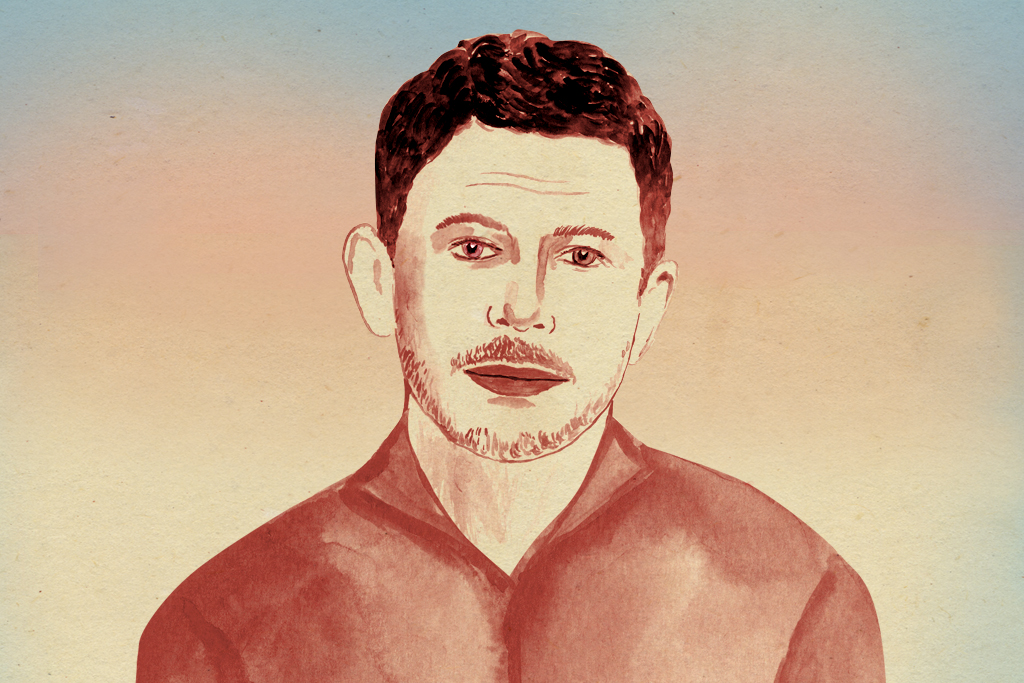 Illustration by Ellen Weinstein
Sharif Abdel Kouddous
Middle East and North Africa editor of Drop Site NewsJournalists in Western newsrooms could strike. They could refuse to work until some sort of substantive demand for a policy change at these institutions is fulfilled. What could this policy change be? Perhaps a disclaimer at the bottom, or within, every article that quotes Israeli authorities that Israel has killed far more journalists in Gaza than anywhere in the world since the Committee to Protect Journalists started keeping records, and therefore the veracity of any statement is dubious. Perhaps it could be an open-ended strike in solidarity with Palestinian journalists.
Ultimately, mass resignations by journalists and media workers in protest of the killing of their colleagues and the relative silence of their newsrooms on the subject of Israel’s genocide would go a long way toward not only highlighting the devastation, but also bringing down a media system that can no longer be reformed, but that needs to be dismantled and replaced.
Arwa Damon
CNN correspondent turned humanitarianEvery single news outlet—TV, print, radio—before and after every report that is Gaza-related, should state something like “Israel is banning journalists from entering Gaza.” Al Jazeera English does this, regarding their not being permitted to report from Israel. I would add the number of journalists and media workers killed to that introduction, as well as the starvation and deliberate-killing numbers. It will add thirty seconds or three sentences, but repetition is important. Outlets should have been doing this all along.
There is also something to be said about basically banning Israeli government and military voices from air and print until they let the press into Gaza: “We won’t air or use your statements until you let us in to see for ourselves.” No government spokespeople, no Israeli Defense Forces spokespeople on TV, no big statements from them refuting everything. There should be no room in the media for “there is no starvation in Gaza” or “Hamas is stealing the aid” until Israel lets the media in, and not on some manufactured IDF dog and pony show. Just let them in and allow them to report independently.
Fadi Quran
Senior director at AvaazThere should be sanctions on Israeli officials responsible for attacks on the press. When Saudi Arabia murdered Jamal Khashoggi, in 2018, the United States, Canada, and several European countries imposed sanctions on Saudi officials. The European Union sanctioned senior Russian officials in response to the persecution of journalists. The US sanctioned Belarusian officials in 2021 after the state’s forced landing of a Ryanair flight to arrest Roman Protasevich, a dissident journalist. Such measures send a clear signal: attacks on the press are attacks on democracy, and they carry a price. Yet when governments, the EU, or the International Court of Justice assess Israel’s actions, the global press freedom community has too often failed to insist that killing journalists and destroying media infrastructure be treated explicitly as human rights violations in the context of these legal reviews—an omission that risks normalizing the idea that attacks on the press are somehow separate from, or lesser than, other abuses.
Newsrooms are also empowered to act. When a journalist in Gaza is killed or silenced, their work should not die with them. Newsrooms worldwide should take up their last story, give it space in their own pages, and publish it prominently—not buried in the back, but on the front page, above the fold. International news outlets—from the New York Times to Le Monde to El País—could produce coordinated editions, and feature blank column spaces and joint op-eds, naming the victim and the government responsible. Such actions should not be symbolic mourning alone, but a collective act of defiance—a reminder to those in power that silencing one reporter will only make their story louder.
Omar Shakir
Israel and Palestine director at Human Rights WatchI wonder if a bunch of newspapers would all print a page that just highlighted pictures of journalists who have been killed by Israeli forces and called on the Israeli government to stop killing journalists. News publications could also use the image on social media, have it on their website, maybe even change their logos on social media. The more, the better.
 Illustration by Ellen Weinstein
Shrouq Aila
A Palestinian journalist still working in Gaza, Aila took charge of Ain Media after her husband, Roshdi Sarraj, a cofounder of the company, was killed by Israel in late October 2023Protect the work of the journalists here—their coverage from Gaza should be saved and kept from being deleted, because you know that the Israelis are going after the Palestinian narrative and trying to delete it, as we see with Meta and Instagram—how they are banning, blocking, and deleting Palestinian content. So, maybe creating a platform that could gather all of those stories and narratives from Gaza, to keep it safe from the risk of being banned and deleted.
Mohammed El-Kurd
Award-winning poet, writer, journalist, and organizer from PalestineHaving no international journalists in Gaza is both a blessing and a curse. It’s mainly a curse, but it’s a blessing because it’s shielded us from rampant levels of obfuscation and willful misinterpretation of what’s happening. Ultimately, I think that more journalists need to be in Gaza not because we are missing the truth or that we need somebody to tell the truth. I think we need to have international bodies on the ground because, unfortunately, that is the only way Israel will lessen the blow, and the devastation of Palestinians—because international journalists’ lives are simply worth more in the public sphere.
There could be a flotilla or some kind of march toward the Rafah border—if two hundred, three hundred journalists just went to Egypt and walked toward the river crossing. Even if it were stopped by the Egyptian forces, that would be a news item and drive massive attention.
We were working on something like this starting in 2023 with a group of Egyptian journalists. It was going to be a convoy of activists and journalists and diplomats. But it never crystallized because of security concerns. We were mainly Arab, with “weak” passports. I think it’s a different question if we’re talking about foreign nationals.
Nader Ihmoud
Palestinian American journalist and founder and editor in chief of Palestine in AmericaAn idea that I would have to keep journalists safe—though it’s impossible and ridiculous to even think this—is: for every Palestinian journalist, you send a journalist from the West. The Westerner would have to stand right next to the Palestinian, sleep next to them. Because Israel and the powers that be in Western nations obviously value Western journalists more than Palestinian journalists.
How are we going to get them in there? You’re talking about Western journalists heading to the border of Egypt, Israel, and present-day Palestine, and just basically putting their lives on the line and trying to walk through that border and force their way in—because there’s no other way in. Bring in the most influential Western journalists—an Anderson Cooper, a Wolf Blitzer—along with some politicians. Put some bodies on the line that Israel would be afraid to attack.
 Illustration by Ellen Weinstein
Kenneth Roth
Served for nearly three decades, until August 2022, as the executive director of Human Rights WatchIt would be useful if the International Criminal Court prosecutor were to file war crime charges explicitly about Israel’s killing of journalists, because killing journalists has a compounding effect by closing the eyes and ears of the world and enabling Israel to commit more war crimes and even genocide. Journalists are already protected as civilians, but by singling out the targeting of journalists, the ICC prosecutor would also spotlight their potential deterrent effect—because when journalists are watching, warring parties tend to behave better.
If journalists are being killed simply because of Israel’s indiscriminate warfare, it would be difficult to single out journalists in war crimes charges. But if cases can be identified where journalists were specifically targeted, those would be cases that could be brought. It would underscore that journalists, like all civilians, are protected, but that journalists are serving a function that protects other civilians.
Trevor Timm
Executive director of the Freedom of the Press FoundationClearly, pressuring the US government is borderline useless at this point, and unless Benjamin Netanyahu personally insults Donald Trump in some way, the administration will continue to facilitate the targeting and killing of journalists. To the extent they can, advocacy organizations should increasingly pressure European governments and the European Union in general to make the protection of journalists on the ground and access to the war zone a key red line in any diplomatic or trade negotiations. Given that the US has granted total support to this travesty, until EU countries and the rest of the world take a united and hard-line stance, these crimes will continue.
Assal Rad
Media critic and historian of the modern Middle EastIn order to pressure Israel into allowing foreign press and to stop targeting Palestinian journalists, foreign journalists and media, especially in the West, can refuse to platform Israeli officials and stop treating their statements as fact. Rely instead on Palestinian journalists on the ground and center Palestinian voices in order to help bring awareness, give Palestinian journalists more access to large platforms, and amplify their public profiles. Journalists can publicly condemn Israel’s targeting and killing of their Palestinian colleagues and stop treating the Israeli government, which is currently committing genocide, as a reliable source of information.
 Illustration by Ellen Weinstein
Hind Hassan
International correspondent and documentary filmmaker covering conflicts and humanitarian crisesMore than two hundred journalists have been killed in Gaza—some of them were affiliated with major international outlets, or working as freelancers supporting global media. In solidarity with those who have lost their lives and those who continue to report under extreme danger, news organizations could coordinate a one-hour global media pause across print, broadcast, and digital platforms. During this hour, regular programming or content would be replaced by a unified message such as “Journalism is not a crime,” along with information on journalists killed in Gaza and international journalists’ lack of access to the Strip. Media platforms would display a blackout screen or a full-page message during the campaign. Newspapers could use a blackout front page or banner.
This campaign would aim to raise international awareness about the risks faced by journalists in Gaza, highlight the ongoing denial of access to foreign media, and increase diplomatic pressure to uphold press freedom as a fundamental right.
Lila Hassan
Independent journalist who focuses on extremism, human rights, and immigrationJust as media organizations and news outlets receive awards for their impact, it’s nonsensical to ignore the reality that they are also responsible for harm. It’s this harm that should be named and shamed, by an international watchdog that tracks violations of media norms and ethics as well as malpractice, offering breakdowns of these practices by journalists, specific news pieces and longer-form stories, or, in extreme cases, entire newsrooms. There are no shared credentials in our profession, which has allowed journalists with histories of violations to continue practices with detrimental—and in Palestine’s case, deadly—consequences without themselves facing repercussions. This watchdog changes that. In Gaza, journalists from Western outlets have shaped ongoing conflicts in favor of one party and given cushion to perpetrators, which is a betrayal of the norm of fairness. They have also parroted government narratives without critical context of past falsehoods and ongoing, proven war crimes, which is a betrayal of the norm of accuracy. Employing active Israeli military-affiliated people as reporters without disclosures is a betrayal of the norm of conflict of interest, and feeds into other professional violations. And misrepresenting and/or omitting major events from coverage altogether—air strikes, starvation, Israeli declarations of intent to commit genocide and prevent distribution of aid—demonstrates inequitable editorial decision-making and facilitates what is now a genocide. Years down the line, the media will be called to account for its role in the extermination of Gaza, and this watchdog would be part of that reckoning.
Jonathan Dagher
Head of the Middle East desk for Reporters Without Borders (RSF)There are several places we can exert pressure. Primarily, we can place pressure on the systems of international law and justice—we’re witnessing a violation of international law coupled with impunity that allows these violations to continue. Some two hundred journalists and media workers have been killed since October 2023, and we’ve collected evidence that at least forty-six have been specifically targeted. That problem started before October 7: no one was arrested for the murder of Shireen Abu Akleh, a Palestinian American journalist who was killed in 2022. The RSF is pushing for the ICC to acknowledge Israel’s war crimes against journalists and asking the court to investigate. We are helping the victims represent themselves before the court. We ran a petition condemning the violence; more than two hundred journalism outlets signed on. We are reaching out to the United Nations Security Council to apply Resolution 2222, which specifically demands protection for journalists covering war zones. We should also continue to pressure NGOs, activists, politicians, and governments. RSF is calling for the European Union to break its association with Israel and demanding the liberation of the Al Jazeera journalists.
Importantly, we need to speak to journalists on the ground in Gaza. We need to humanize them and their experiences. Many Palestinian journalists are considered “terrorists until proven otherwise.” But for RSF, we always use the same metrics to check the integrity of the journalists we advocate for and defend: journalists can’t actively advocate violence, can’t carry weapons, but opinions are allowed and an important part of journalism. I have never seen such questions from the West about who is and isn’t a journalist. But defending the journalists in Gaza is a service to democracies everywhere.
Nick Turse
Investigative journalist and author of Brown University’s Watson Institute report “News Graveyards: How Dangers to War Reporters Endanger the World”We, as a profession, need to adapt to these times or we aren’t going to exist as a profession. Direct action—a flotilla, a march, a convoy, or just trying to breach the border—these are all useful ideas, but journalists, as a whole, don’t normally think this way. It is seen as making yourself part of the story or as some stunt. But we are living in extreme times now, and we have to think outside the box. For this profession to survive in a real or meaningful way, we are going to have to shift our mindset as journalists. It can’t just be ad hoc, conflict to conflict, reinventing the wheel. We need to alter our mindset and make structural changes to how we operate and how we advocate, or we will watch our colleagues be wiped out in place after place and conflict after conflict.
Laila Al-Arian
Executive producer of Al Jazeera’s Fault LinesIn 2023, on the one-year anniversary of Shireen Abu Akleh’s killing, CPJ released a report, “Deadly Pattern,” about twenty journalists killed by Israeli military fire over a period of twenty-two years, including some non-Palestinian journalists. And during that time, not a single Israeli soldier had faced any accountability. So we’re talking about decades of impunity, of Israel targeting and killing journalists who are doing their jobs.
I personally don’t have faith in the Israeli court process. It was only cases that were very high-profile or that involved non-Palestinian journalists where there was enough pressure to even have them be investigated—but even then, there was no accountability. So I think it’ll have to be the international court system. There needs to be war crimes investigations—there needs to be a process by which to hold them to account—because that’s the only way of stopping this.
Frank Smyth
Independent investigative journalist and former arms-trafficking investigator for Human Rights WatchWe need an international, independent investigation that I think should be launched by the leading press freedom groups and other interested entities. They would be able to establish and spread the word that this is the worst atrocity for journalists in recorded history. Most of those who have been killed have been victims of war crimes. We’re not going to get any tribunals, but what we could do is contribute reporting on this situation, and show that violating Palestinians’ rights is weakening international humanitarian law.
The experts should include people with military skills and tactical skills, so they can talk about proportionality. Because whether an attack is indiscriminate enough to be considered a war crime is all about two things: intent and proportionality. The problem is that Israel is weakening the rule of international humanitarian law through its actions, and we’re collaborating in that weakening by not calling it out. We should treat Palestinian journalists the same way we would treat Western journalists getting killed at this rate.
Neha Madhira
Investigative reporter covering health and human rights across MENA and South AsiaMany journalists in Gaza and the West Bank have had their equipment or offices vandalized or destroyed by Israeli soldiers, which has left them with no choice but to turn to social media. Western media outlets should be more open-minded when it comes to publishing the narratives of Palestinian writers who have been driven to post their reporting on social platforms.
That requires the press to make it a priority to amplify the voices of Palestinian journalists. I believe what Prism and The Nation, for instance, have done in setting guidelines and building partnerships with those who cover the genocide should be adopted by other publications. Media hubs, such as the Movement Media Alliance/Media Against Apartheid and Displacement, and other outlets that have shown they are focused on intentional journalism should serve as models as well.
Shmuel Lederman
Researcher of political theory and genocide studiesWe need to provide historical context. We have a tradition we’ve identified in genocide studies: we call them hidden genocides. We need to understand that, historically, countries turn a blind eye while genocides are happening—then, sometimes, acknowledge the atrocities later. This is a legacy and happens again and again. For a recent example, there was very little in the mainstream media about Yemen, where hundreds of thousands have died, or before that about East Timor, where the media turned their backs on genocide in the mid-seventies; in Indonesia, in the sixties, the media actually celebrated the massacre of almost a million “communists,” and in Congo, a mixture of mineral interests and guilt from past failures makes the conflict too hard to report out. This continues about anywhere that the US has interests, and provides support to the perpetrators.
Diana Buttu
Palestinian Canadian lawyer and former spokesperson for the Palestine Liberation OrganizationOverall, journalists tend to side with Israel. This is why, without question, they adopted many of the now-debunked lies in the early days of October 2023, and why many still use techniques—passive voice, playing up protest, etc.—as they cannot accept that the State of Israel is a racist, fascist, genocidal state to its core. And not just this government.
Journalists have to stop repeating whatever the Israeli government and army are stating. For example, parroting—even critically—the statements that people “are Hamas” is lending credibility to their statements. Journalists are not targets unless they are actually in combat. Anas al-Sharif was killed in a tent—clearly not in combat. I suggest that journalists stop interviewing or giving space to these Israeli spokespeople. Don’t be embedded.
Michael Sfard
Israeli lawyer and political activist specializing in international human rights and warAn important stream of activism is action taken by professional associations and individuals against colleagues who abuse basic professional ethics. This is something that should be explored in the journalistic profession. Work can be done to introduce obligations and prohibitions that would prevent serious breaches of solidarity among journalists. Take, for example, the case of a news channel that cheers the destruction of a TV studio. Does that have any implications for how that news channel is received by international organizations of journalists, by other media outlets? Could there be a campaign to put pressure on, maybe even boycott that channel? This may also apply to journalists and channels who incite crimes. Apart from the criminal aspect, there must be disciplinary action and consequences.
Abubaker Abed
Palestinian journalist working in Gaza until April of this yearJournalists outside in the West and all across the globe must support Palestinian journalists in Gaza financially and nonfinancially. Media outlets commissioning the work of journalists in Gaza, even on a freelance basis, must pressure Israel and tell them that those journalists are working for their organizations on the ground and they should be protected. Those journalists ought to be paid double the original rates—because in Gaza, prices are so high and people have to pay loads and loads of money to continue to survive. Have their back all the time—do not leave them alone, provide them with what they need, and make sure they are safe to continue reporting, because there’s not been a more traumatizing environment for journalists to work in than in Gaza.
Got an idea to add? Email us at editors@cjr.org.
Has America ever needed a media defender more than now? Help us by joining CJR today.