Sign up for the daily CJR newsletter.
A lot keeps Tahir Imin up at night. There are the memories of his time imprisoned in Xinjiang, the daughter he was forced to leave behind there, and the ex-wife he divorced in an effort to protect her from retaliation over his activism in the United States. Last he knew, his mother and two brothers were imprisoned in the region, swept up in the Chinese government’s crackdown on the Uyghur ethnic group. “They have already done everything to my family,” Imin, who is forty-five, said of the Chinese government. “I don’t even know if they’re alive.” Imin’s freedom and survival haunt him. “The only thing to do to comfort my guilty conscience is speak for my people,” he said.
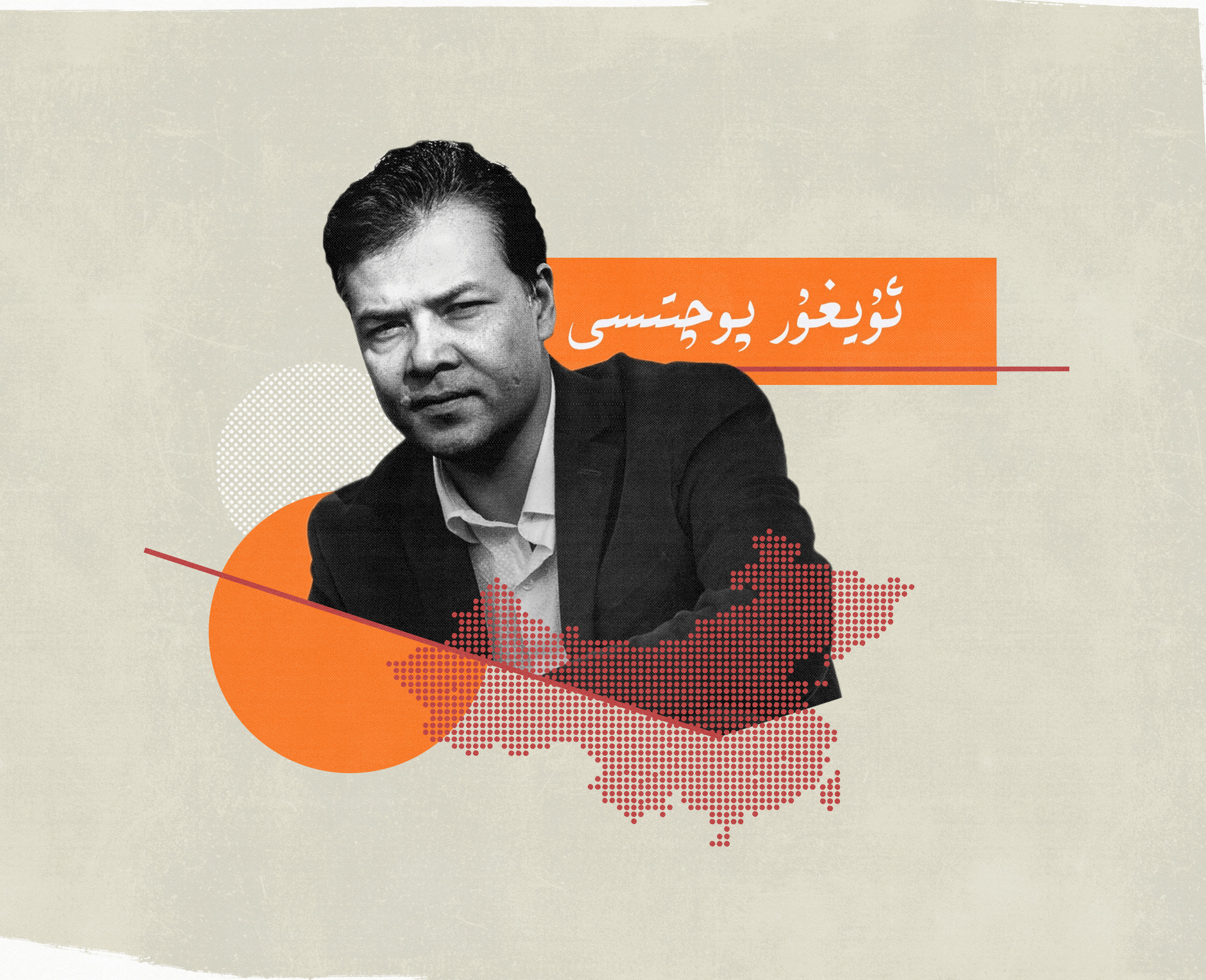
Last November, Imin debuted the Uyghur Post, one of the world’s only Uyghur-language news sites. The outlet publishes daily stories on topics ranging from Uyghur culture in Kazakhstan to an Australian court case on Uyghur forced labor to Turkish Airlines launching a new flight route to Urumqi, Xinjiang’s capital. Its monthly audience measures around thirty thousand readers. In February, the site launched a weekly podcast.
Recently, Imin and I met for lunch at a Uyghur restaurant in northwest Washington, DC. Doppas, traditional Uyghur skullcaps, were scattered around us. Foreign governments have accused the Chinese government of committing genocide against the Turkic, majority-Muslim ethnic group; Uyghur traditions are at risk of disappearing in Xinjiang. In between bites of noodles and lamb and sips of green tea, Imin told me of his hopes to turn the Uyghur Post into a voice for his people. “What matters to them is freedom and feeling like they’re being heard.”
Imin was born in the Kashgar Prefecture of Xinjiang, a region in northwest China; for some Uyghurs, it’s known as the Uyghur Region or East Turkistan. He earned degrees in English and Uyghur literature from Xinjiang University and later found work in Poskam, his hometown. In 2005, Chinese authorities arrested and imprisoned him for two years over articles he wrote about the Chinese government’s suppression of Uyghur culture. In 2009, Imin started the Uyghur Doppa Cultural Festival, later banned by the government. To earn a living, he cofounded an import-export company specializing in textiles and cosmetics and invested in local businesses.
In 2016, Beijing appointed Chen Quanguo to serve as Xinjiang’s party secretary. Imin feared the worst. Chen had previously led a harsh surveillance and forcible assimilation campaign in Tibet, where he had served as the regional leader. Certain that the official would crack down on prominent Uyghurs, Imin fled for Israel. He figured he would be safe there: the Chinese government pays special attention to countries with large Muslim populations, which it deems “sensitive” for Uyghurs, in some cases blocking travel outright; Israel is not on China’s list. Imin planned to return home after a few months. But then the Chinese government escalated its crackdown in Xinjiang, ostensibly to combat terrorism. The operation aimed to forcibly assimilate Uyghurs into the dominant Han Chinese ethnic group. Chinese authorities threatened Imin with arrest, and in 2017 he moved to the United States, home to roughly ten thousand Uyghurs, according to the Uyghur American Association. The largest community is concentrated in DC and the surrounding suburbs.
At the time, the Uyghur-language service of Radio Free Asia (RFA) led coverage on the ongoing crackdown in Xinjiang, publishing early reports on China’s high-tech surveillance state and mass detentions of ethnic minorities. The outlet also documented, between 2017 and 2020, the Chinese government’s detention of between one million and three million people, mainly Uyghurs, in so-called reeducation camps and prisons. Forced sterilization and forced labor became common. As of last year, more than half a million Uyghurs remained in detention. (The Chinese government denies any wrongdoing in Xinjiang and says its policies are for counterterrorism purposes.)
In March 2025, the Trump administration waged a campaign to dismantle the US Agency for Global Media—which oversees RFA, Voice of America (where I previously worked), and Radio Free Europe/Radio Liberty—over allegations of liberal bias. (Although funded by Congress, the outlets have historically been editorially independent.) In May, RFA announced that it would no longer publish news in several languages, including Uyghur. In January, new congressional funding allowed RFA’s Uyghur service to resume publishing. But it returned at a much smaller scale, its staff of twenty reporters reduced to just one.
Over the years, critics accused RFA’s Uyghur service of covering only progressive sects of the Uyghur diaspora while ignoring most conservative, nationalist factions. But however imperfect that service was, its closure still meant “the severing of the sole main artery of professional and independent Uyghur-language journalism on a global scale,” Ishan Ismail, a thirty-one-year-old based in Paris who writes for the Uyghur Post, said. As RFA declined, China ramped up its state propaganda, including material directed at Uyghurs and Tibetans.
Imin decided to form the Uyghur Post in response to the kneecapping of RFA’s Uyghur service. “If we provide important and necessary information, we can be helpful to our community,” he said. “It’s by Uyghur people and for Uyghur people.” Although Imin spent years as an activist, the Uyghur Post aims to remain independent and fact-based in its news coverage. Recently, it has published ambitious stories on controversial Uyghur militants in Syria. “We will never be an advocacy organization,” he said.
Imin is based in Maryland, but the Uyghur Post’s volunteer staff of roughly fifteen reporters and editors live around the world, including in France, Norway, Turkey, and Australia—a reflection of the breadth of the Uyghur diaspora. Most Uyghurs live in Central Asia and Turkey, according to the Uyghur Human Rights Project, but there are sizable communities in Germany, the Netherlands, the United States, and Saudi Arabia. Imin is applying for grants to pay his staff and hire additional employees, he said, and pursuing nonprofit status.
Beyond RFA, few Uyghur-language outlets exist. Those that do, such as Istiqlal Türkçe, tend to have religious overtones. Some prioritize commentary over news coverage. This gap could work to the Uyghur Post’s advantage. “Since there’s no real way for Uyghurs to express their national point of view inside China right now, these kinds of diaspora sources become an important part of the cohesion of the nation,” said Sean Roberts, a George Washington University professor who studies Uyghurs.
“The Uyghur Post stands as a critical center of resistance,” Ismail, the Paris-based writer, said. Amine Vahit Sedef, a forty-three-year-old Uyghur Post writer based in Istanbul, who focuses on Uyghur women and Uyghurs in Turkey, told me: “I feel a responsibility to speak for my people.”
Imin believes Beijing has already taken notice: “Since launching Uyghur Post, the cyberattacks have been continuing,” he said. It’s difficult to prove that Beijing is responsible, but China has long been known for online targeting of Uyghur groups and activists abroad, he told me, and “there is little reason to suspect any other party is behind attempts to compromise Uyghur Post; these attacks are consistent with state-sponsored Chinese activity.” (China’s Washington embassy did not respond to a request for comment.)
Imin speaks with urgency about his publication’s mission to preserve Uyghur tradition. Few Uyghur children in the diaspora have ever set foot in the homeland, where Beijing has effectively criminalized their culture and restricted the use of their mother tongue in schools. “It’s not just a communication tool,” Imin said of his native language. “The Uyghur language has so much salt in it. The Uyghur language has so much water in it. You can drink it, you can taste it, you can enjoy it. This language should be appreciated and used in our daily lives,” Imin said. “That’s how we can survive.”
Has America ever needed a media defender more than now? Help us by joining CJR today.