Sign up for the daily CJR newsletter.
Two weeks ago today, I wrote in this newsletter about the growing hunger crisis in Gaza, and the toll that it was taking on journalists in the territory. I noted that staffers at Agence France-Presse had just warned that their colleagues on the ground were starving to death, and quoted the testimony of other reporters, including Anas al-Sharif, of Al Jazeera, who had written online that he was “drowning in hunger, trembling in exhaustion, and resisting the fainting that follows me every moment.… Gaza is dying. And we die with it.” While the specter of starvation was dominating news coverage out of Gaza at the time, I also pointed out that journalists there were still facing the same acute threats that have rained down on them since Hamas attacked Israel from the enclave on October 7, 2023, and Israel responded with devastating force. As evidence, I pointed to the case of al-Sharif, who, since crying on air while covering the hunger crisis, had been labeled a terrorist by an Israeli military spokesperson. The Committee to Protect Journalists had just warned that it was “gravely worried” about al-Sharif, dismissing the Israeli claims against him as “smears” and warning that the “unfounded accusations represent an effort to manufacture consent” to kill him.
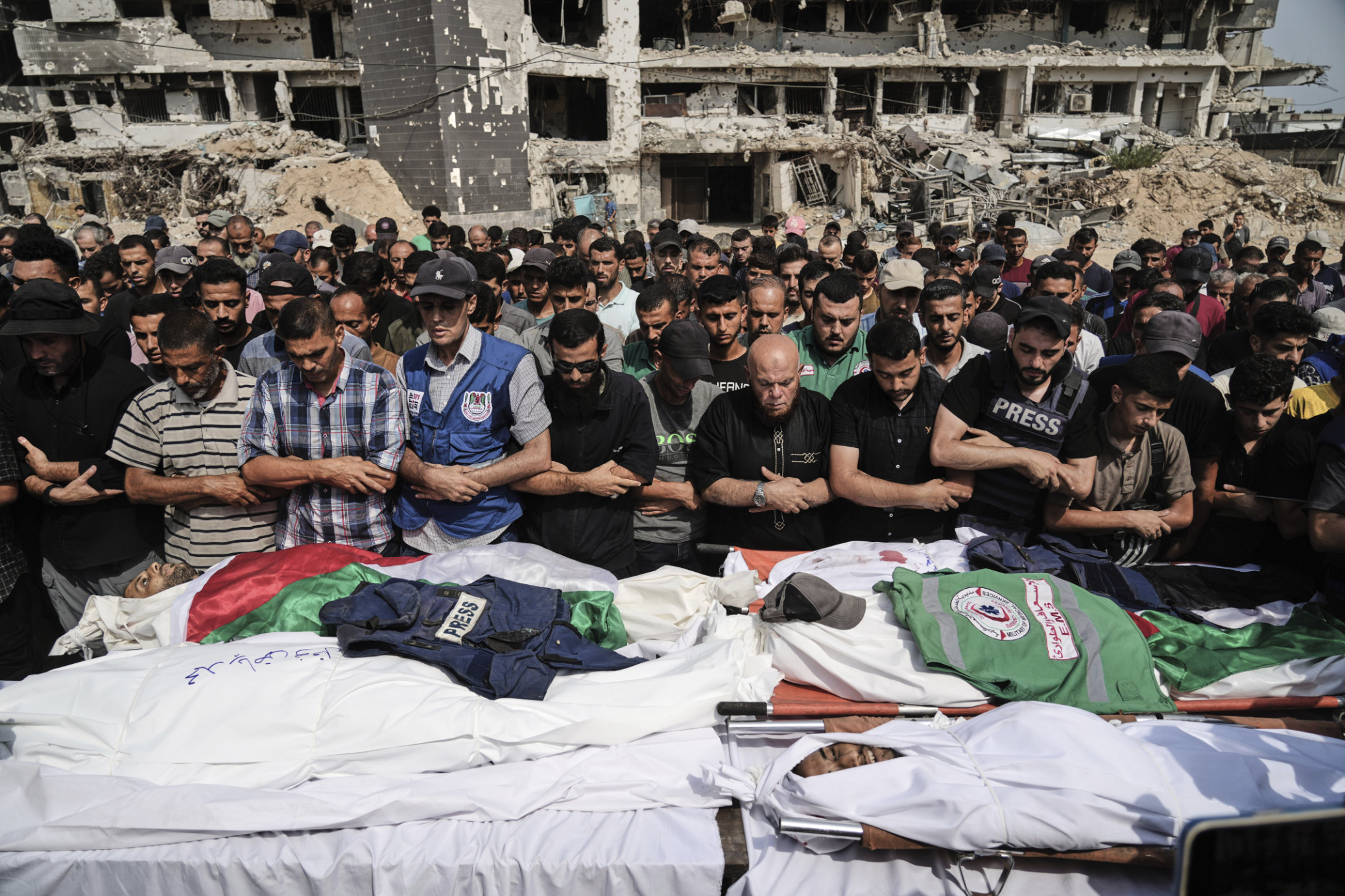
On Sunday, Israel struck a tent housing members of the media in Gaza City, killing not only al-Sharif, but four of his colleagues at Al Jazeera—Mohammed Qreiqeh, Ibrahim Zaher, Mohammed Noufal, and Moamen Aliwa—and a nearby freelancer named Mohammad al-Khaldi. Israel claimed again that al-Sharif was a militant, accusing him of having headed a Hamas cell and of “advancing rocket attacks against Israeli civilians and troops.” While he was alive, al-Sharif had strongly denied any such conduct—“They accuse me of being a terrorist because the occupation wants to assassinate me morally,” he said—and Al Jazeera said that the claims were a fabrication. Following the killing, Al Jazeera decried it as an assassination. CPJ reiterated that Israel’s claims were “smears,” adding that the country “is murdering the messengers.” Reporters Without Borders said that there was no “solid evidence” that al-Sharif was a terrorist, and called for an emergency meeting of the United Nations Security Council aimed at stopping the “massacre” of journalists in Gaza. UN human rights officials condemned the killings as a breach of international law. The EU condemned them too.
Last year, Israel claimed that it had found documents in Gaza proving that al-Sharif was a member of Hamas in the 2010s, citing “personnel rosters, lists of terrorist training courses, phone directories and salary documents” and publishing screenshots of what it said was some of this evidence; after killing him, an official circulated photos showing al-Sharif alongside Yahya Sinwar, the mastermind of the October 7 attack, whom Israel killed last year. Reuters noted, however, that the photos were posted without explanatory context. And various major news organizations said that they have not been able to verify the documents that Israel published. Outlets including the BBC reported that al-Sharif did once work with a Hamas communications team but have not seen evidence that he has continued to be on the group’s payroll, as Israel has claimed; per the BBC, recent social media posts showed al-Sharif criticizing Hamas. Janina Dill, an academic at Oxford University, told the Associated Press that, under international law, “only a journalist that is a Hamas fighter or that is, at the time of attack, directly participating in hostilities can be intentionally targeted.” Spreading propaganda would not theoretically count as a basis for such a strike, Dill said. She added that Israel appears to now be targeting anyone it believes to be a member of Hamas. “I do not consider this a reasonable interpretation of international humanitarian law,” she said.
CPJ and others also noted a pattern of Israel making unsubstantiated or otherwise shaky claims of militancy against Palestinian journalists whom it has killed. A CPJ report published in May 2023 detailed five such cases even before the Hamas attack on October 7. Early last year, an Israeli strike killed Hamza al-Dahdouh and Mustafa Thuraya, colleagues of al-Sharif’s at Al Jazeera, who had been using a drone to film the aftermath of an attack. The Israeli military said that the drone had posed a threat to its troops, then reversed course and suggested that the drone had been mistakenly identified as a threat, then claimed not only that it had posed an imminent threat after all, but that al-Dahdouh and Thuraya were attached to militant groups; officials produced a document, dated 2022, appearing to show al-Dahdouh receiving a payment from the militant wing of Palestinian Islamic Jihad, and alluded to a second document that they said showed Thuraya’s affiliation with Hamas, but a detailed investigation in the Washington Post later found no evidence that either man had been working as anything other than a journalist on the day of their deaths, that they had previously been permitted to pass Israeli checkpoints during the war, and that there were reasons to believe that the alleged PIJ documentation might not be authentic (even if it could have been). A few months later, Israel targeted and killed Ismail al-Ghoul, claiming that he was a Hamas militant who took part in the October 7 attack. Officials pointed to what they said was documentation from 2021 as evidence, but, per CPJ, it contained internal contradictions, appearing, in one place, to suggest that al-Ghoul was awarded a military rank within Hamas when he was ten years old. And all this is without even getting into Israel’s history of questionable claims around journalists it killed but denied having targeted.
In light of all of the above, some observers criticized Western media coverage of al-Sharif’s killing that centered or otherwise prominently highlighted Israel’s claims about him, including a Reuters headline that read “Israel kills Al Jazeera journalist it says was Hamas leader” (though the headline subsequently seems to have been updated to read “Israel strike kills Al Jazeera journalists in Gaza”); according to Drop Site News, protesters unfurled a banner with the message “You killed Anas” outside the BBC’s headquarters in London yesterday. On the whole, the coverage that I’ve read of al-Sharif’s killing has not struck me as excessively credulous of Israel’s claims about him. But the coverage has often been organized around those claims, and has sometimes had a he-said/they-said quality that feels incommensurate with the extremely high level of proof and credibility that would be required to justify taking the life of a journalist in a war zone, or any other human being for that matter. Amid it all, a clear sense of who al-Sharif actually was seemed to get lost, though numerous outlets did quote from a message that he arranged to be posted on social media in the event of his death. It referred to his daughter, Sham, “whom I never got the chance to watch grow up as I had dreamed,” and his son, Salah, “whom I had wished to support and accompany through life until he grew strong enough to carry my burden and continue the mission.”
The coverage has certainly been organized mostly around al-Sharif—a function of Israel’s claims about him, no doubt, but also the fact that he was probably the most visible journalist remaining on the ground inside Gaza. (He had hundreds of thousands of followers on X alone.) And there has been a lot of coverage of his killing. As I’ve explored before in this newsletter, individual press-freedom stories breaking through in the international press is certainly not a bad thing: the attention paid to one case can spread to others, in a way that “lifts all boats,” as one observer once put it to me; in al-Sharif’s case, it’s noteworthy, as CPJ pointed out, that “if Israel can kill the most prominent Gazan journalist, then it can kill anyone.” This being said, certain cases cutting through, and others not, can feel arbitrary, amid the daily flow of horrors and injustices visited upon members of the media all over the world. In this case, the context is not only global, nor even just that of the broader toll in Gaza—where, depending on which figures you follow, anything from a hundred and ninety to well over two hundred journalists have now been killed since October 7—but the single strike that killed al-Sharif, which also took the lives of five other media workers. In the coverage I read, they felt like an afterthought. Israel has made no claims of militancy against them, as CPJ has pointed out. “That’s murder,” a representative for the group said. “Plain and simple.”
In my newsletter on the hunger crisis in Gaza two weeks ago, I also noted the growing row surrounding a photo of a malnourished Palestinian child that many major news outlets had published; pro-Israel critics pointed out that the child had other medical conditions and, in some cases, used this fact as a wedge to cast doubt on the idea of a famine in Gaza, period. After I wrote, the New York Times, which had not mentioned the child’s other conditions in its initial coverage of the photo, issued an update doing so; Semafor’s Max Tani subsequently reported that senior editors at the paper had initially chosen to spotlight the child, rather than another whom they knew to have cerebral palsy, because they believed that he didn’t have other conditions. (“Do we want to use a photo that will be the subject of debate when there is presumably no shortage of images of children who were not malnourished before the war and currently are?” Tani quoted one editor as asking in an internal message.) The update to the Times’ story wasn’t framed as an apology—but some staffers at the paper expressed frustration about it nonetheless, noting to Tani that it was unnecessary since children with other conditions can, obviously, be malnourished, too; indeed, as I noted two weeks ago, an early CNN report highlighted the child’s condition as a way of illustrating how hunger was affecting the most vulnerable. Whatever the debate over one photo, the starvation crisis is continuing to ravage Gaza. Last Thursday, the World Health Organization said that nearly twelve thousand children under five years of age have suffered from acute malnutrition.
When I wrote two weeks ago, Benjamin Netanyahu, Israel’s prime minister, had just denied that there was starvation in Gaza at all; since then, he has suggested that images coming out of the territory are fake, and said that he is looking into whether the State of Israel can sue the Times over its coverage of the malnourished child. I also noted the mounting calls for Netanyahu to let the international press into Gaza so that reporters might see what is happening for themselves. On Sunday—during a press conference aimed at justifying a decision to significantly expand Israeli military operations in Gaza—Netanyahu said that Israel would try to let more foreign journalists enter, but, according to CNN, only under Israeli military escort, a condition that has applied on almost all the previous occasions that outside reporters have been allowed into Gaza and has necessarily limited their coverage. The same day, the Palestinian ambassador to the UN called on members of the Security Council to facilitate access to Gaza for reporters from their countries; “If Netanyahu is so sure of this global conspiracy about a ‘lie,’” he said, “let him prove it.” Hours later, six journalists already on the ground were dead. Their names were Anas al-Sharif, and Mohammed Qreiqeh, and Ibrahim Zaher, and Mohammed Noufal, and Moamen Aliwa, and Mohammad al-Khaldi.
Has America ever needed a media defender more than now? Help us by joining CJR today.