Sign up for the daily CJR newsletter.
Benjamin Netanyahu, the prime minister of Israel, has long ridden US media trends to get his message across—and so it was no surprise recently when he stepped into the so-called “manosphere,” or the constellation of podcasts and Web shows that generally have a right-wing or populist bent, are influential among young American men, and have widely been credited with helping Donald Trump return to the White House last year. During a visit to the US earlier this month, Netanyahu sat down with two members of the Nelk Boys, a collective of fratty pro-Trump pranksters. “I see so much stuff about what’s going on in Israel and Iran and Palestine, and to be honest, I just really don’t know what is going on there,” one of the hosts said; the other said that he was hoping that the interview might help him “get educated.” Mostly, Netanyahu was happy to oblige. But the interviewers did push back on one of his claims. When Netanyahu was asked for his go-to McDonald’s order, he replied that actually, he prefers Burger King. One of the hosts looked quietly disgusted. “Burger King kinda sucks,” he said. The other deemed this to be Netanyahu’s “worst take.”
The day after the interview went up on YouTube, an association that represents journalists at the news agency Agence France-Presse warned that their colleagues in Gaza are starving to death. “Since AFP was founded in August 1944, we have lost journalists in conflicts, we have had wounded and prisoners in our ranks,” a statement read, “but none of us can recall seeing a colleague die of hunger.” AFP bosses echoed the concerns, and were later joined in doing so by their counterparts at the Associated Press, Reuters, and the BBC. Last Wednesday, Meghnad Bose shared testimony from journalists in Gaza in a piece for CJR. “Some of us drink salt water just to remain standing while we work. Others chew dried herbs or wild leaves to quiet the screaming inside,” one, Abdulrahman Ismail, told Bose. “There are moments when my hands tremble too hard to hold a pen, when I can’t focus my eyes on the camera lens in front of me.” (“I used to chase the truth,” Ismail added, quoting a colleague. “Now I chase calories.”) The days since then have brought similar accounts. “I am drowning in hunger, trembling in exhaustion, and resisting the fainting that follows me every moment,” Anas al-Sharif, a journalist at Al Jazeera, wrote online. “Gaza is dying. And we die with it.”
Meanwhile, journalists in Gaza have continued to face all the other threats that have rained down on them since Hamas attacked Israel from the enclave on October 7, 2023, and Israel responded by bombarding the territory. On Thursday, as al-Sharif’s post reverberated through the world’s media, the Committee to Protect Journalists warned that it was “greatly worried” for his physical safety, reporting that, after al-Sharif cried on air while covering the starvation crisis, an Israeli military spokesperson repeatedly attacked him online, including “by falsely alleging that he is a Hamas terrorist”; as CPJ noted, Israel has leveled similar accusations at other journalists in Gaza before killing them, including four of al-Sharif’s colleagues at Al Jazeera. On Friday, it was reported that a different journalist, Adam Abu Harbid, had been killed in an air strike; CPJ’s count of journalists killed since October 7 currently stands at 186, and other groups have pegged the figure at over two hundred. While reporters inside Gaza are facing intensifying danger, Israel has mostly refused to let reporters from outside Gaza enter the territory; almost all of those who have gotten in have done so under Israeli military escort. Over the weekend, major international outlets called on Israel to let starving media workers out and their reporters in, so that they might see what’s happening inside Gaza for themselves. Yesterday, after Israel agreed to let planes from Jordan and the United Arab Emirates air-drop aid packages into Gaza (among other concessions), the BBC’s Jeremy Bowen reported that he’d been allowed to film on the Jordanian plane—but not out of the windows, because Israeli officials told their Jordanian counterparts they didn’t want that.
The airdrops, Bowen reported, won’t make much of a difference on the ground; mostly, they are “symbolic,” he said, adding that “they look good on television, and they give the impression that something’s being done.” He also noted, however, that the fact they were happening at all was clearly an Israeli response to mounting international pressure. That pressure has, in no small part, been diplomatic, but it has also been mediated through the world’s press in recent days—and not just in the progressive quarters that one might expect. Some critics of mainstream US coverage of Gaza have noted that the starvation story has become too big for major outlets to avoid centering (even if the critics continue to take issue with what they see as passive language and other framing flaws). Similar could be said of the commentariat. Ross Douthat, a conservative columnist at the New York Times, wrote on Saturday that while he still sees Israel’s war in Gaza as rooted in a just cause, “Israel’s warmaking at this moment is unjust.” (“There is no way to look at the rubble in Gaza and the death-toll estimates and offer a mathematical proof that Israel is failing to exercise adequate restraint. I just think it’s true,” he wrote. “Deaths from famine are a clearer matter, which is why the threat of starvation is leading even some of Israel’s strongest supporters to warn its government that something must be changed.”) Even members of the manosphere have been harshly critical of Israel of late. This is, in no small part, reflective of the fact that many of the young right-wingers who populate such spaces have very different views on the country than traditional Republicans; some of them, it must also be noted, have trafficked in anti-Semitism and even Holocaust denial. But there is a clear moral revulsion at play, too.
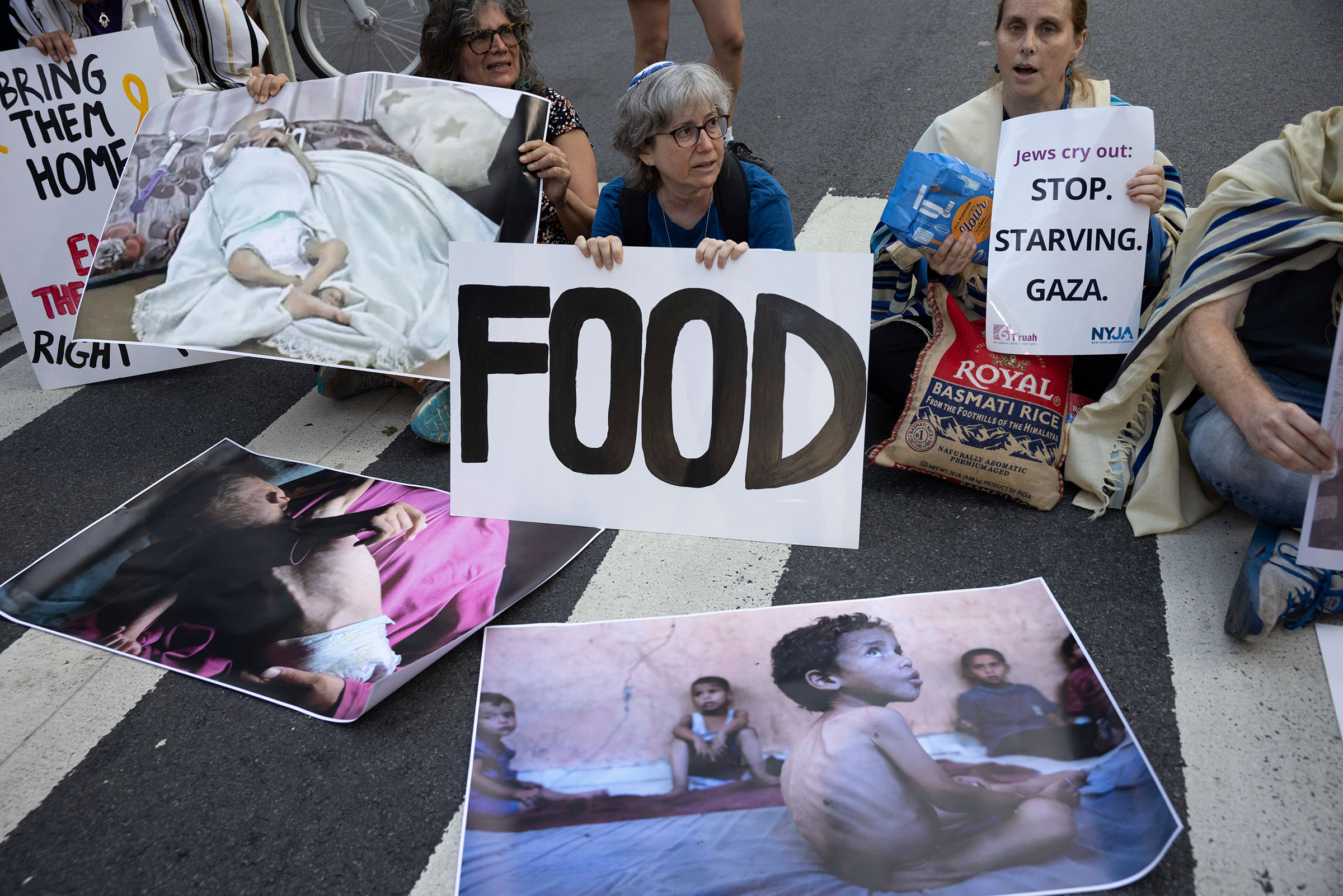
Broadly speaking, the latter has been driven in no small part by horrifying recent images out of Gaza, in particular those showing children who appear to be severely malnourished. “Something’s flipped,” the former CNN correspondent Alex Marquardt observed. “People who never or rarely post about the horrors in Gaza now are. Journalists who might’ve held back are posting more. Clearly the flood of photos of emaciated babies has tipped the balance.” On air last week, his former colleague Abby Phillip similarly described the imagery as an “inflection point.” (Peter Beinart, a CNN panelist who wrote the recent book Being Jewish After the Destruction of Gaza: A Reckoning, responded by asking, “Why did it take this long?”) One image that got a lot of attention—including on the front page of the British tabloid the Daily Express, which is about as far as one can get from being a bastion of bleeding-heart liberalism—was subsequently called into question by critics who pointed to reporting from CNN that the child suffers from a muscle disorder, and suggested that the photo was thus being used to propagate a false narrative to smear Israel. But CNN’s story noted the muscle disorder as a way to stress that the shortage of food is harming the most vulnerable most acutely, and other reports have shared similar stories, with or without photos. Gathering comprehensive statistics is difficult, since Gaza is a war zone and Israel has placed entry restrictions on outside groups, but various UN agencies and aid organizations have painted a dire picture. This morning, the Integrated Food Security Phase Classification, a UN-backed initiative, reported that the “worst-case scenario of famine is currently playing out in the Gaza Strip.”
Israel has, among other targets, blamed Hamas for the disruption of aid supplies, and even of stealing from them. But senior Israeli military officials told the Times recently that they never proved that the latter was happening in any systematic way, at least not when it came to supplies from the UN, the biggest supplier of aid. (Separately, the Times has noted that the malnutrition appears “largely linked to Israel’s decision to block aid between March and May, and to the way it chose to end that blockade.”) And in remarks over the weekend, Netanyahu went further, claiming that “there is no starvation in Gaza,” period. Yesterday, even Trump refuted this. He cited the recent imagery out of Gaza in doing so: asked whether he agreed with Netanyahu’s assessment, he replied that “based on television, I would say not particularly, because those children look very hungry”; he added, “that’s real starvation stuff.… I see it, and you can’t fake that.” Trump is not normally a reliable guide to what’s fake and what isn’t, and the TV can lie. Still, as The Atlantic’s David A. Graham put it last night, Trump appeared to have “arrived at the right conclusion in a terrible way.”
Over the years, as I’ve written before, Netanyahu has been deft at using interviews on US TV to project a certain image—tough, but reasonable, even jovial sometimes; either way, a “big world man,” as one Israeli observer once put it to me—but this time, the power of that medium seems to have worked against him. His recent foray into new media seems to have fallen on deaf ears, too: his interview with the Nelk Boys was widely panned; according to NBC, the YouTube channel on which it appeared lost some ten thousand subscribers in the aftermath. On Monday of last week, the hosts defended the interview: “Someone has to do it,” one of them said. “And if we have to fucking take the fall, and be the ‘bad guys’” (this was accompanied by an aggressive pair of air quotes) “for having the controversial people on, I think we’re willing to do it.” (Besides, they added, the “other side” would be given an opportunity to respond on the following episode.) Nonetheless, the pair did concede that they’re “not the best journalists,” and never claimed to be. As they spoke, actual journalists in Gaza were eating rice, if anything at all. They know what’s going on.
Has America ever needed a media defender more than now? Help us by joining CJR today.