Sign up for the daily CJR newsletter.
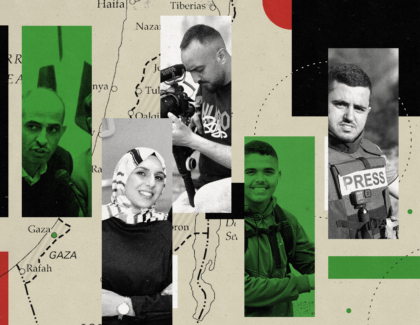
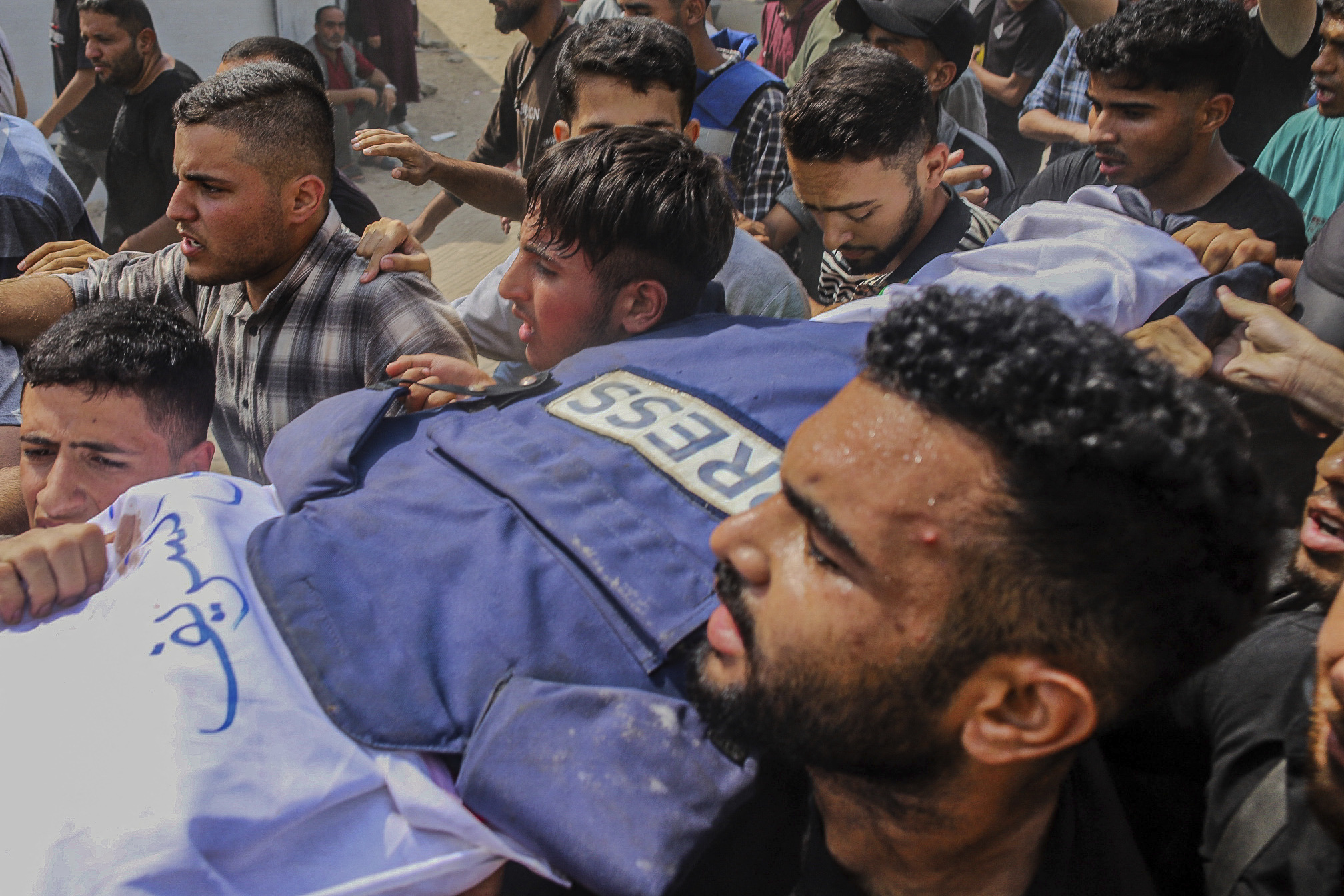
On the night of August 10, Anas al-Sharif, a twenty-eight-year-old correspondent for Al Jazeera and one of the best-known journalists in Gaza, was sleeping in a tent with colleagues outside a hospital in Gaza City when Israeli forces struck. A precision-guided munition fired from a drone scored a direct hit. Smoke and fire billowed from the scene as bystanders screamed. Al-Sharif was killed along with several Al Jazeera staffers—correspondent Mohammed Qreiqeh and camera operators Ibrahim Zaher and Mohammed Noufal—as well as two freelancers, Moamen Aliwa and Mohammad al-Khaldi. Al Jazeera immediately condemned the strike, which it called “a desperate attempt to silence the voices exposing the impending seizure and occupation of Gaza.” The Committee to Protect Journalists labeled it murder, “plain and simple.”
Some two hundred members of the press have been killed in Gaza—including five more who lost their lives in an Israeli strike on Nasser Hospital a week after al-Sharif’s death. Israel quickly acknowledged targeting al-Sharif, alleging on social media that he had been on the Hamas payroll and that he’d participated in rocket attacks. Soon, the Israel Defense Forces (IDF) provided Israeli and international media with undated photographs showing al-Sharif with Hamas leaders; Israel also shared screenshots of documents linking al-Sharif to Hamas, all of which have been impossible to verify. Al Jazeera, CPJ, and others have dismissed these claims as part of a coordinated smear campaign; Lydia Polgreen—a New York Times columnist and CPJ board member—has observed that Israel’s accusations represent “a pretext to eliminate the remaining journalists with the platform to bear witness and terrify anyone brave enough to attempt to take the place of the fallen.” Consistent with that take is the reporting of +972, an Israeli publication, on a “legitimization cell” within the IDF whose aim has been “to identify Gaza-based journalists it could portray as undercover Hamas operatives, in an effort to blunt growing global outrage over Israel’s killing of reporters.”
As a press freedom defender and former executive director of CPJ, I share the growing sense of collective outrage—and a deep skepticism of Israel’s claims. But amid the relentless violence against the press in Gaza, I have wondered if there is any plausible path to justice. After speaking with experts in international humanitarian law, I believe that there is, however tenuous and uncertain. Of central importance is al-Sharif’s status as a civilian. As Jodie Ginsberg, the current CPJ CEO, has relentlessly reminded the world, journalists are civilians—and that means they cannot legally be targeted so long as they “take no action adversely affecting their status as civilians,” according to Article 79 of the Additional Protocols to the Geneva Conventions, which affirms the protections afforded to journalists covering armed conflict. And crucially, what matters in determining if a war crime has been committed in Gaza is not Israel’s public comment, but whether or not the commander or commanders who ordered a strike held a reasonable belief—based on the application of international humanitarian law and grounded in the available information and circumstances—that they were acting lawfully.
Even if we set aside Israel’s flimsy and unsubstantiated attempts to discredit al-Sharif, the single most compelling reason to suspect that Israel targeted him because of his role as a journalist, as opposed to any purported Hamas connection, is the pattern of attacks against reporters covering Israel’s military actions, the civilian death and suffering, the mass destruction, and the hunger and starvation sweeping Gaza. “The doctrinal fight that we have to have is to say that no type of journalism, even one that in principle would be biased, constitutes direct participation in hostilities,” Janina Dill, a professor at Oxford and codirector of the Institute for Ethics, Law, and Armed Conflict, told me. “That’s the kind of line we have to hold legally.”
Among the legal questions at hand in the al-Sharif attack is one of proportionality—specifically, whether the deaths of five other civilians, all of them journalists, were “excessive in relation to the concrete and direct military advantage anticipated.” This is a highly subjective legal standard, experts told me, which can make it difficult to prosecute. But their killing, in a single strike, is shocking precisely because of the role that journalists play in war zones—a status recognized by international humanitarian law. A 2015 United Nations Security Council resolution, for instance, explicitly affirmed that journalists “play an important role in protections of civilians and conflict prevention by acting as an early warning mechanism in identifying and reporting potential situations that could result in genocide, war crimes, ethnic cleansing and crimes against humanity.”
Consider, then, some of the other factors at play in Gaza: Israel has barred international journalists—not something prohibited outright by international humanitarian law, but unusual nonetheless, and which gives credence to the argument that the country’s aim is to hinder journalists’ ability to document the war. Al Jazeera, in particular, has been assailed by Israel—called propaganda, pulled from the airwaves, its equipment raided and seized. Israel is, of course, free to criticize Al Jazeera’s reporting, but international humanitarian law prohibits the targeting of journalists or media facilities based on a determination that they are engaged in propaganda. Al-Sharif is one of ten journalists whom Al Jazeera reports Israel has killed in Gaza—and in at least two of these cases, Israel has acknowledged deliberately targeting Al Jazeera journalists for alleged ties to Hamas. Given the reporting by +972—that the mission of the Israeli military’s legitimization cell has been “not security, but public relations”—this has stark legal implications.
It is important to note that there is no provision in international humanitarian law requiring military forces to publicly explain their targeting decisions. Israel’s choice to do so in the al-Sharif case should be viewed, then, as a clear effort to influence public opinion, not to meet any legal obligation. If Israel discovered “that in fact there was a flawed factual or legal basis for the exercise of a targeting decision,” Fionnuala Ní Aoláin, a professor at the University of Minnesota Law School and a leading expert on international humanitarian law, said, “then they have an obligation to investigate and in fact, arguably, to prosecute.”
Several of the legal experts I spoke with believe there is a basis for opening an investigation into the killing of al-Sharif. The timing of the strike adds to that foundation, since it took place on the eve of a planned military offensive into Gaza City. “Al-Sharif was the most visible recorder of what was a likely imminent attack,” Kenneth Roth, the former director of Human Rights Watch, told me. “The timing is very suggestive that he was killed because of what was about to happen.” To Roth, that indicates Israel’s motivation was to suppress coverage—and he has called for legal prosecution of the killing of journalists in Gaza.
But there are practical challenges. War crimes prosecutions are generally pursued against individuals, who must be identified and indicted. This would be exceedingly difficult to do without access to Gaza or some level of cooperation from Israel, which has shown itself to be contemptuous and disdainful of accountability efforts. The Trump administration has actively sought to undermine the authority of the International Criminal Court—and would almost certainly continue to subvert any investigations along these lines.
Beyond that, the ICC itself is in disarray. In May, Karim Khan, the chief prosecutor, announced that he would temporarily step aside, amid an investigation into allegations that he engaged in sexual misconduct. Khan’s two deputies are in charge for the time being. And then there are the burdens of legal process: Roth, a former prosecutor, told me that “even though Israel has vastly diminished credibility, from a legal perspective its claims must be taken seriously. You’ve got to make sure that you can refute the stated defenses at trial.”
Despite the challenges, Dill argues that pursuing justice for journalists killed in Gaza is “meta important” at a time when the international legal system is fighting for survival—because the presence of journalists is essential for accountability. That need has become all the more acute in the aftermath of Monday’s strike on Nasser Hospital. The Associated Press and Reuters, both of which lost reporters in the attack, wrote to Benjamin Netanyahu, Israel’s prime minister, demanding an investigation. “The IDF has a duty under international law to protect journalists and civilians and to take all feasible precautions to prevent harm,” the letter noted. “Striking a hospital, followed by a second strike while journalists and rescuers were responding, raises urgent questions about whether these obligations were upheld.” (Netanyahu has since said that it was a “tragic mishap.”)
As more members of the press are killed, more of their colleagues and advocates are speaking publicly about why their deaths may represent a war crime. Ultimately, this is not about any single reporter. It’s about the rights of all journalists working in Gaza and the need for new strategies and approaches that move beyond outrage, into the messy and uncertain realm of justice.
Has America ever needed a media defender more than now? Help us by joining CJR today.