Sign up for the daily CJR newsletter.
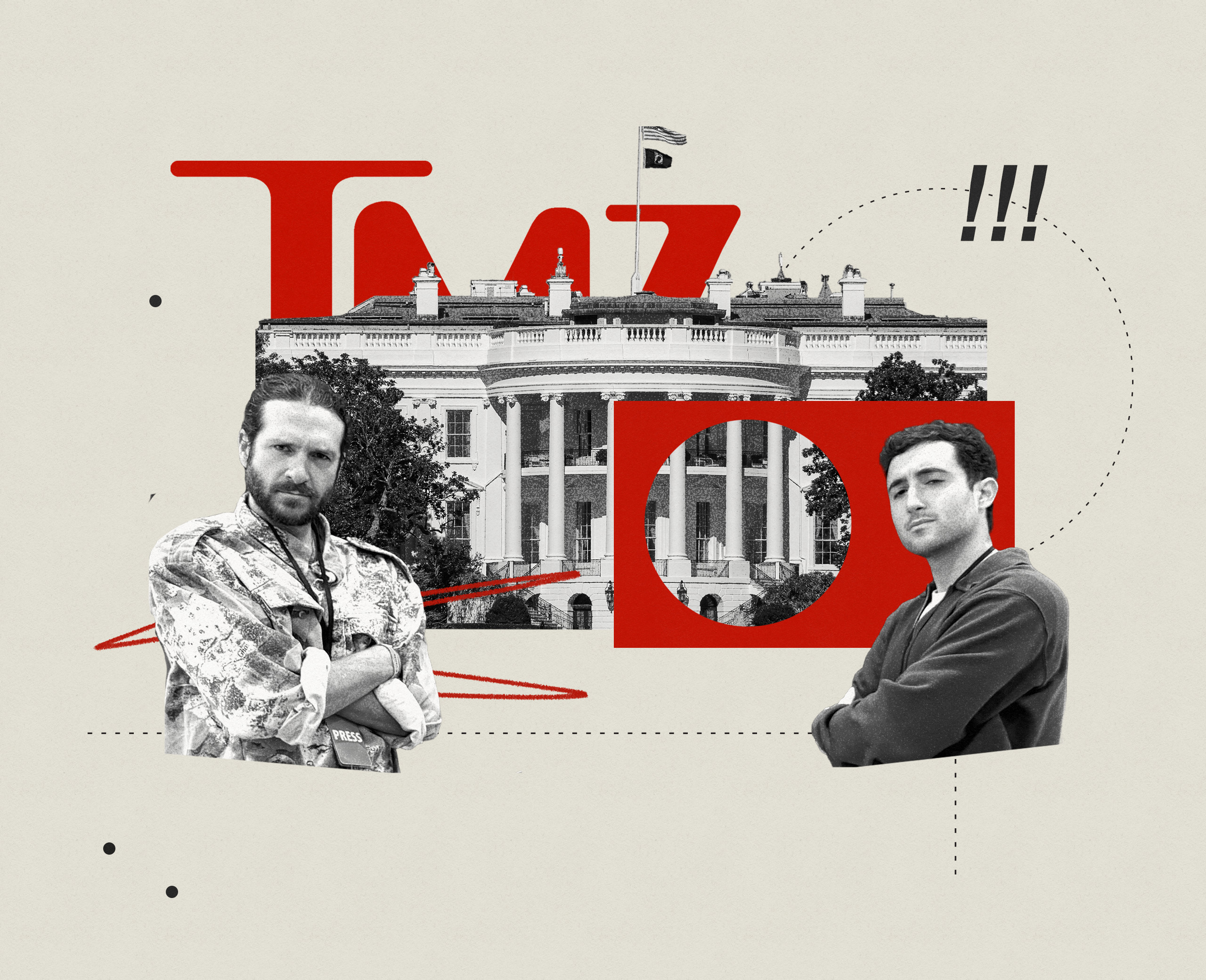
In April, frustrated by the Washington, DC, press corps’s myopia, Harvey Levin, the founder and executive producer of TMZ, sent in a team of his own: Charlie Cotton, a guy from Australia who was previously stationed at LAX to interview celebrities, and Jacob Wasserman, who most recently covered the Diddy trial in New York, were dispatched as co–managing editors. “There are real reasons why we picked Charlie and Jacob, and it’s not just we needed two bodies there. Casting is 90 percent of it. And they’re perfect,” Levin told me. “They stand out because they’re really authentic. And they’re not in that mold of people covering Washington.”
I spoke with them on the Monday morning after the White House Correspondents’ Association dinner. The pair had just survived a rite of passage for anyone new to the DC social circuit and, with the sudden intrusion of a gunman at the Washington Hilton, the weekend had turned out to be more eventful than they could have anticipated. I was expecting them to be subdued, possibly exhausted by the festivities—though the main event was cut short, the constellation of other Washington parties had carried on. Along with Jakson Buhaj, the third member of the TMZ DC team, the guys had covered the Grindr party, where they chatted with Don Lemon and sampled a caviar-and-gummy-bear sundae; then they went to the Time magazine party at the Swiss embassy and hit up Substack’s “New Media” event. But they were upbeat, eager to start the third week of their adventure, and pleased by the warm reception they received. “People are coming up to us in droves and are introducing themselves,” Wasserman recalled. Cotton added: “I think what people are enjoying about us is that we’re new to DC—we’re starry-eyed about everything and everyone.”
The general reaction to TMZ’s arrival has been more mixed, however, marked by as much skepticism and anxiety as anticipation. In Hollywood, Levin had helped dismantle the set of unspoken rules that govern access journalism and determine which stories get chased, or what gets left alone. DC has suddenly found itself also forced to adjust. In late April, Wasserman asked Pete Hegseth at a Pentagon briefing: “When you give these orders to carry out this extreme level of violence, what’s going through your mind and your body?” In May, he asked Trump about people serving in the military who oppose the Iran war, or him; Trump replied, “It doesn’t mean I’m happy about it.” According to an aide who spoke to Courthouse News, Congressional staffers are preparing their bosses for potential TMZ run-ins and studying the faces of producers. “You all are the ones that are really pushing the needle on everything,” Tim Burchett, a congressman from Tennessee, told Wasserman. “I get up at 4:30 every dadgum morning and catch the van with all the other guys from Congress. What has been the number one subject people are talking about? TMZ. And these guys are warning each other: ‘Be careful what you say, man, TMZ’s here.’”
Journalists are taking note, too. “I think a lot of political reporters are used to just the way things work. It’s like the water they swim in, so they don’t write about it,” Tim Miller, the host of The Bulwark Podcast, told me. “Regular people who don’t live in DC are interested in seeing more of the behind-the-scenes stuff and don’t care about this kind of silly reverence about the way things are supposed to be done in the Capitol.”
Since its debut, in 2005, TMZ has grown from a startup celebrity gossip site to a tabloid institution known for its aggressive, often sensational reporting and impressive sourcing. It is owned by Fox Entertainment, which acquired it in 2021. It has enormous reach: according to a spokesperson, between its website and two nationally syndicated television shows, the audience totals ninety-three million people. Data from Similarweb shows that TMZ drew roughly forty-two million website visits in April alone.
A string of high-profile scoops has cemented its place in the cultural zeitgeist. In 2009, TMZ was the first outlet to break the news of Michael Jackson’s death. Five years later, it published a video of Ray Rice, the football player, knocking out his fiancée in an elevator. Most recently, it became part of the investigation into Nancy Guthrie’s disappearance. But its approach has sparked controversy. In 2009, after Rihanna was assaulted by Chris Brown, who was then her boyfriend, TMZ published a picture of her bruised and beaten face. “It was humiliating; that is not a photo you would show to anybody,” Rihanna said about the release of the image. In 2020, TMZ was widely criticized for reporting that Kobe Bryant had died less than two hours after a helicopter crash, before the families of the victims were notified. In 2024, TMZ again drew fierce backlash for posting a photo of the dead body of Liam Payne, who had been a singer for One Direction. (TMZ later pulled the image.)
TMZ has also long been accused of checkbook journalism. In a 2016 profile, The New Yorker reported that a former production assistant said he gave an envelope of money to a contact at a limousine service and that a former cameraman’s expense reports showed small payments to various sources. Levin denied paying for tips or interviews when we spoke, though as he pointed out, “Everybody pays for videos and photos, everybody. And if they say they’re not, they’re lying, because they license photos, they buy photos, and it’s been done for decades.”
Political scandals have always been part of TMZ’s coverage, but the decision to start a Washington bureau, Levin told me, stems from the fact that he was “outraged” when members of Congress left town for their scheduled spring recess during the latest government shutdown, which drove the department of homeland security to a halt. In late March, he interviewed Rebecca Wolf, a TSA worker who had been struggling. “She was telling us that she couldn’t pay rent, that she was worried about paying her car insurance,” he said. “Her mental health was deteriorating. And meanwhile, members of Congress were going on vacation for two weeks.” At the end of the conversation, an obviously appalled Levin made a spontaneous plea to the audience: “You see one of the five hundred and thirty-five members of Congress, take a picture and send it to us at TMZ.” He added, “We want to show what they are doing at your expense.”
Within days, pictures arrived showing Lindsey Graham, the senator from South Carolina, clutching a child’s pink-and-blue bubble wand at Walt Disney World. TMZ published one under the headline “Lindsey Graham Living in Fantasyland as Government Shutdown Drags On.” It immediately went viral. Other shots of Republicans and Democrats soon followed: Ted Cruz, the senator from Texas, at the Fort Lauderdale airport (“Cruzin’ in Ft. Lauderdale!”); Robert Garcia, a California congressman, in Vegas (“It’s a Good Bet I’m in Vegas”); and Rep. Seth Magaziner at a watch party for the premiere of The Real Housewives of Rhode Island (“Shutdown Ain’t Killin’ My ‘Real Housewives’ Party Vibe!”).
A couple of weeks later, Wasserman, Cotton, and Buhaj arrived in DC. A post on TMZ declared: “Our TMZ DC staff is now ensconced in Washington, D.C. and open for business!” In a video announcing their arrival, the trio shared their initial impressions with Levin. Cotton gave a basic civics lesson, letting viewers know that “there’s buildings where the senators all hang out in, and there’s buildings where all the House of Representatives hang out in.” Wasserman quipped, “I actually realized I want to be a senator because it’s the cushiest job ever—it’s like no one goes to work.”
The TMZ DC team frame their effort, in part, as a form of political education. They see themselves as asking the questions any average citizen might have if suddenly face-to-face with their representatives. “I think that one of our responsibilities out here is to almost introduce a lot of these people to America, because it blows my mind that there’s, what, five hundred or five hundred and fifty of these congresspeople. And if you ask the average American to name two, I don’t think they could. And that’s totally understandable,” Cotton told me. “If we can cover this place like we cover celebrities and celebrity culture, then a lot more Americans will know a lot more about the congresspeople that control all of our lives.”
It helps that both Wasserman and Cotton are affable and approach their new gig with a sense of guilelessness that most reporters do not possess. A lot of Washington journalists are “not necessarily accessible to people who are watching them,” Levin said. Molly Jong-Fast, the political commentator and author, told me she’s “a little obsessed” with TMZ’s arrival in Washington. “The people who watch TMZ are not the people who are reading the New York Times op-ed section. These Venn diagrams could not be further apart,” she said. “These are people who will not otherwise follow politics.” As Jack Shafer, the media critic, told me, “It’s not that the established journalists are corrupt. It’s just that they’re in the groove. Sometimes it requires somebody young to come in and say that doesn’t make any sense.”
TMZ’s impact has been acknowledged by elected officials, too. After Congress finally voted to fund most of the Department of Homeland Security and end the shutdown, Cotton caught up with Suhas Subramanyam, a congressman from Virginia. “I think the work at TMZ had a big reason why people wanted to get this done before they went home,” Subramanyam told Cotton.
“Do you mean that?” Cotton asked, shocked.
“I think so, absolutely,” Subramanyam said. “TMZ is changing the way we do things in Washington.”
“I was stunned that he said that,” Levin said when I asked him about it. But he knew not to take full credit. “I have no idea. I think people probably did it for various reasons, and I think a lot of people did it, I hope, because it needed to get funded, and people needed to get paid.” Looking ahead, Levin said he has more plans in the works. “We have other ideas, but we want to kind of roll things out so that we’re not doing so much that it all just becomes white noise. But if I told you, you’d love it,” he said. In the meantime, the response to TMZ DC has exceeded his expectations. “It’s crazy,” he told me. “I haven’t seen anything hit this quickly in my twenty years of doing this—anything.”
Has America ever needed a media defender more than now? Help us by joining CJR today.