Sign up for the daily CJR newsletter.
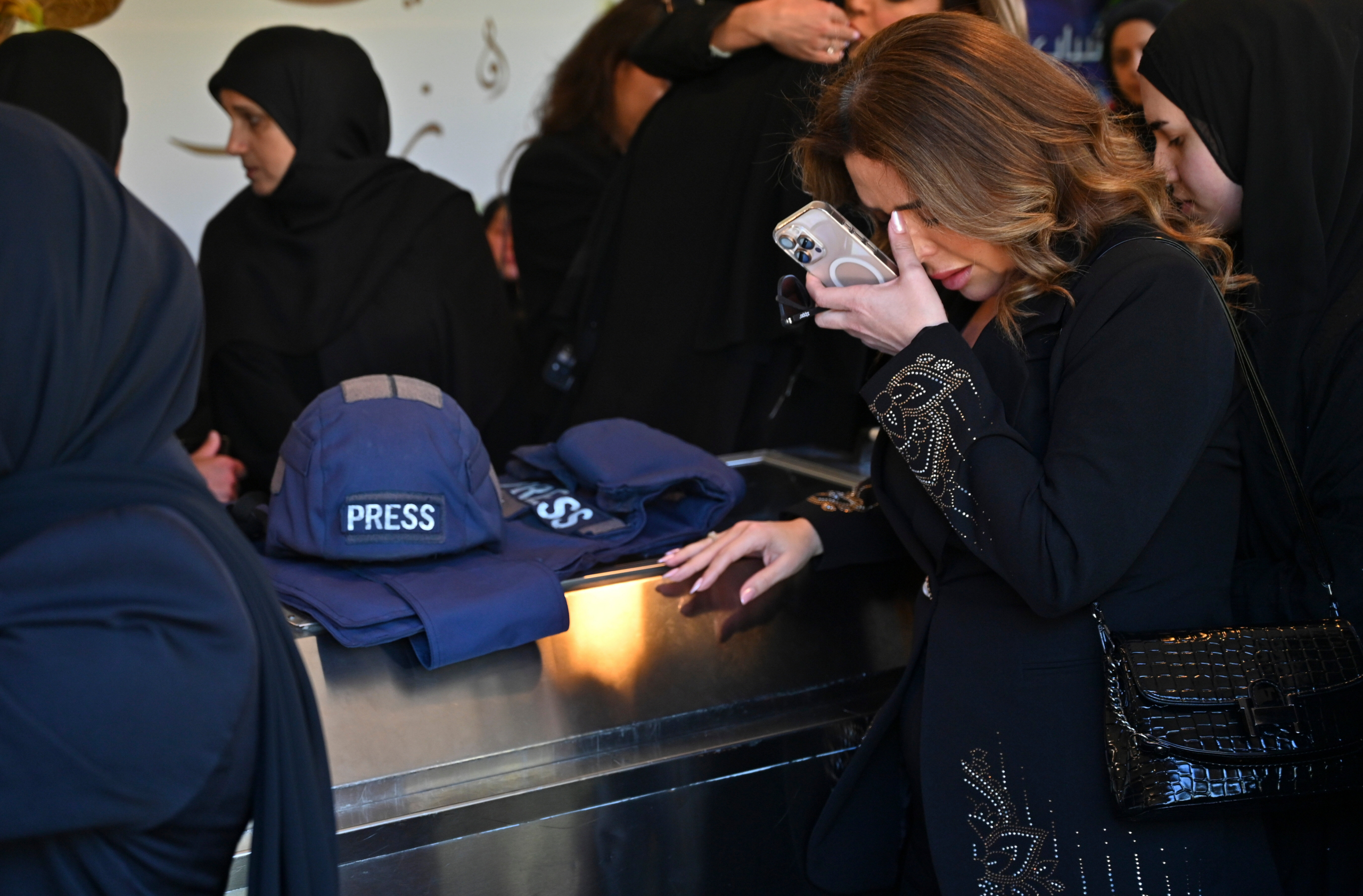
On Thursday, Human Rights Watch (HRW) and Amnesty International released separate reports about the killing of Amal Khalil by the Israeli military on April 22. Khalil was forty-two and a correspondent for Al-Akhbar, a Lebanese newspaper. The two investigations into her death—the groups coordinated their release for impact, alongside a third report, in Arabic, from Legal Agenda, a Lebanese watchdog group—came to essentially the same conclusion: that Israel appears to have committed war crimes when it bombed the vehicle in which Khalil and another journalist, Zainab Faraj, age twenty-one, were traveling, and then destroyed the building where they sought refuge, in the village of al-Tiri, in southern Lebanon. “The Israeli military says it does not target journalists, but the facts and evidence show that it has repeatedly done so. Amal Khalil and Zainab Faraj are the latest victims in a long series of such attacks,” Ramzi Kaiss, a Lebanon researcher at HRW, said in a statement. “Israeli forces’ continued killing of journalists shows a brazen willingness to commit atrocities without any fear of consequences.”
Here’s what we know about the chain of events that led to Khalil’s death. Khalil and Faraj, a freelance journalist, were trying to verify reports that the Israeli army had withdrawn from al-Tiri, in what would have represented a surprising gain for the Lebanese army. The journalists were following a vehicle that was carrying Ali Nabil Bazzi, a local official, and Mohammed Hourani, Bazzi’s friend and a displaced resident of al-Tiri. At around 2:30pm, an Israeli air strike hit Bazzi and Hourani’s car, killing both men instantly. The Israel Defense Forces (IDF) said the two had been targeted because they were “Hezbollah military operatives,” though HRW found no evidence of martyrdom celebrations typical for fighters after their deaths.
Khalil and Faraj left their vehicle and sought refuge below a nearby structure. Khalil called Moussa Chaalan, a rescuer with the Lebanese Civil Defense, as two Israeli surveillance drones circled overhead. Faraj later recalled that “the drones came extremely close through the roof, less than a meter from my face and Amal’s.” Around an hour later, a second strike hit the journalists’ parked vehicle near where they were sheltering, injuring Khalil. “Glass and debris flew toward us. My ear felt like it burst,” Faraj told Amnesty, adding that Khalil “was bleeding heavily from the nose and head and had shrapnel wounds in her arm and thigh.” The journalists next sought shelter in a three-story building to avoid the heat from their flaming vehicle. At about 4:25pm, a third Israeli air strike hit the building. Chaalan told Amnesty he watched it from his location, two kilometers away. “I saw the air force plane rise and fire. I realized they were the target,” he said. The building collapsed, burying both women under rubble. Chaalan tried to call Khalil again. “No answer,” he said.
While all of this was going on, rescuers were trying to get to Khalil and Faraj. But the Israeli military had recently designated al-Tiri a “forward defense” zone, off limits to civilians, and medics and Civil Defense personnel needed the IDF’s permission to enter. Eventually, shortly after 5pm, the Lebanese Red Cross were authorized to go into the area and extracted Faraj. She was alive but had “a fractured skull, severe injuries to her right leg and eye, and a crushed hand,” Amnesty said. The rescuers then came under attack, as an Israeli quadcopter drone dropped a stun grenade—according to HRW, citing “Lebanon’s Health Ministry, Faraj, and two informed sources”—and, according to witness statements and images of the damage reviewed by HRW, the ambulance was apparently struck with small-arms fire. Shortly before 6pm, the Red Cross was forced to retreat. The Israeli military finally granted the rescuers permission to return at 8:15pm, two sources told HRW, and the Red Cross recovered Khalil’s body around 11pm; an autopsy concluded that she died around 7pm. “Khalil was likely alive when paramedics were forced away,” Kaiss told the Associated Press.
The HRW and Amnesty reports are not the first time Khalil’s killing has been labeled a war crime. Nawaf Salam, Lebanon’s prime minister, described it that way at the time. The Committee to Protect Journalists (CPJ) has also designated Khalil’s death a murder—defined as a targeted killing “in direct reprisal for the journalist’s work”—and recorded a total of sixteen journalists killed by Israeli forces in Lebanon since October of 2023. In June, the Washington Post published a detailed reconstruction that laid out how Khalil likely died as Israel prevented rescuers from reaching her. And yet, nearly four months after Lebanese journalists staged a protest and hundreds of mourners expressed sorrow and outrage at Khalil’s funeral, the Israeli military has faced no consequences. The Amnesty and HRW reports are significant, both because they are the most comprehensive accounts of her killing so far and because they urge an independent investigation and for Lebanon to accept the jurisdiction of the International Criminal Court (ICC), which prosecutes war crimes.
At the time of Khalil’s killing, the Israeli military denied that it targets journalists and said the IDF “works as much as possible to minimize harm that may befall them while maintaining the security of our forces.” On June 12, the Israeli military told Amnesty that it “regrets any harm caused to journalists,” that it “respects freedom of press,” and that it “does not intentionally target them as such.” It added that “the incident underwent a preliminary review, and relevant lessons were implemented accordingly.” It’s unclear what exactly the “lessons” were (and the Israeli military’s use of the phrase “as such” is common, as Jon Allsop wrote in this newsletter last year). But even if we were to take at face value the Israeli military’s claim that Khalil and Faraj were simply in the wrong place at the wrong time, Israel would still have violated international law. “The fact that the two journalists were in what Israel has designated a no-return zone does not make them lawful targets. All parties to a conflict have a clear obligation to distinguish between civilians and military targets at all times and to direct their attacks only at military objectives,” Heba Morayef, Amnesty International’s regional director for the Middle East and North Africa, wrote in its report. At the very least, the reports concluded, the Israeli military knew—or should have known—from its surveillance drones that the two sheltering journalists were civilians.
Regrets. Denials. Lessons learned. But no accountability. If it feels as if we’ve been here before, it’s because we have. According to CPJ, Israel was responsible “for two-thirds of all press killings in both 2025 and 2024.” Amnesty warned that “persistent impunity for such violations emboldens Israeli forces to continue carrying out unlawful attacks without fear of accountability.” There are, of course, complicating factors. The Lebanese government has not granted the ICC jurisdiction to investigate and prosecute potential war crimes committed in its territory. The Trump administration has, for its part, actively sought to undermine and delegitimize the ICC, which has issued arrest warrants for Benjamin Netanyahu, the Israeli prime minister, and others for alleged war crimes and crimes against humanity in Gaza. (Marco Rubio, the US secretary of state, said last month that the ICC “threatens every aspect of our political and legal system.”) The US stance has no doubt further emboldened Israel. Moreover, the fourteen-point agreement signed between Lebanon and Israel in late June in an effort to end the fighting states that the countries will “cease all hostile or negative actions in international political or legal forums.” Granting the ICC jurisdiction to investigate Khalil’s death would put Lebanon in violation of the agreement. Plus, there’s the disarray at the ICC, as Joel Simon has written for CJR, which poses practical challenges for prosecution—in spite of the fact that the important role journalists play in war zones has been recognized by international law.
Kaiss, of HRW, told me that Israel’s ability to act with impunity will end only “when there are consequences for these unlawful attacks. When states say, ‘This is not acceptable, we’re suspending arms sales, there’s an arms embargo, no military assistance.’ When an unlawful attack happens and prosecutorial authorities are looking into it, putting military leaders on alert that they’re investigating it as a war crime,” he said. “None of that has happened. And that needs to happen for things to change.” Over the weekend, I also spoke to Alaa Serhal, a freelance journalist in Lebanon, who said he had talked to Khalil the morning she was killed. Her death, he said, has been keenly felt by other members of the press there. Despite journalists’ sticking to strict protocols and safety precautions, they feel targeted, because Israel doesn’t want “the world to see what’s happening,” he told me. The reports classifying Khalil’s killing as an apparent war crime, though, “certainly bring a sense of relief,” Serhal added. “While the path to justice remains long, such classifications offer a glimmer of hope for accountability—especially after previous instances where facts were buried and the perpetrating party was never explicitly named.”
Other Notable Stories …
By Jem Bartholomew
- Sharyn Alfonsi and Scott Pelley, who were ousted from 60 Minutes after clashing with the new leadership of CBS News and its editor in chief, Bari Weiss, will teach and advise students at Columbia Journalism School as journalists in residence for the coming academic year. “Sharyn and Scott bring decades of experience covering some of the defining stories of our time—from war and politics to public health, criminal justice, and international affairs,” Jelani Cobb, the dean of Columbia Journalism School, told staff. Alfonsi and Pelley will also each write a piece for CJR. (For more on what they left behind, read Adam Piore’s profile of Tom Cibrowski, the president and executive editor of CBS News, for CJR.)
- On Tuesday, Judge Araceli Martínez-Olguín, of the US District Court for the Northern District of California, set a date for the antitrust trial that will decide the fate of Paramount Skydance’s 111-billion-dollar purchase of Warner Bros. Discovery. The trial will begin on March 2, 2027, and run for twelve days with two breaks. For more on the efforts by state attorneys general to stop the merger, which would significantly grow the Ellison family’s media empire, check out Amos Barshad’s recent piece for CJR.
- On Thursday, Judge Roy Altman, of the US District Court for the Southern District of Florida, temporarily halted an order requiring Donald Trump to turn over detailed financial information as part of his ongoing defamation lawsuit against the BBC. The broadcaster, which is being sued over its edit of a speech by Trump on January 6, 2021, has sought access to the president’s financial records as part of the case. Joel Simon wrote for CJR last year about how Trump’s lawsuit is part of a long-term strategy “to undermine the very concept of public media.”
- In India, a court sentenced Tarun Tejpal, the founder and former editor of Tehelka magazine, once one of India’s most prominent and respected investigative journalism outlets, to ten years in prison, after convicting him of raping a junior colleague. The ruling overturns that of another court, in 2021, that acquitted Tejpal of charges including rape, sexual harassment, and wrongful restraint. “This is a sentence where a girl has stood up for her rights,” Sunita Sawant, the police investigator who led the case against Tejpal, told reporters, “so this judgment is very important for women who are working in any sector.”
- And the Committee to Protect Journalists on Wednesday announced the journalists it will honor with its 2026 International Press Freedom Awards, which will be presented at a gala in New York on November 19. Honorees include Szabolcs Panyi—whom CJR’s Ivan L. Nagy interviewed earlier this year—and Estefany Rodríguez, whom CJR’s Carolina Abbott Galvão profiled in April, after she was detained by Immigration and Customs Enforcement while covering immigration raids for Nashville Noticias. “This year’s awardees exemplify the determination and courage of journalists worldwide,” Jodie Ginsberg, CPJ’s chief executive, said in a statement.
Has America ever needed a media defender more than now? Help us by joining CJR today.