Sign up for the daily CJR newsletter.

Qassem Aboud spent weeks scouring the hospitals in Beirut, looking for his daughter Zahraa. After air strikes relentlessly pummeled their hometown, in Southern Lebanon, she and her sister fled to the city to live with their aunts. They thought Beirut would be safer.
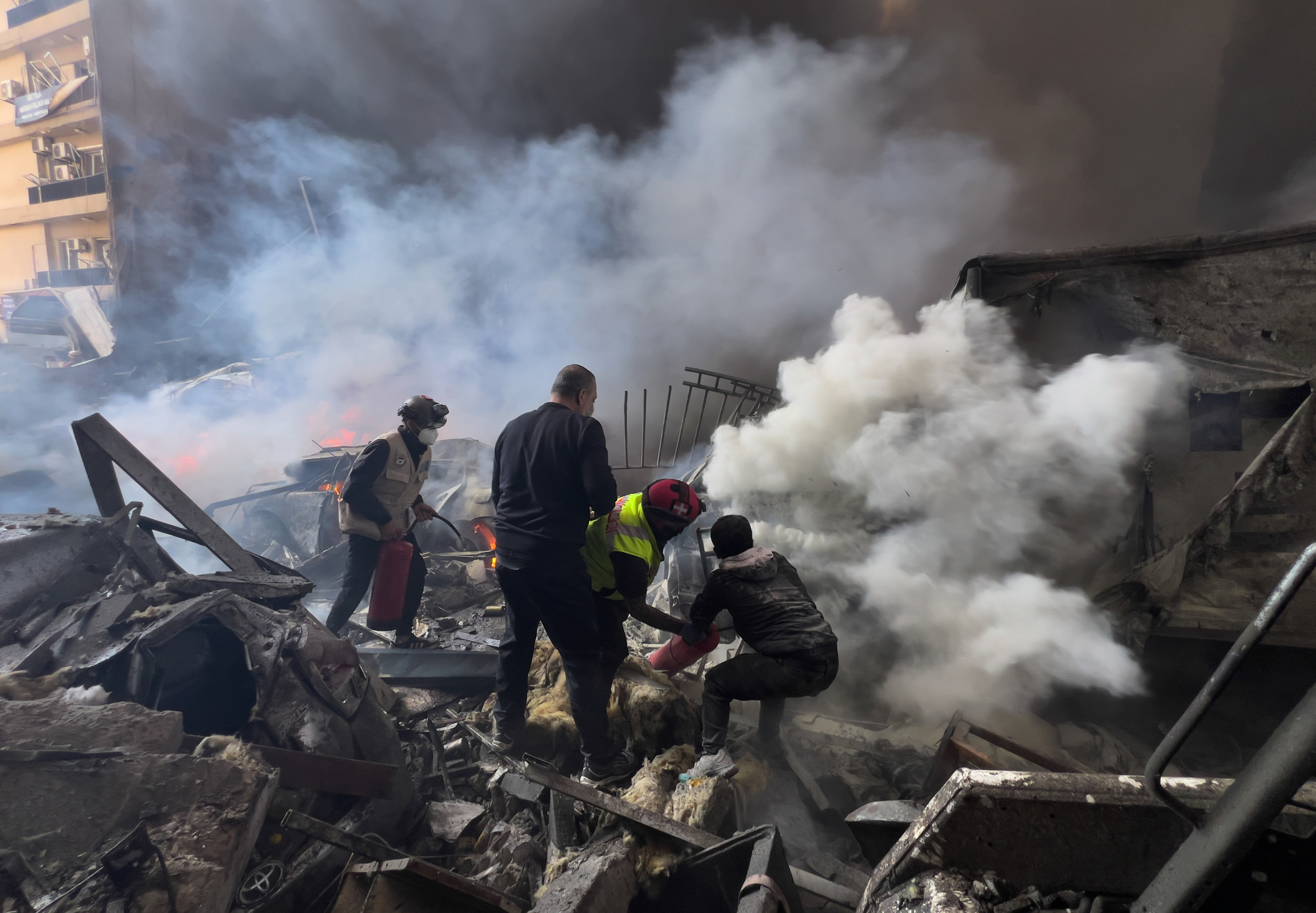
It was not. On April 8, just hours after Donald Trump announced a two-week ceasefire in the war with Iran, Israel launched a massive aerial assault on Lebanon without warning. Israeli jets conducted more than a hundred strikes in just ten minutes, killing more than three hundred and fifty people and wounding more than a thousand others, according to the Lebanese Ministry of Health. It is now known in Lebanon as “Black Wednesday.”
Zahraa’s aunts were killed during the attack. Her sister was injured and taken to a nearby hospital. Zahraa went missing.
In a devastating piece for The Intercept, Alaa Serhal explores the aftermath of Black Wednesday. The strikes hit densely populated civilian areas in Beirut, demolishing residential buildings and leaving damage so severe that many of the dead are unrecognizable. In the ensuing chaos, families have been forced to submit DNA samples to identify loved ones, underscoring both the scale of the destruction and the difficulty of recovery efforts. “The remains are scattered and the features obliterated. We are often not dealing with whole bodies. We are dealing with human fragments that the force of the explosions has turned into medical puzzles,” Hisham Fawwaz, a hospital director at the health ministry, told Serhal.
Weeks later, many remain missing. But when I reached Serhal this week, he had just heard that Aboud’s agonizing search for his daughter was finally over. “She was officially declared a martyr yesterday after her DNA was matched with her father’s. He had been at the site every day under the rubble of the building,” he said. “This story—the story of Zahraa and her sister—was particularly tragic.”
Despite Trump’s announcement last week of a ten-day ceasefire between Israel and Lebanon, Serhal told me that the attacks continue. “As I am speaking to you now, two journalists were targeted by an Israeli strike in Southern Lebanon,” he said. “One female journalist has been injured, and unfortunately, the army and the Red Cross haven’t been able to reach the second female journalist yet.” The second journalist, Amal Khalil, who worked for a local media outlet, Al Akhbar, was later reported killed in the strike.
Since the beginning of March, more than two thousand people have been killed in Lebanon, roughly a third of them women and children. Another sixty-five hundred have been injured, according to local authorities. More than a million people have been displaced. Yet, as Zahra Hankir recently wrote for CJR, “Western newsrooms have, thus far, largely framed the story of Lebanon as a sideshow to the war in Iran.” Serhal’s story is a reminder that the families caught in the devastation in Lebanon, people who are navigating unimaginable grief and uncertainty, are equally deserving of our attention.

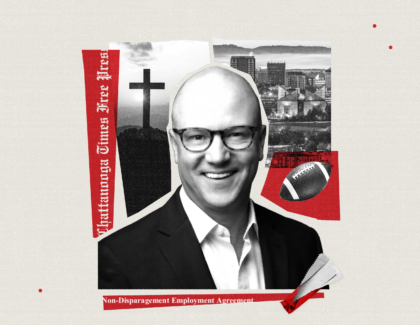
Early Sunday morning, a man killed eight children, including seven of his own, in a horrifying attack in Shreveport, Louisiana. It was the deadliest mass shooting in the United States in more than two years. On Monday, Forbes published a story about it. The piece was standard aggregation, drawing primarily from the Associated Press and the New York Times to detail the tragedy.
Less standard was a widget embedded in the story from ForbesPredict, a prediction market feature, that encouraged readers to place bets on whether Congress would pass gun control legislation this year:
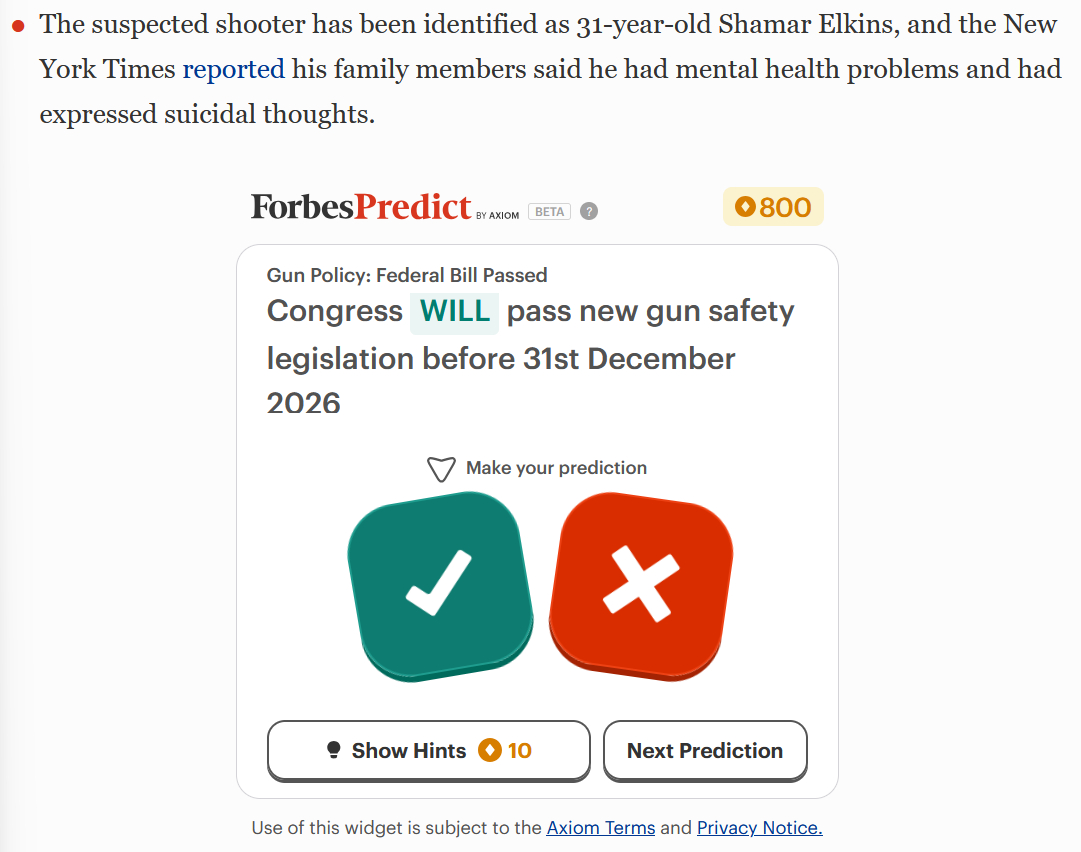
Molly White, who writes a newsletter called Citation Needed, flagged it first, posting a screenshot on Bluesky with a one-word verdict: “Ghoulish.” (Last year, White appeared on The Kicker, which is worth a listen.) 404 Media and Futurism picked the story up. Forbes has since removed the box from the article. “ForbesPredict is in beta,” a Forbes spokesperson told me in a statement. “This article was viewed by 3 percent of our audience. We have established guidelines to prevent markets from appearing on certain topics, and this market was removed for not meeting those standards. As we continue to refine and learn on ForbesPredict, we will adapt our controls with stricter checks and safeguards.”
When Forbes launched ForbesPredict, in January, it was pitched as “a first-of-its-kind prediction platform.” While other news organizations have partnered with outside prediction markets such as Polymarket and Kalshi, Forbes worked with Axiom, a tech startup, to build its own tool. The purpose is to increase “audience engagement and loyalty,” according to a company press release. Unlike other prediction products, ForbesPredict uses fake coins instead of real money to “enable audiences to predict outcomes, follow a news story as it evolves in real-time and see how their expectations compete with others’ predictive powers.” Forbes is hoping to make money from the experiment through brand sponsorships, according to Digiday.
Let’s put aside, for a moment, the broader concerns about so many media companies embracing prediction markets. (Klaudia Jaźwińska outlines the potential pitfalls in this excellent piece for CJR.) The Forbes incident raises what are becoming perennial questions here at Laurels and Darts: Who is this for? And why would they want it? Who is the imagined person so eager to gamify their news-reading experience that they are excited to gamble fake tokens on hot topics after reading aggregated wire copy on Forbes.com?
The threats to journalism’s business model are real. In principle, all newsrooms should be making an effort to deepen audiences’ connection to their work. Innovation is necessary and often requires experimentation. But this doesn’t feel like the right bet.
Jason is a recovering heroin addict. After he got clean, in 2019, he found a job at a rehab facility, working with others in recovery and surrounding himself with sober colleagues. But he is fighting a new addiction, one he is not confident he can beat: online sports betting. Just three years ago, Jason had a hundred thousand dollars in savings. Now he is down to about five thousand bucks.
In a revealing piece for the Miami Herald, Max Klaver takes a hard look at the impact of legalized online gambling in Florida, particularly on young men. Klaver became interested in the topic when he saw how ubiquitous sports betting had become. “As soon as I noticed it, I couldn’t stop seeing it. Driving on the highway, you would see ads for Hard Rock Bet all over the place. If you watched the Super Bowl, it was just flooded with ads for crypto and betting,” he said. “I was really taken aback by the extent to which this was normalized and what that really could mean for the next generation.”
What’s happening in Florida is a growing crisis. Since the state opened the door to legal online sports betting three years ago, it’s become one of the most permissive markets in the country, with limited regulations and few protections. The result: a sharp rise in addiction. Calls to the state’s gambling helpline have increased by 138 percent since 2023, and eighteen- to twenty-five-year-olds now account for 41 percent of them.
The pull, especially for young men, as Klaver writes, is the illusion of a shortcut to financial stability. And yet the state has little incentive to intervene or increase regulations. Florida takes in a sizable cut of the profits, projected to reach 359 million dollars this year.
Klaver outlines some common-sense solutions that could help people like Jason, who might recognize they have a problem but lack the ability to stop themselves: state-mandated bet and loss limits, and banning in-game micro-bets. But Klaver is not optimistic that those measures will be adopted anytime soon. “From where I sit right now, I don’t see that there’s much appetite for change,” he told me. “There are some states that are taking action, and it’s not necessarily just falling along left-right lines. Florida I don’t see being interested in taking meaningful action.”
A bonus laurel this week for this moving story from Kent Babb I still think about whenever sports betting comes up, which follows patients at one of the first sober houses for gambling addicts.
Hat tip to the Sunday Long Read newsletter for the Miami Herald story. If you have a suggestion for this column, please send it to laurelsanddarts@cjr.org. We can’t acknowledge all submissions, but we will mention you if we use your idea. For more on Laurels and Darts, please click here. To receive this and other CJR newsletters in your inbox, please click here.
Has America ever needed a media defender more than now? Help us by joining CJR today.