Sign up for the daily CJR newsletter.
Noémi Martini and I used to sit across from each other at HVG, one of the few independent newspapers left in Hungary under Prime Minister Viktor Orbán’s autocratic reign. In the few years since, she has become one of the most recognizable young journalists in the country, covering protests and chasing down politicians with a microphone.
Now that I live in New York, I’ve been watching her videos to keep a finger on Hungary’s pulse. In the run-up to the general election, this Sunday, it is racing. Orbán, who has run the country for the past sixteen years, trails his opponent, a political newcomer named Péter Magyar, by twenty points. The vote could change the country’s trajectory.
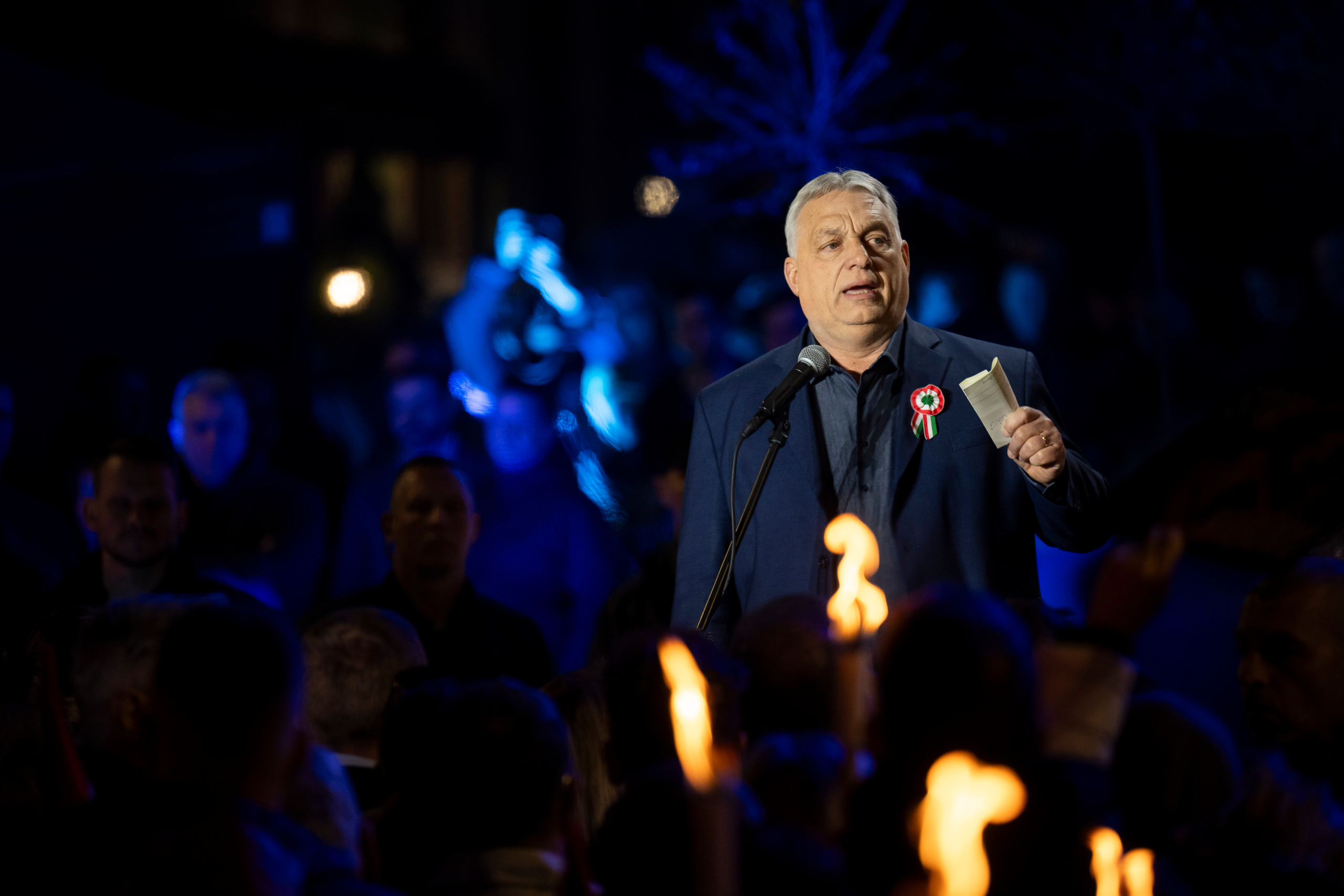
A couple of weeks ago, when Orbán’s camp held a march in Budapest, Martini cut in front of the crowd to record a stand-up and talk to demonstrators. Almost immediately, organizers, security guards, and protesters surrounded her and her cameraman. “Let’s clean them out of here,” a man said, steering the journalists toward the sidewalk. “Are you retarded?” said another man, his face inches from hers. People in the crowd tried to snatch her microphone. “It’s for the security of the event,” a guard told her, defending the partisans.
Independent reporters in Hungary have gotten used to verbal abuse, but physical intimidation is a product of recent political tensions. “It was an out-of-body experience,” Martini told me. “At the time, I didn’t really process it. Only once I rewatched the footage did I get angry. I felt cheated: Why can’t I just do my job?” A week earlier, the mayor of a rural village forcibly removed a crew of female reporters from a public campaign event.
“It’s like we count as political opponents. When you approach people, it’s not that they don’t answer—they straight-up tell you that they despise you,” Martini said, of covering campaign events. “If someone lit up a match, the place would explode.” (It’s no better for pro-government journalists at opposition rallies, she added, although those reporters haven’t been physically intimidated.)
Under Orbán, Hungary, a country of fewer than ten million people, has consistently punched above its weight in international politics, albeit usually for the wrong reasons. His regime has become known for its staunch anti-West agenda (while being an EU and NATO member state), as well as for corruption, xenophobia, homophobia, undermining the rule of law, cozying up to the Kremlin, and violating press freedom. For CJR, Jon Allsop wrote about its use of spyware against journalists and Orbán’s labeling of reporters as “foreign agents.” On The Kicker last year, András Pethő, a Hungarian investigative journalist, spoke to Josh Hersh about Orbán’s role as a grotesque inspiration for Donald Trump’s second term. More recently, Orbán’s business cronies bought a top independent tabloid and ousted its chief editor (who happens to be my father). The election has generated outsize interest in the US; John Oliver dedicated a segment to the vote, and Vice President JD Vance will visit Budapest this week to give Orbán’s campaign a final push.
So what happened to Orbán’s iron grip on the country? And what does its loosening mean for journalists and everyone else? In short, time, negligence, and the rise of a potent challenger have put his regime on the brink of collapse. Hungary’s economy has failed to bounce back from the pandemic and the war in Ukraine, creating a persistent cost-of-living crisis, while sixteen years of underfunding have strained the healthcare, education, and public transit systems. Being worse off made people suspicious of the government, opening their eyes to corruption and other scandals. Magyar, who has held multiple government-adjacent jobs and is the ex-husband of Hungary’s former justice minister, turned his back on Orbán in 2024 and found himself at the helm of a political movement. Through grassroots mobilization and reclaiming national symbols from Orbán’s far-right Fidesz party, Magyar and his Tisza party convinced Hungarians that change is possible.
Orbán’s downfall and Magyar’s ascent both have a lot to do with the tireless work of investigative journalists. When the press revealed that the regime had pardoned a man who had helped hide sexual abuse at a home for children, Magyar came out against Orbán with an explosive interview on Partizán, an online news channel. In the years since, the media has shed light on stories like the central bank embezzling 1.5 billion dollars in public funds—which the bank chief’s family and business circles used to buy, among other things, a thirty-five-million-dollar condo on Fifth Avenue in Manhattan—and how Orbán’s obsession with EV battery production poisoned Hungarians.
Investigations such as these helped Magyar build a strong anti-corruption platform, though the most important theme in the campaign has been Russia’s war in Ukraine. As Orbán lost control of the domestic narrative, he pivoted to anti-Ukrainian messaging, accusing Volodymyr Zelensky and EU officials of trying to install Magyar as a puppet leader and drag Hungary into the war. (If you think that sounds like an elaborate conspiracy theory, you’re right.)
Orbán’s criticism of Ukraine doesn’t come from a place of goodwill toward Hungarians. It stems from strong ties between Russia and Hungary, which investigative journalists have covered thoroughly in recent years. Szabolcs Panyi has led this reporting at Direkt36 and VSquare, investigative outlets focusing on Hungary and Central Europe, respectively. For a decade, he’s been writing about how Russian business ties corrupted the Hungarian regime, how Orbán served Vladimir Putin’s interests in the EU, and how Russian hackers infiltrated the Hungarian foreign ministry, putting the entire EU’s security at risk. It may come as no surprise, then, that in 2019, he was one of a handful of journalists whom the government targeted with Pegasus spyware. “Orbán attributed his electoral loss in 2002 to scandals uncovered by the press, so when he got back into power in 2010, he identified the media as an enemy,” Panyi explained to me. “The goal was to decimate independent journalism. It was very pragmatic.”
In March, Panyi revealed that Russia, in an operation directed by top Kremlin officials, had dispatched agents to Budapest to help Orbán stay in power. “I’ve been informed last year that the intelligence agencies are monitoring my work because they are mad at me,” Panyi told me, so he wasn’t shocked when a recording of a conversation he’d had with a source was published online and shared by cabinet ministers in an effort to invalidate his work and frame him as a “Ukrainian agent.” Nevertheless, Panyi—who is working on a book about Orbán’s Kremlin ties—recently published transcripts of a 2020 phone call between Péter Szijjártó, the Hungarian foreign minister, and Sergei Lavrov, his Russian counterpart, in which the two discussed a plan to help Orbán’s allies to power in Slovakia. A few days later, the Hungarian government filed espionage charges against Panyi; a government official called his reporting “treason,” which is punishable by life in prison. Undeterred, Panyi published a 2024 conversation in which Szijjártó and Lavrov coordinated plans to delist EU-sanctioned Russian oligarchs.
When I asked how he was feeling, Panyi sounded relatively calm. “It didn’t really raise my stress levels,” he said of the spying accusations. “We know how these smear campaigns work: they want to break you. The espionage charge is legal bullshit for political theater. I don’t see it as a real threat.”
If Orbán wins, journalists expect the worst. His government already set up a “Sovereignty Protection Office” to persecute news outlets and NGOs, and has floated plans to shut down news outlets that receive funding from abroad. But it’s worth noting that Magyar is no champion of press freedom, either. His platform contains plans to shut down state propaganda channels and restart them as free and objective public service media outlets, and yet he also has a toxic habit: whenever the press scrutinizes him, he immediately pops up in their social media comments, ridiculing their reporting and accusing them of colluding with the government. Like Orbán, Magyar has a cult following; just as a report critical of Orbán triggers Fidesz’s camp, Tisza’s supporters have increasingly followed Magyar’s lead in bashing the press for negative coverage. Opposition voters tend to mistake the press’s scrutiny of Orbán for partisanship. A new government would certainly force a steep learning curve in media literacy.
As the campaign enters its final week, fatigue is kicking in. A half-dozen whistleblowers have given tell-all interviews about how the regime operates, Orbán is all over the tabloids, and Magyar is still rallying across the country amid rising tensions on the street. “We just want this to end,” Martini said. “I was so excited to cover a campaign from up close, and now I feel like I don’t ever want to do it again.”
“If there is no change in government, I expect the kind of violence we saw in this campaign to normalize,” Panyi said. “The regime never once backed down, and I don’t expect them to ease the pressure. I just hope that a new government would stop hatemongering against the media—and against everyone else, for that matter. My expectations are low, but not seeing my tax money being spent on hate campaigns would be a good place to start.”
Other Notable Stories …
By CJR Staff
- Last week, Shelly Kittleson, a freelance journalist, was abducted in central Baghdad by men affiliated with Kataib Hezbollah, an Iran-backed Iraqi militia. As Kiran Nazish, the founder of the Coalition for Women in Journalism, wrote for CJR, Kittleson, an experienced Middle East reporter who had just received training on what to do in case she was kidnapped, was taken in broad daylight by men who did not conceal themselves. While Iraqi authorities have taken the kidnappers’ driver into custody, Kittleson has not been found. The militia is asking the Iraqi government to release detained Kataib Hezbollah members in exchange for her freedom.
- Last Tuesday, Randolph Moss, a federal judge, ruled that Trump’s order ending federal funding of NPR and PBS violated the First Amendment. The president has said that NPR and PBS have “fueled partisanship and left-wing propaganda with taxpayer dollars.” But Moss, a Barack Obama appointee, wrote in his opinion that the First Amendment does not “tolerate viewpoint discrimination” of this kind. NPR and PBS “need not apply for any federal benefit because the president approves of their ‘left wing’ coverage of the news,” he said. The ruling isn’t likely to have an immediate impact on funding, but it could affect how Congress allocates money to public media in the future. “There’s lots of things that are completely out of our control: economics and politics, and public media is going through a reset,” Thomas Evans, NPR’s editor in chief, told CJR last year. “As journalists, though, the only thing we can control is the journalism.”
- In rural Alabama, a Trump-appointed federal judge dismissed many claims but allowed others in a press freedom case involving the seizure of journalists’ cellphones. The saga began in October of 2023, when Sherry Digmon and Don Fletcher of the Atmore News published a watchdog story about the Escambia County school board that rankled authorities. The reporters were subsequently arrested on felony charges. Digmon, Fletcher, and two others swept up in the case will now proceed in seeking to hold officials—including the county sheriff and district attorney—accountable for violating their constitutional rights.
- The Washington Post rehired multiple staffers who were laid off in February, including Nitasha Tiku, Jake Spring, and Naftali Bendavid, according to Natalie Korach of Status. The paper also brought back reporters to cover the Capitals and the Nationals. The paper laid off roughly three hundred and fifty people in February, including most of its local sports section. A spokesperson for the Post told Status that these reporters were “not being hired back from the same roles they had before.”
- Next Gen News 2, an initiative from Northwestern University’s Knight Lab and FT Strategies to understand Gen Z audiences, is releasing a tool kit to help publishers build functional prototypes to test with younger news consumers. It’s part of a four-part project that will roll out in the coming weeks.
- And last week, the Daily Mail broke the news that Bryan Noem—the husband of Kristi Noem, until recently the head of the Department of Homeland Security—had invested more than twenty-five thousand dollars in the online bimbofication fetish community. The day the story came out, Shawn McCreesh of the New York Times happened to be in South Dakota, reporting on Bryan Noem. As he told Business Insider, his first thought was, “I’m blown out of the water here. This is crazy. How can I adapt to this?” Then he realized: “The news gods had a different plan for me.” He went back to all the locals he’d interviewed the day before, asking what they made of the story. “So in a way, I felt I had a head start.”
Has America ever needed a media defender more than now? Help us by joining CJR today.