Sign up for the daily CJR newsletter.
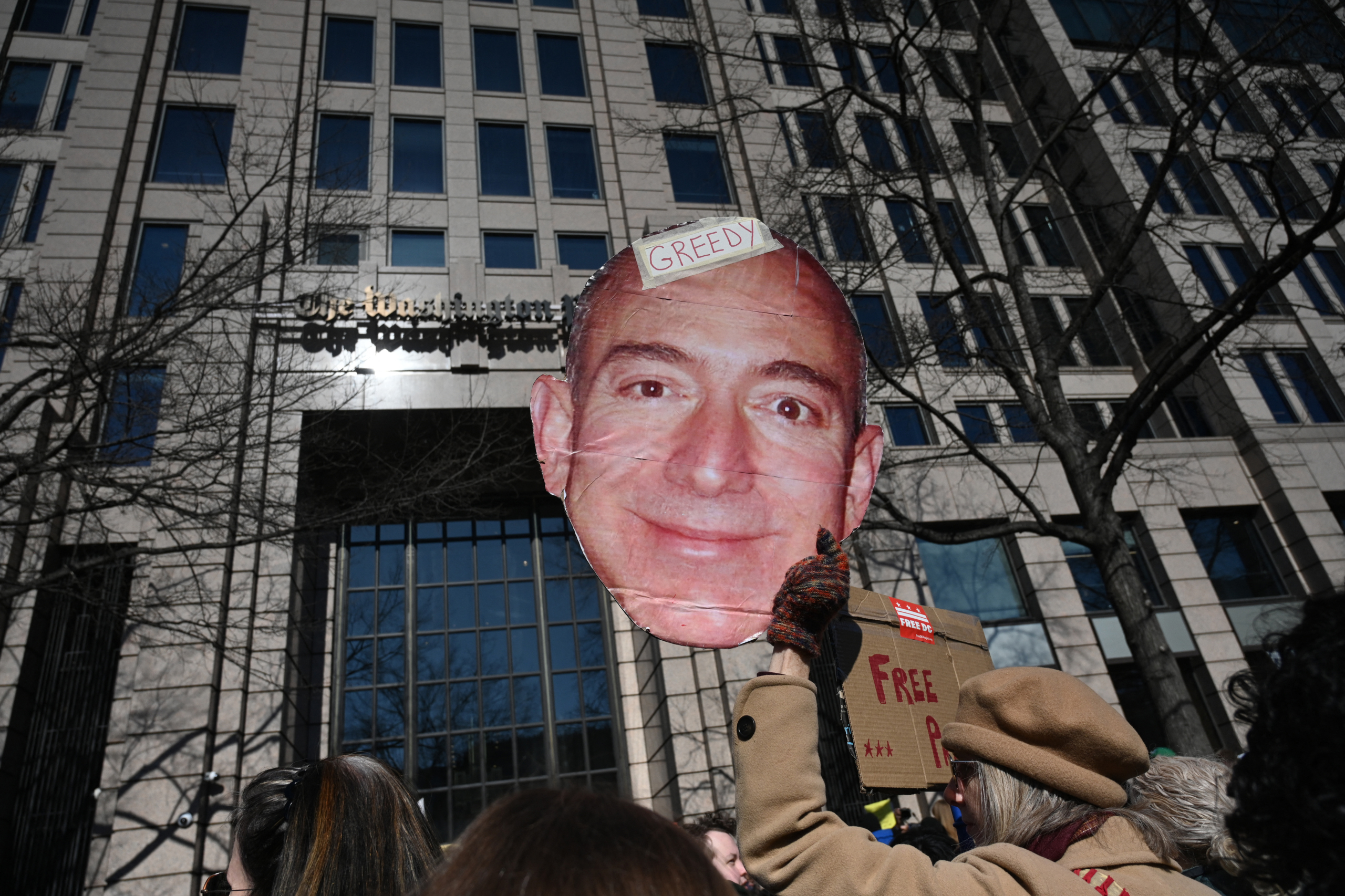
Yesterday, hundreds of Washington Post journalists and supporters amassed in below-freezing temperatures outside the paper’s K Street headquarters to take part in a rally held by the Washington Post Newspaper Guild and the Washington Post Tech Guild. A veteran Post staffer said it was larger than any walkout or picket he’d seen in his time there. The day before, during a Zoom call with staff, Post leadership had announced sweeping cuts, laying off about three hundred journalists, who represent a third of the newsroom—an extraordinary blow to the paper’s capacity and ambition. Now the Washington Post Newspaper Guild was organizing a GoFundMe for laid-off colleagues and international staff not covered by the union and vowing to claw back lost jobs and negotiate for strong severance packages. “We’re told to do more with less, then even more with less. Write faster, publish more, make no mistakes,” Michael Brice-Saddler, an outgoing Post reporter who covered Washington, DC, for the past six years, said. “But the margin of error for us keeps shrinking, while for those on the ninth floor, it keeps growing.” Journalists from Al Jazeera and the New York Times packed in. People handed out donuts.
Being journalists, the crowd had questions. According to an email sent to staff by Matt Murray, the executive editor of the Post, the strategy going forward would be to “concentrate on areas that demonstrate authority, distinctiveness, and impact,” including politics, national security in DC, and around the world; science; health; medicine; technology; climate; and business. “This restructure will help to secure our future in service of our journalistic mission,” Murray wrote. But the specifics of the overhaul appear to undermine much of the new vision. As Sarah Kaplan, a climate reporter speaking in her capacity as a steward with the Washington Post Newspaper Guild, told CJR, “Matt has not articulated how he expects us to be distinctive, to be innovative, to be a newspaper that people are willing to pay for with half of the workforce that we had two days ago.”
The details are staggering. In addition to closing down its sports department and books section, the Post has elected to shutter a number of the paper’s foreign bureaus, which have long supported the work of DC-based national security correspondents. Politics reporters and editors—at least ten—are being let go, including the desk’s enterprise editor, an experienced campaign reporter, and a breaking politics news reporter. The paper will drastically shrink its San Francisco bureau and lay off its Amazon correspondent. Also being dismissed are nine of the fourteen reporters on the health team, one of Murray’s listed areas of focus. From the climate team, some fourteen staffers were let go, including reporters, editors, and videographers; five or six remain. Another casualty of the cuts: a daily podcast called Post Reports, an aspiring competitor to the New York Times’ The Daily that, according to someone with knowledge, had three million downloads a month. (The Post did not immediately respond to a request for comment on these choices.)
Taken together, the decisions seem less than strategic. Many wonder why Jeff Bezos, the owner of the Post, has not simply put the paper up for sale. “He won’t talk to me,” said Kara Swisher, the tech journalist and Post alum, who had previously expressed interest in buying the paper. “I’m sure he will sell it to some stupid guy with whom he swans around in Aspen.”
The Post has struggled for a while with profitability and cultural relevance. For years, the paper failed to adapt to the digital age and retain homegrown talent. Then came the Donald Trump presidency. Under Marty Baron, the Post’s former executive editor, the paper maintained an adversarial approach to Trump, which brought a surge in subscriptions and staff expansion. Over time, that sense of hope was undercut by changes to online search engines and declining reader interest in crusading political coverage. In the newsroom, there was a sense of concern that leaders were unable to contend with those realities. “The lack of editorial vision came from the fact that we were constantly trying to compensate for a business side that had no idea what they were doing,” an outgoing staffer said. (A number of Post-ies spoke on the condition of anonymity, for fear of losing severance.) In the past four years, Kaplan said, the newsroom had already lost about four hundred people; during the past three years, the Post saw a 50 percent decline in organic search traffic. (As a private company, a spokesperson for the company said, the Post does not disclose revenue numbers but aims to break even by the end of this year.)
Many place the blame for the paper’s troubles at the feet of Will Lewis, a former executive at the Telegraph Media Group and Dow Jones who became the Post’s publisher and CEO in late 2023. “We haven’t heard it from Will Lewis because he hasn’t said anything to us in more than a year,” Kaplan said. When Murray announced the cuts, Lewis was absent; later, the staff learned, he was walking the red carpet at a pre–Super Bowl party in San Francisco. Lewis “has been glad to see anyone with deep ties to the place leave,” another outgoing staffer told me. To instill a sense of institutional pride, newsroom leaders had once adorned the walls of meeting rooms with famous headlines from the paper’s past. “And then one day he just removed them all,” the outgoing staffer said of Lewis. “Will does not want the storied Watergate version of the Post to survive. Whether that’s because Bezos is cozied up to Trump or because Will has other plans, I can’t say. But it’s clear the intention is to kill the Post as we know it.” (A spokesperson for the Post said there was “light construction” related to “refreshing spaces” for staffers’ return to office last June.)
Prior to the layoffs, Lewis appeared focused on a future that would include WP Ventures, a hub for creator-driven content experiments, and WP Incubator, an artificial intelligence–focused initiative. It’s unclear how much the Post spent on any of this or whether it generated any growth. (The Post spokesperson did not respond to questions about these efforts.)
For a time, Lewis had sought to launch a premium subscription program for local news, complete with in-person events and a newsletter, none of which panned out in the end. “A lot of it was the right idea, but poor execution,” an outgoing staffer said. A clear vision for local coverage never materialized. Over time, the reporters and editors in the department improved their audience strategy and worked to produce distinctive coverage. But it wasn’t enough: of the local desk’s thirty-four reporters, twelve remain—and some of those twelve are expected to be moved to different departments. The metro desk had ten editors, including the head of the department; eight were cut and it’s unclear if, going forward, the department head will continue to edit metro coverage. Notably, the team will keep its DC, Virginia, and Maryland politics reporters and some of its crime reporters—an asset in the Trump era. But any sense of covering the neighborhoods and regional idiosyncrasies of Washington, Virginia, and Maryland is gone.
Though the Post will maintain a presence in Latin America, Europe, and the Middle East, it will close a number of foreign bureaus, laying off journalists in China, Ukraine, and Australia, as well as the existing team in the Middle East. A reporter from elsewhere is expected to be moved to Jerusalem. The total number of international closures and layoffs remains unclear to members of the staff, because of differing rules around job cuts in different countries. The decisions appear to undermine two priorities the international team had been given: China and national security.
Leadership’s emphasis on providing audiences with what they want also seems undermined by the facts. “Our daily story output has substantially fallen in the last five years,” Murray wrote in his email to staff. “Today’s moves will put us in position to find and develop better ways to connect Post journalism to news consumers in the ways they want it.” Yet the international team regularly produces live updates on breaking news events that draw hundreds of thousands of readers. The now-dismissed Ishaan Tharoor’s WorldView newsletter boasted nearly five hundred thousand subscribers. “They blamed the staff for lower output. But they laid off some of the most productive people, purely measured by output,” a staffer said. Going forward, the international desk will include at least eight correspondents and some local staff, with no dedicated breaking news coverage.
“A part of me respects Matt Murray,” an outgoing staffer said, adding that the task before him now is to try to capture the sort of audience the Wall Street Journal—Murray’s former employer—has built. But Murray faces an impossible task, they said. Another former staffer said ideas like starting a creator hub, investing in personality-driven journalism, and showing reporters how to understand their audiences are worthy. “But the Post cannot figure out how to execute it well and actually integrate it into the newsroom. It takes a lot of work. And you have to give reporters the time to do that. And we’re always kind of asking everyone to do too much,” they said. Yet another told me, “Lewis came in with enough big ideas that I wouldn’t say he wanted to kill it intentionally. It’s just that his ideas really sucked.”
“When Bezos bought this paper, in 2013, he told us at a town hall that shrinking was a survival strategy and it eventually leads to extinction,” Kaplan told CJR. “If he knows that shrinking is leading us to irrelevance, is that what he’s trying to do? And if he’s not willing to make the investment, maybe it’s time for a different steward.”
Amos Barshad contributed to this article.
Has America ever needed a media defender more than now? Help us by joining CJR today.